Parasound
Parasound JC3+ Phono Preamplifier
Parasound JC3+ Phono Preamplifier
Couldn't load pickup availability
Parasound Halo JC 3+ Phono Preamplifier
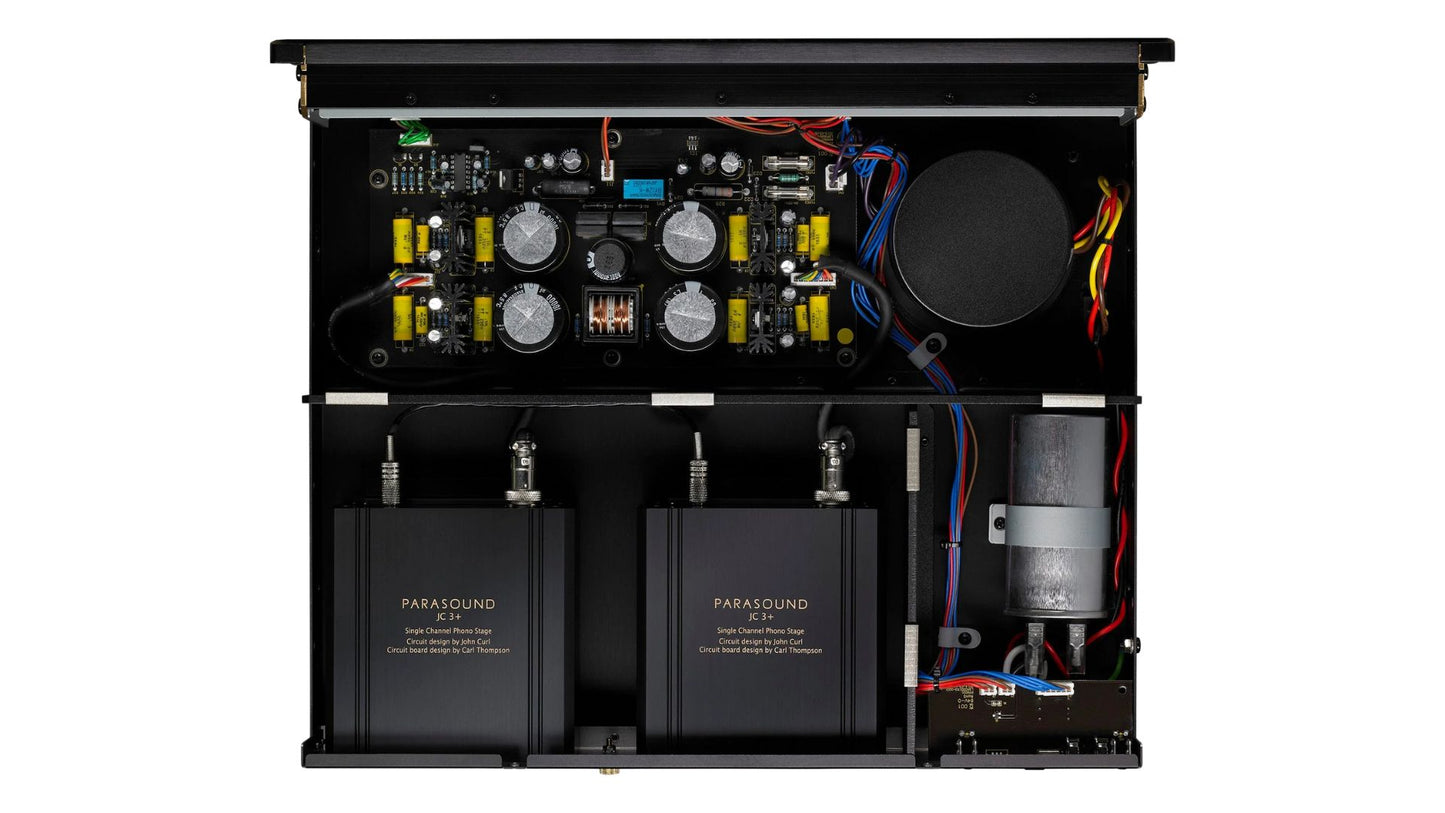
A dual-mono, fully discrete Class A phono stage designed by John Curl — one of the most accomplished circuit designers in high-end audio — built to extract everything your cartridge is capable of.
What It Is and Who It's For
The Parasound Halo JC 3+ is a dedicated phono preamplifier for serious analog listeners who have invested in a quality turntable and cartridge and refuse to let the signal path be the weak link. It is not a budget-friendly entry point and does not pretend to be. At its price, it competes directly with standalone phono stages from companies like Lehmann, Sutherland, and Musical Surroundings, and in most head-to-head evaluations it more than holds its own.
This is a unit for the listener who already knows what phono gain is, has opinions about loading, and has probably already outgrown the phono input in their integrated amplifier. It is equally at home driving a pair of monoblocks in a dedicated two-channel system or serving as the analog front-end anchor in a more complex home theater/hi-fi hybrid. The JC 3+ handles both moving magnet and moving coil cartridges with equal seriousness, and its wide range of loading and gain options means it can be properly matched to virtually any cartridge currently in production.
Engineering: Why This Phono Stage Is Different
The name on the schematic matters here. John Curl is one of a very short list of engineers whose circuit topologies have been referenced, borrowed, and admired throughout the industry for decades. His work on the original Mark Levinson JC-1 preamplifier in the 1970s established his reputation, and his collaboration with the late Bob Crump on Parasound's JC series represents some of the most thoughtful analog circuit design available at anywhere near this price.
The JC 3+ is built around a fully discrete, dual-mono architecture. There are no op-amps in the signal path — every gain stage uses hand-selected, matched discrete transistors operating in pure Class A. The dual-mono layout means the left and right channels share only a power cord; everything else — power supply regulation, gain stages, RIAA equalization network — is completely independent. This matters because crosstalk between channels, even at very low levels, degrades stereo imaging. The JC 3+ takes that variable off the table entirely.
The RIAA equalization network is passive, implemented between two gain stages rather than as a single active network. This approach, often called a "passive RIAA" or "split RIAA" topology, allows each stage to operate at a lower gain with less feedback, which benefits noise performance and preserves the character of the discrete transistors. RIAA accuracy is specified at ±0.2 dB from 20 Hz to 20 kHz — a figure that reflects careful component selection, not just design intent.
For moving coil cartridges, the JC 3+ provides switchable input impedance in eleven steps from 25 ohms to 47k ohms, covering every MC cartridge in common use. Gain is also selectable: 40 dB for high-output moving magnet cartridges, 54 dB for high-output MC or low-sensitivity MM, and 64 dB for low-output moving coil cartridges. Capacitance loading for moving magnet is switchable among 100, 200, 320, and 420 pF. These are not marketing bullet points — they are the controls that allow a knowledgeable listener to systematically optimize the cartridge-to-preamplifier interface, which is one of the highest-leverage adjustments in all of analog playback.
The unit also incorporates a subsonic filter (12 dB/octave at 20 Hz) to suppress warp-induced low-frequency cone excursion, and a mono/stereo switch that is genuinely useful when playing back older mono pressings or diagnosing channel imbalance. Both features are implemented thoughtfully: the subsonic filter is steep enough to be effective without intruding into audible bass, and the mono switch sums the channels passively rather than introducing additional circuitry.
The chassis is built to Halo standards — the same fit and finish as the JC 1 monoblocks and JC 2 preamplifier. The rear panel is uncluttered and logically laid out. The front panel controls are clearly labeled and operate with satisfying precision. This is a product designed to be used by someone who cares about their system, not simply admired.
How It Compares: JC 3+ vs. Parasound JC 3
The original Parasound JC 3 remains one of the most respected phono stages in its class, and some listeners prefer its character. The JC 3+ is the revised, improved version, and the differences are substantive rather than cosmetic.
The JC 3+ adds a second gain stage to the moving coil path, which allows it to reach 64 dB of gain compared to the JC 3's maximum of 60 dB. This four-decibel difference is meaningful for very low-output MC cartridges — those in the 0.2–0.3 mV range — where the original JC 3 could fall slightly short in demanding systems. The JC 3+ also improves the power supply regulation, adding more capacitance and tighter voltage regulation to each channel, and the noise floor is measurably lower. Signal-to-noise ratio at full MC gain is specified at greater than 80 dB (IHF-A weighted), which is genuinely competitive with phono stages at significantly higher prices.
If you are running a moving magnet cartridge or a high-output MC, the practical performance difference between the two is relatively small and system-dependent. If you are running a low-output MC — a Lyra, an Ortofon Windfeld, an Air Tight PC-1 — the JC 3+ is the right tool.
If your budget is higher and you want to move up from the JC 3+, the conversation shifts to separate power supply options and reference-tier phono stages. We carry those options as well and are happy to discuss the full continuum.
Key Specifications
- Type: Dual-mono fully discrete phono preamplifier
- Cartridge compatibility: Moving Magnet (MM) and Moving Coil (MC)
- MM Gain: 40 dB
- MC Gain: 54 dB or 64 dB (switchable)
- Input Impedance (MC): 25, 50, 100, 200, 475, 1k, 2.5k, 10k, 22k, 47k ohms (11 positions)
- Input Impedance (MM): 47k ohms fixed
- Capacitance Loading (MM): 100, 200, 320, 420 pF (4 positions)
- RIAA Accuracy: ±0.2 dB, 20 Hz–20 kHz
- Signal-to-Noise Ratio: >80 dB (IHF-A weighted, MC at 64 dB gain)
- THD+N: <0.0015% (1 kHz, 500 mV output)
- Frequency Response: 20 Hz–20 kHz
- Subsonic Filter: 12 dB/octave at 20 Hz (switchable)
- Topology: Discrete Class A, no op-amps in signal path
- Inputs: 1 pair RCA (MM/MC switchable)
- Outputs: 1 pair RCA
- Power Consumption: Approximately 30W
- Dimensions: 17" W × 3.5" H × 15.75" D (432 × 89 × 400 mm)
- Weight: 18.5 lbs (8.4 kg)
- Warranty: 3 years parts and labor (Parasound USA)
Why Buy From All Elite Audio
All Elite Audio is an authorized Parasound dealer, which means every JC 3+ we sell comes with full factory warranty coverage and factory-direct support. We have listened to this unit extensively and can speak to how it performs with specific cartridge and tonearm pairings in real systems. If you want to talk through whether the JC 3+ is the right match for your cartridge's output voltage and impedance, we are glad to have that conversation before you buy.
Call us at 443-402-5055, text us at 443-402-5064, or visit us at 1921 York Rd, Timonium, MD 21093. We are open six days a week and we answer the phone.
Frequently Asked Questions
What is the Parasound JC 3+ and why does it cost what it costs?
The JC 3+ is a dedicated phono preamplifier — a device whose sole job is to amplify the extremely small signal from a turntable cartridge and apply the RIAA equalization curve that vinyl records require. Unlike the phono input built into most receivers or integrated amplifiers, the JC 3+ uses fully discrete Class A circuitry designed by John Curl, one of the most respected audio engineers in the industry. The price reflects the quality of the components, the depth of the engineering, and the precision of the manufacturing. You are not paying for a brand name — you are paying for a circuit that was genuinely designed from first principles by someone who has been doing this for fifty years.
Do I need a separate phono preamplifier if my amplifier or receiver already has a phono input?
You do not need one, but for most systems at this performance level, a dedicated external phono stage is a significant upgrade. The phono inputs built into integrated amplifiers and receivers are designed to a cost target, use op-amp-based circuits, and share a power supply and chassis with components that generate noise. The JC 3+ is isolated from all of that, uses a completely separate dual-mono power supply, and operates in a noise environment orders of magnitude quieter. If your cartridge costs more than a few hundred dollars, you are very likely leaving performance on the table by running it through a built-in phono stage.
Does the Parasound JC 3+ come with a cartridge?
No. The JC 3+ is a phono preamplifier only — it does not include a cartridge, tonearm, or turntable. It connects between your turntable's tonearm output (or phono output if your table has one) and your line-level preamplifier or integrated amplifier's line input. If you are purchasing a complete analog front end and need cartridge guidance, we are happy to recommend pairings based on your tonearm's effective mass and your budget.
What phono stage or preamplifier does the JC 3+ connect to?
The JC 3+ outputs a standard line-level signal via RCA, which connects to any line-level input on a preamplifier, integrated amplifier, or receiver. Do not connect it to a phono input — connect it to an aux, CD, tuner, or similarly labeled line input. The output impedance is low and it will drive virtually any downstream component without issue.
How do I know which gain setting to use?
Gain selection depends on your cartridge's output voltage. Moving magnet cartridges typically output 3–5 mV, which works well with the 40 dB setting. High-output moving coil cartridges (1.5–2.5 mV output) typically work best at 54 dB. Low-output moving coil cartridges — those outputting 0.2–0.5 mV — require the 64 dB setting. Your cartridge's specification sheet will list its output voltage; if you are not sure, call us and we can help you choose the right setting for your specific cartridge.
How do I set the loading for a moving coil cartridge?
Loading refers to the input impedance presented to the cartridge by the phono stage, and it affects the cartridge's high-frequency response and overall tonal balance. The general starting rule is that MC cartridge loading should be set to at least ten times the cartridge's internal coil impedance, but many cartridges sound best at significantly higher values. The JC 3+ offers eleven impedance positions from 25 to 47,000 ohms. We recommend starting at 100 ohms for most low-output MC cartridges and experimenting upward if the sound seems closed-in or downward if it seems overly bright. If you want a recommendation for a specific cartridge, we can provide one.
How does the JC 3+ compare to the original Parasound JC 3?
The JC 3+ is the refined successor to the JC 3, with three meaningful improvements: maximum MC gain is increased from 60 to 64 dB, which matters for very low-output moving coil cartridges; the dual-mono power supply regulation is tightened with added capacitance and lower noise voltage references; and the noise floor at maximum MC gain is measurably lower. For moving magnet or high-output MC users, the audible difference is subtle and system-dependent. For owners of low-output MC cartridges in the 0.2–0.3 mV range, the JC 3+ is the meaningfully better tool. Both are outstanding; the JC 3+ is simply the more capable, more fully developed version.
What cartridges pair particularly well with the JC 3+?
The JC 3+ is a neutral, low-noise, high-gain phono stage that does not editorialize — it pairs well with virtually any quality cartridge. Its extended loading options and high-gain MC mode make it especially well-suited for low-output moving coil cartridges from makers like Lyra, Ortofon (the Cadenza and Windfeld lines), Hana, Audio-Technica (the ART and OC9 series), ZYX, and Koetsu. For moving magnet, it handles everything from a vintage Shure V15 to a current-production Nagaoka or Audio-Technica VM series cartridge with equal competence. We are happy to discuss specific pairing recommendations.
Can the JC 3+ handle a mono cartridge or mono records?
Yes on both counts. The JC 3+ includes a front-panel mono/stereo switch that sums the two channels to mono, which is the correct way to play back mono records — it reduces noise by 3 dB and eliminates any lateral channel imbalance. If you are playing mono records with a standard stereo cartridge (which tracks the groove properly), engaging mono mode is always recommended. If you have a dedicated mono cartridge, the JC 3+ will work perfectly with it as well.
Is the JC 3+ a balanced design? Can I run it with XLR cables?
The JC 3+ is a single-ended design with RCA inputs and outputs — it does not offer XLR connections. The circuit's dual-mono topology provides many of the noise and isolation benefits of a fully balanced design without requiring balanced interconnects. If your downstream preamplifier has XLR inputs but no RCA inputs, a high-quality RCA-to-XLR adapter will work, though you will not gain the interference rejection benefits of a true balanced connection. For the vast majority of installations — including very long cable runs in treated rooms — this is not a practical limitation.
Where can I buy the Parasound JC 3+ and hear it before purchasing?
All Elite Audio at 1921 York Rd, Timonium, MD 21093 is an authorized Parasound dealer with the JC 3+ in stock. We are the best place to buy it because you can speak directly with someone who has spent time with this unit in real systems and can answer technical questions honestly — including when a less expensive option might serve you better. Call us at 443-402-5055, text at 443-402-5064, or stop in. If you are outside the Baltimore area, we can arrange purchase and shipping with full factory warranty coverage.


Outlet Deals
-
Leben CS-600X Integrated Tube Amplifier (Used)
Regular price $7,995.00 USDRegular priceUnit price per$9,995.00 USDSale price $7,995.00 USDSALE -
Meitner Audio MA3i Integrated DAC and Network Streamer (Used)
Regular price $7,995.00 USDRegular priceUnit price per$11,500.00 USDSale price $7,995.00 USDSALE -
Luxman L-507Z Integrated Amplifier (Used)
Regular price $6,995.00 USDRegular priceUnit price per$10,495.00 USDSale price $6,995.00 USDSALE -
HiFi Rose RS520 Streaming Integrated Amplifier (New / Open Box)
Regular price $2,995.00 USDRegular priceUnit price per$3,995.00 USDSale price $2,995.00 USDSALE -
Cambridge Edge W (USED)
Regular price $2,500.00 USDRegular priceUnit price per$5,000.00 USDSale price $2,500.00 USDSALE -
Luxman D-03X CD Player and DAC (Used)
Regular price $2,495.00 USDRegular priceUnit price per$4,000.00 USDSale price $2,495.00 USDSALE


New Releases
-
EverSolo T10 Streaming Transport
Regular price $2,180.00 USDRegular priceUnit price per$2,180.00 USDSale price $2,180.00 USD -
Luxman L-100 CENTENNIAL Pure Class A Integrated Amplifier
Regular price $11,995.00 USDRegular priceUnit price per$11,995.00 USDSale price $11,995.00 USD -
KLH Model Seven Floorstanding Speakers
Regular price $4,999.98 USDRegular priceUnit price per$5,998.00 USDSale price $4,999.98 USDSALE -
REL Acoustics Planar PL-1 Subwoofer
Regular price From $2,499.00 USDRegular priceUnit price per$2,499.00 USDSale price From $2,499.00 USD -
EverSolo DMP-A8 Gen 2 Master Edition -Music Streamer, CD Player, DAC & Preamplifier
Regular price $2,580.00 USDRegular priceUnit price per$2,580.00 USDSale price $2,580.00 USD -
EverSolo DMP-A8 Gen 2 Music Streamer, DAC & Preamplifier
Regular price $1,980.00 USDRegular priceUnit price per$1,980.00 USDSale price $1,980.00 USD