Parasound
Parasound XRM Phono Preamplifier
Parasound XRM Phono Preamplifier
Couldn't load pickup availability
Parasound ZPhono XRM MM/MC Phono Preamplifier
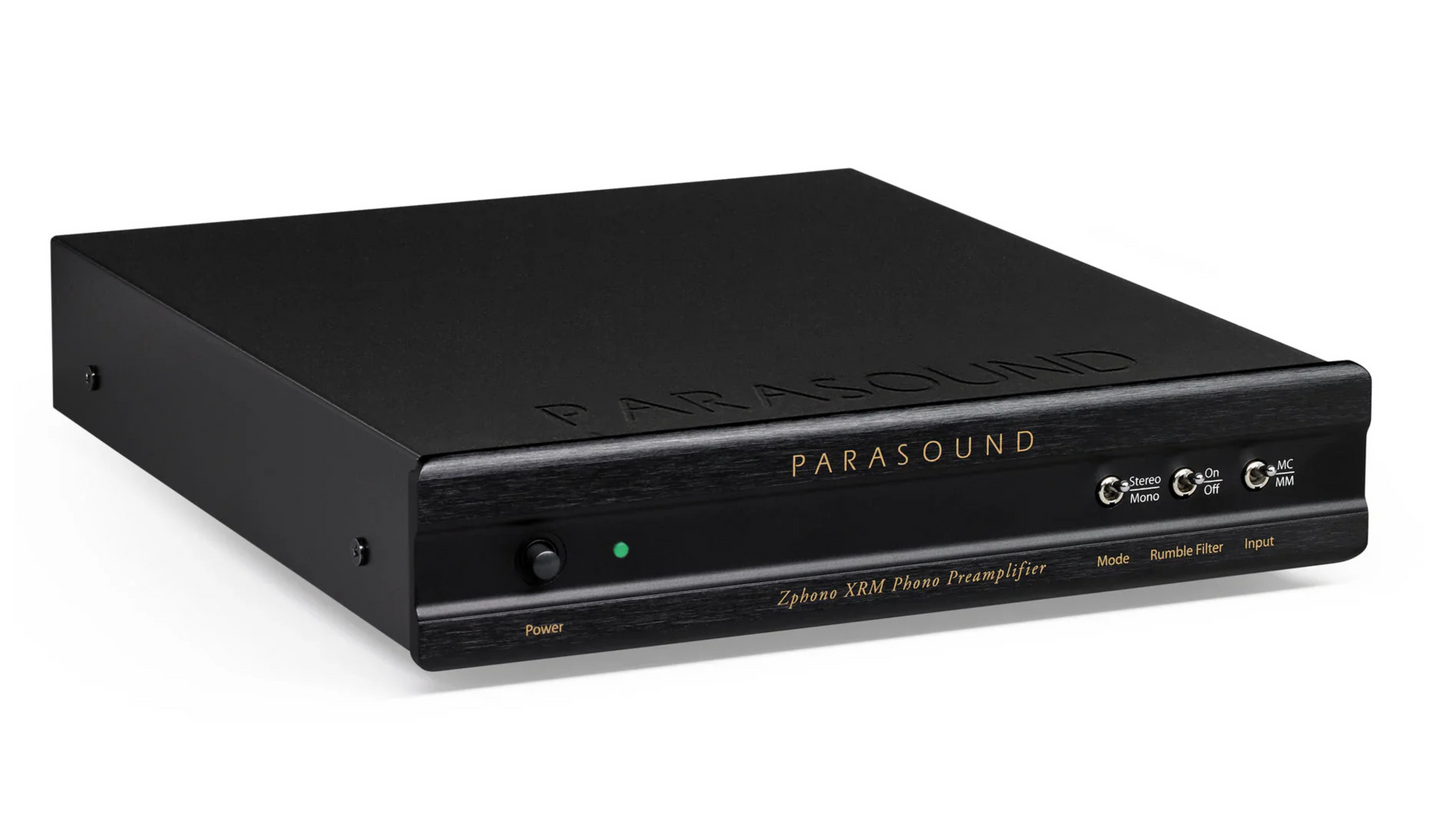
A compact, half-rack phono preamplifier with separate MM and MC input stages, continuously variable MC loading from 50 to 1,050 ohms, switchable gain for both cartridge types, balanced XLR and unbalanced RCA outputs, a front-panel mono switch, and an 18 dB/octave rumble filter — all at a price that sits between Parasound's entry-level ZPhono and the Halo JC 3 Jr.
What It Is and Who It's For
The Parasound ZPhono XRM is a standalone phono preamplifier designed for the vinyl listener who has outgrown the phono input in their integrated amplifier or receiver and wants a dedicated external stage with meaningful setup flexibility — but who is not ready to invest in a Halo-level unit. It occupies the space in Parasound's lineup between the basic ZPhono and the JC 3 Jr., and it makes a strong case for itself on features alone: dual separate input circuits for simultaneous connection of an MM and an MC turntable, continuously variable MC loading, three gain settings per cartridge type, balanced outputs, a rumble filter, and a mono switch, in a chassis that is eight and a half inches wide and weighs under four pounds.
The buyer this serves is varied. It could be the listener with a quality MM cart running into an integrated amplifier that lacks a phono input or has only a basic one. It could equally be the vinyl enthusiast with two turntables — one MM, one MC — who wants both connected and switchable from the front panel without rewiring. The continuously variable MC loading from 50 to 1,050 ohms — rather than the fixed two- or three-position switch found on most phono stages at this price — makes the XRM genuinely useful for systematic cartridge optimization that most buyers at this level never get the opportunity to perform. Michael Fremer reviewed it for Analog Planet and praised Parasound for pricing it so aggressively that "finding a better MM-only phono preamp for around the same money might be difficult."
The XRM is a Z-series product, not a Halo product — it uses op-amp circuitry rather than the discrete JFET-MOSFET topology of the JC 3 Jr. and JC 3+. That is not a criticism: the op-amps selected are ultra-high-speed, ultra-low-noise devices, and the measured performance — THD below 0.02% at 1 kHz, SNR above 94 dB A-weighted for MM, RIAA accuracy within ±0.2 dB — is genuinely competitive with external phono stages at higher prices. This is exactly the kind of value engineering Parasound does well.
Features That Set It Apart at This Price
Dual simultaneous inputs. The ZPhono XRM has completely separate input jacks and amplification circuits for a moving magnet cartridge and a moving coil cartridge — and both can be connected at the same time. A front-panel input selector switches between them. For a listener who owns two turntables, this eliminates the need for a separate selector switch or rewiring when switching between decks. It is a feature that most phono stages at two and three times this price do not offer.
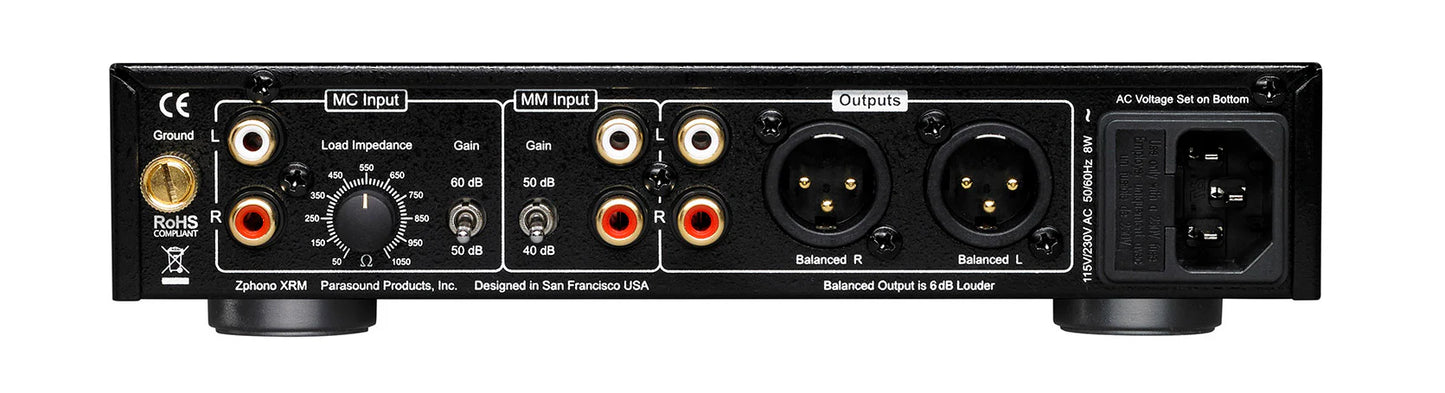
Three gain settings with balanced outputs. MM gain is switchable between 40 dB and 50 dB unbalanced (46 dB and 56 dB at the balanced outputs). MC gain is switchable between 50 dB and 60 dB unbalanced (56 dB and 66 dB at the balanced outputs). The balanced outputs add 6 dB relative to the unbalanced figures — a gain advantage that also brings common-mode noise rejection over long cable runs. The availability of both balanced and unbalanced outputs on a phono stage at this price is unusual and practically valuable: if your preamplifier or integrated has balanced inputs, you can use them and benefit from both the additional gain and the interference rejection.
Continuously variable MC loading. Most phono stages at the ZPhono XRM's price offer two or three fixed MC loading positions, typically 100 Ω and 47 kΩ with perhaps one intermediate position. The XRM provides a continuously variable control adjustable from 50 to 1,050 ohms, allowing the listener to dial in the precise loading value that works best for their specific MC cartridge in their specific system. MC cartridge loading affects high-frequency response and overall tonal balance in ways that are meaningful and audible, and having a continuous control rather than a fixed switch makes systematic experimentation possible.
Front-panel rumble filter. The 18 dB/octave high-pass filter at 40 Hz is defeatable from the front panel. Its purpose is to suppress subsonic energy from record warp, turntable bearing noise, and footfall that can over-excite woofers and reduce headroom in the amplifier and subwoofer without contributing anything audible. For a listener using a turntable without its own subsonic filter — which describes most turntables — the ability to engage this filter and hear the difference in bass clarity and woofer control is often immediately apparent. The 18 dB/octave slope is steep enough to be effective without intruding into the audible bass range at 40 Hz.
Front-panel mono switch. The mono switch sums the two channels to mono, which is the correct way to play back mono records pressed before the stereo era. Engaging it reduces noise by approximately 3 dB and eliminates lateral channel imbalance that can introduce false stereo information on mono pressings. It is equally useful for diagnosing channel balance issues or for listeners using a dedicated mono cartridge.
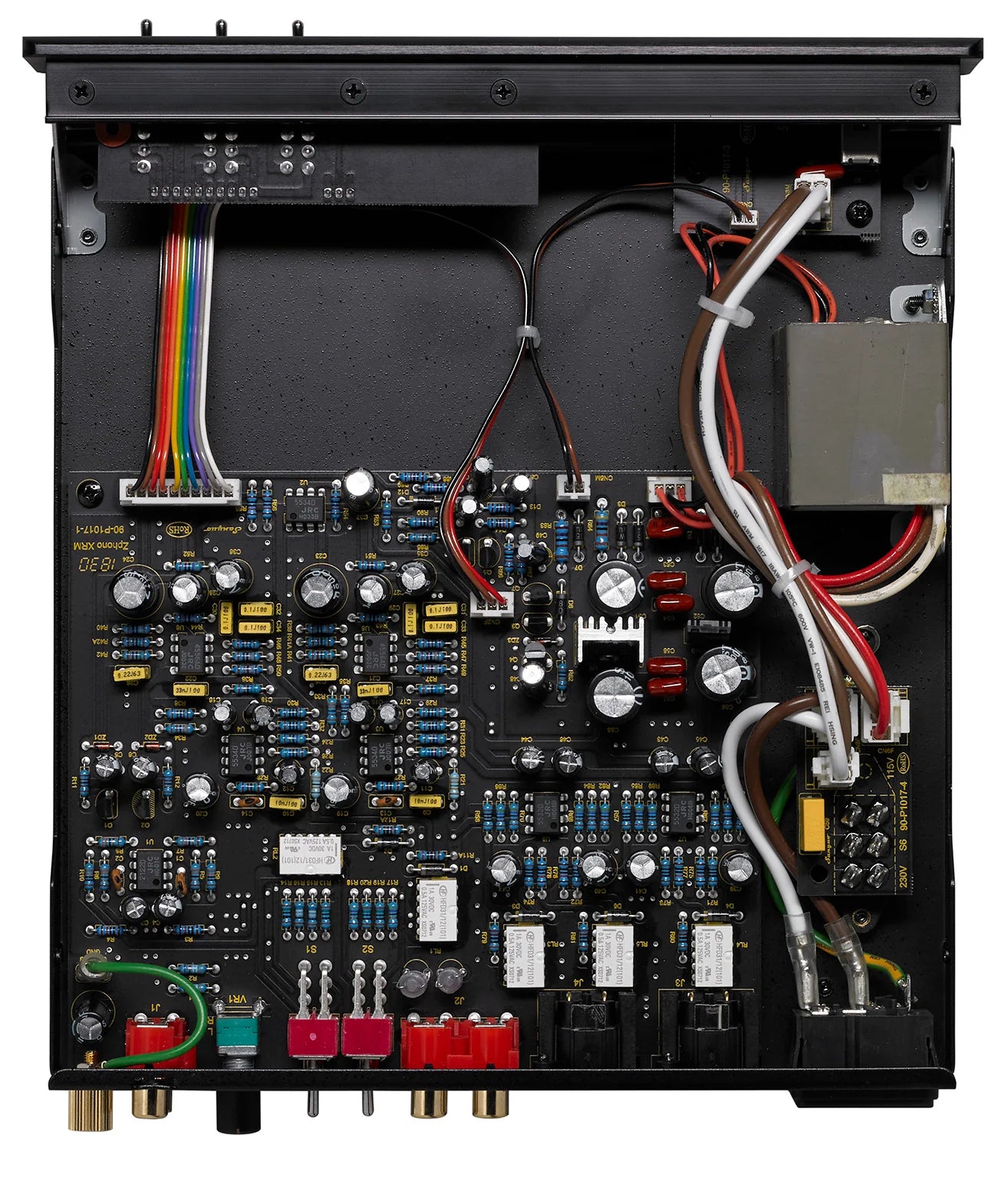
Internal linear power supply. Unlike most phono preamplifiers at this price, which use an external wall-wart switching supply, the ZPhono XRM has an internally mounted linear power supply. A linear supply generates less high-frequency noise than a switching supply, and keeping it inside the chassis means the power supply noise stays away from the signal chain rather than traveling through external cables. It draws 7 watts in operation and zero in standby.
How It Compares: ZPhono XRM vs. JC 3 Jr.
The Parasound Halo JC 3 Jr. is the next step up within the Parasound phono lineup. It uses discrete transistor circuitry — fully discrete, with separate amplification stages — rather than the op-amp-based design of the ZPhono XRM. Its gain options (40, 50, and 60 dB unbalanced; 46, 56, and 66 dB balanced) cover the same range as the XRM's three settings, and its MC loading is variable from 50 to 550 ohms — a narrower range at the top end than the XRM's 1,050 ohms maximum, but covering every practical loading value for standard MC cartridges. The JC 3 Jr. is a full-width chassis at 17.25 inches wide versus the XRM's 8.5 inches, weighs significantly more, and costs substantially more. For the listener who wants the best available phono stage within the Parasound family below the JC 3+, and who values discrete circuitry and the sonic character that comes with it, the JC 3 Jr. is the correct choice. The ZPhono XRM is the correct choice when budget, space, or feature breadth are the deciding factors.
Key Specifications
- Type: MM/MC phono preamplifier
- Cartridge Compatibility: Moving Magnet and Moving Coil (separate input circuits)
- Simultaneous Dual Inputs: Yes — 1 MM + 1 MC; front-panel selector switch
- MM Gain (unbalanced): 40 dB or 50 dB (switchable)
- MM Gain (balanced): 46 dB or 56 dB (switchable)
- MC Gain (unbalanced): 50 dB or 60 dB (switchable)
- MC Gain (balanced): 56 dB or 66 dB (switchable)
- MM Input Impedance: 47 kΩ (fixed)
- MC Input Impedance: 50–1,050 Ω (continuously variable)
- Output Impedance: 150 Ω (unbalanced); 150 Ω per leg (balanced)
- RIAA Accuracy: ±0.2 dB
- THD: <0.02% at 1 kHz
- S/N Ratio — MM (40 dB setting): >94 dB (IHF A-weighted); >90 dB (unweighted)
- S/N Ratio — MM (50 dB setting): >94 dB (IHF A-weighted); >90 dB (unweighted)
- S/N Ratio — MC (50 dB setting): >92 dB (IHF A-weighted); >88 dB (unweighted)
- S/N Ratio — MC (60 dB setting): >82 dB (IHF A-weighted); >80 dB (unweighted)
- Interchannel Crosstalk: >80 dB at 1 kHz
- Rumble Filter: 40 Hz high-pass, 18 dB/octave (front-panel defeatable)
- Mono Switch: Front panel
- Inputs: 1 pair gold-plated RCA (MM); 1 pair gold-plated RCA (MC)
- Outputs: Balanced XLR (gold-plated); unbalanced RCA (gold-plated)
- Power Supply: Internal linear; 7W in operation; 0W standby; auto-switching 115V/230V
- Chassis Width: Half-rack (8.5" / 220 mm)
- Dimensions: 8.5"W × 2"H × 10"D (with feet; 12" depth with cables)
- Weight: 3.9 lbs (1.8 kg)
- Finish: Black
- Warranty: 2 years parts and labor (Parasound USA)
Note on warranty: The ZPhono XRM is a Z-series product and carries Parasound's standard 2-year warranty rather than the 5-year warranty on Halo-series products. Please verify current warranty terms with Parasound if this has been updated.
Why Buy From All Elite Audio
All Elite Audio is an authorized Parasound dealer carrying the complete Parasound phono lineup — from the ZPhono XRM through the JC 3 Jr. and JC 3+. If you are deciding between the XRM and the JC 3 Jr., or trying to determine whether your turntable and cartridge combination will benefit from the XRM's variable MC loading, we are glad to work through those questions with you.
Call 443-402-5055, text 443-402-5064, or visit us at 1921 York Rd, Timonium, MD 21093.
Frequently Asked Questions
What is the Parasound ZPhono XRM and how is it different from a built-in phono stage?
The ZPhono XRM is a dedicated external phono preamplifier — a device whose sole purpose is to amplify the very small signal from a turntable cartridge and apply the RIAA equalization curve that vinyl records require. A built-in phono stage inside an integrated amplifier or receiver is designed to a cost target, shares a power supply and chassis with components that generate noise, and typically offers limited gain and no loading options. The ZPhono XRM is completely independent from other system components, uses an internal linear power supply designed specifically for low-noise phono amplification, and provides three gain settings for each cartridge type, continuously variable MC loading, and balanced outputs — flexibility that built-in stages almost never provide. For a cartridge that costs more than a few hundred dollars, you are almost certainly not hearing its full capability through a receiver's built-in phono input.
What is continuously variable MC loading and why does it matter?
Moving coil cartridges are designed to work into a specific range of input impedance — the load that the phono stage presents at its input. Too low a load value damps the cartridge's resonance and can roll off the treble; too high a value can produce excessive high-frequency brightness. The correct loading for a given MC cartridge depends on the cartridge's internal coil impedance and the listener's taste. Most phono stages at this price offer two or three fixed positions — 100 Ω, 1 kΩ, and 47 kΩ are typical. The ZPhono XRM allows continuous adjustment from 50 to 1,050 ohms, which means you can start at a recommended value for your cartridge, listen, and make small adjustments until the balance of treble extension, tonal weight, and high-frequency behavior is exactly right. For listeners running quality MC cartridges, this control is meaningfully useful.
Can I connect two turntables at the same time?
Yes. The ZPhono XRM has separate input jacks and amplification circuits for one MM cartridge and one MC cartridge, and both can be connected simultaneously. A front-panel switch selects which input is active. This allows a listener with an MM-equipped turntable and an MC-equipped turntable to leave both connected and switch between them with a single front-panel control — no rewiring required. The two circuits are completely independent, so loading and gain settings for each can be optimized separately.
What do the gain settings mean and which should I use?
Gain selection determines how much the phono stage amplifies the cartridge signal. The correct setting depends on your cartridge's output voltage and the sensitivity of the preamplifier or integrated amplifier downstream. Moving magnet cartridges typically output 3–5 mV; the 40 dB setting is correct for most MM cartridges at standard preamplifier sensitivity, and 50 dB can be used if you prefer more headroom or have a lower-output MM cartridge. For MC cartridges, high-output designs (1.5 mV or higher) typically work at 50 dB, while standard and low-output MC cartridges (0.3–1.0 mV) generally need the 60 dB setting. The balanced outputs add 6 dB of gain relative to the unbalanced figures at each setting, which is worth factoring in if your downstream component has balanced inputs.
What is the rumble filter and when should I use it?
The rumble filter is an 18 dB/octave high-pass filter at 40 Hz that attenuates signals below that frequency. Record warp generates very low-frequency undulations — typically 3–8 Hz — that pass through a phono stage as large, infrasonic excursions that the woofers faithfully reproduce by moving in and out at subsonic frequencies. This wastes amplifier headroom, causes woofer distortion at higher listening levels, and can occasionally be audible as a low-frequency heaviness in the bass. Engaging the rumble filter eliminates these subsonic signals without any audible effect on bass content above 40 Hz. For most turntables and listening systems, leaving the filter engaged is the right default. It can be bypassed from the front panel for listeners who prefer an unfiltered chain or who are confident their turntable has minimal warp-induced rumble.
Why does the ZPhono XRM have an internal power supply rather than a wall-wart?
The external switching power supplies ("wall-warts") included with most budget phono stages generate high-frequency switching noise on the output that can couple into the sensitive phono amplification circuit and raise the noise floor. An internal linear power supply — which the ZPhono XRM uses — does not have switching transients and can be optimized specifically for the low-noise requirements of a phono stage. It also eliminates the external cable between the supply and the unit, which is another potential noise pickup path. The ZPhono XRM draws only 7 watts in operation and zero in standby, so the thermal overhead of an internal supply is minimal at this power level.
How does the ZPhono XRM compare to the Parasound Halo JC 3 Jr.?
The JC 3 Jr. uses fully discrete transistor circuitry — a more complex and higher-performance approach than the ZPhono XRM's op-amp design — and is housed in a full-width Halo chassis. Its gain options and MC loading range overlap significantly with the ZPhono XRM's. The JC 3 Jr. carries a 5-year Halo warranty versus the ZPhono XRM's 2-year Z-series warranty. At the XRM's price point, the op-amp implementation is excellent — THD below 0.02% and SNR above 94 dB A-weighted for MM are numbers that a dedicated $500 phono stage is entitled to be proud of. Listeners who want the Halo discrete circuit character, who have a system that resolves the difference, or who are running very low-output MC cartridges that benefit from the JC 3 Jr.'s 66 dB balanced maximum gain will find it worth the step up. For listeners who want practical flexibility — dual inputs, variable loading, balanced outputs — at a more accessible price, the ZPhono XRM delivers substantial value.
Does the ZPhono XRM work with any turntable?
Yes. The ZPhono XRM connects to any turntable via standard RCA phono cables — the same cables used by virtually every turntable produced in the past fifty years. Connect the tonearm output cables to the appropriate input (MM or MC), connect the ground wire to the ground post, and connect the XRM's outputs to a line-level input on your preamplifier or integrated amplifier. If your turntable has a built-in phono stage and outputs a line-level signal rather than a phono signal, bypass that internal stage if possible and connect to the XRM instead — or simply confirm the turntable's output is a phono-level signal before connecting, as connecting a line-level output to a phono stage will result in overloaded, distorted sound.
What does the mono switch do and when should I use it?
The mono switch sums the left and right channels into a single mono signal, which is then reproduced identically in both speakers. For mono records pressed before the stereo era — broadly, records from before 1958 — this is the correct playback mode. Stereo cartridges read mono grooves correctly, but produce a slightly different signal from each channel due to microscopic groove variations. Playing in stereo on a mono record can produce a slightly blurred or unfocused center image. Summing to mono eliminates this and also reduces noise by approximately 3 dB. The mono switch is also useful for diagnosing channel imbalances in the system — if something sounds different in the left and right channels when the mono switch is engaged, the problem is downstream of the phono stage.
What phono cartridges work best with the ZPhono XRM?
The ZPhono XRM handles any moving magnet, moving iron, or high-output moving coil cartridge well with its MM input at the 40 dB or 50 dB setting, and any moving coil cartridge from high-output to moderately low-output (around 0.3 mV) with its MC input at 50 or 60 dB. The continuously variable MC loading makes it compatible with virtually any MC cartridge's loading requirements within the 50–1,050 ohm range. For very low-output MC cartridges below 0.3 mV output, the 60 dB maximum unbalanced gain (66 dB balanced) may provide just enough headroom, but listeners running cartridges in this territory who want additional gain margin would benefit from stepping up to the JC 3 Jr.
Where can I buy the Parasound ZPhono XRM?
All Elite Audio at 1921 York Rd, Timonium, MD 21093 is an authorized Parasound dealer. We carry the full Parasound phono lineup and can help you determine whether the ZPhono XRM, the JC 3 Jr., or the JC 3+ is the right match for your turntable, cartridge, and downstream components. Call 443-402-5055, text 443-402-5064, or stop in.
Outlet Deals
-
Yamaha A-S2200 (USED)
Regular price $4,000.00 USDRegular priceUnit price per$5,000.00 USDSale price $4,000.00 USDSALE -
Cambridge Edge W (USED)
Regular price $2,500.00 USDRegular priceUnit price per$5,000.00 USDSale price $2,500.00 USDSALE -
 SALE
SALEYamaha RX-A6A (USED)
Regular price $2,000.00 USDRegular priceUnit price per$2,700.00 USDSale price $2,000.00 USDSALE -
 SALE
SALEPSB Passif 50 (USED)
Regular price $2,000.00 USDRegular priceUnit price per$3,150.00 USDSale price $2,000.00 USDSALE -
TEAC AX-505 Stereo Integrated Amplifier (Demo / Open Box)
Regular price $1,600.00 USDRegular priceUnit price per$2,000.00 USDSale price $1,600.00 USDSALE -
TEAC AP-505 Stereo Power Amplifier (Demo / Open Box)
Regular price $1,200.00 USDRegular priceUnit price per$1,500.00 USDSale price $1,200.00 USDSALE


New Releases
-
EverSolo T10 Streaming Transport
Regular price $2,180.00 USDRegular priceUnit price per$2,180.00 USDSale price $2,180.00 USD -
Luxman L-100 CENTENNIAL Pure Class A Integrated Amplifier
Regular price $11,995.00 USDRegular priceUnit price per$11,995.00 USDSale price $11,995.00 USD -
Luxman D-100 CENTENNIAL SACD/CD Player
Regular price $18,995.00 USDRegular priceUnit price per$18,995.00 USDSale price $18,995.00 USD -
REL Acoustics Planar PL-1 Subwoofer
Regular price From $2,499.00 USDRegular priceUnit price per$2,499.00 USDSale price From $2,499.00 USD -
REL Acoustics Planar PL-2 Subwoofer
Regular price From $3,299.00 USDRegular priceUnit price per$3,299.00 USDSale price From $3,299.00 USD -
 SALE
SALEKLH Model 7 Speakers
Regular price $4,999.98 USDRegular priceUnit price per$5,998.00 USDSale price $4,999.98 USDSALE