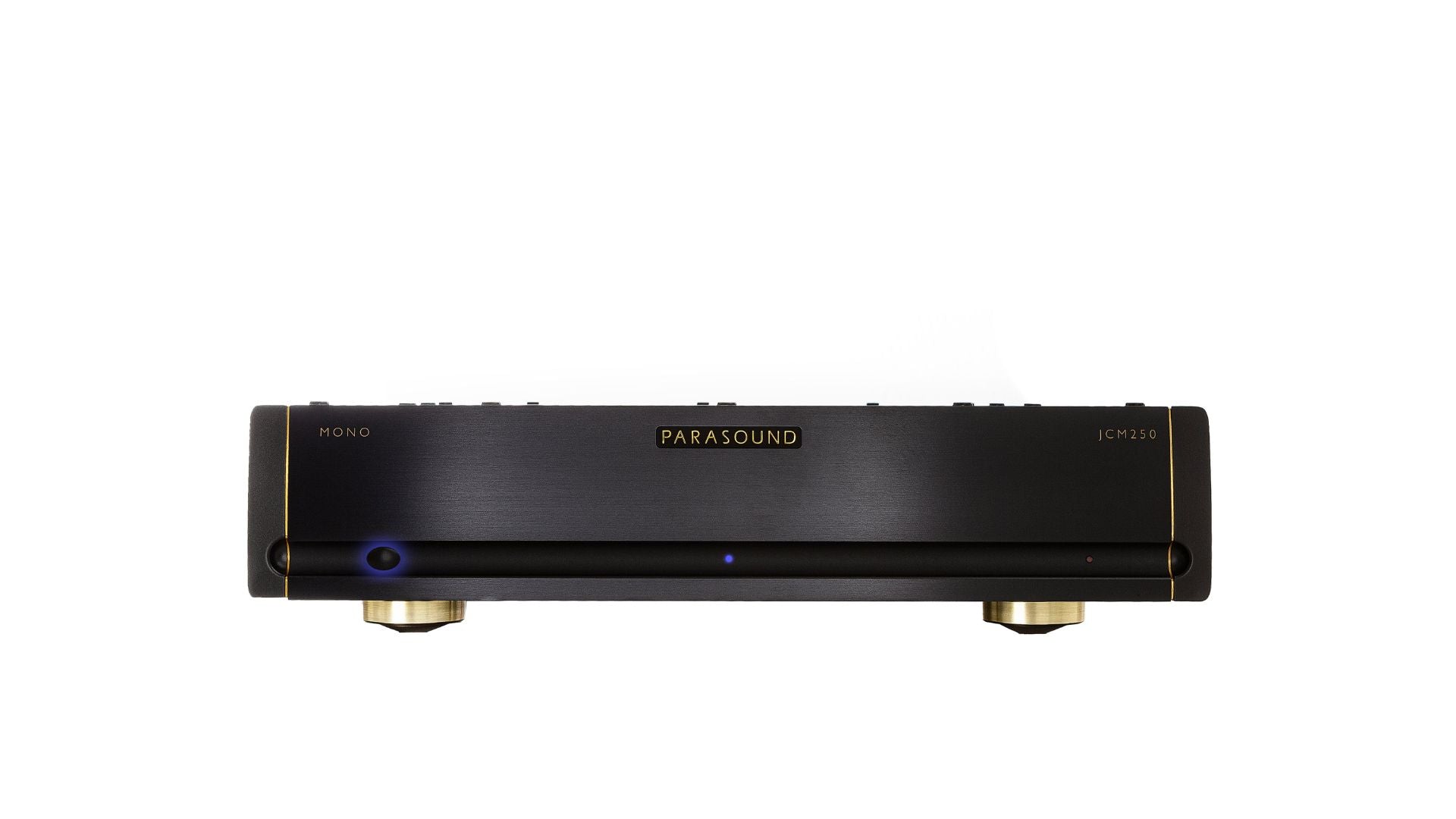
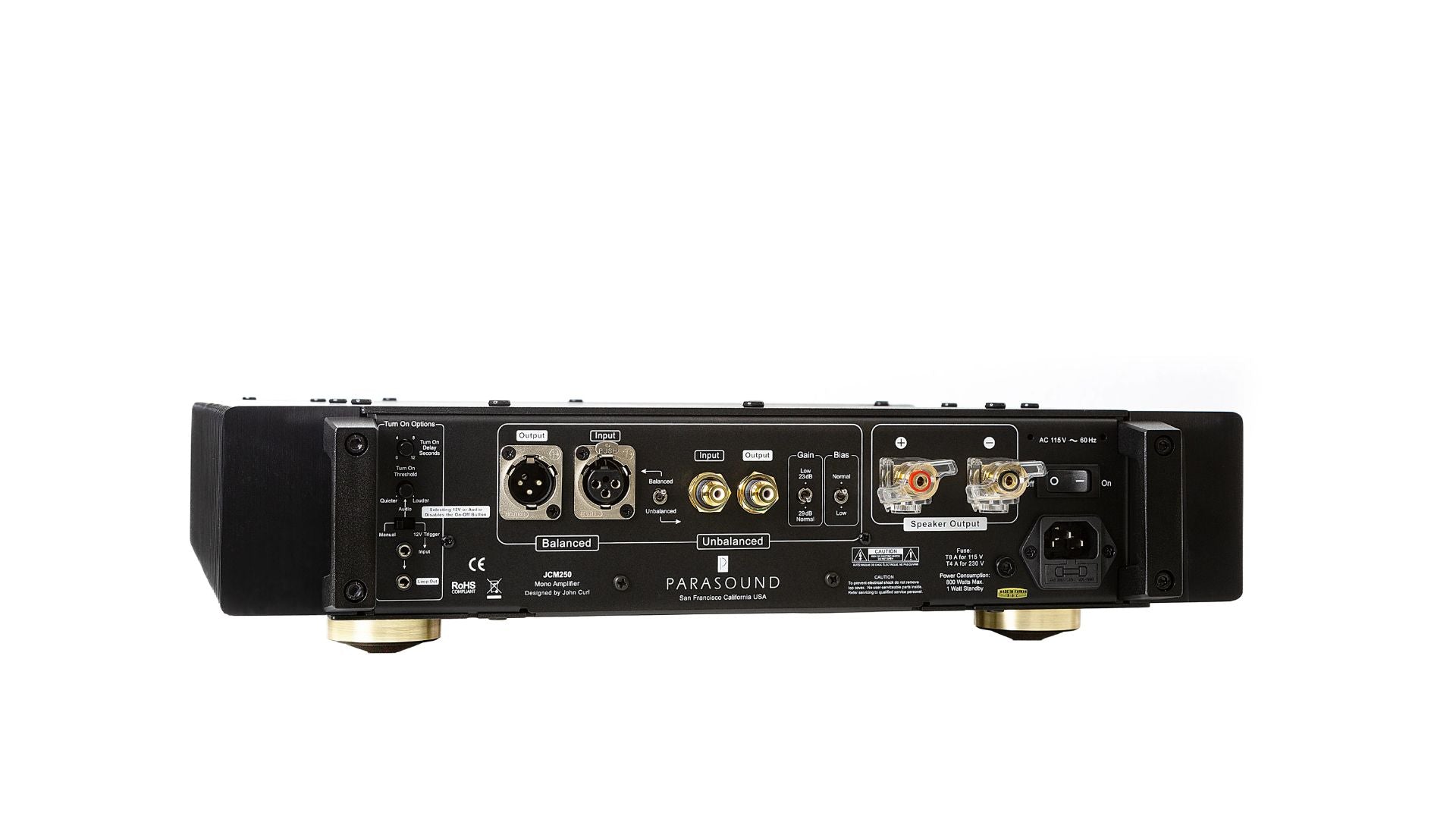
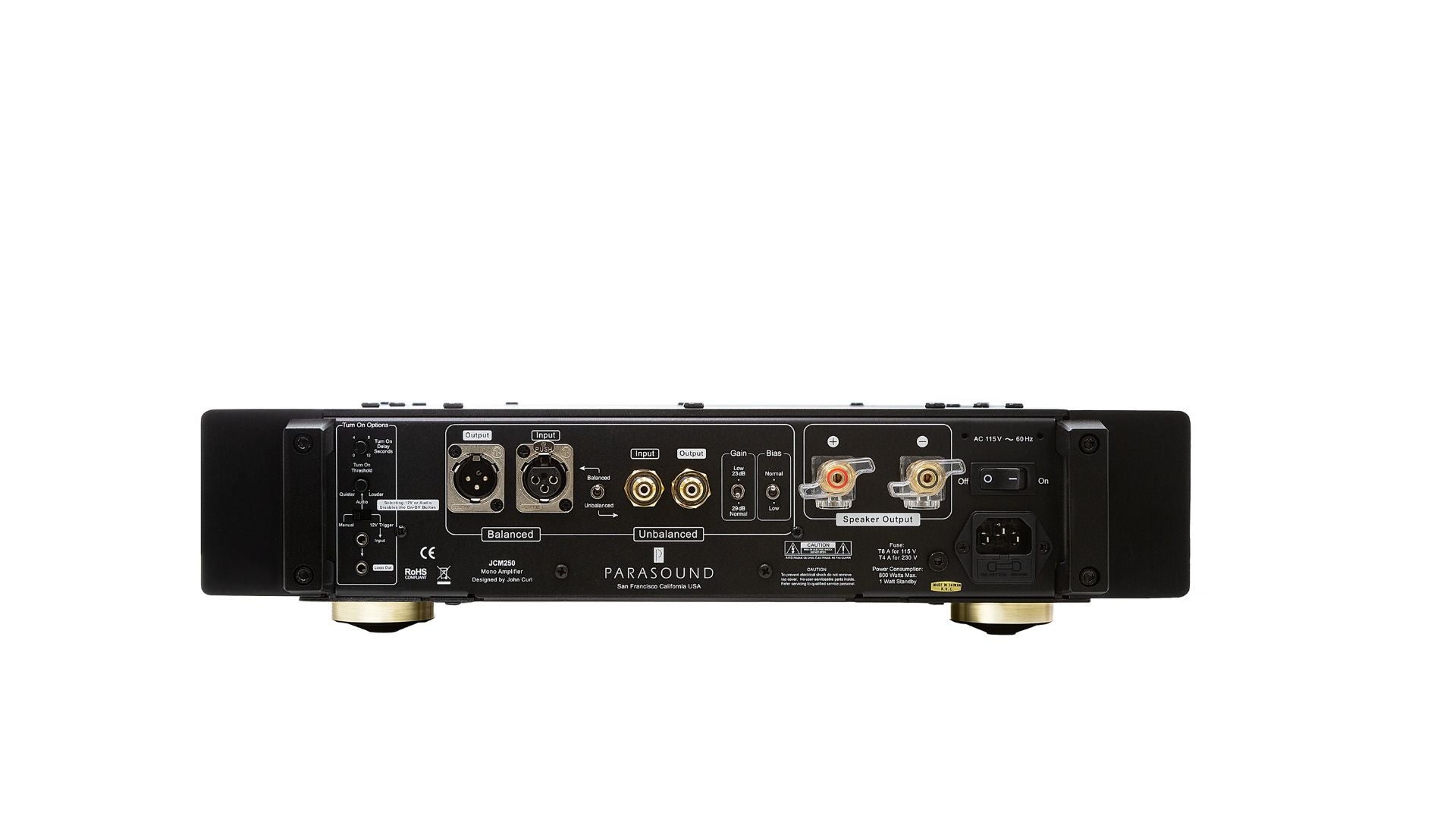
Parasound JCM250 Monoblock Power Amplifier
A 2U monoblock that delivers 250 watts into 8 ohms and 100 amperes of peak current — built on the same JC1+-derived engineering platform, with Bybee Music Rails, FR408 circuit boards, a cascode driver stage, and an independent input stage power supply running on ±112V DC rails.
What It Is, and Why It Exists
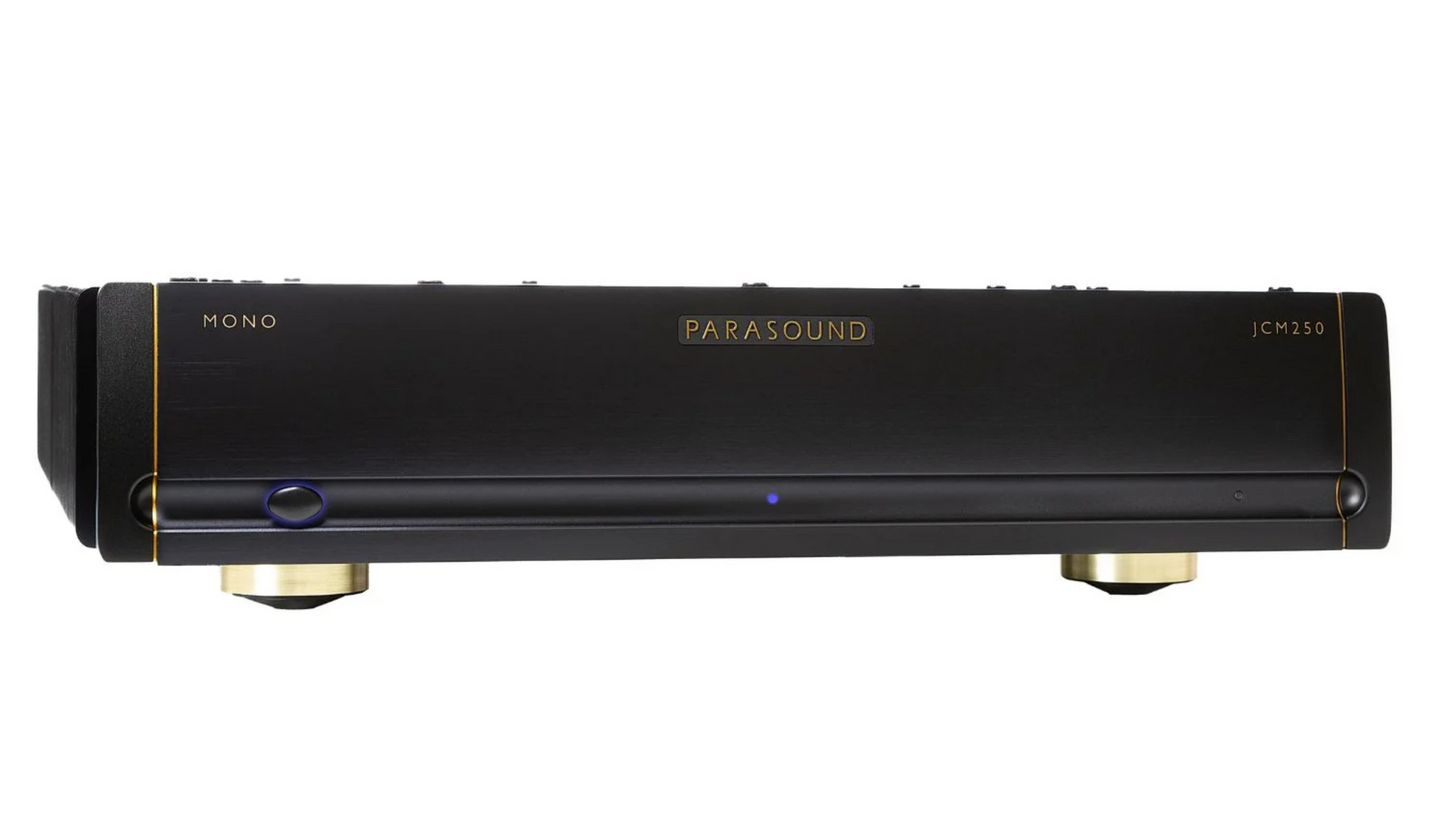
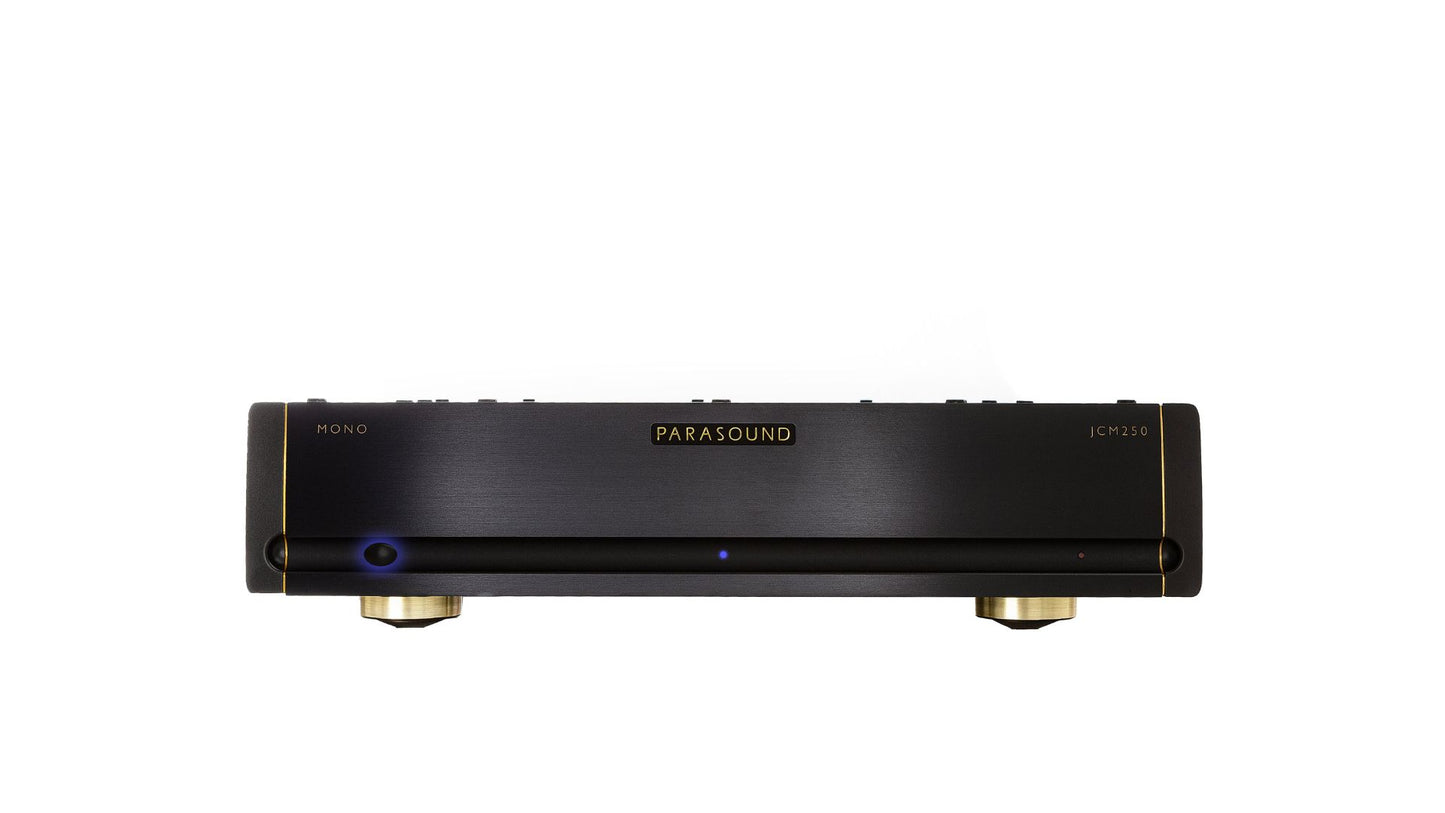
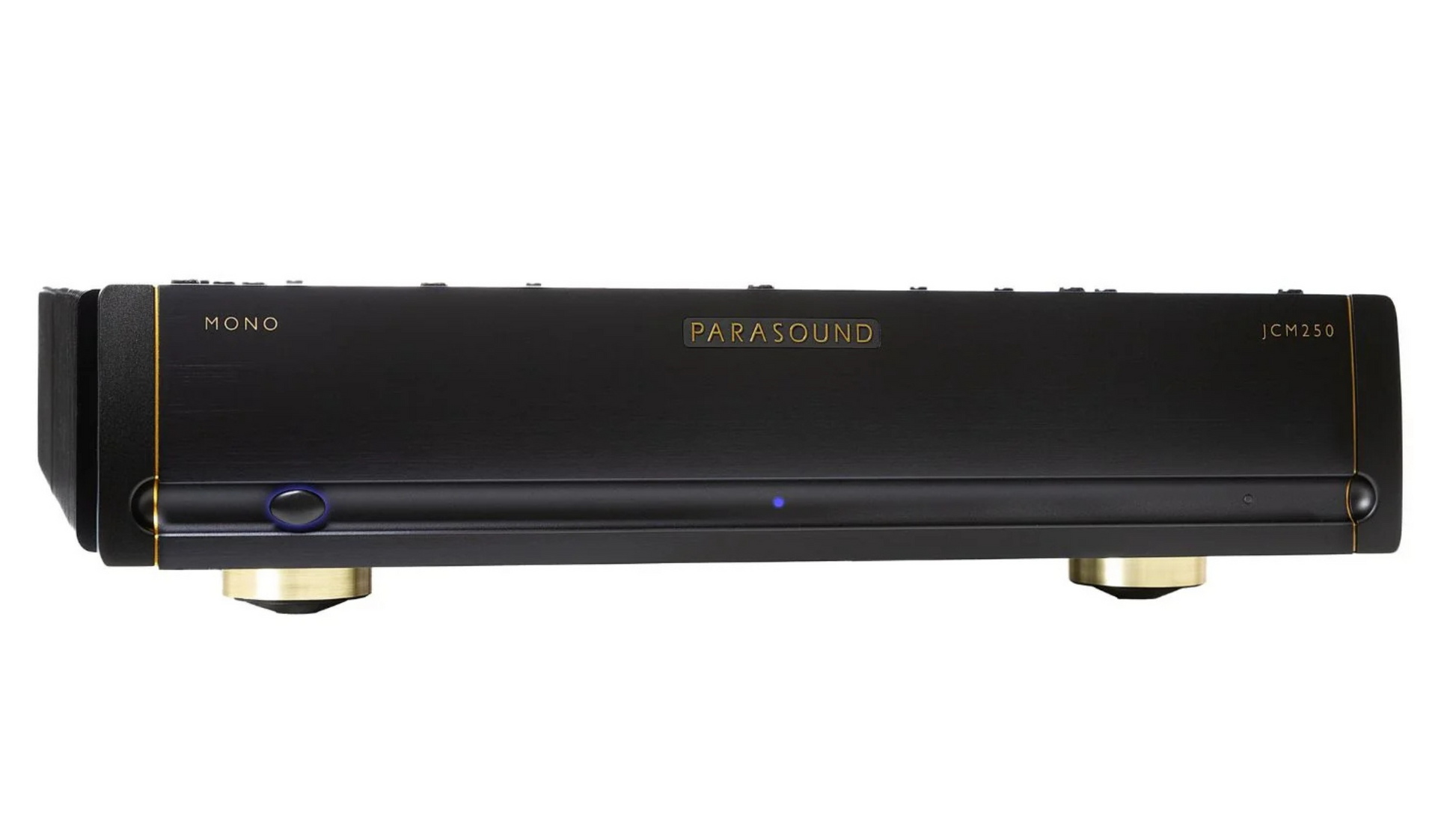
The Parasound JCM250 is a monoblock power amplifier — a single-channel design sold individually, intended to be purchased in pairs for stereo or multiples for multi-channel use. It delivers 250 watts into 8 ohms, 450 watts into 4 ohms, and 800 watts into 2 ohms, from a chassis that is only 3.5 inches tall (2U rack height) and weighs 42 pounds. Those numbers matter for a reason that is easy to overlook: this amplifier contains essentially every engineering technology and circuit topology choice that Parasound and John Curl developed for the JC 1+ reference monoblock, in a form factor that fits comfortably in a standard equipment rack alongside a processor, preamplifier, or other components.
Parasound described the thinking clearly. The JC 1+ is their flagship — a reference that competes with the best amplifiers at any price. But 83 pounds, significant heat output, and a physically imposing chassis mean it is not the right solution for every situation. The JCM250 was designed as the answer to the question of what the JC1+ platform looks like when the constraints are physical compactness and lower heat output rather than maximum output power. The circuit architecture inherited from the JC1+ is not abbreviated or simplified — it is the same topology, the same proprietary technologies, the same parts philosophy, in a more manageable package.
The Absolute Sound reviewed it in March 2024 and called it "excellent in pitch and rich in harmonics." Their 2026 Editors' Choice citation described "tight, controlled bass with pitch definition, lifelike and accurate tonality, and vocals with exceptional dimensionality." These are not descriptions of a compact amplifier doing its best under physical constraints. They are descriptions of a genuinely reference-caliber amplifier.
The JCM250 is sold individually. A pair is required for stereo, and multiples can be used to build complete multi-channel systems with the same circuit quality at every position.
Engineering: What the JCM250 Inherited from the JC 1+
Bybee Music Rails. The JC1+ was the first commercial audio product ever to incorporate Bybee Music Rails — a patented active high-frequency filtering technology developed by Jack Bybee in collaboration with John Curl. The JCM250 carries them forward directly. Music Rails are installed on the B+ and B− power supply rails feeding the input stage, where they perform active filtration of high-frequency noise that conventional passive capacitor filtering cannot adequately address. Residual high-frequency noise on supply rails modulates the operating point of the input transistors and produces correlated noise products — a subtle hardness and loss of fine spatial detail that is audible in direct comparison with amplifiers that do not address this mechanism. Removing it at the rail, before it reaches any active device, is the most effective way to solve it, and it is what Music Rails do.
The Independent Input Stage Power Supply. The JCM250 uses two separate transformers within a single chassis — an architecture that is unusual and expensive to implement at this price point. The main output stage is powered by a heavy shielded toroidal transformer. The input stage has its own completely separate R-core transformer, delivering ±112V DC rails from a supply with its own filter capacitance, its own high-speed soft-recovery rectifier diodes, and no electrical connection to the main power supply. This is the same architecture used in the JC 1+ and JC 5, and it exists to prevent a specific failure mode: under heavy load, the output stage draws large amounts of current and the main supply rails experience small voltage variations. If the input stage shares those rails, those variations modulate the input transistors and introduce low-level dynamic distortion. An independent supply eliminates this entirely — the input stage voltage remains at ±112V regardless of what the output stage is doing.
FR408 Circuit Boards. The input and driver stage circuit boards in the JCM250 are built on FR408 substrate — the same aerospace and supercomputer-grade material used in the JC1+. Standard FR4 boards introduce dielectric losses at high frequencies that degrade signal propagation between stages. FR408's superior high-frequency dielectric properties preserve signal integrity throughout the circuit, and the boards are shielded to isolate them from internal electromagnetic fields. REL and Nichicon Muse capacitors are used throughout — components selected specifically for their immunity to micro-vibrations that can degrade the performance of standard capacitors in high-resolution audio circuits.
The Cascode Driver Stage. The JCM250 uses the same John Curl–designed two-stage cascode driver topology introduced in the JC1+, rather than the single-stage driver used in the earlier JC 5 and A-series amplifiers. The cascode configuration gives the driver stage higher input-output isolation, higher input impedance, and substantially greater open-loop bandwidth than a single-stage design. More bandwidth in the driver means less feedback is needed to control distortion, and the result is better tracking of complex musical transients and more natural behavior under dynamic conditions. The JFET input stage and MOSFET driver together define the JCM250's sonic character, while the output stage handles the current delivery.
Peak Current and Output Stage. With 100 amperes of peak current per monoblock, the JCM250 is specified for stable operation into impedance dips well below 2 ohms. This figure — rather than rated wattage — is the real measure of an amplifier's ability to control difficult speaker loads on transients. Full rated power is specified down to 2 Hz, ensuring that infrasonic program material and warp tones do not cause the amplifier to clip asymmetrically or behave differently below 20 Hz than above it.
How It Compares: JCM250 vs. JC 1+ and JC 5
The most useful comparison is to the JC 1+, because the JCM250 is explicitly positioned as the compact descendant of that amplifier's circuit philosophy. The JC1+ delivers 450 watts into 8 ohms and 180 amperes of peak current, uses 24 Sanken output transistors versus the JCM250's output stage, weighs 83 pounds per monoblock, and runs significantly warmer due to its 25-watt Class A bias in high-bias mode. The JCM250 delivers 250 watts and 100 amperes of peak current, at 42 pounds per unit and with a much lower thermal footprint. The circuit technologies are shared: Bybee Music Rails, FR408 boards, cascode driver, independent input stage supply. For a listener who wants the JC1+ platform in a form factor that can be rack-mounted or installed without dedicated ventilation clearances — or who needs multiple monoblocks for a multi-channel system without filling the room with transformer heat — the JCM250 is the correct choice. For the listener who has unconditional speakers in a large dedicated room where the JC1+'s additional 200 watts and 80 additional amperes of peak current are genuinely useful, the JC1+ justifies its additional size and cost.
The Parasound Halo JC 5, by comparison, is a stereo chassis delivering 400 watts per channel and 90 amperes of peak current — more power than the JCM250 per channel, from a single stereo chassis rather than two monoblocks. The JC 5 uses a single-stage driver rather than the cascode topology, does not have Bybee Music Rails, and does not carry FR408 boards. Two JCM250 monoblocks and one JC 5 are different design philosophies at similar price levels — the JC 5 emphasizes raw power in a single box, while the JCM250 pair emphasizes complete monoblock isolation with the JC1+'s specific circuit refinements.
A Natural Tool for Multi-Channel Systems
The JCM250's 2U rack height and relatively modest thermal output make it uniquely well-suited to multi-channel installations. A listener building a reference home theater can use JC 1+ monoblocks for the front left and right channels and JCM250 monoblocks for center, surrounds, and height channels — maintaining consistent circuit quality throughout the system while managing rack space and thermal load. All channels operate on the same JC-derived topology, so the sonic character is coherent across the soundfield. This is the use case Parasound explicitly built the JCM250 to serve, and it is one of the most compelling arguments for it.
Key Specifications
- Type: Monoblock power amplifier (sold individually; pair required for stereo)
- Topology: Ultra-high-bias Class A/AB, direct-coupled, fully discrete
- Power Output (0.15% THD, 20 Hz–20 kHz): 250W into 8Ω; 450W into 4Ω; 800W into 2Ω
- Class A Output: 8W (high bias); 4W (low bias)
- Peak Current: 100A
- Frequency Response: 2 Hz–110 kHz (+0/−2 dB)
- THD at Full Power: <0.15%
- THD at Typical Listening Levels: <0.02%
- S/N Ratio: >120 dB (IHF A-weighted)
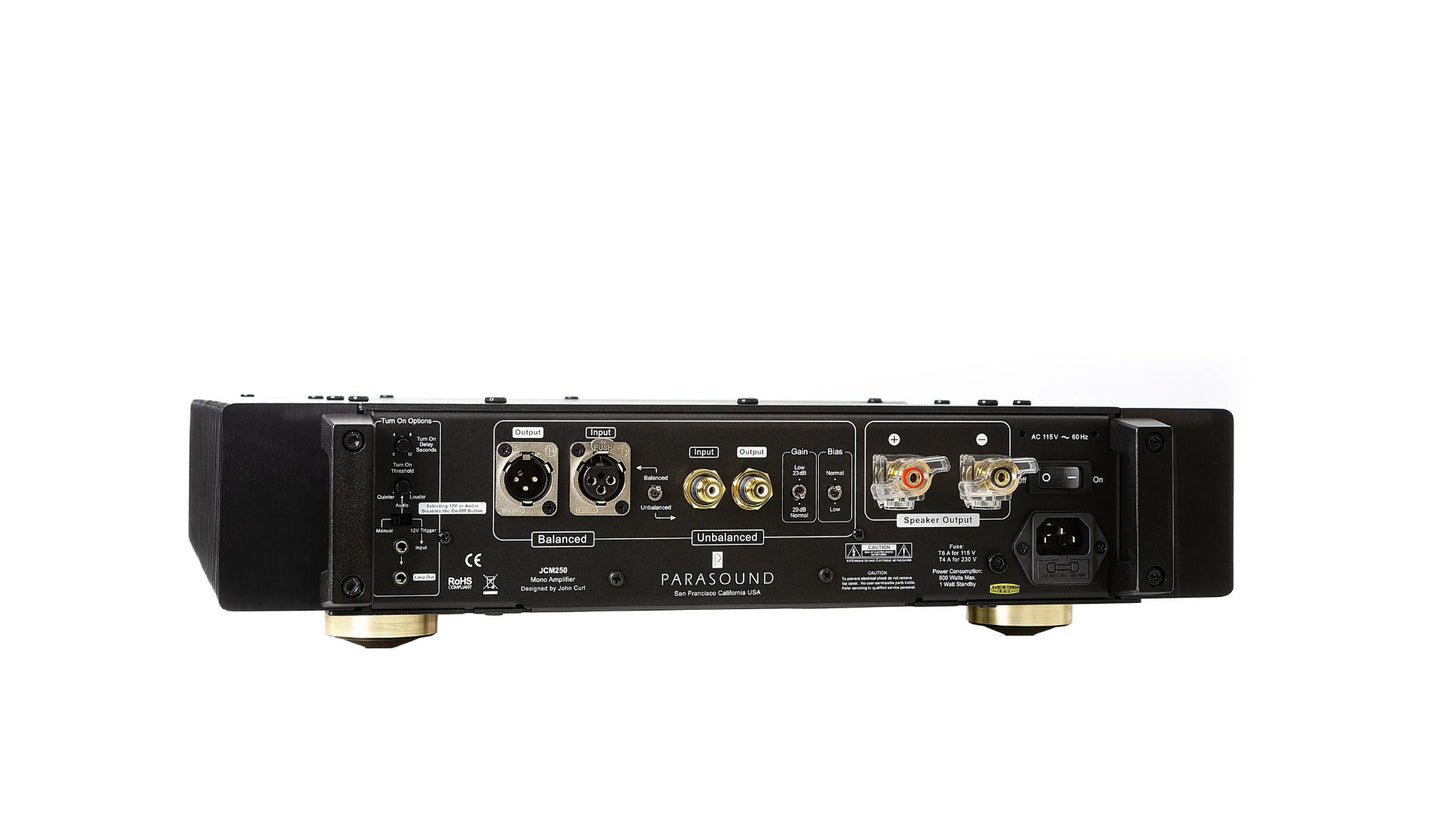
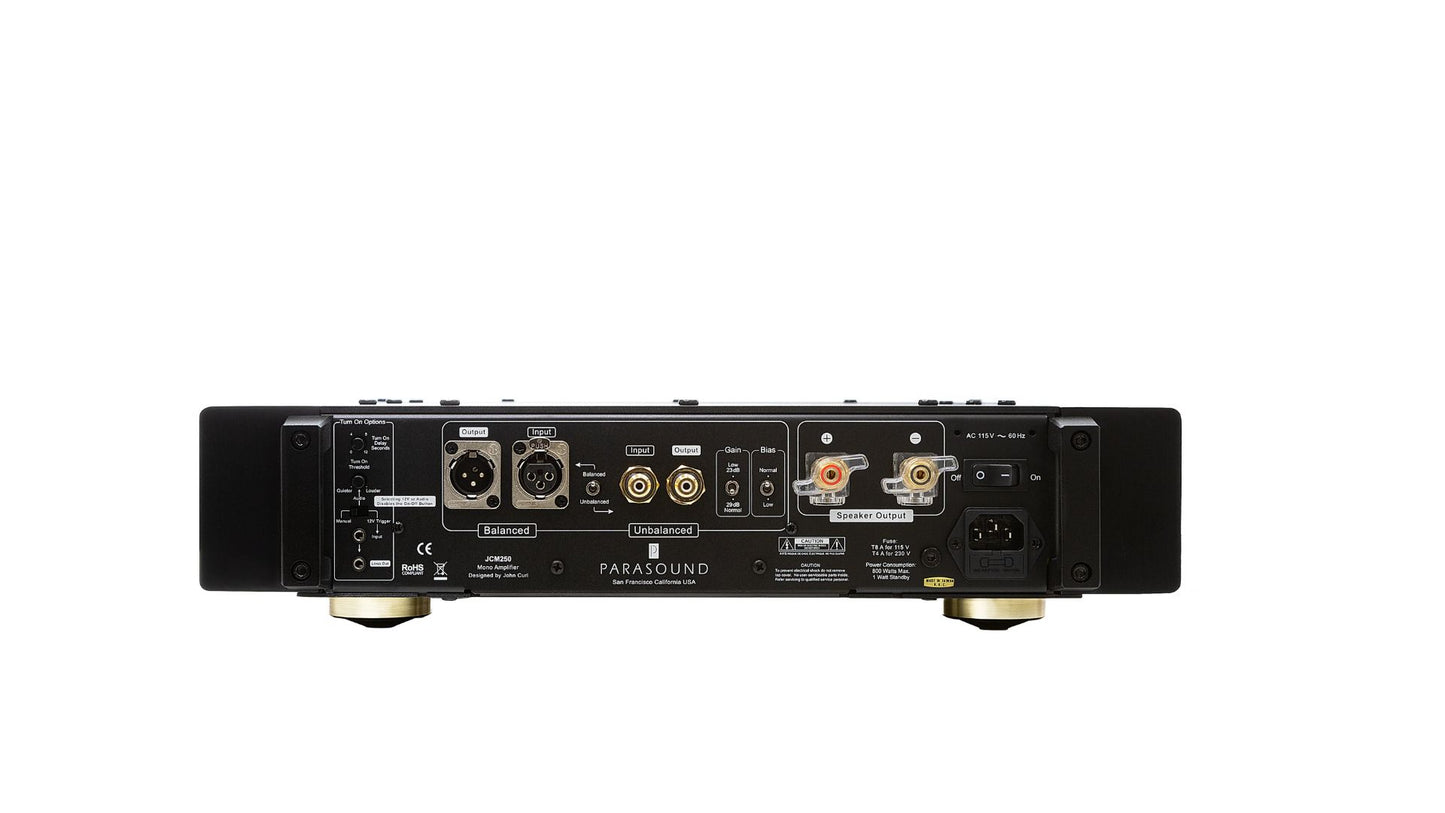
- Gain: 29 dB (normal) / 23 dB (low) — rear panel switch
- Input Stage: JFET; cascode two-stage driver
- Noise Filtering: Bybee Music Rails (active high-frequency input stage supply filtering)
- Circuit Board Material: FR408 (input and driver stages)
- Input Stage Power Supply: Independent; dedicated R-core transformer; ±112V DC rails; separate filter capacitance; high-speed/soft-recovery diodes
- Main Power Supply: Heavy shielded toroidal transformer (independent of input stage supply)
- Capacitors: REL and Nichicon Muse (vibration-immune construction throughout)
- Signal Path: Direct-coupled — no capacitors or inductors in audio path
- Inputs: Balanced XLR; unbalanced RCA
- Loop Outputs: XLR and RCA (for bi-amping or multi-channel daisy-chaining)
- Speaker Outputs: Dual CHK Infinium 5-way gold-plated binding posts
- Trigger: 12V in/out; audio-sense auto-on
- Protection: DC servo, relay speaker protection, thermal sensors, soft-start inrush suppression
- Chassis Height: 2U (3.5" / 88.9 mm) — rack-mountable
- Dimensions: 17.25"W × 3.5"H × 20"D
- Weight: 42 lbs (19 kg) per unit
- Finish: Black
- Warranty: 5 years parts and labor (Parasound USA)
Why Buy From All Elite Audio
All Elite Audio is an authorized Parasound dealer and carries the full JC series. The JCM250 is a product we can speak to in context — where it sits between the JC 5 and the JC 1+, how it functions in a multi-channel system alongside JC 1+ monoblocks, and whether the step from the JC 5 to a pair of JCM250s is the right move for a given set of speakers and room. These are real questions that benefit from a real conversation.
Call 443-402-5055, text 443-402-5064, or visit us at 1921 York Rd, Timonium, MD 21093.
Frequently Asked Questions
What is the Parasound JCM250 and how does it relate to the JC 1+ monoblock?
The JCM250 is a compact monoblock power amplifier that inherits essentially all of the JC1+'s core engineering technologies — Bybee Music Rails, FR408 circuit board material, a John Curl cascode driver stage, and an independent input stage power supply on ±112V DC rails — in a 2U rack-height chassis at a fraction of the JC1+'s size, weight, and cost. Parasound designed it specifically for listeners who want the JC1+ circuit platform but need a physically manageable form factor, lower heat output, or the ability to deploy multiple monoblocks in a multi-channel system without filling a rack with 83-pound units. The Absolute Sound reviewed it in 2024 and awarded it Editors' Choice in 2026, describing its sonic character in terms that reflect the quality of the circuit rather than the constraints of the packaging.
Why does the JCM250 have two separate transformers in a single chassis?
This is the detail that most clearly distinguishes the JCM250 from amplifiers at similar price points. One transformer — a shielded toroidal — powers the output stage. A completely separate R-core transformer powers the input stage, delivering ±112V DC rails through its own independent rectification and filter capacitance. The reason is the same as in the JC 5 and JC 1+: under heavy output stage load, main supply rails experience small dynamic voltage variations as large amounts of current are drawn. If the input stage shares those rails, those variations modulate the input transistors and introduce low-level dynamic distortion that is audible as a subtle compression or hardness during complex musical passages. An isolated input stage supply eliminates this mechanism entirely, regardless of how hard the output stage is working. Most amplifiers at this price point do not do this, because it adds cost and mechanical complexity. Parasound does it because it is the correct engineering solution.
What are Bybee Music Rails and why do they matter here?
Bybee Music Rails are a patented active noise filtering technology first introduced in the JC 1+. They are installed on the power supply rails of the input stage, where they provide active high-frequency filtering that goes beyond what passive capacitors can achieve. Every power supply — no matter how carefully designed — carries some residual high-frequency noise, and that noise modulates the gain of the input transistors in ways that produce low-level correlated noise products. The result is a subtle but consistent reduction in transparency and spatial resolution. Bybee Music Rails address this noise at the source, before it reaches any active device. The JCM250 is one of only two Parasound amplifiers to incorporate this technology — the other being the JC 1+ for which it was developed. The presence of Music Rails in a 2U monoblock is not a marketing feature — it is the same technology performing the same function at lower power levels.
What is the cascode driver stage and how does it differ from the driver in the JC 5?
The JC 5 uses a single-stage driver circuit — an excellent design, but limited in open-loop bandwidth relative to a two-stage arrangement. The JCM250 uses the same cascode driver topology developed by John Curl for the JC 1+: two transistors stacked in series, where the input device operates at a near-fixed voltage and the upper device handles current amplification. This gives the driver higher input-output isolation, higher input impedance, higher output impedance, and substantially greater bandwidth than a single-stage design. More driver bandwidth means less feedback is needed to control distortion at the output stage, which produces more natural and linear behavior — particularly on the fast transients that carry spatial and timbral information in music. The Absolute Sound reviewer specifically cited bass pitch definition and spatial resolution as strengths of the JCM250; the cascode driver is a primary reason for both.
How does the JCM250 compare to the Parasound Halo JC 5 stereo amplifier?
The JC 5 delivers 400 watts per channel and 90 amperes of peak current from a stereo chassis, which makes it more powerful per channel than the JCM250's 250 watts and 100 amperes per monoblock. The JC 5 does not have Bybee Music Rails, does not use FR408 circuit boards, and uses a single-stage rather than cascode driver. Two JCM250 monoblocks provide complete electrical isolation between channels — no shared chassis, no shared transformer, no shared ground — that a stereo chassis cannot match. They also bring the JC1+ circuit refinements that the JC 5 does not carry. The JC 5 is the better choice when maximum output power per channel is the primary requirement and the JC1+ technologies are not the deciding factor. A pair of JCM250 monoblocks is the better choice when circuit quality, monoblock isolation, and form factor are the deciding factors.
Can I use the JCM250 in a multi-channel home theater system?
Yes, and this is one of the clearest use cases for it. The JCM250's 2U chassis, relatively low thermal output compared to the JC 1+, and ability to daisy-chain via loop outputs make it well-suited to multi-channel installations where rack space and heat management are constraints. A common high-performance configuration uses JC 1+ monoblocks for the front left and right channels — where the full power and Class A threshold matter most for music — and JCM250 monoblocks for center, surround, and height channels. All channels run on the same JC-derived circuit topology, so the sonic character is coherent across the full soundfield. The 12V trigger and audio-sense auto-on allow integration with any processor or control system. Loop outputs enable passive bi-amping if desired.
What do the gain switch positions mean, and which should I use?
The JCM250's rear-panel gain switch offers 29 dB (normal) and 23 dB (low) settings. The 29 dB setting is appropriate for most systems and is the natural match for preamplifiers with standard output voltages. The 23 dB setting is provided for systems where the preamplifier has a very high output level or gain, or where the speakers are exceptionally efficient — typically above 95 dB/W/m. In such cases, the combined system gain can result in a very small useful range of the volume control before the system reaches loud levels, and may also raise the audible noise floor. Setting the JCM250 to 23 dB spreads the volume range and reduces system noise floor. If you are uncertain which position is correct for your preamplifier and speakers, we can help you determine the right setting before installation.
What is the high bias / low bias switch and how does it affect operation?
The bias switch controls the Class A operating threshold of the output stage. In high bias mode, the JCM250 operates in pure Class A for the first 8 watts of output before transitioning to Class AB. In low bias mode, the Class A threshold is 4 watts. High bias mode produces more heat and draws more power at idle but provides Class A operation across a wider range of typical listening levels. Low bias reduces heat and idle power consumption while still delivering Class A character at the lowest output levels. For most residential listening environments, high bias is the recommended setting unless thermal management is a genuine concern. The sonic difference between positions is most apparent in the first few watts of output during quiet passages.
How much heat does the JCM250 generate, and what are the ventilation requirements?
The JCM250 generates meaningfully less heat than the JC 1+ due to its lower Class A bias and smaller output stage, and its 2U rack form factor is designed for standard equipment rack installation with normal rack ventilation. Leave at least one rack unit of clearance above and below each unit if rack-mounted. In open-shelf installations, allow adequate airflow around the chassis. The JCM250 can be used in environments where the JC 1+'s thermal output would be problematic, making it the practical choice for enclosed media rooms, wall-mounted equipment bays, and high-density multi-channel racks.
What preamp pairs best with the JCM250?
The JCM250 is a neutral, revealing amplifier that will perform well with any quality line-level preamplifier providing either balanced XLR or unbalanced RCA outputs. Within the Parasound JC series, the natural full-reference pairing is the JC 2 BP — Curl's fully balanced dual-mono preamplifier with hand-matched FETs and a DC-coupled signal path — creating a complete JC-series reference system at significantly lower cost than the JC 2 BP + JC 1+ combination. The Halo P6 is a more accessible option that adds DAC, phono stage, and bass management. For multi-channel theater systems, the JCM250 accepts the balanced preamp outputs of any quality AV processor.
Where can I buy the Parasound JCM250 and get guidance on how many I need?
All Elite Audio at 1921 York Rd, Timonium, MD 21093 is an authorized Parasound dealer with the JCM250 in stock. The purchase decision here involves real questions about quantity, system configuration, and whether the JCM250 or JC 5 or JC 1+ is the right approach for your specific speakers and room — questions we are glad to work through with you before you commit. We carry the full Parasound JC series and can discuss how any combination of these amplifiers works in both stereo and multi-channel contexts. Call 443-402-5055, text 443-402-5064, or stop in.