Parasound
Parasound JC5 Stereo Power Amp
Parasound JC5 Stereo Power Amp
Couldn't load pickup availability
Parasound Halo JC 5 Stereo Power Amplifier
The JC 5 is John Curl's answer to a specific question: could the engineering principles behind the legendary Halo JC 1 monoblock — the amplifier Stereophile named to their Class A Recommended Components list for fifteen consecutive years — be realized in a single stereo chassis? The answer is yes, and the result is the most capable stereo power amplifier Parasound builds.
What It Is and Who It's For
The Parasound Halo JC 5 is a reference-class two-channel stereo power amplifier delivering 400 watts per channel into 8 ohms, 600 watts into 4 ohms, and 1,200 watts bridged into 8 ohms as a monoblock. It is the flagship stereo amplifier in the Halo lineup — above the A21+ in power, current delivery, and circuit sophistication, and below only the JC 1+ monoblocks in Parasound's overall hierarchy. At 73 pounds and with a depth of 20 inches, it is built to the physical scale the circuit requires.
This amplifier serves a specific and discerning listener. That listener has speakers that deserve the finest amplification available in this price range — large floorstanders, Magnepan planar magnetics, electrostatic panels, or other designs that reveal exactly what the amplifier does and does not do. That listener wants true bi-wiring capability directly from the amplifier's binding posts, not a single pair with a jumper at the speaker. That listener has reached the point where the A21+ has become the conversation about what comes next rather than the destination. The JC 5 is what comes next — not because the A21+ is inadequate, but because this amplifier operates at a categorically higher level of circuit complexity, parts quality, and measured performance.
Engineering: What Separates the JC 5 from the Rest of the Halo Line
The Halo A-series amplifiers — the A23+ and A21+ — use John Curl's three-transistor circuit topology with a shared power supply structure. The JC 5 takes that topology and surrounds it with the power supply architecture that Curl pioneered in the JC 1: fully independent power supplies not just per channel, but per stage within each channel. The input stages, driver stages, and output stages each have their own dedicated supply rails, isolated from one another. This separation prevents the high-current demands of the output stage from inducing noise or voltage sag in the sensitive input and driver stages where such interference would be audible.
The input stage detail is particularly significant. Each channel's input stage operates on ±110 volt DC rails drawn from a completely separate supply with 8,880 µF of Nichicon Gold Tune filter capacitors — independent from the main output stage power supply. These input stage rails are maintained at a constant 10 volts above the output stage rails at all times. Under heavy load, when the output stage draws large amounts of current and the main supply rails sag slightly, the input stage voltage remains stable and unaffected. This prevents the input stage from being modulated by the output stage's demands, which is one of the primary mechanisms by which distortion creeps into amplifier designs under dynamic conditions. It is a design principle borrowed directly from the JC 1 monoblock, and it is the most meaningful architectural difference between the JC series and the Halo A-series at the circuit level.
The input transistors are Toshiba 2SJ74 JFETs — a device that Toshiba discontinued, making the remaining stock of tested and matched pairs increasingly rare. The 2SJ74 is coveted among amplifier designers for its ultra-low noise characteristics and its particular behavior in low-level signal handling. Parasound sourced and stockpiled matched pairs for the JC 5 production run specifically because no adequate substitute exists. The driver stage follows with MOSFETs, and the output stage uses 24 beta-matched Sanken bipolar transistors, each rated at 15 amperes and 60 MHz bandwidth. The 60 MHz figure is not incidental — it is the transistor's slew-rate headroom, and it is why the JC 5 achieves a slew rate greater than 130 volts per microsecond with an effectively unmeasurable transient intermodulation distortion figure. Music contains transients of extraordinary speed; an output stage that cannot track them accurately introduces a form of distortion that is not well captured by steady-state THD measurements but is audible as a loss of fine detail and spatial information.
The output stage is backed by 132,000 µF of Rubycon filter capacitors — a brand and type selected specifically for their combination of low equivalent series resistance, high ripple current handling, and long-term stability. Behind all of this is a 1.7 kVA toroidal transformer with independent secondary windings for left and right channels, encapsulated in an epoxy-filled steel canister for vibration isolation and minimal radiated hum.
The result of this power supply and output stage architecture is 90 amperes of peak current per channel — 50% more than the A21+'s 60 amperes — and a signal-to-noise ratio greater than 116 dB A-weighted. For context, that noise figure is better than many reference preamplifiers and approaches the theoretical limits of what analog circuit design can achieve. Interchannel crosstalk is greater than 87 dB at 1 kHz and 72 dB at 20 kHz — figures that place the JC 5 in the same measurement territory as much more expensive amplifiers.
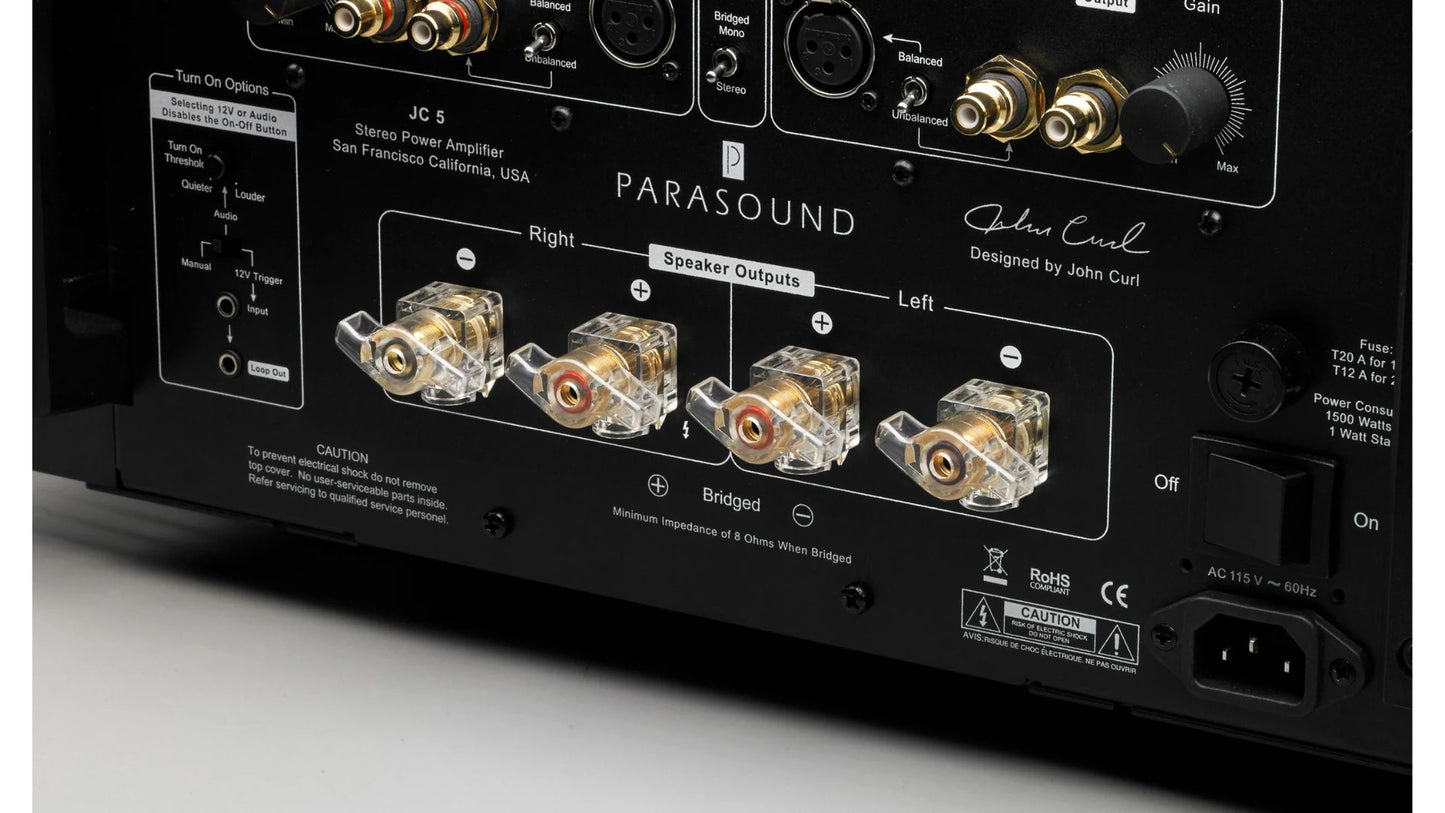
The speaker binding posts deserve specific mention. The JC 5 provides two full sets of CHK Infinium "propeller" binding posts per channel — a total of four sets — allowing true bi-wiring from the amplifier itself rather than bridging jumpers at the speaker or splitting the cable at the speaker end. For speakers with separate woofer and tweeter/midrange inputs, this means each driver section receives its signal through an independent conductor path from the amplifier, which eliminates the back-EMF coupling between driver sections that occurs when both share a single amplifier terminal pair. These CHK Infinium posts accept spade lugs up to 16mm, banana plugs, or bare wire up to 7 gauge, and they are 24k gold-plated over brass — the same mechanical design Parasound specified for the JC 1.
How It Compares: JC 5 vs. A21+ and JC 1+ Monoblocks
The Parasound Halo A21+ uses the same JFET-MOSFET-bipolar three-stage circuit topology as the JC 5, but with a shared rather than independent per-stage power supply architecture, 60 amperes of peak current versus 90 amperes, and a single set of speaker binding posts per channel. The A21+ delivers 300 watts per channel and weighs 71 pounds. The JC 5 delivers 400 watts per channel and weighs 73 pounds. The physical size difference is modest; the internal complexity and measured performance difference is substantial. For listeners with speakers that have a single pair of binding posts and who are not bi-wiring, the A21+ is an outstanding amplifier. For listeners who need or want true bi-wiring, higher peak current, the independent input stage supply architecture, or the higher SNR figure, the JC 5 is the correct tool.
The Parasound Halo JC 1+ monoblocks are the reference above the JC 5. Each JC 1+ delivers 450 watts into 8 ohms, 850 watts into 4 ohms, and 1,300 watts into 2 ohms, with 25 watts of pure Class A and 180 amperes of peak current. The JC 1+ uses FR408 circuit board material — the same specification used in aerospace electronics — and REL capacitors throughout. Two JC 1+ units will cost significantly more than one JC 5 and require two chassis in the equipment rack. For the listener who has the budget, the space, and speakers that genuinely need what the JC 1+ delivers, those monoblocks represent the apex of what Parasound has built. For a very large majority of serious reference-level systems, the JC 5 is the amplifier the music requires.
Key Specifications
- Type: Two-channel stereo power amplifier
- Topology: Ultra-high-bias Class A/AB, dual-mono, direct-coupled
- Power Output (Stereo, 0.05% THD): 400W × 2 into 8Ω; 600W × 2 into 4Ω
- Power Output (Bridged Mono, 0.05% THD): 1,200W into 8Ω (4Ω bridged not recommended)
- Class A Operation: First 12 watts per channel
- Peak Current: 90A per channel
- Slew Rate: >130 V/µs
- Minimum Stable Impedance: 1.5Ω
- THD at Full Power: <0.05%
- THD at Typical Listening Levels: <0.03%
- IMD: <0.04%
- TIM: Unmeasurable
- S/N Ratio: >116 dB (IHF A-weighted, input shorted); >111 dB (unweighted)
- Interchannel Crosstalk: >87 dB at 1 kHz; >72 dB at 20 kHz
- Frequency Response: 5 Hz–100 kHz (+0/−3 dB); 20 Hz–20 kHz (+0/−0.25 dB)
- Damping Factor: >1,200 at 20 kHz; 1,000 at 20 Hz
- Total Gain: 29 dB
- Input Impedance: 33 kΩ (unbalanced); 66 kΩ (balanced, 33 kΩ per leg)
- Input Sensitivity: 1V unbalanced; 1V per leg balanced (for 28.28V output into 8Ω)
- Input Transistors: Toshiba 2SJ74 JFET (input stage); MOSFET (driver stage)
- Output Transistors: 24 beta-matched Sanken 15A/60MHz bipolar transistors per channel
- Input Stage Power Supply: Independent per channel; ±110V DC rails; 8,880 µF Nichicon Gold Tune capacitors; maintained 10V above output stage rails
- Output Stage Power Supply: 1.7 kVA encapsulated toroidal transformer with independent secondary windings per channel; 132,000 µF Rubycon filter capacitors
- Inputs: Balanced XLR (Neutrik locking connectors) + unbalanced RCA (Vampire gold-plated); per channel
- Loop Outputs: RCA per channel (Vampire gold-plated)
- Speaker Outputs: Two full sets of CHK Infinium "propeller" 24k gold-plated 5-way binding posts per channel (accepts spade lugs to 16mm, bananas, bare wire to 7 gauge)
- Trigger: 12V in/out; audio sensing auto-on
- Ground Lift: Rear panel switch
- Rack-Mountable: Yes — rack mount hardware included; rear carry handles
- Power Cord: Included — 9 ft (3m), 12-gauge IEC with silver-soldered connectors
- Protection: DC servo, relay speaker protection, thermal sensors, soft-start inrush suppression with relay bypass
- Dimensions: 17⅝"W × 7¾"H × 21½"D (448 × 197 × 546 mm)
- Weight: 73 lbs (33.1 kg)
- Finish: Black
- Warranty: 3 years parts and labor (Parasound USA)
Why Buy From All Elite Audio
All Elite Audio is an authorized Parasound dealer, and the JC 5 is one of the amplifiers we discuss most often with customers who are building or upgrading serious systems. The conversation around this amplifier — which speakers deserve it, which preamplifiers match it best, whether the step from the A21+ is audible in a given system — is exactly the kind of consultation that makes buying from an authorized dealer worth it. We know the Halo lineup from bottom to top and can speak to how each step in the chain actually sounds, not just how it measures.
Call 443-402-5055, text 443-402-5064, or visit us at 1921 York Rd, Timonium, MD 21093.
Frequently Asked Questions
What makes the JC 5 different from the Parasound Halo A21+ — they're similar in size and price, so why pay more?
The core difference is the power supply architecture. The A21+ uses a single main power supply that feeds all stages of each channel. The JC 5 uses fully independent power supplies not just per channel, but per stage — the input stages have their own dedicated supply with Nichicon Gold Tune capacitors running on ±110 volt DC rails, always maintained 10 volts above the output stage rails. This prevents the high-current demands of the output stage from modulating the voltage reaching the input stage, which is one of the primary sources of dynamic distortion in amplifier designs under real musical conditions. The JC 5 also delivers 90 amperes of peak current per channel versus 60 amperes for the A21+, uses 24 output transistors versus 16, has a slew rate more than twice as fast, achieves a noise floor of 116 dB versus 115 dB, and provides two full sets of speaker binding posts per channel for true bi-wiring. These are not incremental differences — they represent a categorically more sophisticated engineering approach at a meaningfully different price point.
What is the significance of the independent input stage power supply at ±110V DC?
Every amplifier stage draws current from its power supply, and under heavy load — during loud musical passages or with difficult speaker loads — that current demand causes small voltage variations on the supply rails. If all stages share a single supply, the output stage's large current draws can modulate the voltage available to the input stage, introducing low-level noise and dynamic distortion. The JC 5 solves this by giving the input stages their own dedicated supply with independent regulation, running at ±110 volts — a much higher rail voltage than typical input stages — and maintained at a constant 10 volts above the output stage rails regardless of load. This is a design principle John Curl developed for the JC 1 monoblock, which is one of the reasons that amplifier measured and sounded the way it did. Implementing it in a stereo chassis at the JC 5's price point is an unusual commitment to circuit integrity.
What is the Toshiba 2SJ74 JFET and why does it matter?
The 2SJ74 is a JFET transistor that Toshiba discontinued years ago. It is coveted among serious amplifier designers for its ultra-low noise figure and its particular behavior at small signal levels — characteristics that affect how the amplifier handles fine musical detail, spatial information, and the texture of acoustic instruments. When a component like this goes out of production, designers typically source as much remaining matched stock as possible and specify a substitute for future runs. Parasound specifically chose the 2SJ74 for the JC 5's input stage and stockpiled matched pairs to maintain production. The fact that they did so rather than simply substituting a more available JFET type reflects the seriousness with which the JC 5 was engineered. It is a component decision that most buyers will never read about but will experience in the amplifier's character at the listening seat.
What does having dual speaker binding posts per channel actually give me?
With a single pair of binding posts per channel, all the current going to both the woofer and the tweeter/midrange sections of a speaker passes through the same connection point. When the woofer produces back-EMF — the voltage a speaker generates when its cone is decelerating — that signal flows back through the same terminal and interacts with the signal going to the tweeter section. True bi-wiring, using separate conductor runs from two separate amplifier terminals to each section of the speaker, keeps these return currents isolated. The JC 5's two sets of CHK Infinium binding posts per channel allow this from the amplifier side without any adapters or workarounds. Bi-wiring is not universally audible on all speakers and systems, but for speakers with separate woofer and tweeter inputs and in systems with sufficient resolution to reveal the difference, it is a meaningful capability — and the JC 5 is one of the few amplifiers at its price to provide it properly.
What preamp should I pair with the JC 5?
The JC 5 is transparent enough that it will reveal the character — and the limitations — of whatever preamplifier is upstream of it. Within the Parasound Halo family, the natural reference pairing is the JC 2 BP — John Curl's dual-mono fully balanced preamplifier with hand-matched FET input devices, a DC-coupled signal path, and a four-gang motorized volume control. The JC 2 BP and JC 5 together form a complete JC-series reference system that represents the highest level of performance Parasound offers in a separates configuration below the JC 1+ monoblocks. The Halo P6 is a more affordable and highly capable option that adds a DAC, phono stage, and bass management at the cost of some of the JC 2 BP's purity of analog signal path. We carry both and can discuss which makes more sense for your system.
How does the JC 5 compare to using a pair of Parasound Halo JC 1+ monoblocks?
The JC 1+ monoblocks are the reference above the JC 5 in the Parasound lineup. Each delivers 450 watts into 8 ohms, 850 watts into 4 ohms, and 1,300 watts into 2 ohms, with 25 watts of pure Class A and 180 amperes of peak current per monoblock. The JC 1+ uses FR408 circuit board material specified for aerospace applications and REL capacitors throughout. The most meaningful practical difference — beyond raw power — is that monoblocks place each channel's entire circuit in its own chassis with its own dedicated power supply, which is the ultimate form of channel isolation. A pair of JC 1+ units will cost substantially more than a JC 5 and require two chassis. For the listener whose speakers, room, and budget justify the JC 1+, those monoblocks are extraordinary. For the overwhelming majority of serious reference systems, the JC 5 is the correct amplifier.
Can the JC 5 be bridged to mono, and what does that give me?
Yes. In bridged mono mode, the JC 5 delivers 1,200 watts into 8 ohms. This configuration uses both amplifier channels to drive a single speaker, effectively doubling the voltage swing at the output. Two JC 5 units bridged to mono would give a pair of 1,200-watt monoblock amplifiers — a configuration that approaches the output capability of the JC 1+ monoblocks at a lower cost, though without the JC 1+'s circuit refinements and dedicated per-chassis architecture. Note that bridged operation into 4 ohms is not recommended — in bridged mode, the amplifier sees a 2-ohm effective load per output stage, which approaches the stability limit. Bridged operation is best suited to 8-ohm speakers.
Is the JC 5 truly stable into 1.5-ohm loads? What does that mean in practice?
Yes, the JC 5 is specified for stable operation with impedance dips to 1.5 ohms. Speaker impedance is not fixed — it varies continuously with frequency, and the nominal 4- or 8-ohm rating of a speaker reflects only the average. Many speakers dip well below their nominal impedance in the bass region, and some demanding designs — particularly large full-range electrostatics, certain planar magnetics, and some exotic passive speaker designs — can present loads of 2 ohms or less in specific frequency bands. An amplifier that becomes unstable at those impedances will compress dynamically, harden tonally, or trigger protection circuits. With 90 amperes of peak current available and a direct-coupled output stage that has maintained stable operation to 1.5 ohms in design testing, the JC 5 is specified for the full range of speakers a serious listener is likely to encounter.
What are the CHK Infinium speaker binding posts and why are they significant?
CHK is a hardware manufacturer that developed the Infinium "propeller" binding post in collaboration with Parasound specifically for the JC 5. The post accepts spade lugs up to 16mm wide — wider than most competing binding posts, which matters for high-quality terminated speaker cables — as well as banana plugs and bare wire up to 7 gauge. They are machined from brass and 24k gold-plated. The "propeller" wing design provides the mechanical advantage needed to tighten them firmly by hand without tools, ensuring a solid, repeatable electrical connection. These are not stock binding posts sourced from a commodity parts catalog — they are a custom component that reflects the same attention to signal path integrity that characterizes the rest of the JC 5's design.
What protection circuits does the JC 5 use, and are they in the signal path?
The JC 5 includes DC servo speaker protection, relay-based soft-start inrush suppression with relay bypass, and thermal management circuits. The DC servo continuously monitors and corrects any DC offset voltage at the output — if DC were to reach the speakers, it could damage or destroy the woofer voice coils. The relay soft-start limits the inrush current surge when the amplifier powers on, protecting the amplifier and any connected components; the relay then bypasses itself after startup so it is not in the signal path during operation. Thermal sensors monitor output transistor temperature and will shut the amplifier down if safe operating limits are exceeded. None of these protection circuits are in the audio signal path during normal operation — they operate in parallel and only intervene when a fault condition exists.
Where can I buy the Parasound Halo JC 5 and get expert support?
All Elite Audio at 1921 York Rd, Timonium, MD 21093 is an authorized Parasound dealer with the JC 5 in stock. We carry the complete JC series — JC 5, JC 2 BP, JC 3+, and JC 1+ — and can demonstrate the JC 5 in a full JC-series system context or alongside the A21+ for a direct comparison. Purchasing from an authorized dealer is the only way to receive full factory warranty coverage and factory service access for the life of the product. Call 443-402-5055, text 443-402-5064, or stop in. We ship with full warranty intact for customers outside the Baltimore area.


Outlet Deals
-
Leben CS-600X Integrated Tube Amplifier (Used)
Regular price $7,995.00 USDRegular priceUnit price per$9,995.00 USDSale price $7,995.00 USDSALE -
Meitner Audio MA3i Integrated DAC and Network Streamer (Used)
Regular price $7,995.00 USDRegular priceUnit price per$11,500.00 USDSale price $7,995.00 USDSALE -
Luxman L-507Z Integrated Amplifier (Used)
Regular price $6,995.00 USDRegular priceUnit price per$10,495.00 USDSale price $6,995.00 USDSALE -
HiFi Rose RS520 Streaming Integrated Amplifier (New / Open Box)
Regular price $2,995.00 USDRegular priceUnit price per$3,995.00 USDSale price $2,995.00 USDSALE -
Cambridge Edge W (USED)
Regular price $2,500.00 USDRegular priceUnit price per$5,000.00 USDSale price $2,500.00 USDSALE -
Luxman D-03X CD Player and DAC (Used)
Regular price $2,495.00 USDRegular priceUnit price per$4,000.00 USDSale price $2,495.00 USDSALE


New Releases
-
EverSolo T10 Streaming Transport
Regular price $2,180.00 USDRegular priceUnit price per$2,180.00 USDSale price $2,180.00 USD -
Luxman L-100 CENTENNIAL Pure Class A Integrated Amplifier
Regular price $11,995.00 USDRegular priceUnit price per$11,995.00 USDSale price $11,995.00 USD -
KLH Model Seven Floorstanding Speakers
Regular price $4,999.98 USDRegular priceUnit price per$5,998.00 USDSale price $4,999.98 USDSALE -
REL Acoustics Planar PL-1 Subwoofer
Regular price From $2,499.00 USDRegular priceUnit price per$2,499.00 USDSale price From $2,499.00 USD -
EverSolo DMP-A8 Gen 2 Master Edition -Music Streamer, CD Player, DAC & Preamplifier
Regular price $2,580.00 USDRegular priceUnit price per$2,580.00 USDSale price $2,580.00 USD -
EverSolo DMP-A8 Gen 2 Music Streamer, DAC & Preamplifier
Regular price $1,980.00 USDRegular priceUnit price per$1,980.00 USDSale price $1,980.00 USD