

Parasound Halo JC 1+ Monoblock Power Amplifier
Five years in development, 83 pounds of deliberate engineering, and the result of John Curl applying everything he has learned across a fifty-year career to a single design: the JC 1+ is the finest amplifier Parasound has ever built, and it contains several technologies and components that have never before appeared in a commercial audio product.
What It Is and Who It's For
The Parasound Halo JC 1+ is a monoblock power amplifier — a single-channel design, sold individually, intended to be purchased in pairs for stereo use. Each unit delivers 450 watts into 8 ohms, 850 watts into 4 ohms, and 1,300 watts into 2 ohms. The first 25 watts operate in pure Class A with the bias switch set to high. Peak current capability is 180 amperes. These are extraordinary figures, and they exist not because the JC1+ is designed to compete on specification sheets, but because the engineering choices required to achieve them at the JC1+'s level of circuit refinement naturally produce performance of this magnitude.
This amplifier is for a specific and clearly defined listener. That listener has speakers that reveal everything an amplifier does — large reference floorstanders, electrostatics, planar magnetics, or other demanding designs whose performance scales directly with the quality of power driving them. That listener has arrived at the point in their audio journey where the question is not whether to spend more, but whether spending more produces a meaningful and lasting improvement. For that listener, the JC1+ is the answer. Stereophile placed the original JC 1 on their Class A Recommended Components list for fifteen consecutive years — an achievement without parallel in the publication's history. The JC1+ is a more ambitious, more thoroughly engineered, and more capable successor to that amplifier, and it was five years in development precisely because Parasound and John Curl refused to release it until it surpassed the original in every respect.
The JC1+ is sold individually. A pair is required for stereo operation. All Elite Audio can supply a matched pair, and we recommend discussing installation, ventilation, and preamp compatibility before purchasing.
The History Behind the Design
The "JC" in the Parasound Halo product names stands for John Curl. Curl began his professional engineering career designing tape machines at Ampex in the 1960s, contributed to the Grateful Dead's legendary Wall of Sound touring system, and in the mid-1970s produced the Mark Levinson ML-1 and ML-2 amplifiers and JC-1 and JC-2 preamplifiers — the designs that first established transistor amplification as a genuine competitor to tubes in high-end audio. He has been working with Parasound since 1989. The Halo JC 1 monoblock, introduced in 2003, brought his circuit philosophy to a commercial product at a price that made genuine reference performance accessible, and the audio community responded accordingly.
The JC1+ began development five years before its 2020 release. Richard Schram, Parasound's founder, worked alongside Curl and circuit board designer Carl Thompson — who has designed the boards for every JC-series product including the Vendetta Research phono stage and the JC 2 BP, JC 3+, and JC 3 Jr — to identify every aspect of the original JC 1 that could be meaningfully improved without compromising its essential character. The result incorporates four technologies or components that had never previously appeared in a commercial audio product: Bybee Music Rails, FR408 circuit board material in the input and driver stages, a cascode two-stage driver circuit, and 24 Sanken output transistors where the JC 1 used 18 — a 33% increase. Every one of these choices has a specific engineering rationale, and each is worth understanding.
Engineering: The Four Advances That Define the JC 1+
The Cascode Driver Stage. The original JC 1 used an excellent single-stage driver circuit. John Curl predicted — and the JC1+ confirms — that a two-stage cascode driver would produce a substantial improvement in open-loop bandwidth and linearity. A cascode topology stacks two transistors in series, with the input device operating at a nearly fixed voltage and the output device handling the current amplification. This arrangement gives the driver stage some of the favorable properties of vacuum tube circuits: higher input-output isolation, higher input impedance, higher output impedance, and a wider bandwidth. The result is an amplifier with lower distortion under dynamic conditions and more accurate tracking of complex musical transients. This is the most significant circuit innovation in the JC1+ relative to both the JC 1 and the JC 5.
Bybee Music Rails. The JC1+ is the first commercial audio product to incorporate Bybee Music Rails, a patented active noise filtering technology developed by Jack Bybee in collaboration with Curl and Carl Thompson. Music Rails are installed on the power supply rails feeding the input stage, where they perform active high-frequency filtering — eliminating noise that conventional passive capacitor filtering cannot fully address. High-frequency noise on the power supply rails modulates the gain of the input transistors and introduces low-level correlated noise products that are audible as a subtle but persistent hardness and loss of fine detail. Removing that noise at the rail, before it reaches the transistors, produces a quieter, more transparent signal path. Carl Thompson designed dedicated Music Rail circuit boards specifically for the JC1+.
FR408 Circuit Board Material. The input and driver stages of the JC1+ are built on FR408 circuit board substrate — a material developed for ultra-high-speed applications in supercomputers and aerospace electronics. Standard audio circuit boards use FR4, which limits high-frequency signal propagation and can introduce dielectric losses at frequencies that matter for audio bandwidth and slew rate. FR408 has substantially superior dielectric properties at high frequencies, meaning the signals traveling on the board itself are preserved more accurately between stages. Carl Thompson evaluated and specified FR408 specifically for its high-frequency propagation characteristics, and the boards are shielded to isolate them from internal stray electromagnetic currents within the chassis.
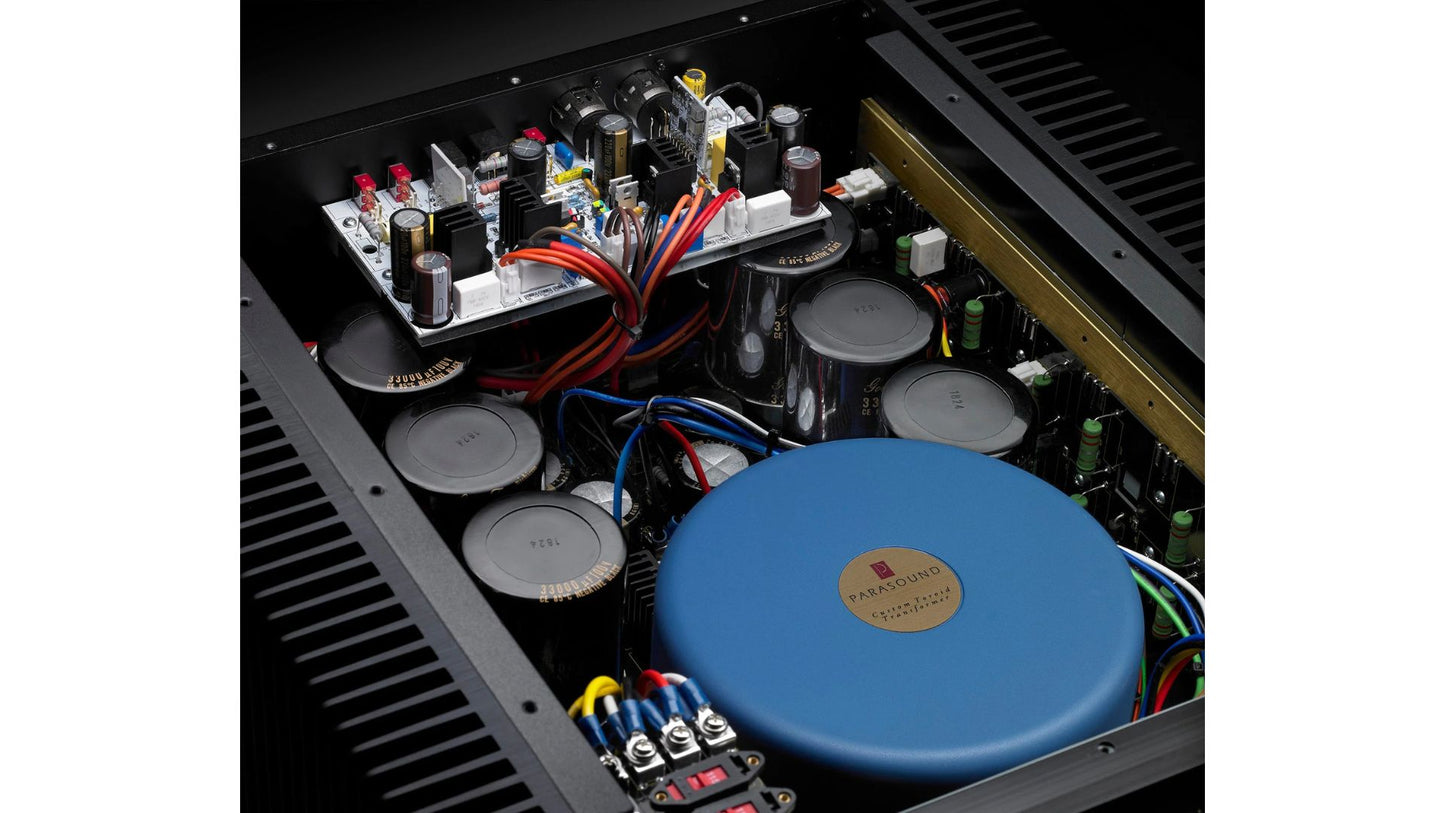
The Input Transistors and Output Stage. The input stage uses hand-matched complementary pairs of Toshiba 2SJ74 P-channel and 2SK170 N-channel JFETs — the same devices used in the JC 1 and the JC 5. Toshiba discontinued these transistors, and no device currently in production matches their combination of ultra-low noise and favorable small-signal characteristics. Parasound invested specifically to secure a substantial stock of matched pairs to sustain JC1+ production. The output stage uses 24 Sanken high-voltage, high-current bipolar transistors — 33% more than the 18 used in the original JC 1 — producing 180 amperes of peak current, compared to the 90 amperes of the JC 5. The output stage filter capacitance is 198,000 µF using six 33,000 µF Nichicon Gold Tune capacitors, compared to 132,000 µF in the JC 5.
The Power Supply Architecture
The JC1+'s power supply architecture follows and extends the independent-stage supply philosophy established in the JC 1 and continued in the JC 5. The input stage has its own completely independent power supply with a dedicated R-core transformer — chosen for its superior noise rejection versus toroidal designs at high frequencies — and 22,400 µF of filter capacitance delivering ±112V DC rail voltage. This supply is maintained independently of the main power supply regardless of output stage current demand, preventing any modulation of input stage operating voltage by output stage load currents. The main output stage is backed by a 2.4 kVA power transformer with independent secondary windings per channel and 198,000 µF of Nichicon Gold Tune filter capacitance. The 2.4 kVA rating is 26% larger than the transformer in the original JC 1 — the single biggest factor in the increased power output and peak current figures.
Practical Features for Real Installations
The JC1+ includes a two-position gain switch (29 dB normal / 23 dB low) that provides meaningful flexibility in matching the amplifier's sensitivity to different preamplifiers and speaker efficiencies. Very high-gain preamplifiers paired with efficient speakers can produce too much gain at the system level, compressing the useful range of the volume control and elevating noise. The 23 dB position addresses this directly. A staggered turn-on delay circuit prevents electrical overload when powering multiple amplifiers simultaneously — relevant when operating a stereo pair, which requires careful attention to startup sequence in systems without a master power management controller. The CHK Infinium speaker binding posts accept spade lugs up to 16mm wide, banana plugs, or bare wire up to 5 AWG — a wire gauge rarely accommodated by competing binding posts. The Neutrik locking XLR balanced input connectors provide a secure, keyed connection that does not accidentally disengage. Vampire gold-plated RCA jacks are provided for unbalanced inputs and loop outputs for bi-amping configurations.
How It Compares: JC 1+ vs. JC 5 and the Original JC 1
The Parasound Halo JC 5 is the stereo amplifier immediately below the JC1+ in the Halo lineup. It uses the same Toshiba JFET input devices and the same JFET-MOSFET-bipolar three-stage circuit topology, but with a single-stage rather than cascode driver, no Bybee Music Rails, conventional FR4 rather than FR408 circuit boards, 24 output transistors per chassis rather than 24 per monoblock channel, and 132,000 µF of output stage capacitance versus 198,000 µF per JC1+. The JC 5 delivers 90 amperes of peak current per channel versus the JC1+'s 180. Two JC1+ monoblocks represent a categorically different level of engineering investment than one JC 5 — they cost substantially more, occupy two chassis, generate more heat, and require more careful installation. For a system whose speakers and resolution genuinely reveal the difference, that investment is fully justified. For most serious listening systems, the JC 5 is excellent. The JC1+ is what comes after excellent.
The original Halo JC 1 was in production from 2003 until the JC1+'s arrival. The JC1+ surpasses it in every measured dimension: more power, more current, a new cascode driver, Bybee Music Rails, FR408 boards, 33% more output transistors, a larger transformer, and more filter capacitance. Owners of the original JC 1 considering an upgrade will find the JC1+ represents a genuine advancement rather than an incremental revision.
Key Specifications
- Type: Monoblock power amplifier (sold individually; pair required for stereo)
- Topology: Ultra-high-bias Class A/AB, direct-coupled, fully discrete
- Power Output (0.15% THD, both conditions 20 Hz–20 kHz): 450W into 8Ω; 850W into 4Ω; 1,300W into 2Ω
- Class A Output: 25W (bias switch high); 10W (bias switch low)
- Peak Current: 180A
- Frequency Response: 2 Hz–120 kHz (+0/−2 dB)
- THD at Full Power: <0.15%
- THD at Typical Listening Levels: <0.02%
- S/N Ratio: >122 dB (IHF A-weighted)
- Damping Factor: >1,200 at 20 Hz
- Gain: 29 dB (normal) / 23 dB (low) — rear panel switch
- Input Impedance: 33 kΩ (unbalanced); 66 kΩ (balanced)
- Driver Stage: New John Curl two-stage cascode circuit; superior open-loop bandwidth and linearity
- Input Transistors: Hand-matched Toshiba 2SJ74 P-channel and 2SK170 N-channel JFETs (discontinued; Parasound-stockpiled matched pairs)
- Output Transistors: 24 Sanken 15A/230V high-voltage/high-current bipolar transistors
- Circuit Board Material: FR408 (input and driver stages) — aerospace/supercomputer-grade
- Noise Filtering: Bybee Music Rails (active high-frequency supply noise filtering) — first commercial audio product use
- Input Stage Power Supply: Independent; dedicated R-core transformer; ±112V DC rails; 22,400 µF filter capacitance; high-speed/soft-recovery diodes
- Output Stage Power Supply: 2.4 kVA R-core transformer with independent secondary windings; 198,000 µF Nichicon Gold Tune filter capacitance (six 33,000 µF capacitors)
- Inputs: Neutrik locking balanced XLR; Vampire 24k gold-plated RCA
- Loop Outputs: Neutrik locking XLR; Vampire 24k gold-plated RCA
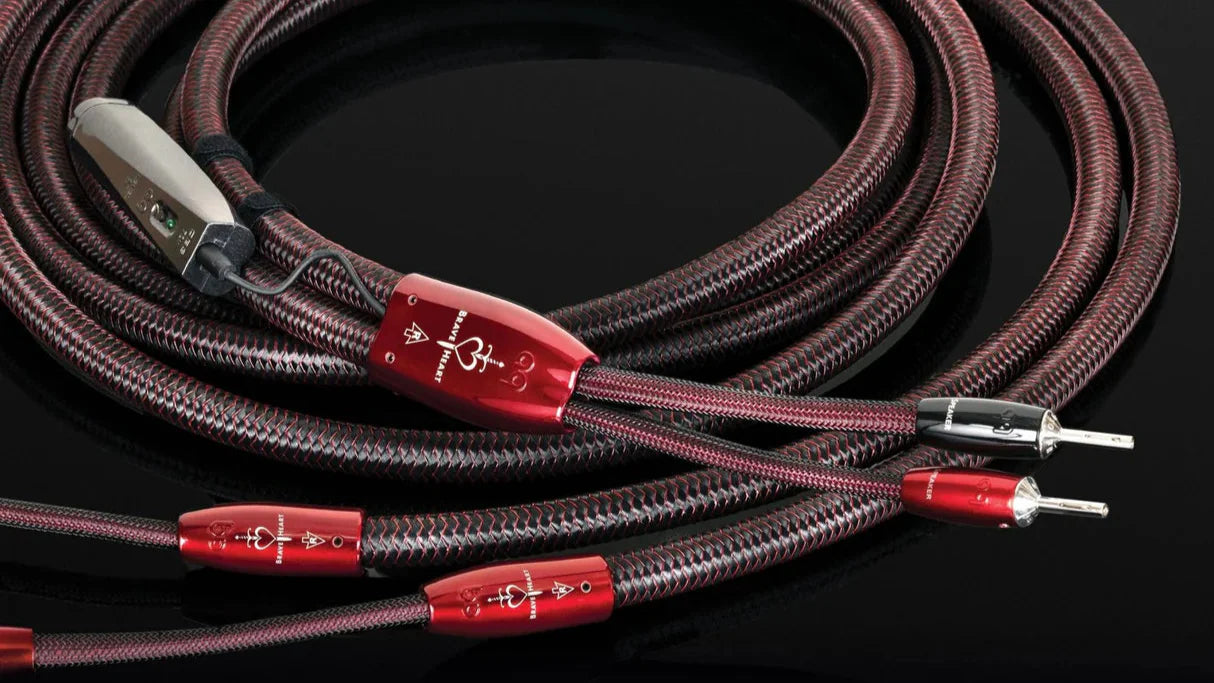
- Speaker Outputs: Dual sets of CHK Infinium 5-way binding posts (accepts spade lugs to 16mm, banana plugs, bare wire to 5 AWG)
- Trigger: 12V in; staggered turn-on delay for multi-unit installations
- Protection: DC servo, relay speaker protection, thermal management, soft-start inrush suppression
- Dimensions: 17.6"W × 7.75"H × 20"D
- Weight: 83 lbs (37.6 kg) per unit; 107 lbs (45.4 kg) shipping weight per unit
- Finish: Black
- Warranty: 5 years parts and labor (Parasound USA)
Why Buy From All Elite Audio
All Elite Audio is an authorized Parasound dealer, and the JC1+ is the amplifier we discuss most carefully with customers who have arrived at the top of their system-building journey. A purchase at this level involves real questions about installation — ventilation requirements, preamp gain matching, whether the bias switch position is right for your speakers, how to manage the startup sequence for a stereo pair. We know the full JC series from top to bottom and can walk through all of it before you decide. This is not a component to buy without a conversation first, and we are glad to have that conversation.
Call 443-402-5055, text 443-402-5064, or visit us at 1921 York Rd, Timonium, MD 21093.
Frequently Asked Questions
Why is the JC 1+ sold individually, and how many do I need?
The JC1+ is a monoblock amplifier — each unit amplifies a single audio channel. To drive a stereo pair of speakers, you need two units: one for the left channel and one for the right. This architecture is the highest-performing way to build a power amplification system because each channel has its own entirely independent chassis, power supply, transformer, and output stage with no physical or electrical interaction between channels. Inter-channel crosstalk, ground loop interaction, and power supply coupling between channels — all unavoidable in a stereo chassis — are eliminated. The cost and physical complexity of two separate units is the price of that isolation. All Elite Audio can supply a matched pair and will confirm that both units are from the same production run.
What is the Bybee Music Rails technology, and why does it matter?
Bybee Music Rails are a patented active noise filtering technology invented by Jack Bybee in collaboration with John Curl and circuit board designer Carl Thompson. They are installed on the power supply rails feeding the input stage, where they perform active high-frequency filtering. The problem they address is real: power supply rails always carry some residual high-frequency noise, and that noise modulates the operating point of the input transistors in ways that introduce low-level correlated noise products — a subtle hardness and reduced transparency that conventional passive capacitor filtering cannot fully eliminate. Music Rails address the noise at the rail itself, before it reaches any active device. The JC1+ is the first commercial audio product ever to incorporate this technology. Carl Thompson designed dedicated circuit boards for the JC1+'s Music Rails specifically to optimize their effect within this amplifier's topology.
What is a cascode driver stage and how does it improve on the JC 1's single-stage driver?
The original JC 1 used a single-stage driver circuit — excellent by any standard, but limited in open-loop bandwidth and input-output isolation. The JC1+'s driver uses two transistors stacked in a cascode configuration: the input device operates at a near-fixed voltage while the upper device handles current amplification. This arrangement gives the driver stage properties that more closely resemble a vacuum tube stage: higher input impedance, higher output impedance, better input-output isolation, and substantially greater bandwidth. More bandwidth in the driver means less feedback is required to control distortion, and less feedback means more natural, linear behavior under dynamic conditions. John Curl described this upgrade as producing a noticeable improvement in sound quality — praise that carries weight given his engineering standards.
What is FR408 and why does it matter for audio circuit boards?
FR408 is a high-performance glass-epoxy laminate developed for ultra-high-speed digital applications in supercomputers and aerospace electronics. Standard audio circuit boards use FR4, which has adequate properties for most applications but begins to show dielectric losses at higher frequencies. FR408 has dramatically superior high-frequency propagation characteristics — signals traveling on the board between stages are preserved more accurately, and the dielectric losses that can subtly smear fast transients in FR4 are essentially eliminated. Carl Thompson, who has designed the circuit boards for every JC-series product, specified FR408 for the JC1+'s input and driver stage boards after evaluating it against all available alternatives. The boards are also shielded to isolate them from internal electromagnetic fields within the chassis.
What is the Toshiba 2SJ74 / 2SK170 JFET pair and why did Parasound stockpile them?
The 2SJ74 and 2SK170 are complementary P-channel and N-channel JFET transistors that Toshiba manufactured and subsequently discontinued. They are regarded by serious amplifier designers as the finest devices ever produced for audio input stages, with an unmatched combination of ultra-low noise, favorable small-signal behavior, and consistent matching characteristics. When Toshiba stopped making them, the supply of tested and matched pairs began to decline. Parasound, having used them in both the JC 1 and JC 5, made the decision to invest in securing a substantial stock of matched pairs specifically to sustain JC1+ production into the foreseeable future. Substituting a different JFET type would require redesigning the input stage to accommodate the new device's different characteristics — a path Parasound declined because the result would not be the same amplifier.
How does the JC 1+ compare to the Parasound Halo JC 5?
Both amplifiers use the Toshiba JFET input devices and the three-stage discrete topology that John Curl developed for the Halo series. The JC1+ adds the cascode two-stage driver, Bybee Music Rails, FR408 circuit boards, 180 amperes of peak current versus 90 amperes, 24 output transistors per monoblock versus 24 per stereo chassis (effectively 12 per channel in the JC 5), 198,000 µF of output stage capacitance versus 132,000 µF, and the complete isolation of a monoblock architecture. The JC 5 is a superb amplifier. The JC1+ represents a substantially greater engineering investment at every level of the signal chain and power supply. Whether the difference is audible in your system depends on your speakers, your room, your preamplifier, and your listening habits — which is a conversation worth having with us before you decide.
What do the gain switch positions mean, and which should I use?
The JC1+ has a two-position gain switch accessible on the rear panel: 29 dB (normal) and 23 dB (low). The 29 dB position is correct for most systems — it matches the sensitivity of the original JC 1 and the JC 5. The 23 dB position is provided for systems where the preamplifier has very high output voltage or gain, or where the speakers are exceptionally efficient (typically above 95 dB/W/m). In such systems, the combined gain of the preamp and amp may result in only a small usable range of the volume control before the system reaches very loud levels, which can also raise the noise floor. Switching to 23 dB reduces the amplifier's input sensitivity, spreading the useful volume range and lowering system noise. If you are unsure which position is right for your preamplifier and speakers, we can help you determine the correct setting before installation.
What are the heat and ventilation requirements for a pair of JC 1+ amplifiers?
Each JC1+ runs warm due to its high-bias Class A operation. In the high-bias position (25 watts Class A), the amplifier generates substantially more heat than a standard Class AB amplifier. Parasound recommends adequate open space above, behind, and on both sides of each unit for convection cooling — enclosed cabinet installations without forced air circulation are not appropriate. At a minimum, allow six inches of clearance above each unit and do not stack anything on top of them. Some owners prefer purpose-built amplifier stands that allow air to circulate around the chassis freely. If you are planning a custom installation or equipment rack, we are glad to discuss ventilation requirements before you finalize the design.
What preamp pairs best with the JC 1+?
The natural reference pairing within the Parasound JC series is the JC 2 BP — John Curl's fully balanced dual-mono preamplifier with hand-matched FETs, a DC-coupled signal path, four-gang motorized volume control, and output impedance below 60 ohms. The JC 2 BP and JC1+ together form a complete JC-series reference system. The JC 2 BP's gain is well-matched to the JC1+'s normal (29 dB) gain setting in most systems. The Halo P6 is a more affordable alternative that adds a DAC, phono stage, and bass management at the cost of the JC 2 BP's purity of signal path. For owners arriving at the JC1+ from a different preamp brand, the JC1+'s balanced XLR inputs — Neutrik locking connectors — will interface correctly with any quality balanced preamplifier.
What protection circuits does the JC 1+ include, and how does the staggered turn-on work?
The JC1+ incorporates DC servo speaker protection, relay-based soft-start inrush suppression, and thermal management. The staggered turn-on delay is a practical feature for multi-unit installations: when powering a stereo pair, both amplifiers should ideally not draw their startup inrush current simultaneously, as the combined surge can trip breakers or stress the AC line. The JC1+'s staggered turn-on circuits introduce a delay between the time the power switch is engaged and the time the amplifier draws full current, and the two units in a stereo pair have slightly different delay timings to spread the startup load across a brief interval. This is particularly relevant in systems that do not use a master power sequencer and are simply switched on at the wall.
Where can I buy the Parasound Halo JC 1+ and discuss the purchase?
All Elite Audio at 1921 York Rd, Timonium, MD 21093 is an authorized Parasound dealer with the JC1+ in stock. A purchase at this level genuinely benefits from a conversation before committing — we can discuss your preamplifier, your speakers' efficiency and impedance characteristics, the gain switch setting, installation and ventilation requirements, and whether the JC1+ or the JC 5 is the right choice for your specific system. Purchasing from an authorized dealer ensures full factory warranty coverage and factory service access for the life of the product. Call 443-402-5055, text 443-402-5064, or visit us in person.