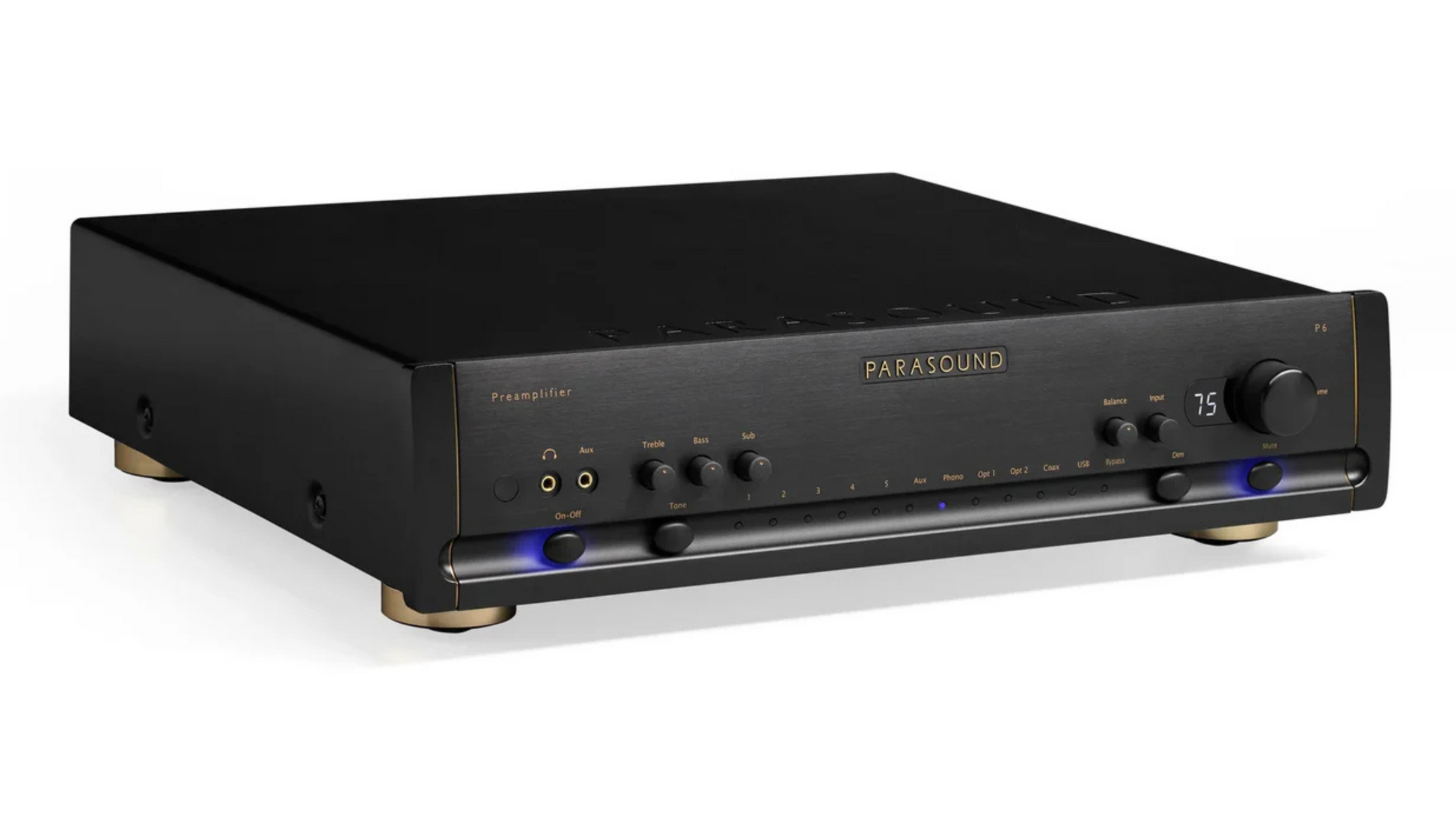
Parasound
Parasound HALO P6 Preamplifier
Parasound HALO P6 Preamplifier
Couldn't load pickup availability
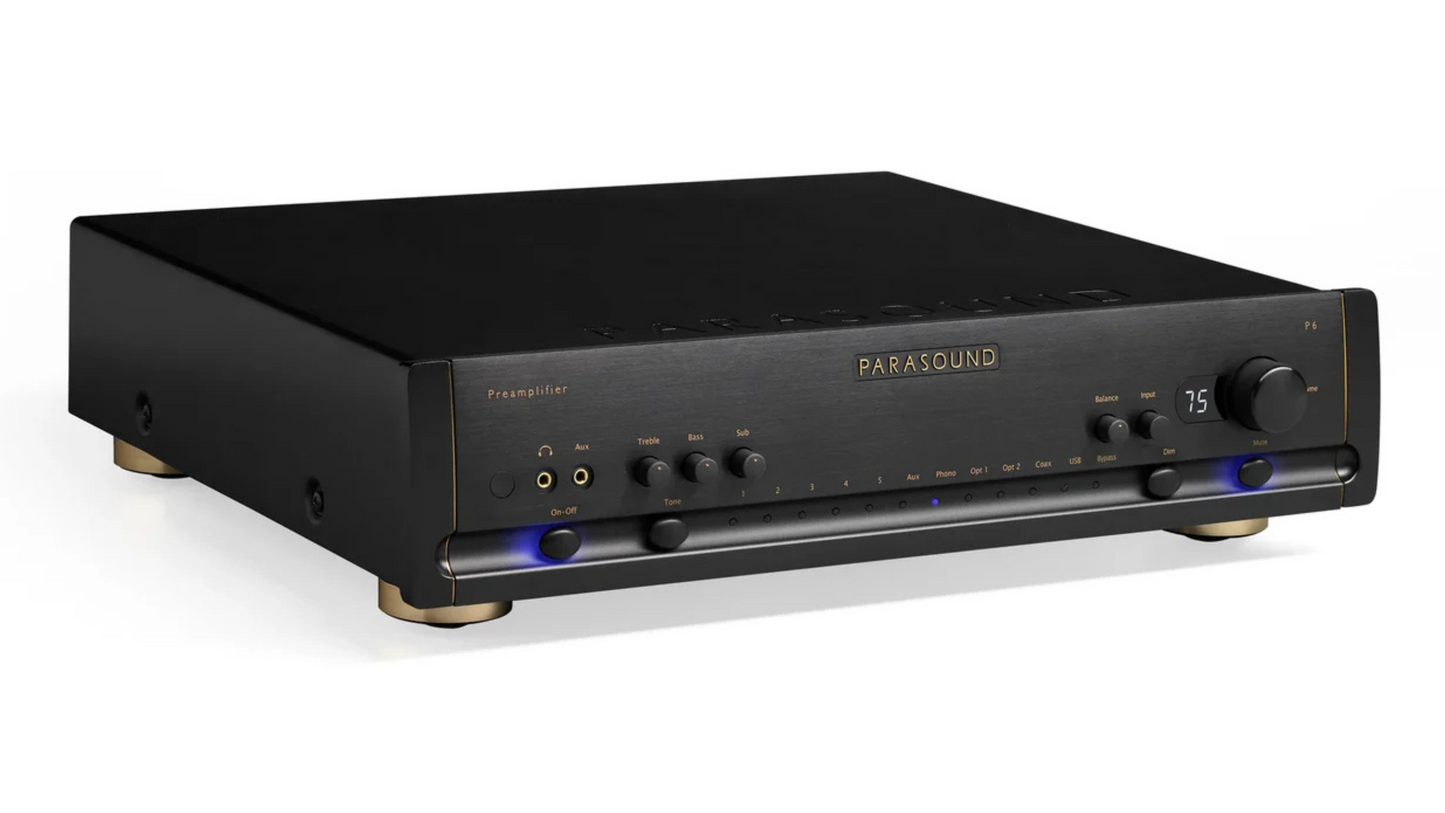
Parasound Halo P6 2.1-Channel Preamplifier and DAC
The Swiss Army knife of the Halo lineup — a full-featured, audiophile-grade stereo preamplifier that incorporates a reference ESS Sabre32 DAC, MM/MC/MI phono stage, analog bass management, and a dedicated headphone amplifier in a single, compact chassis.
What It Is and Who It's For
The Parasound Halo P6 is a 2.1-channel stereo preamplifier and DAC built for listeners who want a single, serious component to serve as the control center of a complete audio system — analog, digital, vinyl, and subwoofer integration all handled with equal competence. It is the successor to the Halo P5, one of Parasound's most popular products, and it improves on it in every measurable way.
This is the right preamplifier for a wide range of buyers. The listener building a separates system around a Parasound power amplifier — an A23+, an A21+, or the JC 5 — will find the P6 a natural and extraordinarily capable pairing that leaves nothing missing. The home theater enthusiast who also listens seriously to music will find its Home Theater Bypass implementation makes dual-use integration genuinely seamless. The vinyl listener will find a built-in phono stage that is good enough to make them think twice about whether they need a dedicated external unit. The person who streams high-resolution audio or has a large library of DSD files will find DAC support that reaches 384 kHz/32-bit PCM and native DSD256 over USB — formats that most standalone DACs in this price range do not reach.
What the P6 is not is a minimalist, purist line stage. If you have a separate DAC you love and a separate phono stage you love and all you want is the cleanest possible gain stage in between, the JC 2 BP is the conversation to have. The P6 is for the listener who wants everything done correctly in one place, at a price that would be impossible to match by assembling equivalent separate components.
Engineering: Every Feature Done Right
The most important thing to understand about the P6 is that its feature count does not come at the expense of its core function. This is, first and foremost, a preamplifier — a low-noise, low-distortion gain stage with a well-implemented volume control. Every additional function is layered on top of that foundation without compromising it.
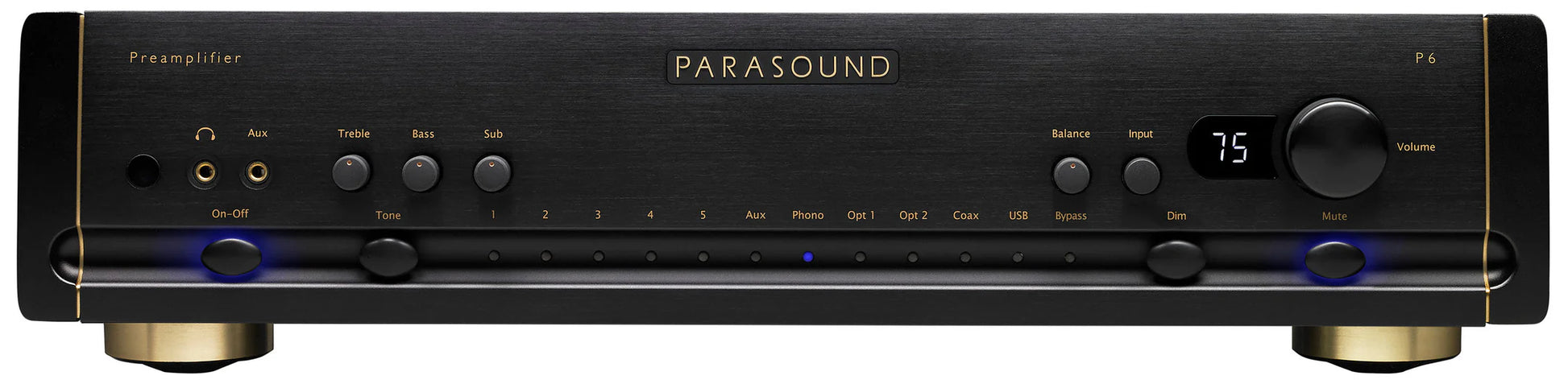
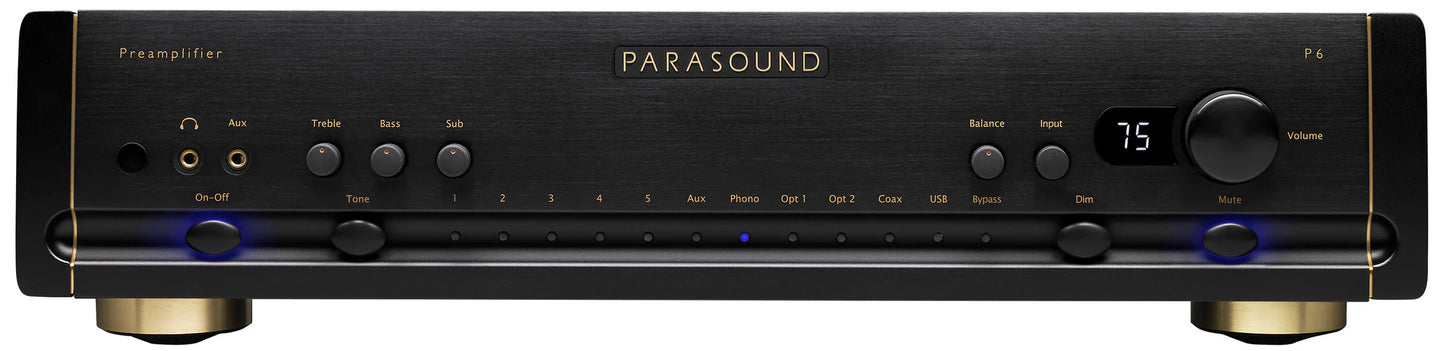
The volume control is a Burr-Brown analog resistor-ladder design, and it matters more than it might seem. Most volume controls — even in expensive equipment — use a mechanical potentiometer, which introduces varying channel imbalance at low levels and degrades over time as the wiper contact wears. The P6's resistor-ladder control uses precision fixed resistors selected by a digitally controlled switch. The analog signal itself passes through the resistor; the digital control logic simply chooses which resistor is in the path. The result is perfectly matched channel balance at every volume position, long-term reliability, and an audio-log taper that provides finer adjustments in the middle of the dial — exactly where critical listening happens. The volume knob itself is solid aluminum, supported on ball bearings, and feels like what it is: a precision mechanical interface on a serious component.
The DAC section is built around the ESS Sabre32 Reference ES9018K2M chip, paired with a Savitech SA9227 USB 2.0 controller. USB supports up to 384 kHz/32-bit PCM and native DSD64, DSD128, and DSD256, as well as DSD over PCM at 384 kHz. Coaxial and optical digital inputs accept up to 192 kHz/24-bit PCM. The ESS Sabre32 architecture is well-regarded for its very low noise floor and high dynamic range, and in the P6 it is implemented in a way that reviewers have consistently positioned above similarly priced standalone DACs. This is not a budget chip added to check a box — it is a genuinely capable converter that most buyers will not feel compelled to bypass.
The phono stage supports Moving Magnet, Moving Coil, and Moving Iron cartridges. MM loading is fixed at 47 kΩ with 38 dB of gain, which is standard and correct for the vast majority of MM and MI cartridges. MC loading is switchable between 100 Ω and 47 kΩ with 52 dB of gain — enough for most high-output and moderate-output moving coil cartridges, though buyers running very low-output MC cartridges (below 0.3 mV) will likely want a dedicated external phono stage for the additional gain margin. The P6's phono section is a genuine upgrade from its P5 predecessor, with improved gain tracking, better channel separation, and measurably lower noise. It is good enough that a meaningful percentage of P6 owners who intended to add an outboard phono stage decide they do not need to.
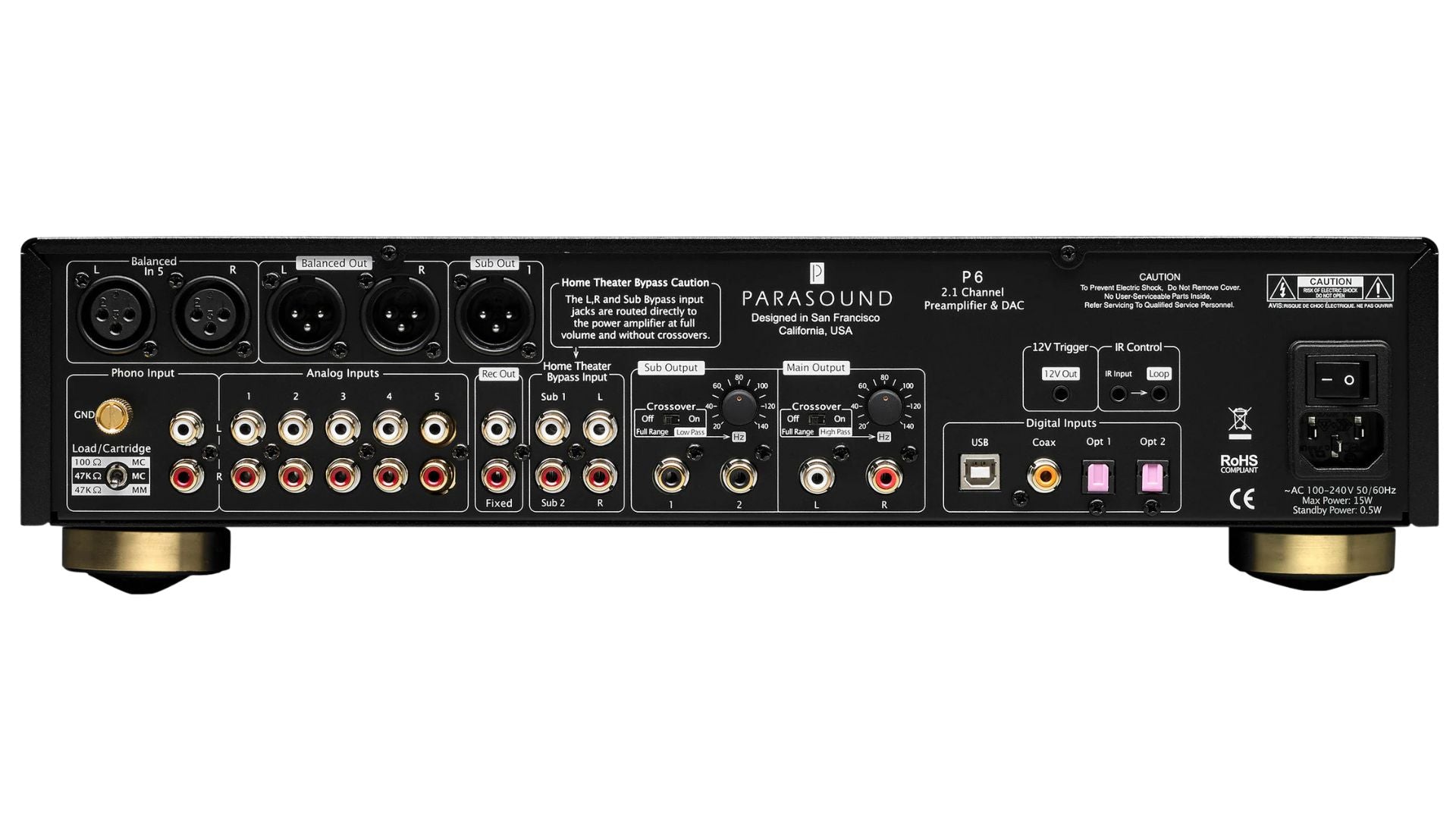
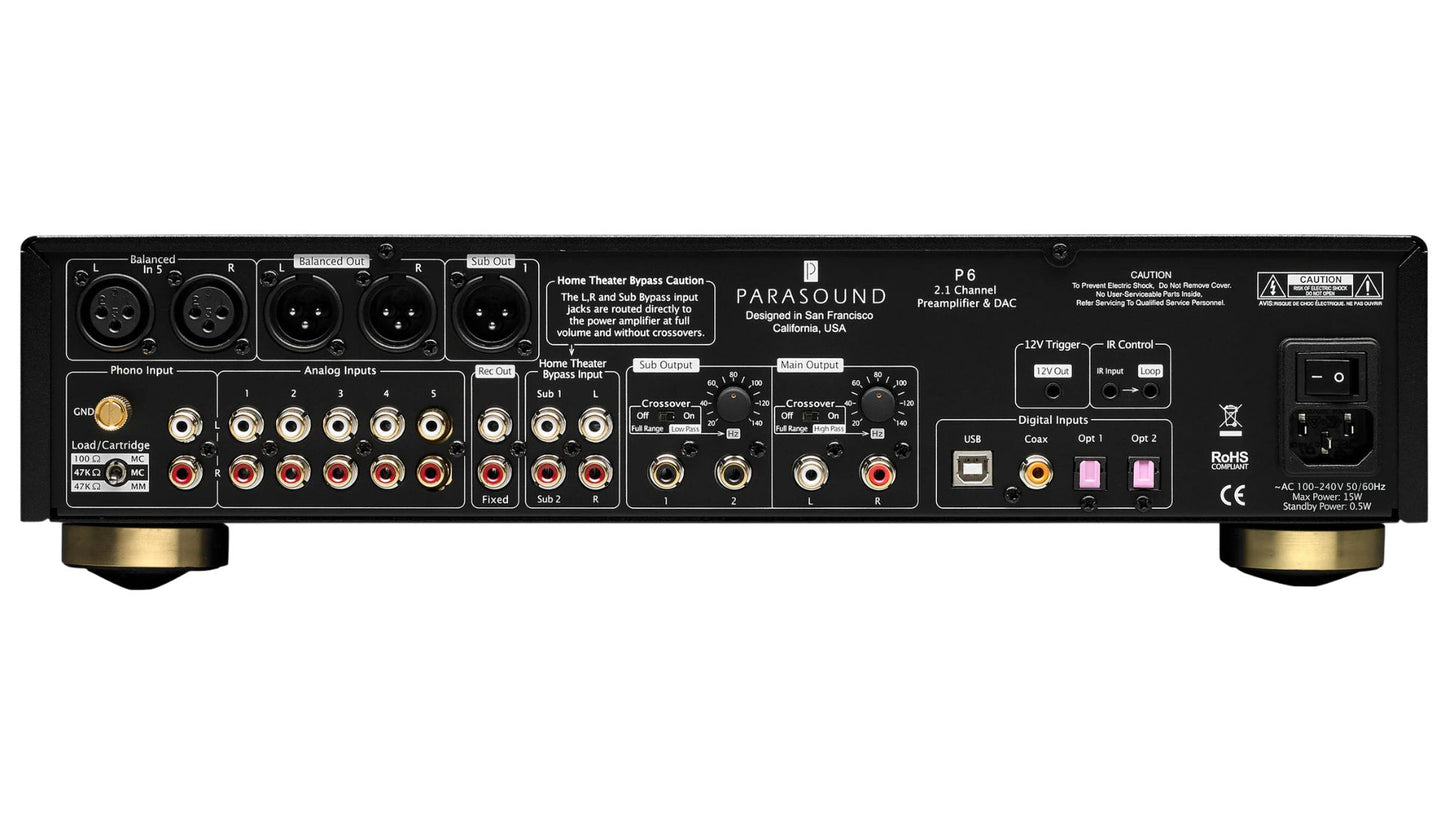
The bass management system is one of the P6's most underappreciated features, and it is implemented in the analog domain — not digitally, which would introduce latency and conversion artifacts. The P6 provides independent high-pass and low-pass filters at a 12 dB/octave slope, allowing you to cross the main speakers over to a subwoofer at the correct frequency without compromising the signal to either. The subwoofer output level is adjustable from the front panel, and there are both XLR balanced and dual RCA unbalanced subwoofer outputs. For a listener running a 2.1 system — which is an extremely common configuration in serious two-channel listening rooms — this means the P6 handles a function that would otherwise require either a separate active crossover or an AV processor in the chain.
The headphone amplifier is built around the Texas Instruments TPA6120A high-current integrated circuit, which delivers the current necessary to drive low-impedance headphones without compression or hardening. Output impedance is 10 ohms. This is not an afterthought headphone output — it is a dedicated amplification stage that handles itself well with a broad range of headphones and is meaningfully better than the headphone outputs on most integrated amplifiers.
The front panel also includes a 3.5mm auxiliary input with 12 dB of additional gain — a practical feature that adds enough level to bring the output of a phone, tablet, or media player up to standard line level without forcing the volume control toward its maximum.
How It Compares: P6 vs. HINT 6 and JC 2 BP
The Parasound Halo HINT 6 integrated amplifier shares the P6's DAC section, phono stage, and resistor-ladder volume control, and adds a 160-watt-per-channel power amplifier. If you want everything in one chassis and do not have strong feelings about a specific power amplifier, the HINT 6 is the more practical solution. The P6 is the right choice when you already own or plan to buy a dedicated power amplifier — the A23+, A21+, or something from another brand — because separating the preamp from the amplifier gives each component its own power supply and chassis isolation, which benefits noise and dynamic performance.
The Parasound Halo JC 2 BP is the reference preamplifier in the Halo lineup, designed by John Curl with hand-matched FETs, a DC-coupled signal path with no capacitors in the audio chain, a four-gang motorized volume control, and dual-mono construction throughout. It does not have a DAC, phono stage, or headphone amplifier — it is a pure line stage built without compromise. The JC 2 BP is the right choice for the listener who has dedicated external components for every function and wants the best possible pure gain stage between them. The P6 is the right choice for the listener who wants everything done at a high level in one place, with room to grow.
Key Specifications
- Type: 2.1-channel stereo preamplifier with DAC, phono stage, and headphone amplifier
- Frequency Response: 10 Hz–100 kHz (+0/−3 dB); 20 Hz–20 kHz (+0/−0.5 dB)
- THD: <0.01%
- Interchannel Crosstalk: >70 dB at 20 kHz; >78 dB at 1 kHz
- S/N Ratio — Line Inputs: >108 dB (IHF A-weighted); >88 dB (unweighted)
- S/N Ratio — DAC Inputs: >108 dB (IHF A-weighted)
- S/N Ratio — Phono MM: >80 dB (IHF A-weighted); >70 dB (unweighted)
- S/N Ratio — Phono MC: >67 dB (IHF A-weighted); >55 dB (unweighted)
- Preamplifier Gain: 10 dB
- Maximum Output: 7.5V
- Input Impedance: Unbalanced 24 kΩ; Balanced 100 kΩ per leg
- Output Impedance: Unbalanced 100 Ω; Balanced 470 Ω per leg
- Volume Control: Burr-Brown analog resistor-ladder, digitally controlled
- Phono Stage — MM: 38 dB gain / 47 kΩ loading (MM, MI compatible)
- Phono Stage — MC: 52 dB gain / 47 kΩ or 100 Ω loading (switchable)
- DAC Chip: ESS Sabre32 Reference ES9018K2M
- USB Controller: Savitech SA9227, 384 kHz/32-bit
- USB Input: Up to 384 kHz/32-bit PCM; native DSD64/128/256; DSD over PCM at 384 kHz
- Coaxial/Optical Inputs: Up to 192 kHz/24-bit PCM
- Headphone Amplifier: Texas Instruments TPA6120A; output impedance 10 Ω
- Crossover (Bass Management): 12 dB/octave high-pass and low-pass, analog
- Subwoofer Outputs: 1× XLR balanced + 2× RCA unbalanced
- Main Outputs: 1 pair XLR balanced + 1 pair RCA unbalanced
- Inputs: 5 line-level unbalanced RCA; 1 balanced XLR; 1 USB-B; 2 optical; 1 coaxial; 1 front-panel 3.5mm auxiliary
- Home Theater Bypass: Yes
- 12V Trigger: In and out
- RS-232: Yes
- Power Consumption: 15W (on); 0.5W (standby)
- Voltage: 100–250 VAC, 50/60 Hz (auto-switching)
- Dimensions: 17¼"W × 4⅛"H × 15"D (437 × 105 × 381 mm)
- Weight: 14 lbs (6.3 kg)
- Finish: Black
- Warranty: 3 years parts and labor (Parasound USA)
Why Buy From All Elite Audio
All Elite Audio is an authorized Parasound dealer, and the P6 is a component we know well — it pairs with nearly everything in our lineup and we have helped a great many customers configure it correctly for their specific systems. Whether you are integrating a subwoofer for the first time, adding a turntable, or building out your first serious separates system, the P6 raises questions worth talking through before you buy. We are glad to have that conversation.
Call 443-402-5055, text 443-402-5064, or visit us at 1921 York Rd, Timonium, MD 21093.
Frequently Asked Questions
What exactly does the Parasound Halo P6 do, and does it replace multiple components?
The P6 is a preamplifier — the control center and gain stage that sits between your sources and your power amplifier. It takes every source you own (turntable, streaming device, CD player, TV, phone), lets you switch between them, controls the volume, and routes the signal to the amplifier and speakers. The P6 goes well beyond a basic preamp by incorporating a high-quality ESS Sabre32 DAC for digital sources, an MM/MC/MI phono stage for vinyl, a dedicated headphone amplifier, and a fully analog bass management system for subwoofer integration. For most listeners, it effectively replaces a standalone DAC, a standalone phono stage, and a headphone amp — all in a single chassis at a price that would be very difficult to match by buying those components separately.
What is Home Theater Bypass and why does it matter?
Home Theater Bypass is a mode where one input on the P6 passes the signal directly through to the main outputs at a fixed, unity gain — bypassing the volume control entirely. This matters for listeners who use the P6 in a dual-use system alongside an AV processor or surround receiver. In normal stereo use, the P6 controls the volume for two-channel music. When watching a movie, the surround processor takes control and passes its front-channel output through the P6's HT Bypass input at a fixed level, so the surround volume control works correctly without the P6 fighting it. The result is a system that handles serious two-channel music through a proper analog preamp and switches seamlessly to home theater without requiring any rewiring or workarounds.
How good is the built-in phono stage, and do I need a separate phono preamplifier?
The P6's phono stage is a genuine strength of the design — it is not a convenience feature added as an afterthought. It supports MM, MC, and MI cartridges, with 38 dB of gain and 47 kΩ loading for moving magnet, and 52 dB of gain with switchable 100 Ω or 47 kΩ loading for moving coil. Signal-to-noise ratio is better than 80 dB A-weighted for MM, which is competitive with standalone phono stages at two and three times this unit's total price. Most buyers using MM cartridges or moderate-output MC cartridges will find the P6's phono stage fully satisfying. Buyers running very low-output moving coil cartridges (below 0.3 mV) who want additional gain headroom and independent per-channel loading control may want to consider a dedicated external phono stage such as the Parasound JC 3+.
What is the resistor-ladder volume control and why is it better than a standard potentiometer?
A conventional potentiometer volume control uses a mechanical wiper that slides along a resistive track — it is inherently prone to channel imbalance at low settings (the left and right channels track slightly differently), it generates a small amount of noise as the wiper moves, and it degrades over years of use as the track wears. The P6 uses a Burr-Brown analog resistor-ladder design instead: the signal passes through precision fixed resistors selected by a digital switch, with no moving mechanical contact in the audio path. The result is perfectly matched channel balance at every volume position, no tracking noise, and no long-term mechanical wear. Parasound also programmed an audio-log taper that gives finer volume steps in the middle of the control's range — exactly where most critical listening happens — so you have real resolution at the levels you actually use.
What DAC formats does the P6 support, and what digital inputs does it have?
Via USB, the P6 supports PCM audio up to 384 kHz/32-bit and native DSD in DSD64, DSD128, and DSD256 formats, as well as DSD over PCM at 384 kHz. USB connects the P6 directly to a computer or a USB audio device without needing an external interface. Coaxial and optical digital inputs accept PCM up to 192 kHz/24-bit. There are two optical inputs and one coaxial input, giving you flexibility to connect a CD transport, television, streaming device, and computer simultaneously. The ESS Sabre32 Reference chip used in the P6 is the same platform found in dedicated DACs at substantially higher prices, and its implementation here has been praised by reviewers who connected it to reference-quality external DACs for direct comparison.
How does the P6 compare to the Parasound Halo HINT 6 integrated amplifier?
The HINT 6 and P6 share the same DAC section, phono stage, and resistor-ladder volume control — they are built from the same audio platform. The HINT 6 adds a 160-watt-per-channel Class A/AB power amplifier, making it a complete integrated system in one chassis. The P6 is the right choice when you want the flexibility to pair your preamplifier with a specific power amplifier — whether that is the Parasound A23+, A21+, or an amplifier from another brand — because separating the preamp and amplifier gives each its own dedicated power supply and chassis isolation, which benefits noise performance and long-term flexibility. The HINT 6 is the right choice when simplicity matters and you want a single high-performance box.
How does the bass management work, and do I need it for a subwoofer?
The P6's bass management system is fully analog — it uses 12 dB/octave high-pass and low-pass crossover filters implemented in the analog domain, not digitally processed. You set a crossover frequency, and the P6 rolls off the deep bass from the signal to the main speakers (high-pass) while simultaneously routing the low-frequency content to the subwoofer output (low-pass). The subwoofer output level is adjustable from the front panel without going into a menu. There are both XLR balanced and dual RCA unbalanced subwoofer outputs. You do not need the bass management system to use a subwoofer with the P6 — you can also run the subwoofer off its own LFE input from an AV processor in an HT Bypass setup — but for pure two-channel listeners who want correct crossover integration, the analog bass management is a significant advantage over systems that rely on digital signal processing for this function.
Can I use the P6 with any power amplifier, or does it need to be a Parasound amp?
The P6 works with any power amplifier that accepts line-level inputs, regardless of brand. It has both balanced XLR and unbalanced RCA main outputs, which cover virtually every power amplifier available. The natural pairing within Parasound is the A23+ or A21+, and those combinations have been praised in numerous reviews for their synergy — they are designed to work together and share an aesthetic and engineering philosophy. But the P6 is a genuinely neutral and transparent preamplifier that will perform well with quality amplifiers from other manufacturers. If you are building a system around an existing amplifier or want to pair it with something specific, we are happy to discuss compatibility.
How does the P6 compare to its predecessor, the Halo P5?
The P6 improves on the P5 in several meaningful ways. The DAC is upgraded from a Burr-Brown chip supporting 96 kHz/24-bit PCM to the ESS Sabre32 ES9018K2M supporting 384 kHz/32-bit PCM and native DSD256 — a substantial increase in resolution ceiling. The phono stage gains additional headroom for lower-output MC cartridges, with improved gain tracking and better channel separation than the P5. The front-panel 3.5mm auxiliary input adds 12 dB of gain compared to the P5's standard-level auxiliary input, making phone and tablet connections practical without running the volume near maximum. The cosmetic refresh gives the P6 a cleaner front panel, and the overall build quality reflects the incremental refinements Parasound made after years of feedback on the P5's design.
Where can I buy the Parasound Halo P6 and hear it before I purchase?
All Elite Audio at 1921 York Rd, Timonium, MD 21093 is an authorized Parasound dealer with the P6 in stock. We carry the full Halo line and can demonstrate the P6 in the context of a complete system, with amplifiers and speakers that let you hear what it actually does rather than reading about specifications. If you are building a system from scratch or upgrading an existing one, we can walk you through how the P6 fits alongside the other components you are considering. Call 443-402-5055, text 443-402-5064, or stop in. We ship with full factory warranty coverage for customers outside the Baltimore area.
Outlet Deals
-
Leben CS-600X Integrated Tube Amplifier (Used)
Regular price $7,995.00 USDRegular priceUnit price per$9,995.00 USDSale price $7,995.00 USDSALE -
Meitner Audio MA3i Integrated DAC and Network Streamer (Used)
Regular price $7,995.00 USDRegular priceUnit price per$11,500.00 USDSale price $7,995.00 USDSALE -
Luxman L-507Z Integrated Amplifier (Used)
Regular price $6,995.00 USDRegular priceUnit price per$10,495.00 USDSale price $6,995.00 USDSALE -
HiFi Rose RS520 Streaming Integrated Amplifier (New / Open Box)
Regular price $2,995.00 USDRegular priceUnit price per$3,995.00 USDSale price $2,995.00 USDSALE -
Cambridge Edge W (USED)
Regular price $2,500.00 USDRegular priceUnit price per$5,000.00 USDSale price $2,500.00 USDSALE -
Luxman D-03X CD Player and DAC (Used)
Regular price $2,495.00 USDRegular priceUnit price per$4,000.00 USDSale price $2,495.00 USDSALE


New Releases
-
EverSolo T10 Streaming Transport
Regular price $2,180.00 USDRegular priceUnit price per$2,180.00 USDSale price $2,180.00 USD -
Luxman L-100 CENTENNIAL Pure Class A Integrated Amplifier
Regular price $11,995.00 USDRegular priceUnit price per$11,995.00 USDSale price $11,995.00 USD -
KLH Model Seven Floorstanding Speakers
Regular price $4,999.98 USDRegular priceUnit price per$5,998.00 USDSale price $4,999.98 USDSALE -
REL Acoustics Planar PL-1 Subwoofer
Regular price From $2,499.00 USDRegular priceUnit price per$2,499.00 USDSale price From $2,499.00 USD -
EverSolo DMP-A8 Gen 2 Master Edition -Music Streamer, CD Player, DAC & Preamplifier
Regular price $2,580.00 USDRegular priceUnit price per$2,580.00 USDSale price $2,580.00 USD -
EverSolo DMP-A8 Gen 2 Music Streamer, DAC & Preamplifier
Regular price $1,980.00 USDRegular priceUnit price per$1,980.00 USDSale price $1,980.00 USD