

Parasound
Parasound HALO HINT6 Integrated Amp
Parasound HALO HINT6 Integrated Amp
Couldn't load pickup availability
Parasound Halo HINT 6 Integrated Amplifier
The HINT 6 is what happens when Parasound builds an integrated amplifier the way they build their separates — John Curl's Class A/AB amplifier circuit, an ESS Sabre32 Reference DAC, an MM/MC phono stage, analog bass management, and a dedicated headphone amplifier, all sharing one power supply and one chassis.
(Only available in SILVER)
What It Is and Who It's For
HINT stands for Halo INTegrated, and the name carries weight. This is not a budget-tier integrated amplifier with Halo branding applied for marketing reasons. The HINT 6 is built on the same John Curl amplifier circuit found in Parasound's acclaimed Halo A23+ and A21+ separate power amplifiers, with 160 watts per channel into 8 ohms and 240 watts into 4 ohms, running in the same high-bias Class A/AB topology with the same three-transistor architecture. Around that amplifier, Parasound built a complete preamplifier section with a Burr-Brown analog resistor-ladder volume control, a full-function phono stage, an ESS Sabre32 Reference DAC, analog bass management for subwoofer integration, preamp outputs for adding an external amplifier, and a dedicated headphone amplifier. Stereophile named it a Recommended Component. Positive Feedback called it revelatory. What HiFi called it fun to listen to. These are not contradictory reactions — they are the same amplifier experienced in different contexts.
The buyer this serves well is one who wants a complete, excellent audio system in a single chassis without compromise on any individual function. The listener building their first serious separates-style system but working within a footprint constraint. The person who has outgrown their receiver and wants genuine high-end amplification without the complexity and cable runs of a full separates rack. The music lover who plays records, streams high-resolution audio, occasionally watches films, and wants one component that handles all of it correctly. The HINT 6 fits any of these situations with a seriousness of purpose that most integrated amplifiers at its price never approach.
The Amplifier Section: John Curl's Circuit in an Integrated Chassis
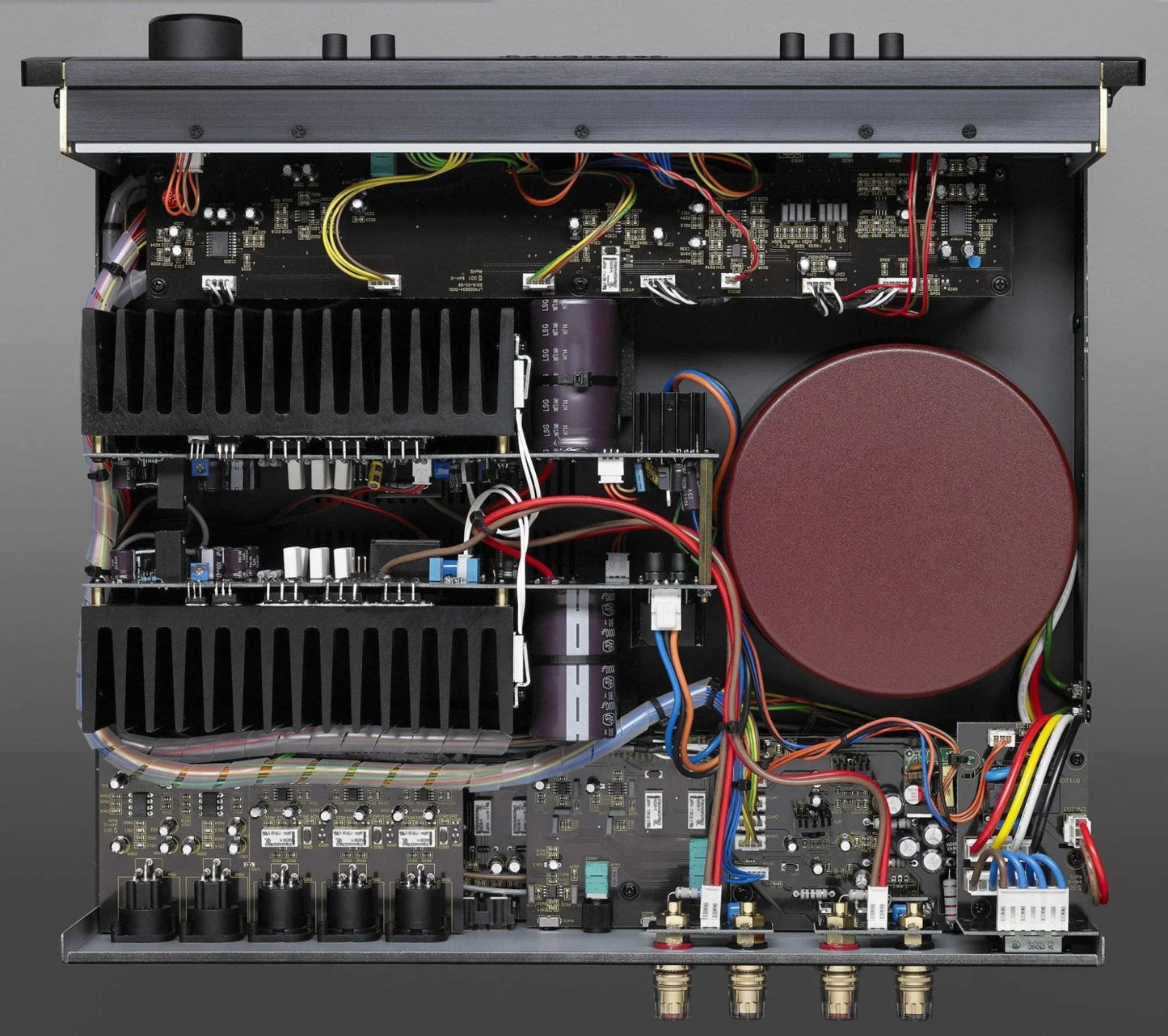
The power amplifier inside the HINT 6 is not a simplified or cost-reduced derivative of the Halo separate power amplifiers. It uses the same JFET input stage, MOSFET driver stage, and bipolar output stage topology — the same three-transistor architecture that defines the sonic character of the A21+ and A23+. The output stage uses 12 high-voltage, high-current bipolar transistors that are beta-matched for symmetry between the positive and negative halves of the audio cycle. The signal path is direct-coupled throughout — no capacitors or inductors in the audio chain between input and speaker terminals.
The power supply behind this circuit is a 1.1 kVA toroidal transformer encapsulated in an epoxy-filled steel canister to eliminate transformer hum and minimize radiated interference. The transformer has independent secondary windings for left and right channels, which reduces inter-channel crosstalk and gives each side its own voltage source under load. Total filter capacitance is 40,000 µF, which gives the output stage the current reserves to deliver 45 amperes of peak current per channel — the figure that determines how confidently the amplifier controls difficult speaker loads during transients. The damping factor exceeds 800 at 20 Hz, providing firm authority over woofer motion.
The amplifier operates in high-bias Class A/AB mode. At average listening levels, the output transistors are biased deep into Class A, meaning both the positive and negative devices are conducting simultaneously with no crossover distortion. At average listening levels, THD measures below 0.01% — a figure that most amplifiers at two or three times this price cannot match. At full rated power, THD is below 0.05%. These numbers matter not because listeners read spec sheets during music, but because they reflect the quality of the bias circuit and the output stage design that produce the clean, fatigue-free character that has defined Halo amplifiers since the original A21.
The Preamplifier Section: Every Feature, Done Properly
The volume control in the HINT 6 is a Burr-Brown electronically controlled analog resistor-ladder array — the same approach used in the standalone Halo P6 preamplifier. The analog signal passes through precision fixed resistors selected by a digital switch; the processor chooses the resistor, never touches the audio. The result is perfect channel tracking at any volume position, including at very low levels where mechanical potentiometers typically degrade. The volume control offers a favorite-volume recall function, accessible from both the front panel and the full-function backlit remote, that returns the amplifier to a saved level with a single button press. The front-panel display shows the current volume position numerically, removing any ambiguity about where the level is set.
The phono stage supports Moving Magnet and Moving Coil cartridges via a three-position selector switch: MM at 47 kΩ with 41 dB of gain, MC at 47 kΩ with 54 dB of gain for high-output cartridges, and MC at 100 Ω with 54 dB of gain for standard-output MC cartridges. This is a genuine phono stage, not a token input, and it represents one of the HINT 6's most practical advantages over integrated amplifiers that omit vinyl support entirely or include only rudimentary MM stages. The phono gain figures were increased over the original HINT to better accommodate lower-output coils, a refinement that matters to anyone running a quality moving coil cartridge.
The bass management system is analog and operates at a 12 dB/octave slope. It provides both high-pass filtering to the main speakers and simultaneous low-pass routing to the subwoofer output, with independent front-panel level control for the subwoofer. Subwoofer connectivity includes one XLR balanced output and two RCA unbalanced outputs, giving flexibility for single or dual subwoofer configurations. Bass and treble tone controls are provided on the front panel with a relay bypass that takes them entirely out of the signal path when engaged — a correct implementation that adds flexibility without penalizing listeners who prefer a pure signal path. The preamp outputs allow the HINT 6 to drive an external power amplifier, making it possible to use the HINT 6 as a preamp for a more powerful dedicated power stage if the system grows.
The headphone amplifier is built around the Texas Instruments TPA6120A high-current device, the same circuit used in the P6, and outputs through a 3.5mm jack on the front panel. It handles low-impedance headphones without strain and provides meaningfully better performance than the headphone outputs built into typical integrated amplifiers.
The DAC Section: ESS Sabre32 Reference
The digital section centers on the ESS Sabre32 Reference ES9018K2M chip, supported by an asynchronous USB 2.0 receiver with plug-and-play compatibility for both Windows and Mac without driver installation. USB accepts PCM audio up to 384 kHz/32-bit and native DSD in DSD64, DSD128, and DSD256, as well as DSD over PCM. Two optical and one coaxial digital inputs accept PCM up to 192 kHz/24-bit, covering CD transports, televisions, and streaming devices with digital outputs. The Parasound engineering team bypassed the DAC chip's onboard gain stage, routing the output through an external high-performance operational amplifier with its own dedicated power supply — a circuit choice that measurably reduces noise and distortion compared to using the chip's integrated output path.
How It Compares: HINT 6 vs. P6 + A23+ Separates
The Parasound Halo P6 and A23+ used together share the same DAC chip (ESS Sabre32 ES9018K2M), the same phono stage topology, and the same Burr-Brown volume control design as the HINT 6. The A23+ amplifier section delivers 160 watts per channel from the same John Curl circuit. In other words, the HINT 6 consolidates much of what the P6 + A23+ combination provides into a single chassis at a lower total cost, with a smaller footprint and fewer interconnect runs.
What the separates configuration gains over the HINT 6 is architectural independence: separate chassis mean separate power supplies, separate vibration environments, and more flexibility to upgrade one component without the other. The P6 also supports Moving Iron cartridges in addition to MM and MC, which the HINT 6 does not. And the A23+ can be bridged to 500 watts mono, which the HINT 6 cannot. For a listener who is certain they want an integrated amplifier, the HINT 6 is an exceptional value that delivers the essential character of the Halo separates in one box. For a listener who wants maximum long-term flexibility and is comfortable with the additional cost and complexity, the separates path rewards investment over time.
Key Specifications
- Type: 2.1-channel integrated amplifier with DAC, phono stage, and headphone amplifier
- Power Output (0.05% THD, both channels driven): 160W × 2 into 8Ω; 240W × 2 into 4Ω
- Power Output (0.09% THD, both channels driven): 180W × 2 into 8Ω; 270W × 2 into 4Ω
- Peak Current: 45A per channel
- THD at Average Listening Levels: <0.01%
- THD at Rated Power: <0.05%
- Interchannel Crosstalk: >70 dB at 20 kHz; >78 dB at 1 kHz
- S/N Ratio — Line Input: >103 dB (IHF A-weighted)
- S/N Ratio — Digital Input: >106 dB (IHF A-weighted)
- Frequency Response: 10 Hz–100 kHz (+0/−3 dB); 20 Hz–20 kHz (+0/−0.5 dB)
- Damping Factor: >800 at 20 Hz
- Amplifier Topology: High-bias Class A/AB, dual-mono, direct-coupled
- Output Transistors: 12 high-voltage/high-current bipolar transistors (per channel)
- Input/Driver Stages: Matched JFET input; MOSFET driver
- Power Supply: 1.1 kVA encapsulated toroidal transformer with independent secondary windings per channel; 40,000 µF filter capacitance
- Preamplifier Gain: 10 dB; Max output 7V unbalanced / 9V balanced
- Amplifier Stage Gain: 28 dB
- Volume Control: Burr-Brown analog resistor-ladder, electronically controlled
- Phono Stage — MM: 41 dB gain / 47 kΩ
- Phono Stage — MC: 54 dB gain / 47 kΩ or 100 Ω (switchable)
- DAC Chip: ESS Sabre32 Reference ES9018K2M
- USB Input: Up to 384 kHz/32-bit PCM; native DSD64/128/256; DSD over PCM
- Coaxial/Optical Inputs: Up to 192 kHz/24-bit PCM
- Analog Inputs: 5× RCA unbalanced; 1× XLR balanced; 1× 3.5mm front-panel auxiliary
- Digital Inputs: 1× USB-B; 2× optical; 1× coaxial
- Outputs: Balanced XLR + RCA preamp outputs; 1× XLR + 2× RCA subwoofer outputs; 3.5mm headphone
- Speaker Outputs: Gold-plated 5-way binding posts
- Headphone Amplifier: Texas Instruments TPA6120A
- Bass Management: Analog 2.1-channel; 12 dB/octave crossover; front-panel subwoofer level control
- Tone Controls: Bass and treble; relay bypass
- Home Theater Bypass: Yes
- 12V Trigger: In and out
- RS-232: Yes
- Remote Control: Full-function backlit aluminum remote; favorite volume recall
- Power Consumption: Approximately 40W idle; standby <0.5W
- Dimensions: 17"W × 5.9"H × 16.1"D (437 × 150 × 413 mm)
- Weight: 33 lbs (15 kg)
- Finish: Black
- Warranty: 5 years parts and labor (Parasound USA)
Why Buy From All Elite Audio
All Elite Audio is an authorized Parasound dealer, and the HINT 6 is one of the most versatile components in our lineup — it spans the gap between the integrated amplifier world and the separates world in a way that very few products at any price manage convincingly. We know this amplifier's strengths and its limits, and we can speak honestly about when it is the right answer and when a separates configuration would serve you better. If you are deciding between the HINT 6 and a P6 + A23+ combination, or evaluating it against integrated amplifiers from other brands we carry, that comparison is worth having in person.
Call 443-402-5055, text 443-402-5064, or visit us at 1921 York Rd, Timonium, MD 21093.
Frequently Asked Questions
What is the Parasound Halo HINT 6, and how is it different from a typical integrated amplifier?
The HINT 6 is a 2.1-channel integrated amplifier that combines a John Curl–designed Class A/AB power amplifier section with a full-function preamplifier, ESS Sabre32 Reference DAC, MM/MC phono stage, analog bass management, headphone amplifier, and tone controls — all in one chassis. What separates it from typical integrated amplifiers at its price is that none of these functions are compromised versions added to check a box. The amplifier section uses the same circuit topology as Parasound's standalone Halo A23+ power amplifier — JFET input, MOSFET driver, bipolar output — with a genuine 1.1 kVA transformer and 40,000 µF of filter capacitance behind it. The phono stage, DAC, and volume control are the same designs Parasound uses in the standalone P6 preamplifier. Reviewers from Stereophile, Positive Feedback, and What HiFi have all praised it specifically for delivering this depth of performance across every function in a single chassis.
How does the HINT 6 compare to buying a Parasound P6 and A23+ separately?
The P6 and A23+ together share the same ESS Sabre32 DAC chip, the same Burr-Brown volume control, and the same John Curl amplifier circuit topology as the HINT 6 — they are built from the same engineering DNA. The HINT 6 consolidates those functions into one box at a lower combined cost and with a smaller physical footprint. What you gain with the separate components is architectural independence: each has its own chassis, its own power supply, and its own upgrade path. The A23+ can also be bridged to 500 watts mono, which the HINT 6 cannot do, and the P6 supports Moving Iron cartridges in addition to MM and MC. For a listener committed to an integrated amplifier architecture, the HINT 6 is a genuine value. For a listener who anticipates wanting to upgrade components individually over time, the separates path rewards that flexibility.
What does "Home Theater Bypass" mean on the HINT 6, and how do I use it?
Home Theater Bypass is a mode where one input on the HINT 6 — typically labeled Bypass or Amp In — passes the incoming signal directly to the amplifier output at a fixed gain, bypassing the HINT 6's volume control entirely. This is how you integrate the HINT 6 into a surround sound system: the AV processor or receiver handles the volume for the front channels during movie playback, routing its front-left and front-right preamp outputs into the HINT 6's bypass input, which then drives the speakers at whatever level the processor sets. For music listening, you switch back to a normal input and the HINT 6 controls volume as usual. The result is a system that handles serious two-channel music through proper audiophile electronics and switches to home theater without rewiring anything.
Is the built-in phono stage good enough, or should I add an external one?
The HINT 6's phono stage is a genuine strength and represents one of its most practical advantages over competing integrated amplifiers. It supports MM cartridges at 47 kΩ and 41 dB gain, and MC cartridges at 54 dB gain with switchable 47 kΩ or 100 Ω loading. That loading flexibility covers the majority of MC cartridges in common use. The gain figures were increased over the original HINT to better serve lower-output moving coil designs — a refinement that matters for buyers running cartridges in the 0.3–0.6 mV output range. Most buyers using MM or moderate-output MC cartridges will find the HINT 6's phono stage fully satisfying without an external unit. Buyers running very low-output MC cartridges — below 0.3 mV — or who want per-channel loading control may benefit from a dedicated external phono stage such as the Parasound JC 3+.
What DAC formats does the HINT 6 support, and what digital inputs are available?
Via USB, the HINT 6 supports PCM up to 384 kHz/32-bit and native DSD in DSD64, DSD128, and DSD256 formats, plus DSD over PCM. The USB receiver is plug-and-play compatible with Windows and Mac without requiring driver installation. Two optical and one coaxial digital inputs accept PCM up to 192 kHz/24-bit PCM, covering CD transports, televisions, and network streamers with digital outputs. The ESS Sabre32 Reference ES9018K2M chip at the center of the DAC section is the same device used in the standalone P6 preamplifier, and Parasound's engineers bypassed the chip's onboard gain stage in favor of an external op-amp with a dedicated power supply, reducing noise and distortion at the output.
Does the HINT 6 have tone controls, and can they be bypassed?
Yes to both. The HINT 6 includes bass and treble tone controls that are genuinely useful for compensating for room acoustics, speaker placement, or source characteristics — tools that are absent from many audiophile integrated amplifiers on the principle that they color the sound. Parasound's implementation includes a relay bypass accessible from both the front panel and the remote, which completely removes the tone control circuitry from the signal path when engaged. This gives the flexibility of tonal adjustment without compromising signal purity when you do not need it. Both the engaged and bypassed positions are legitimate operating modes for different listening situations.
Can I use the HINT 6 as a preamplifier with an external power amplifier?
Yes. The HINT 6 includes both balanced XLR and unbalanced RCA preamp outputs that operate independently of the built-in amplifier. This allows you to connect an external power amplifier — or a pair of active speakers with balanced inputs — while using the HINT 6's preamplifier, DAC, phono stage, and volume control as the system's control center. This is a practical upgrade path: a listener could start with the HINT 6 driving speakers directly, then add a more powerful external amplifier later without replacing the entire unit. The built-in amplifier and the preamp outputs are independent, so both can be active simultaneously if desired.
What speakers work best with the HINT 6, and how demanding a load can it handle?
At 160 watts per channel into 8 ohms with 45 amperes of peak current per channel and a damping factor above 800, the HINT 6 handles a very wide range of speakers confidently. It is stable into 2-ohm loads, which puts virtually any speaker within reach. In practice, it has been reviewed with Magnepan 1.7i panels, DeVore O/93s, Klipsch Heresy IIIs, Spendor A7s, and Quad electrostatics — a spectrum of difficulty that speaks to the amplifier's genuine versatility. The main practical constraint is room size and volume requirement: in very large rooms or with speakers below roughly 84 dB sensitivity, a more powerful separate amplifier may be warranted. For most residential listening rooms and a broad range of speaker sensitivities, the HINT 6's amplifier section is fully adequate.
What is the Burr-Brown volume control and why does it matter?
The Burr-Brown analog resistor-ladder volume control replaced the motorized mechanical potentiometer used in the original HINT. A mechanical potentiometer uses a wiper sliding on a resistive track, which introduces channel imbalance at low settings and degrades with wear over time. The HINT 6's Burr-Brown control uses precision fixed resistors that are switched electronically — the digital logic selects the resistor, the analog audio passes through it cleanly. This provides perfect channel matching at every volume position, including very low listening levels, and eliminates mechanical contact noise. The control also includes a favorite-volume recall function that stores a preferred level and returns to it at the press of a button on the remote — a practical feature that proves useful every day.
Does the HINT 6 include a remote control, and what does it do?
Yes. The HINT 6 comes with a full-function backlit aluminum remote that covers essentially every front-panel function: source selection with dedicated buttons for each input, volume up and down, mute, tone bypass, display dimming, and favorite-volume recall. The backlit buttons are practical in a darkened listening room and the remote feels solid rather than like a budget afterthought. It also controls the HINT 6's trigger outputs, allowing the remote to power associated components simultaneously. The front-panel display shows the current volume numerically, current source, and status indicators, providing clear feedback without requiring you to look closely at analog indicators.
Where can I buy the Parasound Halo HINT 6 and get support?
All Elite Audio at 1921 York Rd, Timonium, MD 21093 is an authorized Parasound dealer with the HINT 6 in stock. We carry the full Halo line and can demonstrate the HINT 6 in a complete system context, including comparisons with the P6 + A23+ separates combination and with other integrated amplifiers we carry. Purchasing from an authorized dealer ensures full factory warranty coverage and direct access to factory service. Call 443-402-5055, text 443-402-5064, or stop in. We ship with full warranty intact for customers outside the Baltimore area.


Outlet Deals
-
Yamaha A-S2200 (USED)
Regular price $4,000.00 USDRegular priceUnit price per$5,000.00 USDSale price $4,000.00 USDSALE -
NAD T-778 (NEW in BOX)
Regular price $3,500.00 USDRegular priceUnit price per$4,500.00 USDSale price $3,500.00 USDSALE -
Cambridge Edge W (USED)
Regular price $2,500.00 USDRegular priceUnit price per$5,000.00 USDSale price $2,500.00 USDSALE -
 SALE
SALEYamaha RX-A6A (USED)
Regular price $2,000.00 USDRegular priceUnit price per$2,700.00 USDSale price $2,000.00 USDSALE -
 SALE
SALEPSB Passif 50 (USED)
Regular price $2,000.00 USDRegular priceUnit price per$3,150.00 USDSale price $2,000.00 USDSALE -
TEAC AX-505 Stereo Integrated Amplifier (Demo / Open Box)
Regular price $1,600.00 USDRegular priceUnit price per$2,000.00 USDSale price $1,600.00 USDSALE


New Releases
-
EverSolo T10 Streaming Transport
Regular price $2,180.00 USDRegular priceUnit price per$2,180.00 USDSale price $2,180.00 USD -
Luxman L-100 CENTENNIAL Pure Class A Integrated Amplifier
Regular price $11,995.00 USDRegular priceUnit price per$11,995.00 USDSale price $11,995.00 USD -
Luxman D-100 CENTENNIAL SACD/CD Player
Regular price $18,995.00 USDRegular priceUnit price per$18,995.00 USDSale price $18,995.00 USD -
REL Acoustics Planar PL-1 Subwoofer
Regular price From $2,499.00 USDRegular priceUnit price per$2,499.00 USDSale price From $2,499.00 USD -
REL Acoustics Planar PL-2 Subwoofer
Regular price From $3,299.00 USDRegular priceUnit price per$3,299.00 USDSale price From $3,299.00 USD -
 SALE
SALEKLH Model 7 Speakers
Regular price $4,999.98 USDRegular priceUnit price per$5,998.00 USDSale price $4,999.98 USDSALE