Parasound
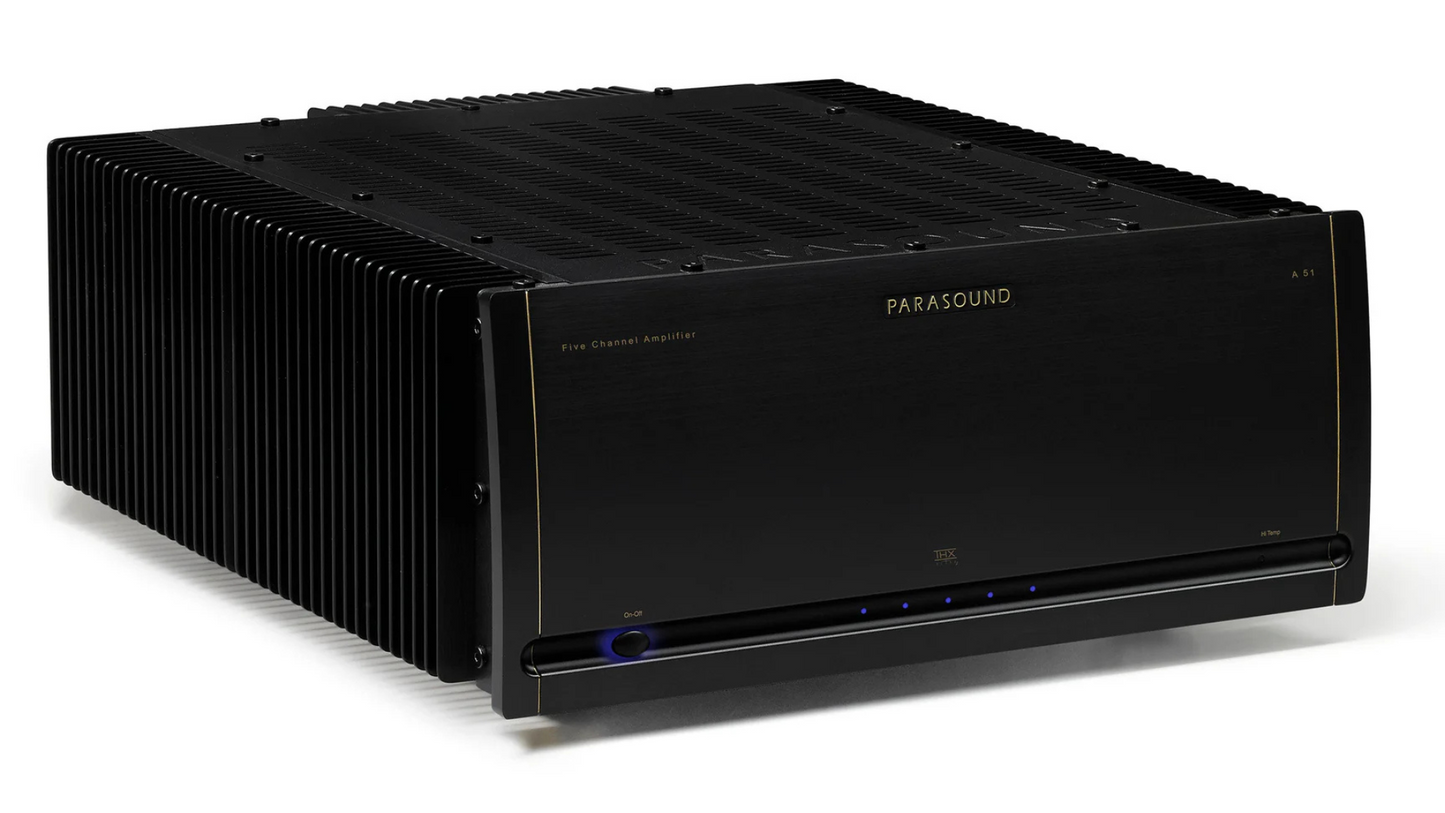
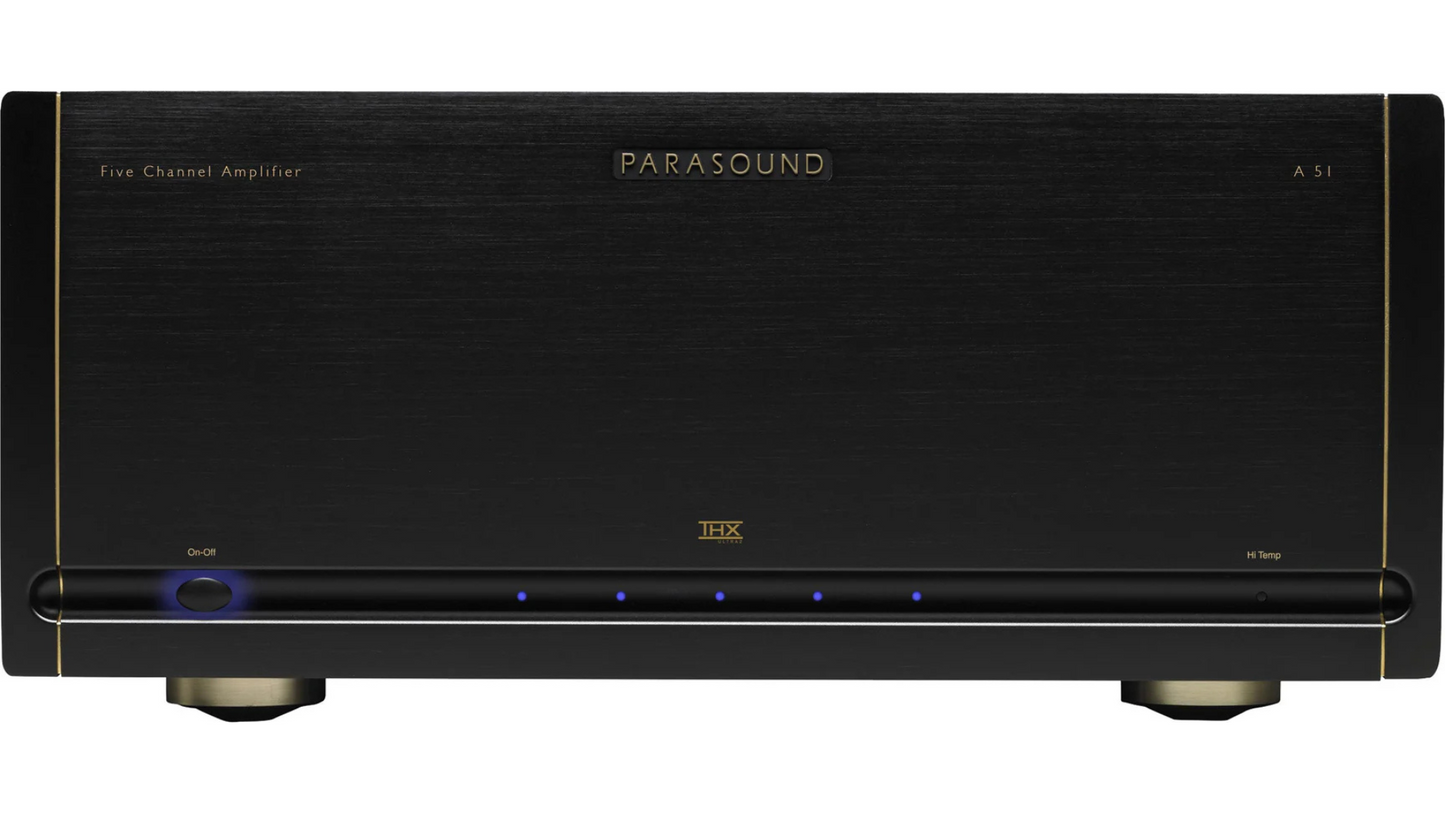
Parasound HALO A51 Five Channel Power Amp
Parasound HALO A51 Five Channel Power Amp
Couldn't load pickup availability
Parasound Halo A51 Five-Channel Power Amplifier
Five channels of the same JFET-MOSFET-bipolar circuit architecture that defines the Halo A-series — 250 watts per channel into 8 ohms with all channels driven, backed by the largest power supply in the Halo lineup, in a 4U chassis that has been a reference point for high-performance home theater amplification for over two decades.
What It Is and Who It's For
The Parasound Halo A51 is a five-channel power amplifier designed for listeners who want the same Halo circuit quality across every channel of a surround system — front, center, and surround — without the complexity or cost of separate amplifiers per channel. It delivers 250 watts per channel into 8 ohms and 400 watts per channel into 4 ohms with all five channels driven simultaneously. That simultaneous full-load specification matters: many multichannel amplifiers publish their power ratings with only one or two channels driven, where the power supply is not under its full real-world stress. The A51 rates its output under the actual conditions of multi-speaker, multi-channel program material.
This amplifier is purpose-built for serious home theater — the kind of installation where the speakers deserve better than the amplifier section inside an AV receiver, where all five channels carry meaningful program content and deserve equal power reserves, and where the system will be used at reference levels with demanding loudspeakers for years. It is also a compelling choice for a listener building a 5.1 system who wants sonic consistency across the full soundstage rather than the tonal character mismatch that often results from mixing amplifier brands or quality levels between channels.
Stereophile Guide to Home Theater praised the A51 for a midrange it called "totally seductive" and soundstaging "in the same league as some of the best gear I've ever heard at any price." For a multichannel amplifier at its price point, that level of critical praise from a demanding stereo-audiophile publication is meaningful context for what the A51 actually sounds like — not just how it measures.
Engineering: The Halo Circuit at Scale
The A51 uses the same three-transistor, direct-coupled circuit topology that Parasound and John Curl developed for the Halo A-series and that has defined these amplifiers' sonic character since their introduction. The input voltage amplification stage in each channel uses matched JFET pairs, chosen for their low noise and natural gain behavior at small signal levels. The driver stage uses matched MOSFET pairs, which deliver smooth, linear gain with the character that distinguishes well-designed solid-state amplification from harsher designs. The output stage uses eight beta-matched 15A/60 MHz bipolar output transistors per channel — 40 total across the five channels — handling the current delivery that actually drives speakers.
The 60 MHz bandwidth of these output transistors is directly relevant to performance. Transistors with insufficient bandwidth introduce slew-rate distortion — a form of high-frequency distortion that occurs when the output stage cannot track the rate of change of the input signal. It manifests as a loss of fine detail and spatial information at the upper end of the audio band and in the tracking of musical transients. The A51's slew rate is specified at greater than 130 V/µs, which means the amplifier can track voltage changes of 130 volts in a single microsecond — a figure that ensures music is reproduced with the full transient detail the source contains.
The signal path is entirely direct-coupled — no capacitors or inductors anywhere in the audio chain between input and output. Full rated power is available down to 5 Hz, relevant for the deep bass content of film soundtracks and for the signal integrity of LFE channel material that feeds powered subwoofers. The instant-bias circuit brings the amplifier to proper operating temperature from the moment it turns on, without the warm-up period that conventional bias designs require.
The power supply behind all five channels is the largest in the Halo A-series: a 2.2 kVA toroidal transformer — encapsulated in an epoxy-filled canister for vibration isolation and minimal radiated hum — with independent secondary windings for each channel, and 164,000 µF of filter capacitance. This is meaningfully more than the 1.5 kVA / 98,400 µF of the A31 and the 1.3 kVA / 108,000 µF of the A21+, scaled appropriately for five channels of simultaneous 60-ampere-per-channel peak current delivery. Each channel has 60 amperes of peak current available — the same figure as the A31 — because each channel draws from its own dedicated secondary winding rather than competing with adjacent channels for current from a shared winding.
THX Ultra2 certification confirms that the A51 meets independently verified requirements for output power, distortion at rated power, dynamic range, and crosstalk — measured with all channels driven, under controlled conditions. The A51 was designed to exceed those requirements, not merely meet them, which is why its circuit draws on the same design principles as the Halo two-channel amplifiers rather than being a separate, lower-cost design dressed in the same chassis.
Practical Features for Real Installations
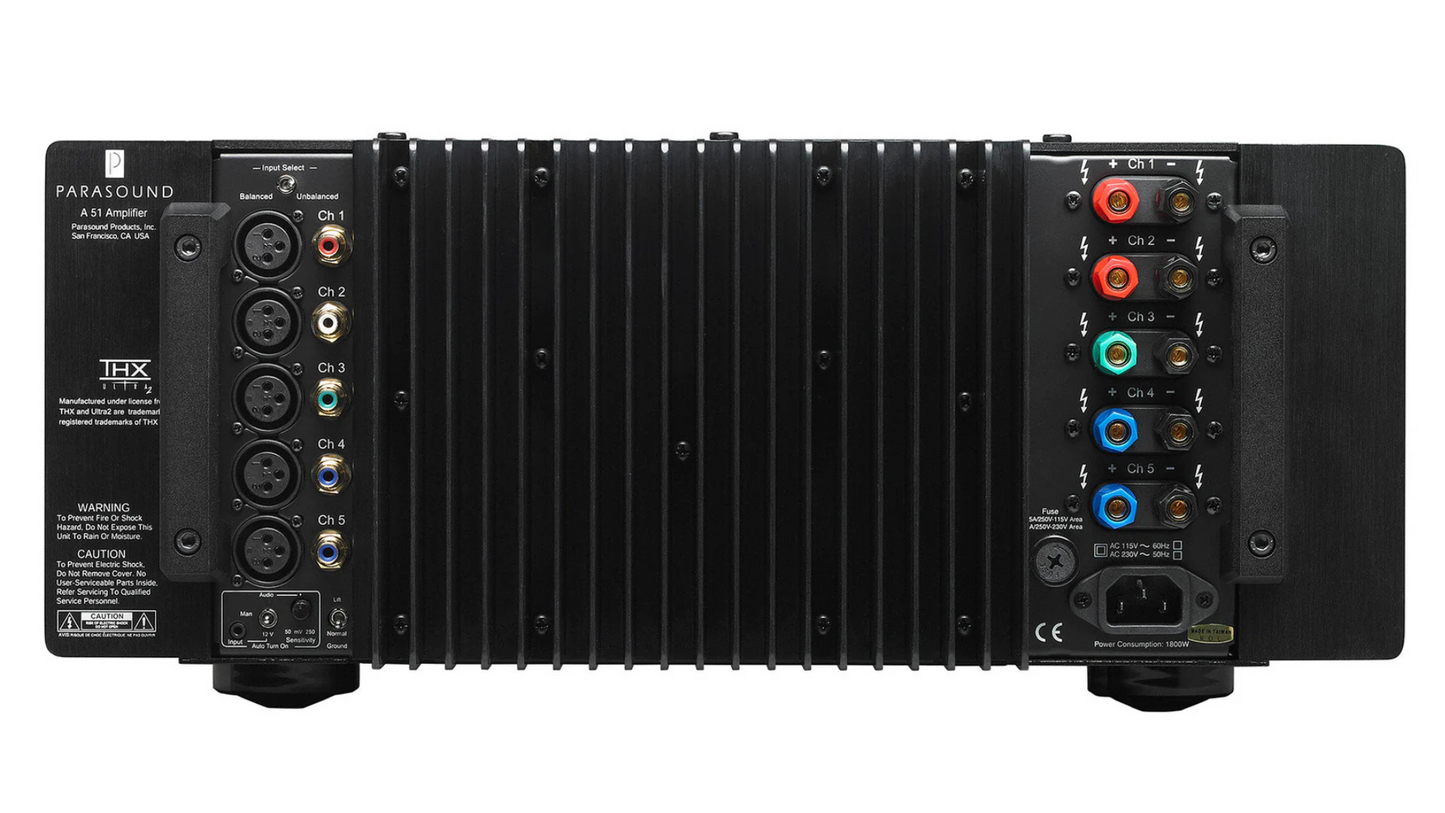
Each of the five channels has an individual adjustable gain control that allows ±6 dB of level adjustment relative to THX reference level. In a multi-channel installation, this per-channel control allows the A51 to be calibrated to match the level of any other amplifiers in the system, to compensate for differences in speaker sensitivity between positions, or to fine-tune the system-level balance without relying entirely on the processor's trim controls. The rear panel includes a ground lift switch that can eliminate audible hum caused by ground loops — a common practical issue in complex multi-component systems. Auto turn-on responds to either a 12V trigger from the processor or an audio-sensing circuit with an adjustable threshold. The 4U chassis includes carry handles and ships with a rack-mount adapter for installation in standard 19-inch equipment racks.
How It Compares: A51 vs. A52+ and A31
The Parasound Halo A52+ is the five-channel amplifier below the A51 in the Halo lineup, delivering 180 watts per channel into 8 ohms with all channels driven. It uses a 1.5 kVA transformer with 100,000 µF of total filter capacitance and weighs 55 pounds versus the A51's 80 pounds. The A52+ shares the same Halo circuit topology and is THX Ultra2 certified. For a listener whose speaker sensitivity and room size do not require 250 watts per channel, the A52+ is an excellent amplifier at a lower cost. For a listener driving large full-range speakers in a substantial room at demanding levels — or running speakers with low sensitivity or difficult impedance curves on any of the five channels — the A51's additional power and current headroom is genuinely useful, not just on paper.
The Parasound Halo A31 is the three-channel amplifier at the same per-channel power level — 250 watts per channel, the same circuit topology, the same peak current per channel. The A31 uses a 1.5 kVA transformer for three channels, while the A51 uses 2.2 kVA for five — giving the A51 proportionally more transformer capacity per channel. The choice between them comes down entirely to channel count: if you need five matched channels of this quality in one chassis, the A51 is the answer. If you want to pair separate amplifiers for different channel groups — or if you specifically want the front three channels at a higher level of amplification than the surrounds — the A31 as part of a mixed configuration may serve better.
Key Specifications
- Type: Five-channel power amplifier
- Topology: High-bias Class A/AB, direct-coupled, fully discrete
- Power Output (all channels driven, 20 Hz–20 kHz): 250W × 5 into 8Ω; 400W × 5 into 4Ω
- Class A Operation: First ~8 watts per channel
- Peak Current: 60A per channel
- Slew Rate: >130 V/µs
- Frequency Response: 5 Hz–100 kHz (+0/−3 dB at 1W)
- THD at Full Power: <0.2%
- IMD: <0.04% (balanced, 16V rms)
- S/N Ratio: >112 dB (IHF A-weighted, input shorted)
- Dynamic Headroom: >1.5 dB
- Interchannel Crosstalk: >78 dB at 1 kHz; >63 dB at 20 kHz
- Damping Factor: >1,100 at 20 Hz
- Input Transistors: Matched JFET pairs (input); matched MOSFET pairs (driver)
- Output Transistors: 8 beta-matched 15A/60 MHz bipolar transistors per channel (40 total)
- Signal Path: Direct-coupled — no capacitors or inductors
- Power Supply: 2.2 kVA encapsulated toroidal transformer with independent secondary windings per channel; 164,000 µF filter capacitance
- Bias: Parasound exclusive instant-bias circuit — no warm-up required
- Input Sensitivity: 1V for 28.28V output (THX reference level)
- Input Impedance: 47 kΩ (unbalanced); 94 kΩ (balanced)
- Gain Adjustment: ±6 dB relative to THX reference level (per channel)
- Inputs: Balanced XLR and unbalanced RCA per channel (with toggle switch); gold-plated RCA jacks
- Speaker Outputs: Heavy-duty 24k gold-plated 5-way binding posts per channel
- Ground Lift: Rear panel switch
- Trigger: 12V in/out; audio-sense auto-on
- Certification: THX Ultra2
- Chassis: 4U height; carry handles; rack-mount adapter included
- Dimensions: 17½"W × 7⅝"H × 20"D (7" H without feet)
- Weight: 80 lbs (36.3 kg)
- Finish: Black
- Warranty: 5 years parts and labor (Parasound USA)
Why Buy From All Elite Audio
All Elite Audio is an authorized Parasound dealer with the full Halo A-series in stock. The A51 comes up most often in conversations about building or upgrading complete home theater systems, and the practical questions — whether it is the right call versus the A52+, how to integrate it with a separate stereo amplifier, what processor it pairs best with, and how to calibrate its per-channel gain — are worth working through with someone who knows the product. We are glad to have that conversation.
Call 443-402-5055, text 443-402-5064, or visit us at 1921 York Rd, Timonium, MD 21093.
Frequently Asked Questions
Why does the A51 rate its power with all five channels driven, and why does that matter?
Rating an amplifier with all channels driven simultaneously is the real-world stress test — it is how the amplifier actually operates during multi-speaker surround playback. Many multichannel amplifiers publish their power output measured with only one or two channels driven, where the power supply has idle capacity from the inactive channels available as a buffer. The A51's 250-watt-per-channel rating with all five channels driven simultaneously reflects what the amplifier actually delivers under real program conditions, not a laboratory condition that inflates the headline number. A 2.2 kVA transformer and 164,000 µF of filter capacitance is what it takes to sustain 250 watts per channel across five channels simultaneously, and Parasound built it accordingly.
What circuit design does the A51 use and how does it compare to the Halo two-channel amplifiers?
The A51 uses the same three-transistor, JFET-MOSFET-bipolar circuit topology that Parasound and John Curl developed for the two-channel Halo A-series. Each channel's input uses matched JFET pairs for low-noise voltage amplification, matched MOSFET pairs in the driver stage for smooth gain, and eight beta-matched 15A/60 MHz bipolar output transistors per channel for current delivery. The direct-coupled signal path and instant-bias circuit are shared across the A-series. The A51's per-channel circuit is essentially identical to the A31's — the A51 simply drives five of them from a proportionally larger power supply. This means all five channels of the A51 have the same sonic character as the A21+ or A31 two- and three-channel amplifiers, making it possible to build a multi-component Halo system with consistent amplifier voicing across every speaker.
How does the A51 compare to the Halo A52+ five-channel amplifier?
The A52+ delivers 180 watts per channel into 8 ohms with all five channels driven, from a 1.5 kVA transformer with 100,000 µF of filter capacitance. It weighs 55 pounds versus the A51's 80. Both share the same Halo circuit topology and both carry THX Ultra2 certification. For a listener whose speakers are 88 dB or more sensitive and whose room does not require sustained high-level output, the A52+ is an excellent amplifier at a lower cost. The A51 is the right choice when you need the full 250 watts per channel — for larger rooms, lower-sensitivity speakers, or demanding impedance loads — or when you want the maximum current reserve the Halo A-series offers at the five-channel level.
Is the A51 suitable for use as a pure stereo amplifier?
Yes. You can connect only two channels of the A51 and drive a stereo pair of speakers — the remaining three channels simply sit idle. Reviewers who specifically evaluated the A51 for two-channel music performance praised its midrange character and soundstage performance at the level of much more expensive amplification. The JFET-MOSFET-bipolar circuit topology and direct-coupled signal path are as relevant to music playback as to home theater, and the A51's per-channel circuit operates identically whether one or all five channels are in use.
Can I mix the A51 with other Parasound amplifiers in the same system?
Yes, and this is one of the more common configurations we discuss with customers. A typical approach pairs the A51 for surround and height channels with a dedicated stereo amplifier — an A21+, JC 5, or JC 1+ pair — on the front left and right mains. Since all Halo A-series amplifiers share the same circuit topology and gain settings, calibrating the system for consistent level across all channels is practical and precise. The per-channel gain control on the A51 allows it to match whatever the front-channel amplifier's sensitivity is, and the AV processor handles the final trim. This combination gives the stereo mains dedicated higher-power amplification while the A51 handles the remaining channels with the same sonic character.
What does the per-channel gain control do and how should I set it?
The A51's per-channel gain control allows ±6 dB of level adjustment relative to THX reference level. In standard THX-calibrated systems, leave it at the reference position. The main practical use case is matching the A51's sensitivity to a different amplifier sharing the same system — if a separate stereo amplifier on the front mains has a different input sensitivity than the A51, the gain controls allow you to equalize the levels before running processor auto-calibration. They are also useful for matching different speaker sensitivities between positions without using up all of the processor's trim range. Setting both controls on a stereo pair of channels to the same calibrated position ensures consistent channel balance regardless of where in the control range you land.
What is the instant-bias circuit and why does it matter?
Parasound's exclusive bias circuit is designed to bring the amplifier to its correct operating bias essentially from the moment it powers on, rather than requiring a conventional warm-up period. In a standard Class A/AB bias design, the amplifier's operating point drifts as the output stage heats from idle to operating temperature — during that period, the amplifier sounds subtly different from how it sounds at stable operating temperature. The instant-bias circuit compensates for this thermal drift in real time, so the A51 sounds like itself within moments of turning on. For a home theater amplifier that is switched on at the start of a listening session and may not have had time to thermally stabilize, this is a practical benefit that translates directly to consistent performance.
Does the A51 require a fan or special ventilation?
The A51 is passively cooled — no fan. Cooling is handled entirely by the large heatsink fins that form the side panels of the chassis, and the amplifier operates silently in any listening environment. Adequate ventilation is required: leave several inches of clearance above and behind the unit in open-shelf installations, and at least one rack unit of space above the amplifier in rack installations. The chassis includes AC, channel status, and high-temperature indicator lights on the front panel — the thermal indicator will illuminate before the protection circuit engages if the operating temperature is approaching its limit, giving you advance notice that ventilation needs improvement.
What processor or preamp should I use with the A51?
The A51 works with any AV processor, surround sound receiver with preamp outputs, or multichannel preamplifier that provides the standard 1V reference output level used throughout the home theater industry. Both balanced XLR and unbalanced RCA inputs are provided for each channel. Balanced XLR connections are recommended where the processor supports them — they provide better noise rejection over cable runs and the 6 dB gain advantage of balanced differential signaling. If you are using the A51 in a system that also has a separate high-performance stereo preamplifier on the front mains, the processor's front-channel preamp outputs feed the front-channel stereo amplifier while the remaining preamp outputs feed the A51.
Why does the A51 include a ground lift switch?
Ground loops — the audible hum caused when two or more components in a system create different ground reference potentials and the interconnects carry the resulting current as an audio signal — are a frequent practical issue in complex multi-component home theater installations. The A51's ground lift switch disconnects the chassis ground from the audio circuit ground, which breaks the ground loop at the amplifier and eliminates the hum in most cases. It is a tool that real installers regularly need and appreciate, and its absence from competing amplifiers is a genuine practical limitation. If your A51 installation is hum-free, leave the switch in its default position. If you have a ground loop, try engaging the ground lift before investigating other remedies.
Where can I buy the Parasound Halo A51 and get help designing a system around it?
All Elite Audio at 1921 York Rd, Timonium, MD 21093 is an authorized Parasound dealer with the A51 in stock. We carry the complete Halo lineup and can help you determine whether the A51 or A52+ is the right five-channel amplifier for your speakers and room, how to pair it with a separate stereo amplifier for the mains, and how to configure the gain controls for your specific processor and speaker combination. Call 443-402-5055, text 443-402-5064, or stop in.
Outlet Deals
-
Yamaha A-S2200 (USED)
Regular price $4,000.00 USDRegular priceUnit price per$5,000.00 USDSale price $4,000.00 USDSALE -
NAD T-778 (NEW in BOX)
Regular price $3,500.00 USDRegular priceUnit price per$4,500.00 USDSale price $3,500.00 USDSALE -
Cambridge Edge W (USED)
Regular price $2,500.00 USDRegular priceUnit price per$5,000.00 USDSale price $2,500.00 USDSALE -
 SALE
SALEYamaha RX-A6A (USED)
Regular price $2,000.00 USDRegular priceUnit price per$2,700.00 USDSale price $2,000.00 USDSALE -
 SALE
SALEPSB Passif 50 (USED)
Regular price $2,000.00 USDRegular priceUnit price per$3,150.00 USDSale price $2,000.00 USDSALE -
TEAC AX-505 Stereo Integrated Amplifier (Demo / Open Box)
Regular price $1,600.00 USDRegular priceUnit price per$2,000.00 USDSale price $1,600.00 USDSALE


New Releases
-
EverSolo T10 Streaming Transport
Regular price $2,180.00 USDRegular priceUnit price per$2,180.00 USDSale price $2,180.00 USD -
Luxman L-100 CENTENNIAL Pure Class A Integrated Amplifier
Regular price $11,995.00 USDRegular priceUnit price per$11,995.00 USDSale price $11,995.00 USD -
Luxman D-100 CENTENNIAL SACD/CD Player
Regular price $18,995.00 USDRegular priceUnit price per$18,995.00 USDSale price $18,995.00 USD -
REL Acoustics Planar PL-1 Subwoofer
Regular price From $2,499.00 USDRegular priceUnit price per$2,499.00 USDSale price From $2,499.00 USD -
REL Acoustics Planar PL-2 Subwoofer
Regular price From $3,299.00 USDRegular priceUnit price per$3,299.00 USDSale price From $3,299.00 USD -
 SALE
SALEKLH Model 7 Speakers
Regular price $4,999.98 USDRegular priceUnit price per$5,998.00 USDSale price $4,999.98 USDSALE