Parasound
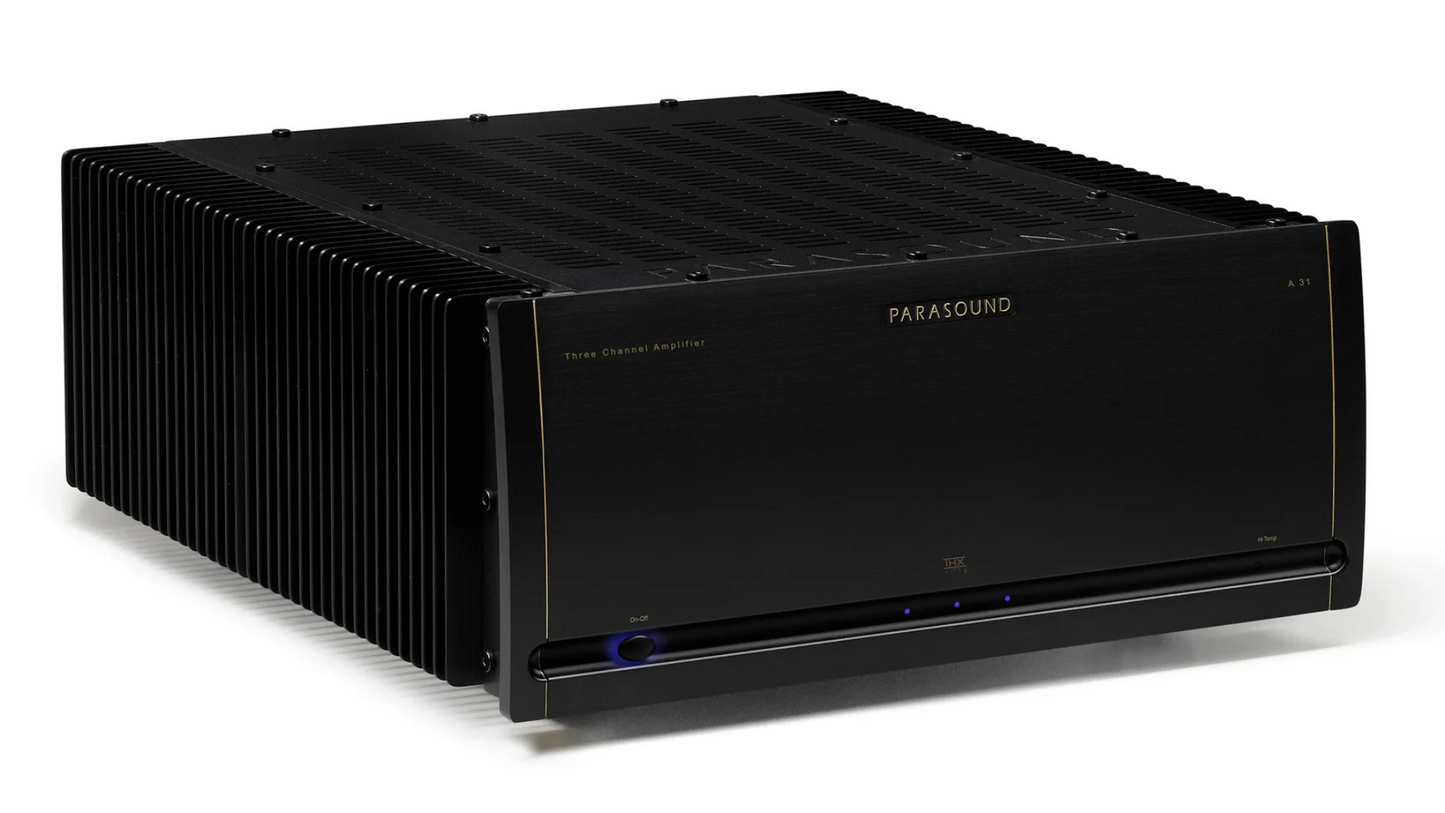
Parasound HALO A31 Power Amp
Parasound HALO A31 Power Amp
Couldn't load pickup availability
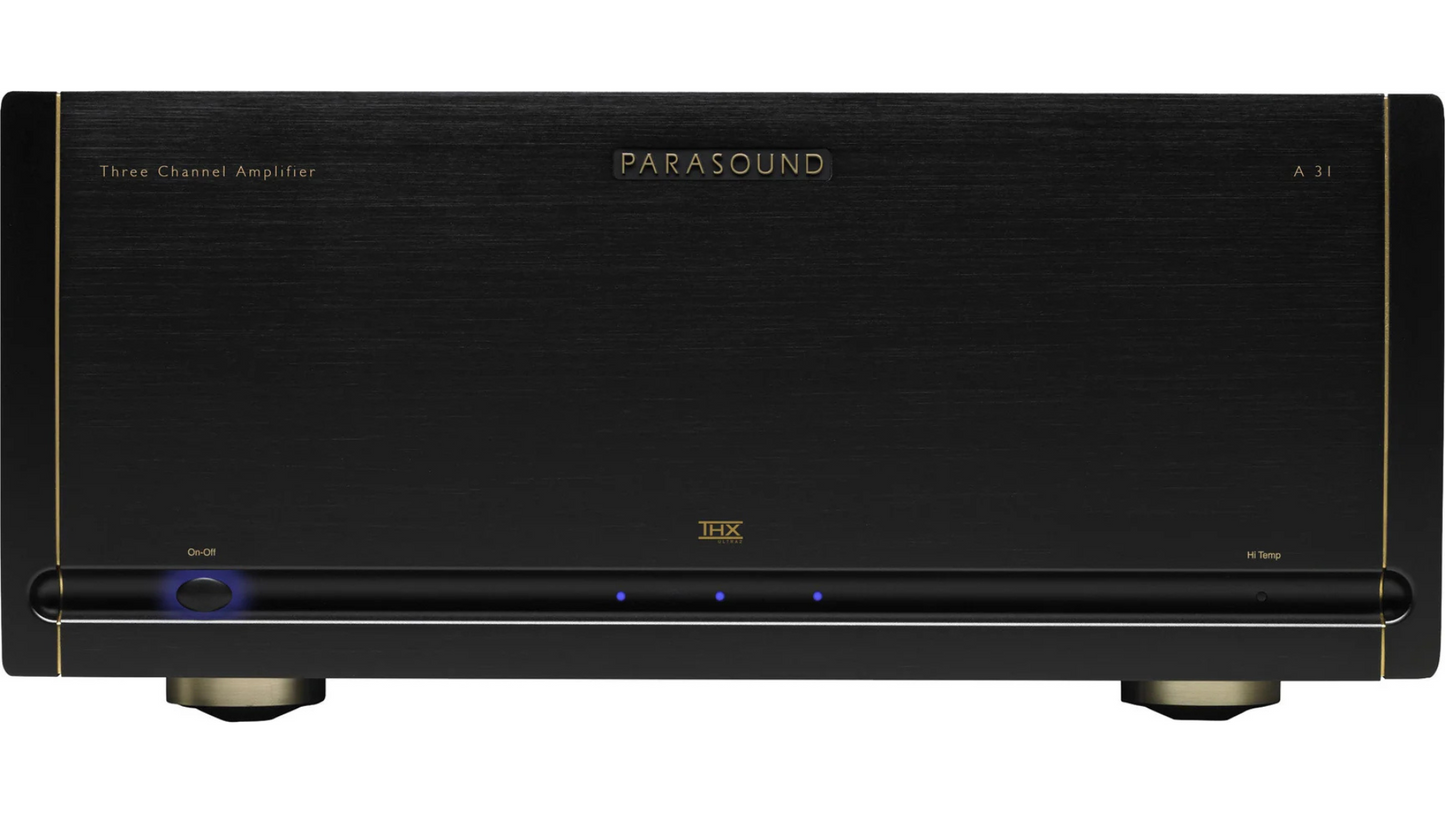
Parasound Halo A31 Three-Channel Power Amplifier
Three channels of the same John Curl–designed, high-bias Class A/AB amplifier circuit found in the Halo A21+ — 250 watts per channel into 8 ohms with all channels driven, in a 4U chassis built for serious home theater and LCR-dedicated applications.
What It Is and Who It's For
The Parasound Halo A31 is a three-channel power amplifier designed for listeners who want Halo-quality amplification across the front soundstage of a home theater system without purchasing separate amplifiers for each channel or paying for unused channels in a five- or seven-channel unit. It delivers 250 watts per channel into 8 ohms and 400 watts per channel into 4 ohms with all three channels driven simultaneously — a specification that reflects the full, continuous output of a genuinely high-current design rather than a peak or burst figure that falls apart under real program material.
The three-channel configuration is more purposeful than it might first appear. A home theater front stage — left, center, and right — does the heaviest amplification work in any surround system. Dialogue, music, the primary soundstage, and the most demanding dynamic content all live in those three channels. A dedicated three-channel amplifier of this caliber gives those channels everything they deserve while allowing the listener to choose a separate, appropriately sized amplifier for the surround and height channels, which have fundamentally different power requirements. It also makes the A31 a natural anchor for systems that pair it with a dedicated two-channel stereo amplifier: the A21+ or JC 5 for the left and right mains during music listening, with the A31 adding the center channel when switching to home theater mode.
SoundStage! Access awarded it a Reviewers' Choice. Secrets of Home Theater & High Fidelity called it "powerful but refined." These are not descriptions of a compromise — they describe an amplifier doing its intended job at the level the Halo name has always meant.
Engineering: The Same Circuit in Three Channels
The A31's amplifier circuit is the same design used across the Halo A-series — the JFET-MOSFET-bipolar three-stage topology that John Curl refined for the Halo line. Each channel's input stage uses matched pairs of JFETs, chosen for their low noise and natural gain character at the small-signal level. The driver stage uses matched pairs of MOSFETs, which provide the smooth voltage gain that characterizes well-designed solid-state amplification. The output stage uses eight beta-matched 15A/60 MHz bipolar transistors per channel — 24 total across the three channels — handling the current delivery to the speakers.
The signal path is entirely direct-coupled throughout, with no capacitors or inductors anywhere in the audio chain. Full rated power is available down to 5 Hz, meaning the amplifier does not compress or change behavior below the audible band — relevant for subwoofer crossover regions and for the low-frequency content in film soundtracks that can cause asymmetric limiting in less capable designs.
Behind all three channels is a 1.5 kVA toroidal transformer with independent secondary windings for each channel, encapsulated to minimize vibration and radiated hum. The 98,400 µF of filter capacitance — distributed across the three channels with their independent windings — gives each channel 60 amperes of peak current capacity. This is the same per-channel current figure as the Halo A51 five-channel amplifier, which draws on a proportionally larger transformer shared across five channels. On a per-channel basis, the A31 has a somewhat larger transformer allocation than the A51, which is part of why the two amplifiers measure similarly despite having different total power supply capacities.
The amplifier operates in high-bias Class A/AB mode, with approximately the first 7 watts per channel in pure Class A before transitioning to Class AB. Parasound's exclusive bias circuit brings the amplifier to proper operating bias essentially from the moment it powers on, rather than requiring the warm-up period that conventional bias designs need. The auto turn-on circuit — available via 12V trigger or audio sensing — includes an adjustable turn-on threshold, which allows the amplifier to be tuned to respond only to program material above a certain level rather than triggering from low-level noise or test tones.
The gain control per channel allows adjustment of up to ±6 dB relative to THX reference level, which is a meaningfully useful feature in real multi-channel installations. Matching the gain of different amplifiers driving different channels in a system — particularly when the A31 is used alongside a separate stereo amplifier or an AV receiver powering other channels — is a calibration step that matters for correct channel balance during both music and movie playback. THX Ultra2 certification provides an independent verification that the A31 meets controlled performance requirements for output power, distortion, and signal-to-noise at the levels demanded by reference home theater standards.
System Architecture: How to Use Three Channels Strategically
The flexibility of a three-channel amplifier is best understood in terms of the system configurations it enables. The most common is LCR duty: the A31 drives left, center, and right speakers while a separate two-channel amplifier (or pair of monoblocks) handles the stereo mains, and the AV receiver or a smaller multichannel amplifier drives surround and height channels. This approach gives the front soundstage — which carries the majority of home theater content and all of the critical stereo music content — a dedicated high-power amplifier without over-specifying the channels that need less.
A second common use is center-plus-surround: the A31 drives the center channel and two surround channels, while a high-performance stereo amplifier handles the critical left and right mains independently. This is the configuration of choice for the listener who is unwilling to compromise stereo performance — the A21+ or JC 5 on the left and right mains, the A31 on center and surrounds, each optimized for its role.
A third configuration uses the A31 as the sole amplifier for an LCR front system in an AV receiver-based setup, bypassing the receiver's internal amplifiers for the three channels that matter most while leaving the receiver to handle surrounds and heights natively. This is one of the most cost-effective ways to substantially improve the front-channel performance of a receiver-based system.
How It Compares: A31 vs. A51 and A52+
The Parasound Halo A51 is the five-channel amplifier in the Halo lineup, delivering the same 250 watts per channel into 8 ohms as the A31 but across five channels rather than three. It uses a proportionally larger 2.2 kVA transformer and 164,000 µF of total filter capacitance. For a listener who needs five identical channels at this power level, the A51 is the efficient solution. For a listener who wants to pair a dedicated stereo amplifier with a multi-channel unit for the remaining channels, or who specifically wants the front three channels at a higher investment level than the surrounds, the A31 makes more engineering and economic sense.
The Parasound Halo A52+ is the five-channel amplifier at lower per-channel power — 180 watts per channel into 8 ohms — and is designed for systems where the full 250 watts of the A51 or A31 is more than the application requires. The A31 is the right choice when front-channel power and current delivery are the priority and channel count is not.
Key Specifications
- Type: Three-channel power amplifier
- Topology: High-bias Class A/AB, direct-coupled, fully discrete
- Power Output (all channels driven, 20 Hz–20 kHz): 250W × 3 into 8Ω; 400W × 3 into 4Ω
- Class A Operation: First ~7 watts per channel
- Peak Current: 60A per channel
- Slew Rate: >130 V/µs
- Frequency Response: 5 Hz–100 kHz (+0/−3 dB at 1W)
- THD at Full Power: <0.2%
- IMD: <0.04% (balanced, 16V rms)
- S/N Ratio: >112 dB (IHF A-weighted, input shorted)
- Dynamic Headroom: >1.5 dB
- Interchannel Crosstalk: >78 dB at 1 kHz; >63 dB at 20 kHz
- Damping Factor: >1,100 at 20 Hz
- Input Transistors: Matched JFET pairs (input); matched MOSFET pairs (driver)
- Output Transistors: 8 beta-matched 15A/60 MHz bipolar transistors per channel (24 total)
- Signal Path: Direct-coupled — no capacitors or inductors
- Power Supply: 1.5 kVA encapsulated toroidal transformer with independent secondary windings per channel; 98,400 µF filter capacitance
- Bias: Parasound exclusive instant-bias circuit — no warm-up required
- Input Sensitivity: 1V for 28.28V output (THX reference level)
- Input Impedance: 47 kΩ (unbalanced); 94 kΩ (balanced)
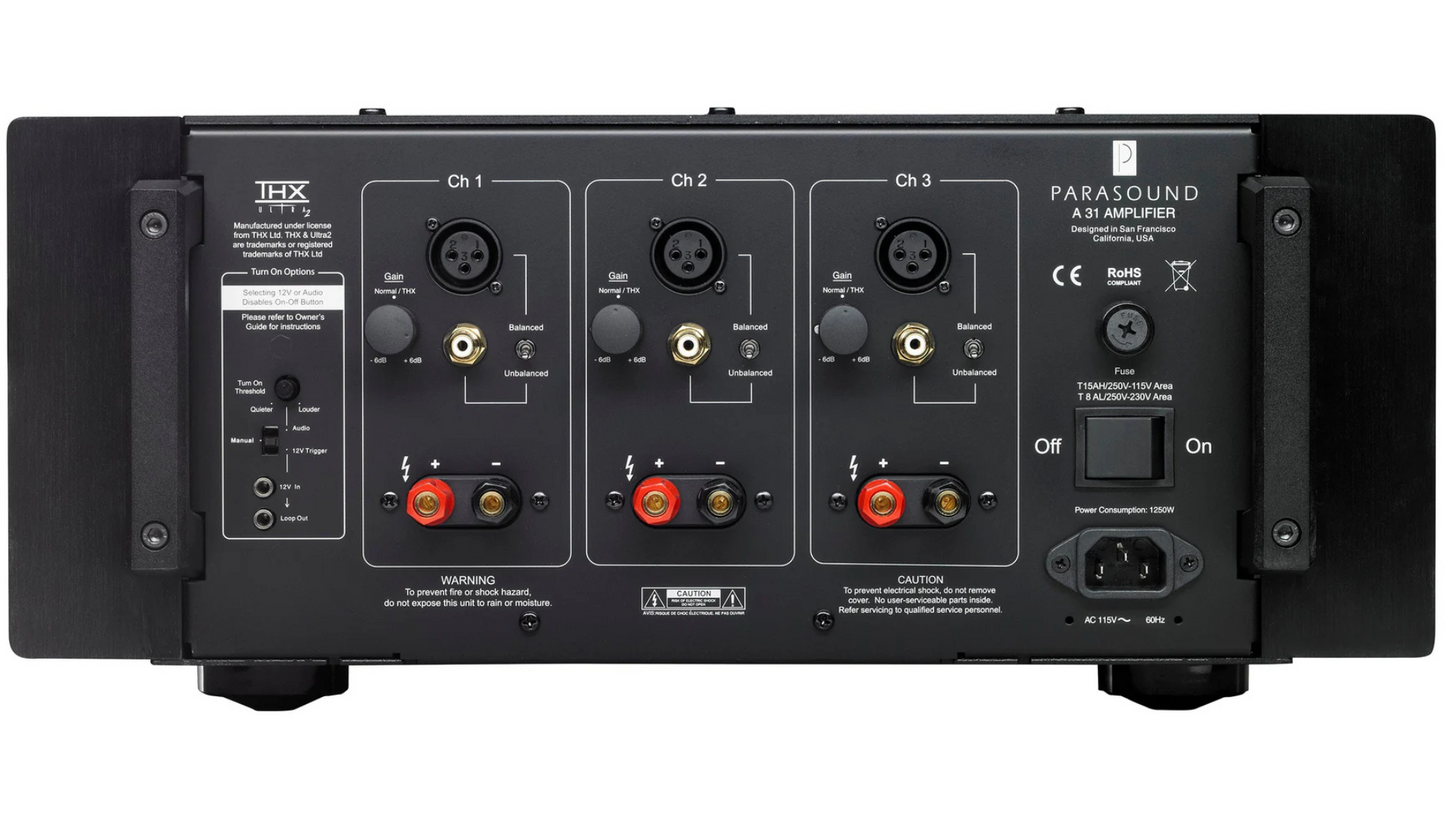
- Gain Adjustment: ±6 dB relative to THX reference level (per channel)
- Inputs: Balanced XLR and unbalanced RCA per channel (with toggle switch)
- Speaker Outputs: Heavy-duty 24k gold-plated 5-way binding posts per channel
- Trigger: 12V in/out; audio-sense auto-on with adjustable turn-on threshold
- Certification: THX Ultra2
- Chassis: 4U height; carry handles; rack-mount adapter included
- Dimensions: 17½"W × 7⅝"H × 20"D (7" H without feet)
- Weight: 65 lbs (29.5 kg)
- Finish: Black
- Warranty: 5 years parts and labor (Parasound USA)
Why Buy From All Elite Audio
All Elite Audio is an authorized Parasound dealer, and the A31 comes up regularly in the system-building conversations we have with customers designing or upgrading home theater setups. Which channels it should drive, what it should be paired with on the stereo mains, how to calibrate its per-channel gain relative to a receiver or processor — these are practical questions we work through with every A31 buyer. We carry the full Halo line and can help you configure the right combination for your specific room and speaker layout.
Call 443-402-5055, text 443-402-5064, or visit us at 1921 York Rd, Timonium, MD 21093.
Frequently Asked Questions
Why would I buy a three-channel amplifier instead of a five-channel one?
A three-channel amplifier makes the most sense when you want to give the front soundstage — the left, center, and right channels that carry the majority of home theater content and all stereo music content — a dedicated, high-power amplification system while using a different, separately optimized amplifier for the surround and height channels. The practical result is that you spend your amplifier budget where it matters most. A five-channel amplifier at the same total cost must divide its power supply and output stage across five channels rather than three, which means each channel gets proportionally less. The A31 also opens up a configuration that many serious listeners prefer: pairing a high-performance stereo amplifier on the left and right mains with the A31 on center and surrounds, keeping the music playback chain fully separate from the surround processing path.
What circuit design does the A31 use and how does it relate to the Halo A21+?
The A31 uses the same John Curl–designed JFET-MOSFET-bipolar three-stage circuit topology as the Halo A21+ and the rest of the Halo A-series. Matched JFET pairs handle the input voltage amplification, matched MOSFET pairs provide the driver stage, and eight beta-matched 15A/60 MHz bipolar output transistors per channel handle current delivery — 24 transistors total across the three channels. The power supply architecture is also similar: a 1.5 kVA toroidal transformer with independent secondary windings per channel and 98,400 µF of filter capacitance. The A21+ has a larger per-channel power supply allocation because it serves only two channels from a 1.3 kVA transformer, but the circuit topology and output transistor complement are drawn from the same design lineage. On the bench, the A31 consistently outperforms its own distortion specifications.
What is THX Ultra2 certification and does it matter?
THX Ultra2 is a performance certification that defines minimum requirements for amplifier output power, distortion at rated power, dynamic range, signal-to-noise ratio, and crosstalk under controlled conditions. It was developed originally for professional cinema use and adapted for home theater. Certification means these specifications have been independently verified, not just claimed by the manufacturer. For the A31, THX Ultra2 certification provides meaningful assurance that the amplifier will perform as rated under real multi-channel program material with all channels driven simultaneously — a stress condition that exposes power supply limitations in less capable designs. The A31 was also designed to exceed THX reference level by up to 6 dB per channel, giving it headroom above the standard.
How does the per-channel gain adjustment work and when would I use it?
Each channel of the A31 has an individual gain control that allows adjustment of up to ±6 dB relative to THX reference level. The primary use case is matching gain levels between different amplifiers in the same system. If you are using a separate stereo amplifier on your left and right mains alongside the A31 on the center and surrounds, those amplifiers may have different input sensitivities that result in uneven channel levels. The A31's per-channel gain control allows you to correct for these differences in the amplifier itself rather than relying entirely on the processor's trim levels. It is also useful for matching the A31 to an AV receiver's preamp outputs when the receiver's reference level calibration leaves individual channel offsets that the processor trim alone cannot fully address.
Can I use the A31 with my AV receiver or processor?
Yes, and this is one of the most common and effective uses for the A31. Connect the front left, center, and right preamp outputs of your receiver or processor to the A31's balanced XLR or unbalanced RCA inputs, then connect the A31's speaker outputs to those three speakers. The receiver continues to decode surround formats and handle volume control for all channels; the A31 provides dramatically better amplification for the three most important speakers in your system. The 12V trigger input allows the A31 to power on and off automatically with the receiver, and the audio-sense auto-on provides an alternative if your processor does not have a 12V trigger output. We can walk through the specific connection requirements for your receiver or processor if you have questions before purchasing.
How does the A31 compare to the Halo A51 five-channel amplifier?
Both amplifiers use the same John Curl circuit topology and deliver 250 watts per channel into 8 ohms with all channels driven. The A51 extends that power to five identical channels using a proportionally larger 2.2 kVA transformer and 164,000 µF of filter capacitance. The A31 serves three channels from a 1.5 kVA transformer with 98,400 µF, giving it a somewhat more generous per-channel power supply allocation. If you need five matched channels at this power level — for a full 5.1 surround configuration without separate amplification — the A51 is the right choice. If you want to pair a dedicated high-performance stereo amplifier with a multi-channel unit, or if your system architecture separates the front three channels from the surrounds, the A31 is the more purposeful solution.
What speakers work best with the A31?
The A31 works confidently with a very wide range of speakers. At 250 watts per channel and 60 amperes of peak current, it has enough headroom and current delivery to control demanding full-range floorstanders, center channel speakers with complex crossover networks, and surround speakers that benefit from real power rather than the modest output of an AV receiver's internal amplifiers. It is stable into 2-ohm loads, which covers essentially any speaker on the market. For center channel use specifically — where the amplifier must handle full-range music content, dialogue, and high-SPL effects simultaneously — the A31's output capacity provides meaningful headroom over what most receivers can deliver.
How does the auto turn-on threshold adjustment work?
The A31's audio-sense auto-on circuit monitors the input signal level and turns the amplifier on when it detects program material above a user-adjustable threshold. The threshold adjustment allows you to set the sensitivity so the amplifier does not trigger from low-level noise on the interconnects, test tones, or brief transients below normal listening level, while still responding quickly when actual program material begins. This is more practical than a fixed threshold in real installations where the source material and noise floor vary. The 12V trigger input provides an alternative and more deterministic turn-on method if your processor supports it, and is generally preferred for systems where precise power sequencing matters.
Does the A31 need special ventilation?
The A31 runs warm due to its high-bias Class A operation, and adequate ventilation is necessary for reliable long-term performance. In open-shelf installations, leave several inches of clearance above and behind the unit for convection cooling. In equipment rack installations, at least one rack unit of clear space above the A31 is recommended, and avoid placing heat-generating components directly above it. The chassis includes carry handles on the rear panel that also serve as rear standoffs, providing some clearance from the back wall. The amplifier includes thermal protection that will shut it down before any damage occurs if it exceeds safe operating temperature — but preventing that from happening through adequate airflow is the better approach.
Can I use the A31 for stereo music listening?
Yes, and with excellent results. The A31 drives two channels as effectively as three — simply leave one channel unused or connect it to a third speaker if your system includes one. SoundStage! Access specifically praised its stereo music performance, noting excellent transparency, imaging, and a richness through the midrange that is easy to listen to while remaining highly revealing. The direct-coupled signal path, JFET input stage, and 60A peak current capability are as relevant for music playback as they are for home theater. Listeners who run a combined music and home theater system with three front speakers will find the A31 equally satisfying in both roles.
Where can I buy the Parasound Halo A31 and get guidance on system integration?
All Elite Audio at 1921 York Rd, Timonium, MD 21093 is an authorized Parasound dealer with the A31 in stock. We carry the full Halo lineup and can help you determine how the A31 fits into your specific system architecture — whether you are pairing it with a stereo amplifier, an AV receiver, or building a complete Halo multi-channel system from scratch. Call 443-402-5055, text 443-402-5064, or visit us in person.
Outlet Deals
-
Yamaha A-S2200 (USED)
Regular price $4,000.00 USDRegular priceUnit price per$5,000.00 USDSale price $4,000.00 USDSALE -
NAD T-778 (NEW in BOX)
Regular price $3,500.00 USDRegular priceUnit price per$4,500.00 USDSale price $3,500.00 USDSALE -
Cambridge Edge W (USED)
Regular price $2,500.00 USDRegular priceUnit price per$5,000.00 USDSale price $2,500.00 USDSALE -
 SALE
SALEYamaha RX-A6A (USED)
Regular price $2,000.00 USDRegular priceUnit price per$2,700.00 USDSale price $2,000.00 USDSALE -
 SALE
SALEPSB Passif 50 (USED)
Regular price $2,000.00 USDRegular priceUnit price per$3,150.00 USDSale price $2,000.00 USDSALE -
TEAC AX-505 Stereo Integrated Amplifier (Demo / Open Box)
Regular price $1,600.00 USDRegular priceUnit price per$2,000.00 USDSale price $1,600.00 USDSALE


New Releases
-
EverSolo T10 Streaming Transport
Regular price $2,180.00 USDRegular priceUnit price per$2,180.00 USDSale price $2,180.00 USD -
Luxman L-100 CENTENNIAL Pure Class A Integrated Amplifier
Regular price $11,995.00 USDRegular priceUnit price per$11,995.00 USDSale price $11,995.00 USD -
Luxman D-100 CENTENNIAL SACD/CD Player
Regular price $18,995.00 USDRegular priceUnit price per$18,995.00 USDSale price $18,995.00 USD -
REL Acoustics Planar PL-1 Subwoofer
Regular price From $2,499.00 USDRegular priceUnit price per$2,499.00 USDSale price From $2,499.00 USD -
REL Acoustics Planar PL-2 Subwoofer
Regular price From $3,299.00 USDRegular priceUnit price per$3,299.00 USDSale price From $3,299.00 USD -
 SALE
SALEKLH Model 7 Speakers
Regular price $4,999.98 USDRegular priceUnit price per$5,998.00 USDSale price $4,999.98 USDSALE