Parasound
Parasound HALO A23+ Power Amp
Parasound HALO A23+ Power Amp
Couldn't load pickup availability
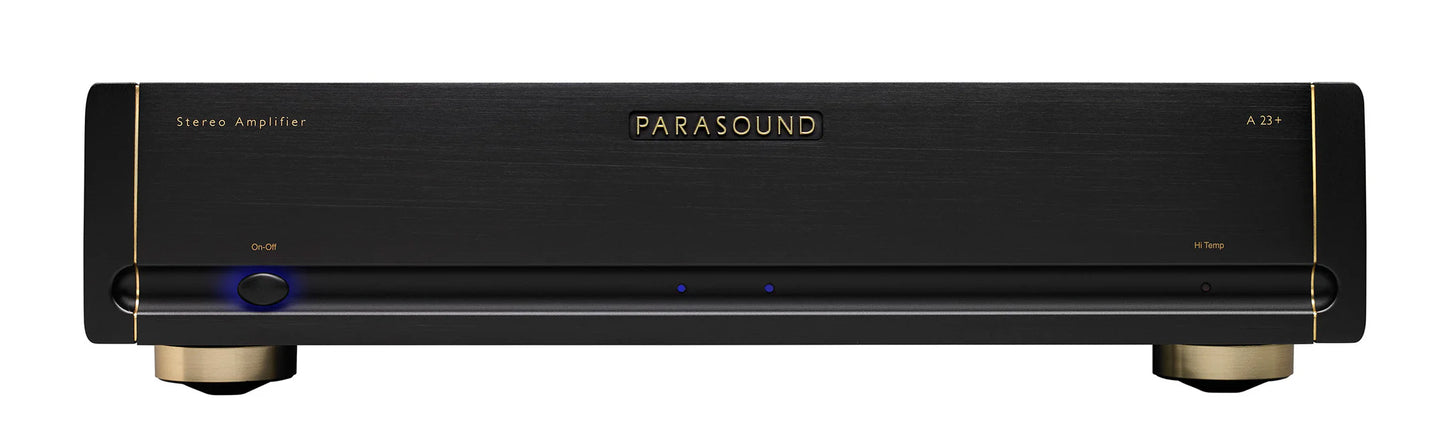
Parasound Halo A23+ Stereo Power Amplifier
A compact, dual-mono, high-bias Class A/AB amplifier co-designed by John Curl — delivering 160 watts per channel with the circuit sophistication and build quality of amplifiers that cost considerably more.
What It Is and Who It's For
The Parasound Halo A23+ is a two-channel stereo power amplifier built for listeners who want serious amplification without a serious footprint. It occupies only 2U of rack space — 3.5 inches of front-panel height — yet it delivers 160 watts per channel into 8 ohms, 240 watts into 4 ohms, and 500 watts bridged into 8 ohms as a mono block. That is a substantial amount of controlled, musical power in a chassis that fits comfortably on a shelf, in a rack, or in a room where a 71-pound monolith simply is not practical.
This amplifier is designed for two distinct buyers, and it serves both exceptionally well. The first is the dedicated two-channel listener who wants a separates-based system — a standalone power amplifier paired with a quality preamplifier or DAC/preamp — without spending at the reference tier. The second is the home theater enthusiast who needs a high-quality, high-current amplifier for front-channel duty in a system where the surround processor handles decoding and the A23+ handles the work of actually driving the speakers. Its 12V trigger input, loop outputs, and balanced XLR inputs make theater integration seamless. The A23+ handles both roles with equal composure.
The A23+ replaced the original Parasound Halo A23, a design that remained in the lineup for 17 years — a near-unheard-of run in consumer electronics. That longevity speaks to how well the original was received. The A23+ is not a cosmetic refresh; it is a substantively improved amplifier that builds on what made the A23 a reference-class value and corrects every meaningful limitation.
Engineering: The Circuit Behind the Numbers
The A23+ was co-designed by John Curl, who has been working with Parasound since 1989. Curl's professional history includes work at Ampex on professional tape and video recorders and a hand in the design of the Grateful Dead's legendary Wall of Sound touring system. His commercial audio designs have been installed in professional facilities at Lucasfilm, Pixar, and Sony Pictures. When a power amplifier carries Curl's circuit work, the engineering is not a marketing claim — it is a verifiable fact with decades of professional credibility behind it.
The amplifier's circuit topology is a carefully considered hybrid of three transistor types, each chosen for what it does best at a specific stage of amplification. The input voltage amplification stage uses JFETs — Junction Field Effect Transistors — which are prized for their extremely low noise characteristics and their ability to handle the signal cleanly at low levels. The driver stage uses MOSFETs — Metal Oxide Field Effect Transistors — which offer smooth, natural gain characteristics and are associated with the liquidity that distinguishes well-designed solid-state amplifiers from harsh ones. The output stage uses bipolar transistors, which excel at delivering the high current that speakers actually demand on transients and during complex musical passages. This is not a cost-cutting compromise — it is an intentional design choice to get the best sonic characteristic of each transistor type at the stage where that characteristic matters most.
The amplifier operates in high-bias Class A/AB mode. This means the first several watts of output — the range that covers most of what you actually hear at typical listening levels — are reproduced in pure Class A. In Class A, the output transistors remain active for the full audio cycle, which eliminates the crossover distortion that can afflict less carefully biased Class AB designs. When the music demands more power, the amplifier transitions smoothly into Class AB without an audible step. The result is the warmth and resolution of Class A where it is audible, and the efficiency and headroom of Class AB where it is needed.
The signal path is direct-coupled throughout — there are no capacitors or inductors in the audio path between input and output. This approach preserves phase accuracy and eliminates the frequency-dependent impedance of series capacitors, which can subtly affect bass dynamics and treble extension. Combined with a damping factor exceeding 1,100 at 20 Hz, the A23+ maintains very tight control over woofer motion, which translates directly into accurate, well-defined bass reproduction regardless of the speaker's impedance characteristics.
The dual-mono architecture means the left and right channels have independent power supply regulation, separate toroidal transformers, and isolated signal paths from input to output. The A23+'s 1.1 kVA transformer and 54,400 µF of filter capacitance give the amplifier substantial current reserves — 45 amps peak per channel — to handle transient demands without compression. The upgraded power supply is one of the most meaningful improvements over the original A23, which used a 1.0 kVA transformer and 40,000 µF of capacitance. More filter capacitance means more charge available during the instantaneous peaks of music, which translates to better dynamic contrast and lower distortion at high power levels.
The A23+ also carries THX Ultra2 certification, which requires meeting a set of controlled performance measurements including distortion limits, dynamic range, signal-to-noise ratio, and crosstalk. THX certification does not define the sound of an amplifier, but it does confirm that the unit meets a documented, independently verified performance standard — a useful baseline for a buyer who wants measurable assurance alongside subjective praise.
How It Compares: A23+ vs. A21+ and HINT 6
The A23+ sits at the center of Parasound's stereo amplifier lineup, and understanding where it lands relative to the models above and below it is genuinely useful.
The Parasound Halo A21+ is the step up. It delivers 300 watts per channel into 8 ohms — nearly double the A23+'s output — and uses a 1.3 kVA transformer with 108,000 µF of filter capacitance, roughly double the A23+'s power supply capacity. It weighs 71 pounds. The A21+ is the right choice for large rooms, high-volume listening, very difficult speakers with low sensitivity or demanding impedance curves, or any application where headroom is the primary concern. The A23+ is the right choice when you want the same John Curl circuit topology and the same Halo build quality in a form factor that fits a normal equipment shelf and does not require moving the furniture.
The Parasound Halo HINT 6 integrated amplifier uses the same 160W/4-ohm amplifier section as the A23+, but combines it with a preamplifier, DAC, MM/MC phono stage, and headphone amplifier in a single chassis. If you are building a system from scratch and want everything in one box, the HINT 6 is the answer. If you already have a preamplifier or processor you are happy with, or if you want the cleanest possible separation between gain and amplification stages, the A23+ as a dedicated power amplifier is the better architecture.
Key Specifications
- Type: Two-channel stereo power amplifier
- Topology: High-bias Class A/AB, dual-mono, direct-coupled
- Power Output (Stereo, 0.1% THD): 160W × 2 into 8Ω; 240W × 2 into 4Ω
- Power Output (Bridged Mono, 0.1% THD): 500W into 8Ω (4Ω bridged operation not recommended)
- Peak Current: 45A per channel
- Input Transistors: JFET (input stage), MOSFET (driver stage), bipolar (output stage)
- Damping Factor: >1,100 at 20 Hz
- Frequency Response: 5 Hz–100 kHz (+0/–3 dB)
- THD+N: <0.1% at rated power
- IMD: <0.03%
- Signal-to-Noise Ratio: >117 dB (A-weighted, IHF)
- Crosstalk: >70 dB at 20 kHz
- Inputs: Balanced XLR (per channel), unbalanced RCA (per channel)
- Input Sensitivity: 1V RMS (unbalanced), 2V RMS (balanced)
- Gain: 29 dB (balanced); 23 dB (unbalanced)
- Loop Outputs: Yes (one per channel)
- Speaker Outputs: Two sets of binding posts (A/B), 5-way gold-plated
- Trigger: 12V in/out
- Power Supply: 1.1 kVA toroidal transformer, 54,400 µF filter capacitance
- Standby Power: <0.5W
- Chassis Height: 2U (3.5" / 88.2 mm) — rack-mountable with optional HRA-2 kit
- Dimensions: 17¼"W × 4⅛"H × 15"D (438 × 105 × 381 mm)
- Weight: 27 lbs (12.3 kg)
- Certification: THX Ultra2
- Warranty: 5 years parts and labor (Parasound USA)
Why Buy From All Elite Audio
All Elite Audio is an authorized Parasound dealer, which means every A23+ we sell comes with full factory warranty support and factory-direct service access if you ever need it. We carry the full Halo line and can demonstrate how the A23+ performs in context — paired with the Parasound P6, the JC 2 BP, or with speakers from the brands we carry. If you want to talk through whether the A23+ or the A21+ makes more sense for your room, your speakers, and your listening habits, that is exactly the conversation we are here to have.
Call 443-402-5055, text 443-402-5064, or visit us at 1921 York Rd, Timonium, MD 21093. We answer the phone and we know the products.
Frequently Asked Questions
What is the Parasound Halo A23+ and what does it actually do in a system?
The A23+ is a dedicated two-channel power amplifier — its job is to take the low-level audio signal from a preamplifier or processor and amplify it with enough current and voltage to physically drive loudspeakers. It does not have a volume control, inputs for sources, or a remote for day-to-day use; all of that is handled upstream by a preamp or integrated processor. What it does contribute is clean, high-current power with the circuit sophistication of John Curl's dual-mono Class A/AB design — which is why it sounds substantially better than the amplifier section built into most integrated amplifiers or receivers at a similar price. In a separates system, the A23+ is typically paired with a preamplifier like the Parasound P6 or JC 2 BP, or with an AV processor that has preamp outputs.
What makes the A23+ sound different from a less expensive amplifier?
The core difference is in the circuit topology and power supply. Less expensive amplifiers typically use integrated circuit op-amps in the signal path, which are convenient but limit how well the design can be optimized for audio. The A23+ uses three different types of discrete transistors — JFETs at the input for low noise, MOSFETs at the driver stage for smooth gain, and bipolar transistors at the output for high-current delivery — each chosen for what it does best at that specific point in the signal chain. The direct-coupled signal path means there are no series capacitors coloring the sound or restricting bass dynamics. And the high-bias Class A operation across the first several watts of output eliminates crossover distortion during the loudest passages you will actually hear at normal listening levels.
How does the A23+ compare to the Parasound Halo A21+?
The A21+ delivers 300 watts per channel versus the A23+'s 160 watts, uses a larger 1.3 kVA transformer with 108,000 µF of filter capacitance versus the A23+'s 1.1 kVA and 54,400 µF, and weighs 71 pounds versus 27. Both amplifiers use the same John Curl–designed circuit topology and the same dual-mono architecture. The A21+ is the right choice for large rooms, high-volume listening, or speakers with low sensitivity or difficult impedance loads below 4 ohms. The A23+ is the right choice when you want the same Halo circuit quality in a compact, manageable form factor and your speakers are reasonably efficient — generally 87 dB or higher — and your room is not enormous. We are happy to talk through which one makes sense for your specific situation.
What preamp or processor should I pair with the A23+?
The A23+ is a neutral, revealing amplifier that will perform well with any quality line-level preamplifier. The natural pairing within the Parasound family is the Halo P6, which includes a DAC, phono stage, and bass management, or the Halo JC 2 BP for a more purist, fully balanced topology. For home theater use, any AV processor with preamp outputs and balanced XLR connections will integrate cleanly. The balanced XLR inputs are strongly recommended over the unbalanced RCA inputs when possible — using balanced connections provides a 6 dB gain advantage and better common-mode noise rejection over long cable runs.
What is the difference between the Balanced/Unbalanced switch and using it as an input selector?
This is a common point of confusion. The Balanced/Unbalanced switch on the A23+ is not an input selector — it does not toggle between the XLR and RCA inputs for switching between two sources. Its function is to optimize the signal-to-noise ratio for whichever type of input you are using. You should connect only one input type at a time (either XLR or RCA, not both simultaneously), then set the switch to match. Attempting to connect both a balanced and an unbalanced source at the same time will cause signal degradation. If you want to switch between a preamp and a processor, that switching should happen upstream at the preamp or through a dedicated selector.
Can I bridge the A23+ to mono, and what does that mean?
Yes. Bridging combines the two amplifier channels to drive a single speaker with dramatically more power — 500 watts into 8 ohms in the A23+'s case. In bridged mode, the amplifier's full output stage is dedicated to one channel, effectively doubling the voltage swing available to the speaker. This is useful for bi-amping a subwoofer, powering a single high-efficiency speaker with enormous headroom, or running a pair of bridged A23+ units as mono blocks for a full system. Note that bridging into a 4-ohm load is not recommended — at 4 ohms, the amplifier sees a 2-ohm effective load per channel, which is below its rated minimum and could cause instability. Bridging works best with 8-ohm speakers.
Is the A23+ suitable for difficult or low-impedance speakers?
Yes. The A23+ is stable into 2-ohm loads and delivers 45 amps of peak current per channel, which is the figure that actually determines how well an amplifier controls speakers with demanding impedance curves. Many speakers that are nominally rated at 4 or 8 ohms dip well below those figures in the bass region, and an amplifier with insufficient current capability will compress or harden dynamically in those moments. The A23+'s current delivery and low output impedance — reflected in its damping factor exceeding 1,100 — mean it maintains authoritative control over woofer motion even with speakers that other amplifiers at this price struggle to drive cleanly.
How does the A23+ fit into a home theater system?
The A23+ integrates naturally into home theater setups. It accepts both balanced XLR and unbalanced RCA inputs (matching whatever your processor provides), includes a 12V trigger input for automatic power-on with the rest of the system, and loop outputs that allow you to daisy-chain additional amplifiers in the same system. In a two-channel system used for both music and home theater, the A23+ is typically driven by a preamplifier with a Home Theater Bypass input — the Parasound P6 and JC 2 BP both include this feature — allowing the processor to take direct control of the front channels for surround decoding while the preamp handles music duties independently. We can walk you through any integration scenario.
What is THX Ultra2 certification and does it matter?
THX Ultra2 is a performance certification developed originally for professional cinema and adapted for home use. It defines minimum requirements for amplifier power output, distortion at rated power, dynamic range, signal-to-noise ratio, and crosstalk — measured under controlled conditions. Certification means an independent body has verified the unit meets those specs, not just that the manufacturer claims they do. For the A23+, THX Ultra2 certification is a useful baseline assurance: it confirms the specs are real and the amplifier will perform as measured. It does not tell you how the amplifier sounds, but it does tell you it is not hiding anything.
What does the A23+ improve over the original Parasound Halo A23?
The improvements are substantive across the board. Power output increased from 125W to 160W into 8 ohms, 225W to 240W into 4 ohms, and 400W to 500W bridged. The power supply was upgraded with a larger 1.1 kVA transformer (up from 1.0 kVA) and 54,400 µF of filter capacitance (up from 40,000 µF), which improves dynamic performance and lowers distortion at high power. Crosstalk at 20 kHz improved from 63 dB to 70 dB. Internal audio connections were upgraded to gold-on-gold. The rear panel received heavy-duty speaker binding posts derived from the HINT 6 integrated amplifier. The cosmetics were refined with aluminum end caps and gold highlights. These are not incremental tweaks — taken together, they constitute a meaningfully more capable amplifier.
Where can I buy the Parasound Halo A23+ and get support?
All Elite Audio at 1921 York Rd, Timonium, MD 21093 is an authorized Parasound dealer with the A23+ in stock. Purchasing from an authorized dealer ensures full factory warranty coverage and factory service access. We carry the full Halo line and can help you match the A23+ to a preamplifier, speakers, and cables that will let it perform at its best. Call 443-402-5055, text 443-402-5064, or stop in. If you are outside the Baltimore area, we ship with full warranty intact.


Outlet Deals
-
Technics SU-R1000 (Open Box)
Regular price $9,000.00 USDRegular priceUnit price per$12,000.00 USDSale price $9,000.00 USDSALE -
Accuphase E-280 Integrated Stereo Amplifier (Open Box)
Regular price $5,500.00 USDRegular priceUnit price per$7,000.00 USDSale price $5,500.00 USDSALE -
Yamaha A-S2200 (USED)
Regular price $4,000.00 USDRegular priceUnit price per$5,000.00 USDSale price $4,000.00 USDSALE -
NAD Masters Series M33 BluOS Streaming DAC Amplifier (Demo / Open Box)
Regular price $4,000.00 USDRegular priceUnit price per$7,200.00 USDSale price $4,000.00 USDSALE -
NAD T-778 (NEW in BOX)
Regular price $3,500.00 USDRegular priceUnit price per$4,500.00 USDSale price $3,500.00 USDSALE -
Monitor Audio Gold 200 5G
Regular price $3,000.00 USDRegular priceUnit price per$6,700.00 USDSale price $3,000.00 USDSALE


New Releases
-
KLH Model 7 Speakers
Regular price $5,998.00 USDRegular priceUnit price per -
Luxman L-100 CENTENNIAL Pure Class A Integrated Amplifier
Regular price $11,995.00 USDRegular priceUnit price per$11,995.00 USDSale price $11,995.00 USD -
Mission 778S Streamer
Regular price $1,199.00 USDRegular priceUnit price per$1,199.00 USDSale price $1,199.00 USD -
Mission 778CDT CD Transport
Regular price $1,199.00 USDRegular priceUnit price per$1,199.00 USDSale price $1,199.00 USD -
Matrix Audio MS-1c - Music Streamer and DAC
Regular price $6,999.00 USDRegular priceUnit price per$6,999.00 USDSale price $6,999.00 USD -
Luxman D-100 CENTENNIAL SACD/CD Player
Regular price $18,995.00 USDRegular priceUnit price per$18,995.00 USDSale price $18,995.00 USD