Matrix Audio
Matrix Audio SS-1 Pro Audio Grade Network Switch
Matrix Audio SS-1 Pro Audio Grade Network Switch
Couldn't load pickup availability
Matrix Audio SS-1 Pro Audio Grade Network Switch
The network infrastructure your streaming system has always deserved.
The Matrix Audio SS-1 Pro is an audiophile-grade Ethernet network switch engineered from the ground up for high-fidelity streaming audio systems. It replaces the consumer-grade switch or router port that most systems use as the last network connection before the streamer, DAC, or music server — and addresses every dimension of that connection: power quality, clock precision, RF shielding, port isolation, and the fundamental physics of high-speed digital transmission at audio-relevant speeds. The result is a cleaner, more precisely timed digital data environment that allows connected audio components to perform at the ceiling of their capability rather than being limited by the noise and instability of standard network infrastructure.
Available now at All Elite Audio, your authorized Matrix Audio dealer in Timonium, Maryland — with in-store demos, expert guidance, and nationwide shipping.
The Core Engineering Philosophy: Why Higher Speed Means Lower Noise
One of the most important and least obvious principles behind the SS-1 Pro is Matrix Audio's reasoning for building an audio switch capable of 10 Gbps speeds when audio streaming requires only a fraction of that bandwidth. The argument is rooted in digital circuit design physics: a switch designed and tested for very high-speed signal transmission operates with inherently tighter timing tolerances and lower error rates across its entire architecture. When that high-speed circuitry operates at the lower speeds required for audio data, it does so with a stability margin that a switch built specifically for those lower speeds simply cannot match. In other words, a 10 Gbps capable switch running audio data at 100 Mbps is operating well within its comfort zone — producing far fewer timing errors, far less electrical noise, and far more stable data delivery than a 100 Mbps or 1 Gbps switch working at or near its performance limit.
This is the foundational engineering decision that separates the SS-1 Pro from generic audio switches, and it informs every other design choice in the product.
The Clock System: Femtosecond Internal Clock and RF Synthesizer
The clock system is where the SS-1 Pro most clearly separates itself from the standard SS-1. Inside the SS-1 Pro, timing is managed by a two-stage clock architecture: a femtosecond-grade internal clock serves as the master reference, feeding a high-precision RF synthesizer. The RF synthesizer uses a DPLL — Digital Phase-Locked Loop — to generate a highly stable, low-phase-noise output clock signal for the switch's main controller. This two-stage approach provides dramatically lower phase noise and jitter at the output than a single-stage femtosecond clock alone can achieve.
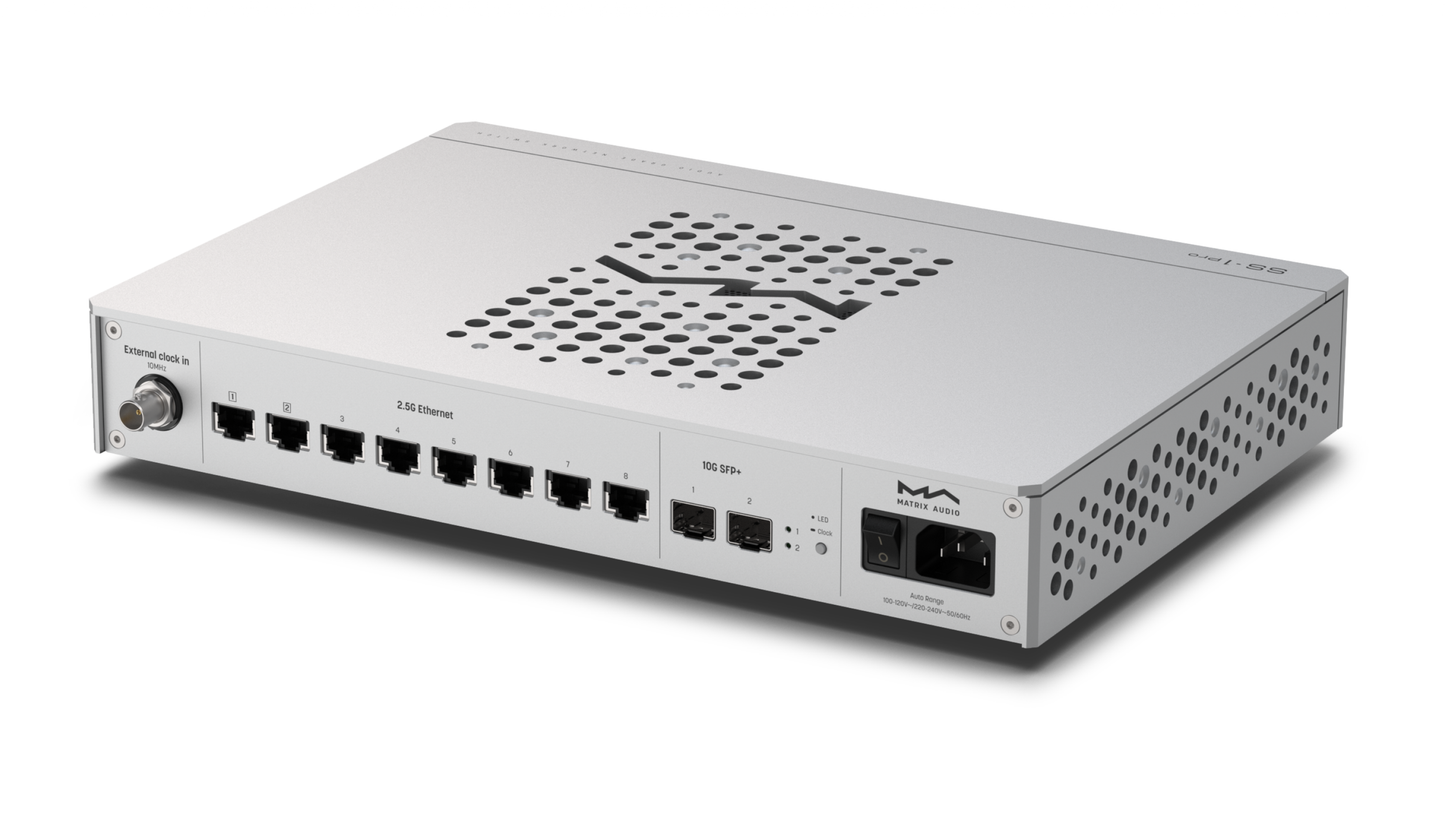
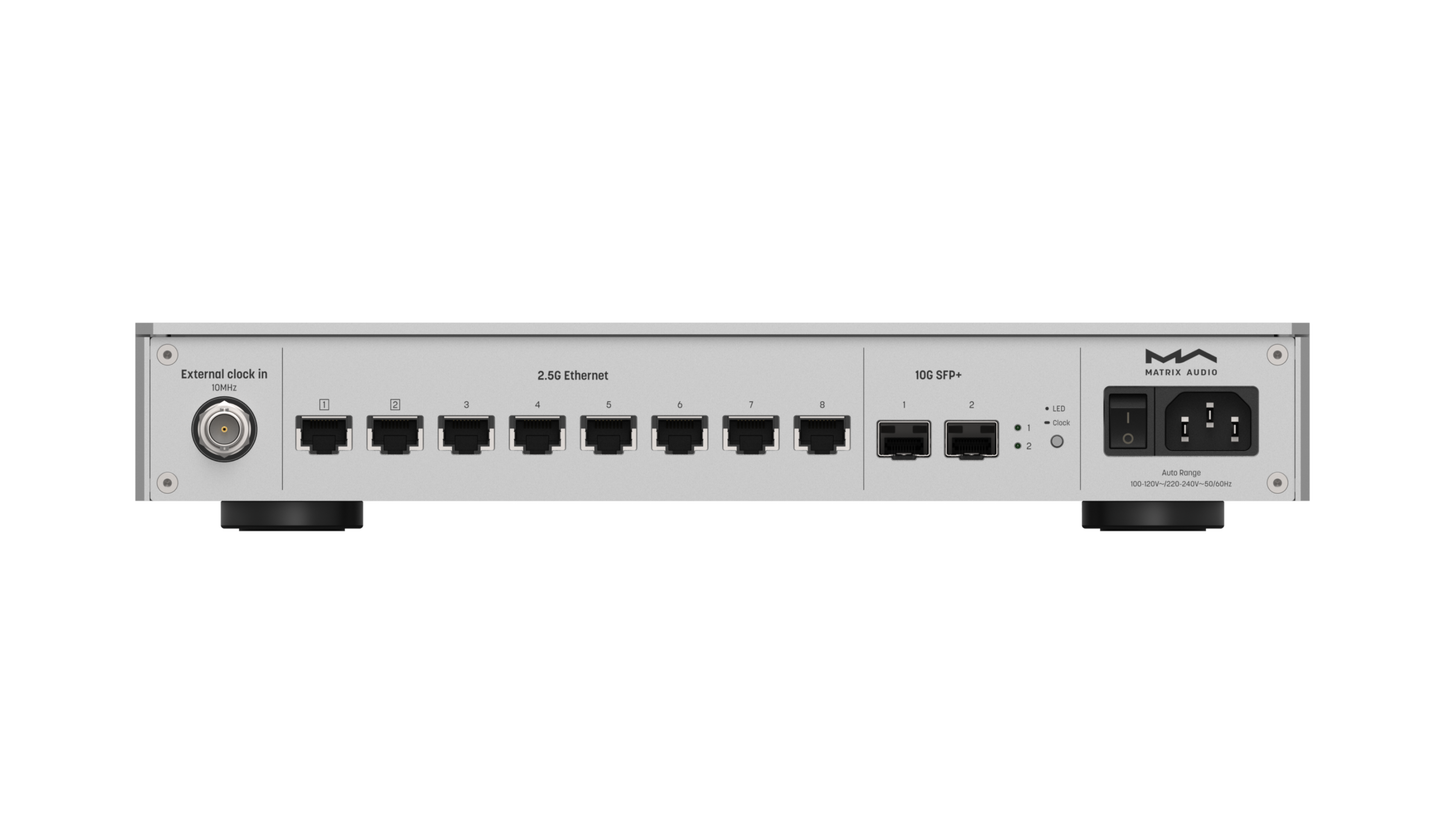
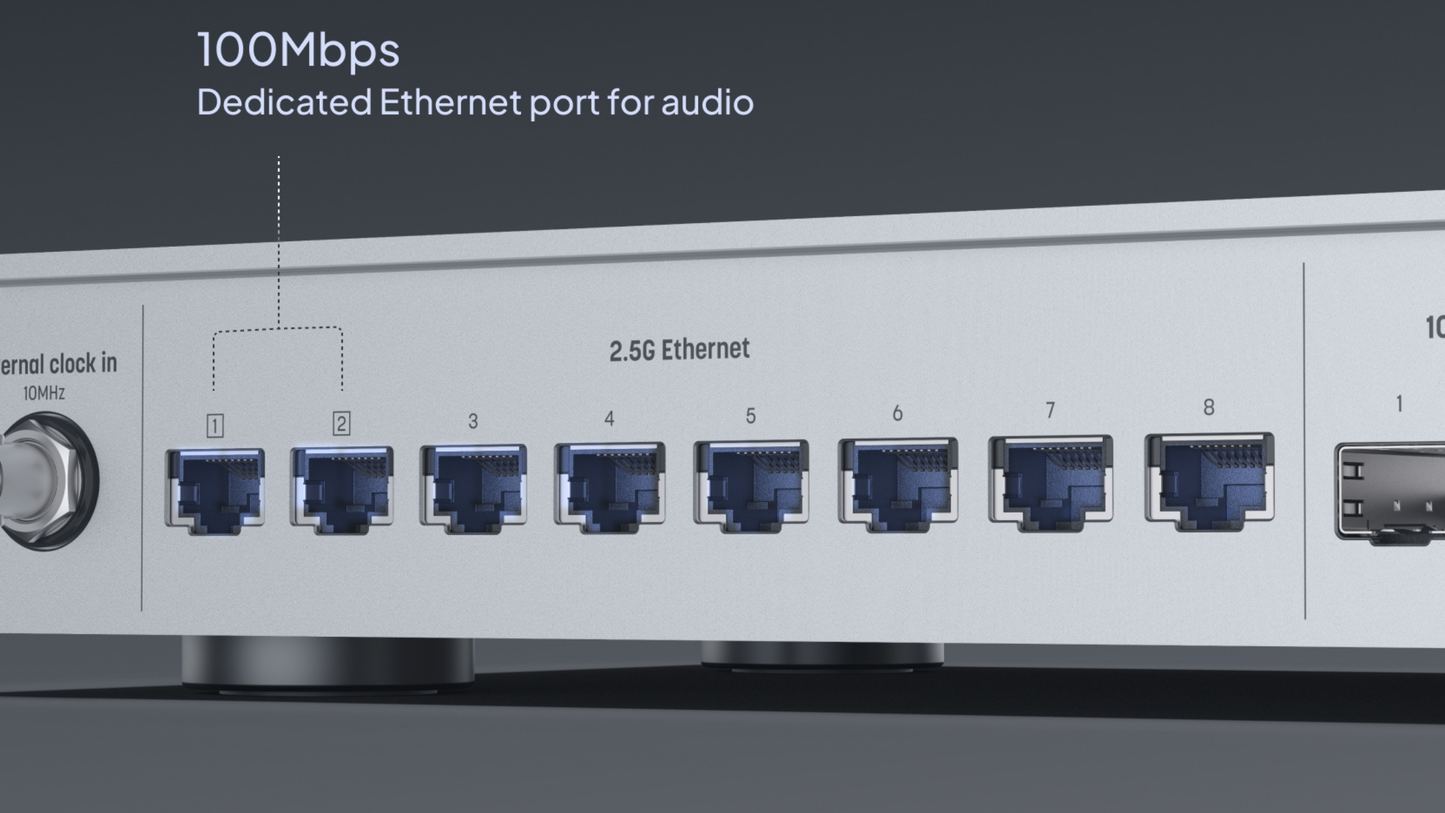
The SS-1 Pro also accepts an external 10 MHz reference clock signal via a rear-panel BNC input. In external clock mode, the DPLL locks to the incoming 10 MHz signal from a reference clock — such as the Matrix Audio SC-1 — rather than the internal oscillator. The synchronized output maintains the stability and low phase noise characteristics of the RF synthesizer but is now disciplined to the external reference, providing the most accurate and coherent timing possible across a complete Matrix Audio ecosystem. The standard SS-1 uses a single femtosecond clock without the RF synthesizer — capable and effective, but without the two-stage precision that the SS-1 Pro's system achieves.
Port Architecture: Audio-Optimized Low-Speed Ports and High-Speed Backbone
The SS-1 Pro provides ten physical ports configured in three distinct speed tiers, each serving a specific function in an audio network architecture.
The two 100 Mbps ports are the dedicated audio device connections. By operating at 100 Mbps rather than the higher speeds of the other ports, these connections reduce the rate of high-frequency switching events and the associated electromagnetic interference generated at the port level — creating a quieter electrical environment for the sensitive audio components connected to them. These two ports are physically wider-spaced than typical switch ports, with larger gaps between the RJ45 sockets to accommodate high-end audiophile Ethernet cables with oversized plugs or large cable bodies without crowding. Each port uses a 10 Gbps-grade independent Ethernet transformer, and each transformer is individually enclosed in a metal shielding shell to prevent radio frequency interference between ports.
The six 2.5 Gbps ports handle high-speed connections to routers, NAS devices, computers, and other non-audio network equipment, providing bandwidth headroom for high-resolution file access and multi-room streaming without creating bottlenecks elsewhere on the network.
The two 10 Gbps SFP/SFP+ ports accept either fiber optic modules or high-speed copper RJ45 modules depending on the application. With fiber modules installed, these ports provide complete galvanic isolation between the wider network and the switch itself — the same optical isolation principle used in the SI-1 network isolator, applied at the switch input level. This makes it possible to achieve electrical isolation between the router and the SS-1 Pro using fiber, while also isolating individual audio components downstream via the dedicated audio ports.
Power Supply: O-Core Toroidal Transformer With Audio-Grade Filtering
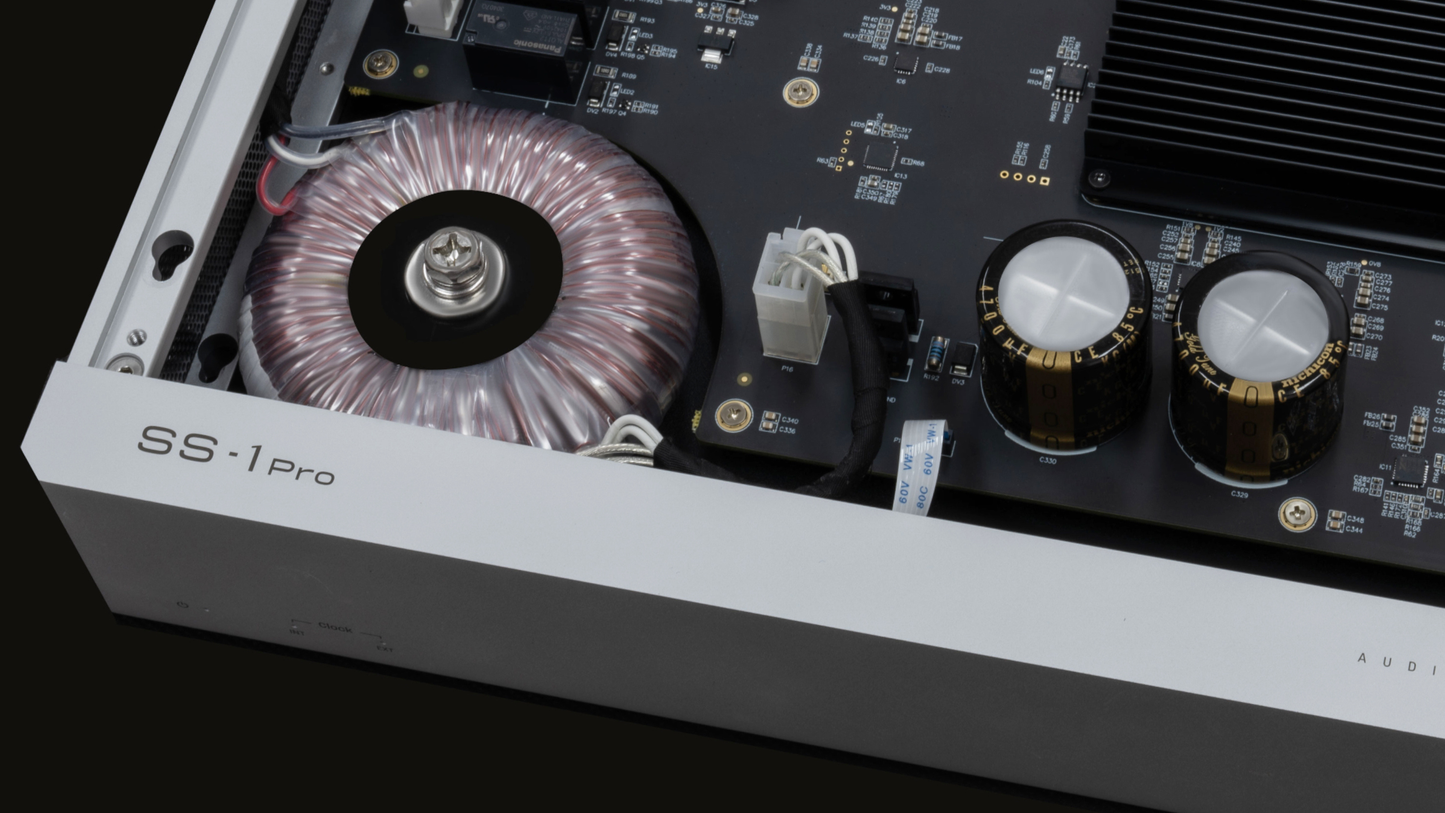
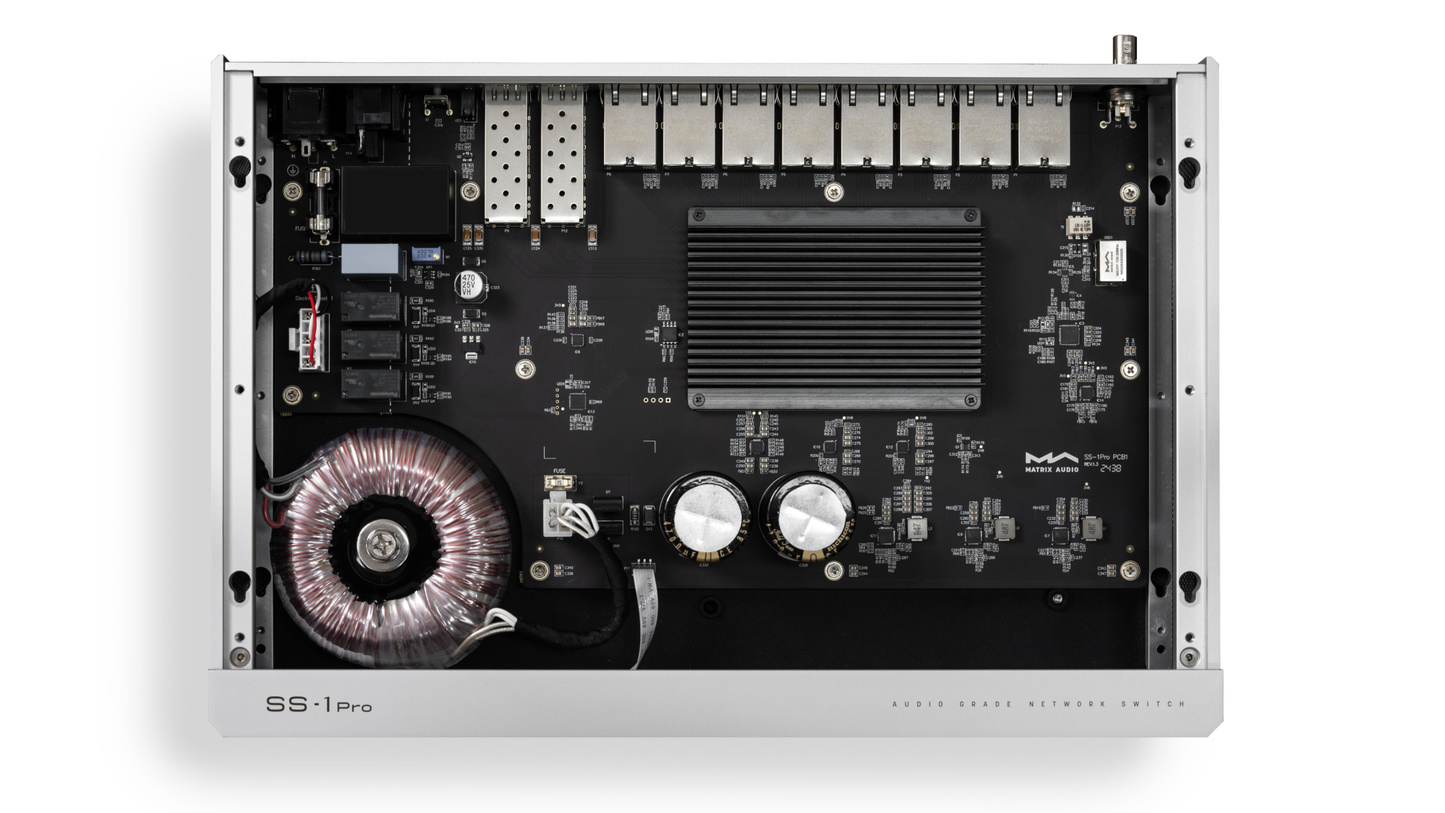
The SS-1 Pro's internal power supply is built around a custom O-core toroidal transformer — a winding geometry that provides better magnetic flux confinement and lower electromagnetic emissions than conventional toroidal or EI-core transformers. The primary rectification stage uses high-speed Schottky diodes, chosen for their lower switching noise compared to standard rectifier diodes. The filter stage employs approximately 10,000µF of audio-grade capacitance for highly effective reservoir and smoothing. Four ultra-low-noise LDO linear regulator circuits provide the final stage of voltage regulation, delivering clean, stable power to the femtosecond clock and the main controller.
When an external linear power supply is connected to the DC input on the rear panel, the internal AC supply disconnects automatically. The incoming DC power is then conditioned through an internal power line noise suppression filter before reaching the LDO regulators, ensuring any noise from the external supply is attenuated before it can affect the clock or controller circuits. This upgrade path allows SS-1 Pro owners to progressively refine their system's power quality over time.
Individual Port RF Shielding
Each of the Ethernet ports on the SS-1 Pro uses a fully shielded RJ45 socket, with the Ethernet signal transformer for each port individually enclosed in its own metal shielding shell. This port-level shielding prevents radio frequency interference generated by one port's activity from coupling into adjacent ports — a source of noise that standard switches do nothing to address. In a system where a computer or NAS is connected on a high-speed port while a sensitive DAC or streamer is connected on an audio port, this individual shielding ensures the activity of the computer side does not contaminate the electrical environment of the audio side.
Passive Cooling, Adjustable Isolation Feet, and Build Quality
The SS-1 Pro uses entirely passive cooling — no fans, no spinning parts, no vibration sources of any kind. The chassis dissipates heat naturally through its aluminum construction and the reinforced steel base plate that provides both structural rigidity and thermal mass.
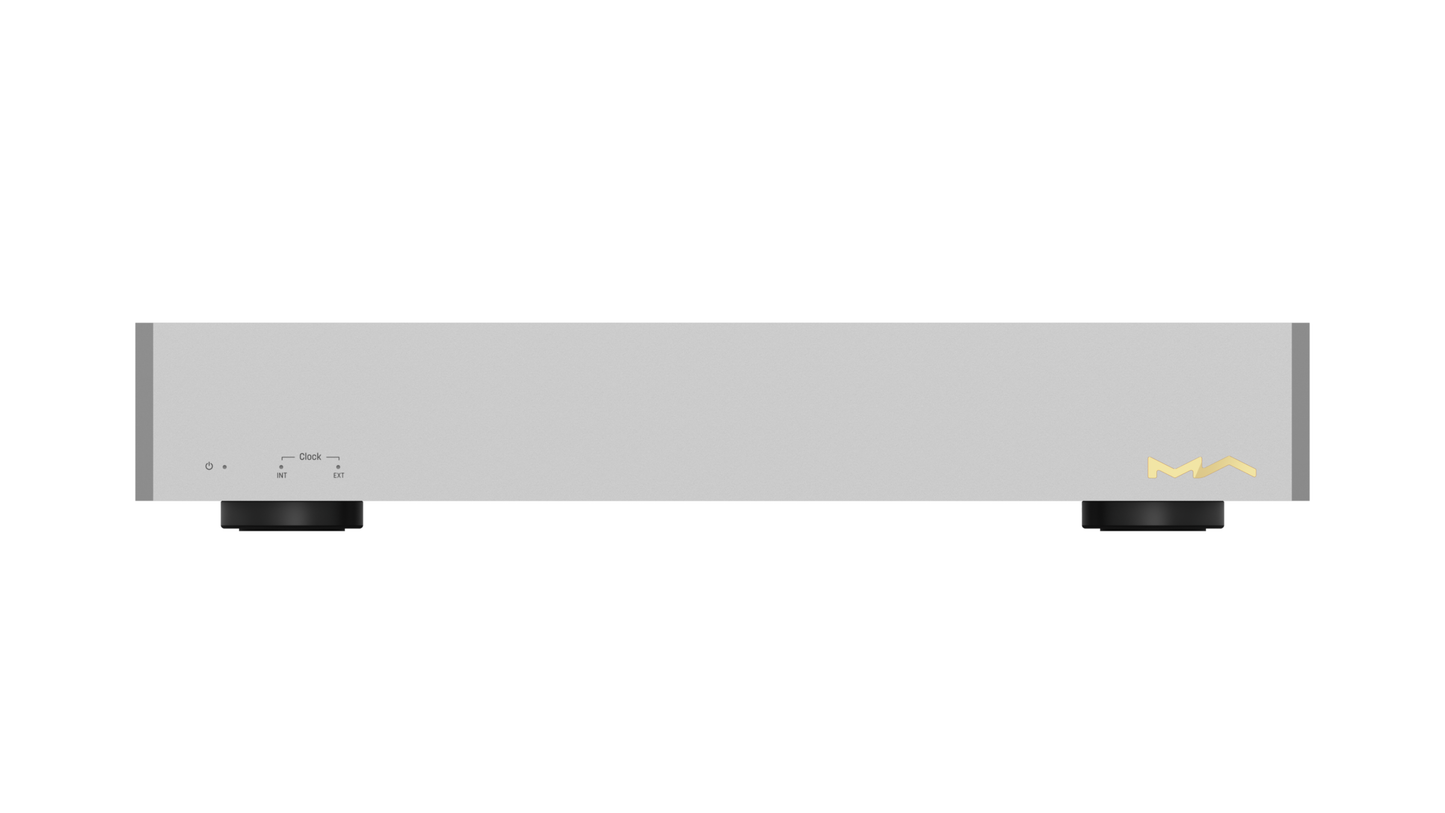
The unit comes with four isolation feet installed by default. These can be reconfigured to three feet if preferred — a three-point contact arrangement eliminates any rocking on uneven surfaces and represents the acoustically preferred configuration for many audiophiles, since a three-point support is inherently stable without requiring precisely leveled placement. The adjustable foot configuration is a thoughtful practical detail that reflects the SS-1 Pro's attention to the real conditions of audiophile equipment placement.
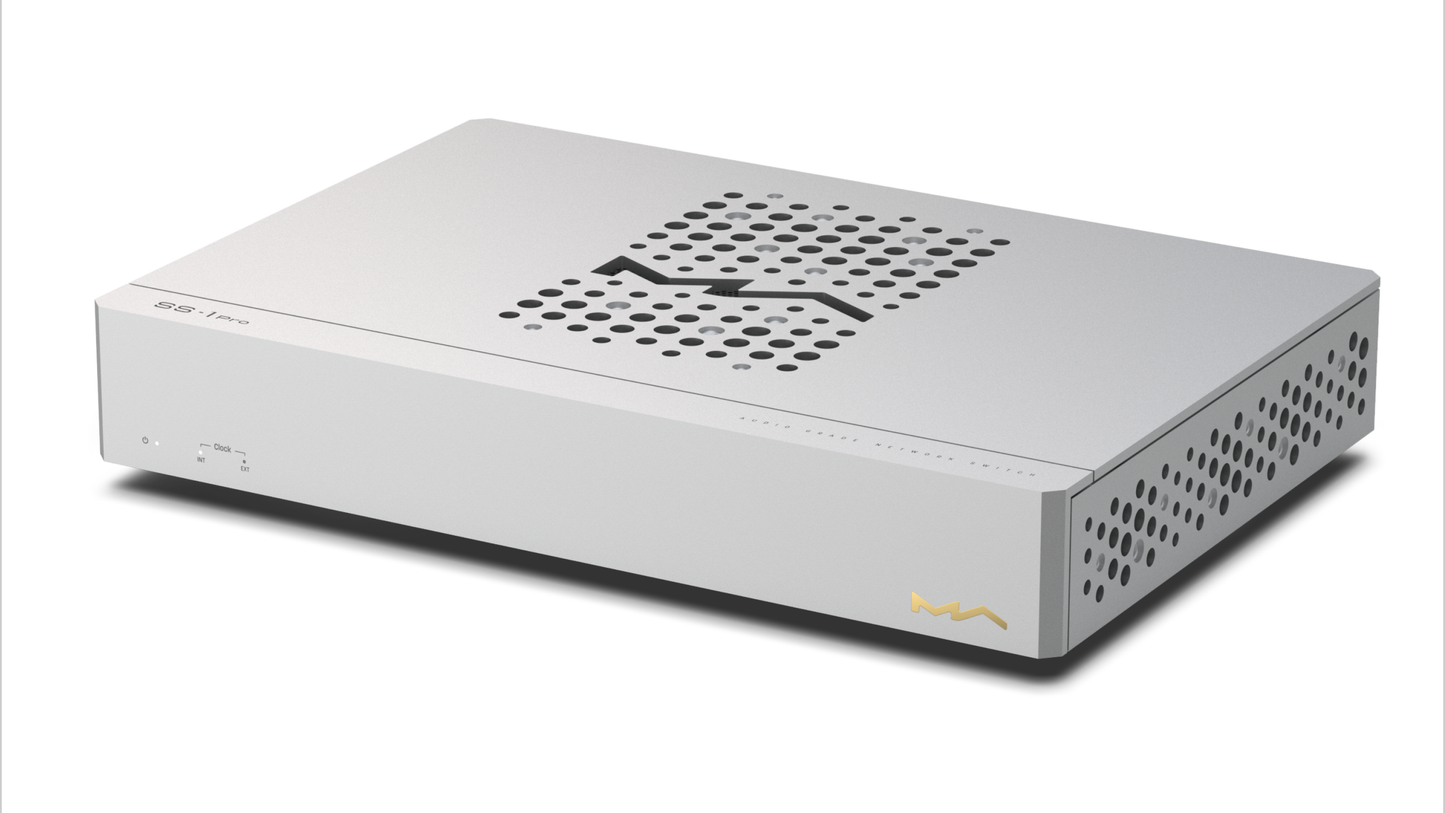
The precision CNC-machined aluminum chassis continues Matrix Audio's established industrial design language, with the signature perforation pattern and beveled edges. At 330mm wide, 235mm deep, and 58.5mm tall, it fits naturally on a equipment shelf or rack alongside Matrix Audio's other components.
LED Dimming for Listening Environments
The Ethernet port LED status indicators on the SS-1 Pro can be disabled by pressing the settings button on the rear panel. In a dedicated listening room or in any environment where the flicker of active network port LEDs is distracting, this feature allows the switch to operate completely dark without affecting its function in any way.
Key Specifications
Ports: 2x 100 Mbps RJ45 (dedicated audio), 6x 2.5 Gbps RJ45, 2x 10 Gbps SFP/SFP+ (fiber or copper module) External Clock Input: 10 MHz BNC, 50 ohm Clock System: Internal femtosecond-grade reference clock + RF synthesizer + DPLL (SS-1 Pro exclusive); external clock mode via 10 MHz BNC input Port Shielding: Individual metal-shell shielding per Ethernet transformer Audio Ports: Wide-spaced independent sockets for high-end cable compatibility; 10 Gbps-grade transformers Power Supply: O-core toroidal transformer, high-speed Schottky diodes, approx. 10,000µF audio-grade capacitance, four ultra-low-noise LDO regulators External DC Input: Yes — when connected, internal AC supply disconnects automatically; internal noise filter + LDO regulation Cooling: Passive, fanless LED Control: Ethernet port LEDs switchable off via rear panel button Isolation Feet: Four installed (reconfigurable to three) Chassis: CNC-machined aluminum with reinforced steel base plate Power Consumption: Less than 15W Power Voltage: AC 100-120V or 220-240V, 50/60Hz (auto-adaptive) Dimensions (W x D x H): 330 x 235 x 58.5 mm Weight: 3.4 kg (7.5 lbs) Warranty: 1 year manufacturer warranty
Why Buy From All Elite Audio
All Elite Audio is an authorized Matrix Audio dealer located in Timonium, Maryland — part of the greater Baltimore area. We carry the full Matrix Audio ecosystem including the SS-1 Pro network switch, the SC-1 reference clock, the SI-1 network isolator, the NT-1 streaming transport, and Matrix Audio's complete DAC and streamer lineup. Our team has direct experience configuring complete Matrix Audio network chains and can help you determine the right placement and configuration for the SS-1 Pro in your specific system.
We offer white-glove service, in-store demos, and support before and after your purchase. Whether you are local to Maryland or ordering nationwide, we are here to help you get the most from your system.
Call: 443-402-5055 Text: 443-402-5064 Visit: 1921 York Rd, Timonium, MD 21093
Frequently Asked Questions — Matrix Audio SS-1 Pro
What is the Matrix Audio SS-1 Pro and what does it do? The Matrix Audio SS-1 Pro is an audio-grade Ethernet network switch that replaces the standard consumer switch or router port feeding your streaming components with a purpose-engineered device optimized for audio data transmission. It uses a high-precision femtosecond clock with an RF synthesizer and DPLL, individual port RF shielding, audio-grade power supply components, and a high-speed architecture that delivers lower timing errors and less electrical noise than conventional switches. The result is a cleaner, more stable digital data environment for connected streamers, DACs, and music servers.
Why does a network switch affect audio quality? The Ethernet cable and switch that carry data to your streamer or DAC are also carrying the electrical noise generated by everything else on your network — switching power supplies in routers, RF interference from connected computers, ground potential differences between devices, and the high-frequency switching activity of the switch's own circuitry. This noise travels on the cable into the streamer or DAC and can affect the analog output stage, elevating the noise floor and reducing timing precision. An audio-grade switch like the SS-1 Pro addresses these noise sources through better power supply design, lower-noise clocking, individual port shielding, and dedicated audio ports operating at lower speeds that generate less switching noise.
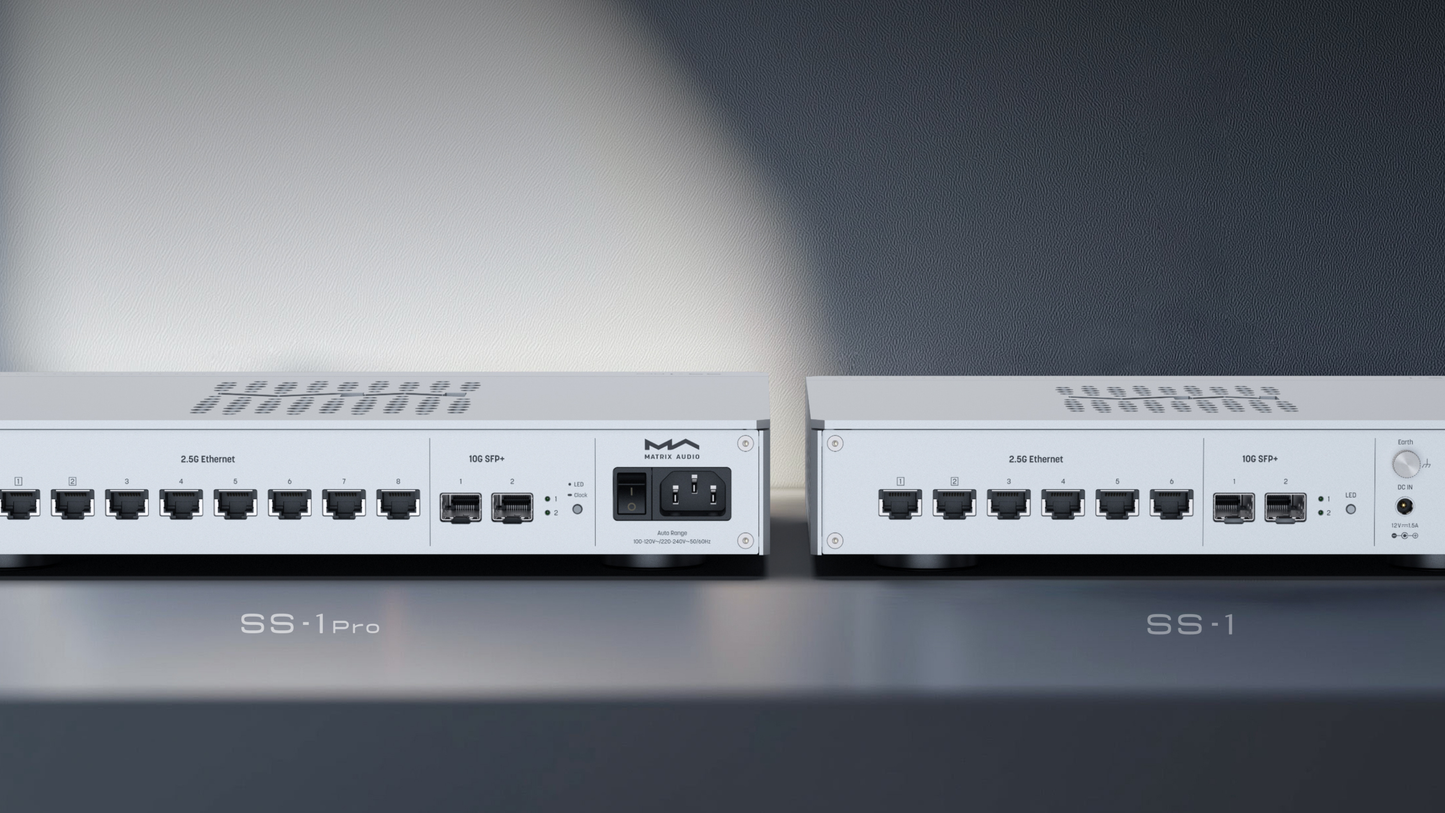
What is the difference between the SS-1 Pro and the standard SS-1? The SS-1 Pro's defining advantage over the standard SS-1 is its clock system. The SS-1 Pro uses a two-stage architecture: an internal femtosecond reference clock feeds a high-precision RF synthesizer, which uses a DPLL to generate the output clock signal for the main controller. This produces lower phase noise and better jitter performance than the SS-1's single-stage femtosecond clock. The SS-1 Pro also includes a 10 MHz BNC external clock input that allows integration with an external reference clock like the Matrix Audio SC-1 — the SS-1 does not have this input. The SS-1 Pro's internal power supply also uses an O-core toroidal transformer and a more refined audio-grade filtering stage. For listeners who want the maximum performance the platform can offer, including SC-1 clock synchronization, the SS-1 Pro is the right choice.
What is the RF synthesizer and DPLL in the SS-1 Pro and why do they matter? In the SS-1 Pro, the internal femtosecond clock provides the timing reference but feeds into a high-precision RF synthesizer rather than driving the switch controller directly. The RF synthesizer uses a DPLL — Digital Phase-Locked Loop — to generate the output clock signal, which provides a further stage of jitter attenuation and phase noise optimization beyond what the femtosecond oscillator alone achieves. The result is a clock signal for the switch's main controller with lower phase noise and better overall timing precision than single-stage designs. When an external 10 MHz clock is connected, the DPLL locks to that reference instead, synchronizing the entire switch's timing to the external source.
Why does the SS-1 Pro have 100 Mbps audio ports when audio only needs a fraction of that bandwidth? The 100 Mbps audio ports reduce the rate of high-frequency switching activity at the port level compared to higher-speed ports, which lowers the amount of electromagnetic interference generated at that point in the network. Audio streaming requires only a few Mbps at most even for DSD512 or PCM 768 kHz, so 100 Mbps is already substantial headroom. The wider physical spacing between the audio port sockets is also specifically designed to accommodate the larger plugs and heavier build of premium audiophile Ethernet cables.
Can I connect the SS-1 Pro to the Matrix Audio SC-1 reference clock? Yes. The SS-1 Pro's rear-panel 10 MHz BNC external clock input is designed specifically for this purpose. When a 10 MHz reference signal from the SC-1 is connected, the SS-1 Pro's DPLL locks the switch's internal clock to that external reference, synchronizing the switch's timing to the same precision clock source driving your DAC or transport. This creates a coherent timing reference across the entire digital chain — from the network switch through the audio component — for maximum timing accuracy and minimum jitter.
Where should I place the SS-1 Pro in my network chain? The SS-1 Pro sits between your router and your audio components. The typical configuration is: router → SS-1 Pro (via a 2.5 Gbps port) → audio streamer or DAC (via one of the 100 Mbps audio ports). For fiber isolation, you can use an SFP fiber module in the SS-1 Pro to receive the connection from the router via fiber, eliminating the electrical path entirely from the router side. For the most refined Matrix Audio chain, the recommended sequence is: modem → SS-1 Pro → SI-1 Network Isolator → audio component, placing both the switch and the isolator in series before the final audio device.
What SFP modules work with the SS-1 Pro's 10 Gbps ports? The SFP/SFP+ ports accept standard SFP and SFP+ modules for both fiber and copper. Single-mode single-fiber, single-mode dual-fiber, and multimode fiber modules are all compatible, as are copper SFP modules for those who prefer RJ45 connections on those ports. SFP+ modules must match the capabilities of the connected switch or router on the other end. Our team at All Elite Audio can advise on specific module recommendations for your network infrastructure.
Does the SS-1 Pro require any configuration or software? No. The SS-1 Pro is an unmanaged switch — plug in your cables, connect power, and it operates immediately with no software, web interface, or configuration required. The only user-accessible control is the rear-panel button that disables the port LEDs.
Can I use an external linear power supply with the SS-1 Pro? Yes. The SS-1 Pro includes a DC input on the rear panel for an external linear power supply. When a DC supply is connected, the internal AC supply disconnects automatically. The incoming DC power passes through an internal noise suppression filter and four ultra-low-noise LDO regulators before reaching the clock and controller circuits, ensuring any noise from the external supply is thoroughly attenuated. This upgrade path allows gradual refinement of the power source over time.
Where can I buy the Matrix Audio SS-1 Pro and get expert setup advice? All Elite Audio is an authorized Matrix Audio dealer with a full home audio showroom located at 1921 York Rd, Timonium, Maryland 21093. We carry the complete Matrix Audio lineup including the SS-1 Pro, SC-1 clock, SI-1 isolator, and NT-1 transport, and can advise on the optimal network chain configuration for your specific system. Call us at 443-402-5055 or text 443-402-5064. We also ship nationwide.
Outlet Deals
-
Yamaha A-S2200 (USED)
Regular price $4,000.00 USDRegular priceUnit price per$5,000.00 USDSale price $4,000.00 USDSALE -
Cambridge Edge W (USED)
Regular price $2,500.00 USDRegular priceUnit price per$5,000.00 USDSale price $2,500.00 USDSALE -
 SALE
SALEYamaha RX-A6A (USED)
Regular price $2,000.00 USDRegular priceUnit price per$2,700.00 USDSale price $2,000.00 USDSALE -
 SALE
SALEPSB Passif 50 (USED)
Regular price $2,000.00 USDRegular priceUnit price per$3,150.00 USDSale price $2,000.00 USDSALE -
TEAC AX-505 Stereo Integrated Amplifier (Demo / Open Box)
Regular price $1,600.00 USDRegular priceUnit price per$2,000.00 USDSale price $1,600.00 USDSALE -
TEAC AP-505 Stereo Power Amplifier (Demo / Open Box)
Regular price $1,200.00 USDRegular priceUnit price per$1,500.00 USDSale price $1,200.00 USDSALE


New Releases
-
EverSolo T10 Streaming Transport
Regular price $2,180.00 USDRegular priceUnit price per$2,180.00 USDSale price $2,180.00 USD -
Luxman L-100 CENTENNIAL Pure Class A Integrated Amplifier
Regular price $11,995.00 USDRegular priceUnit price per$11,995.00 USDSale price $11,995.00 USD -
Luxman D-100 CENTENNIAL SACD/CD Player
Regular price $18,995.00 USDRegular priceUnit price per$18,995.00 USDSale price $18,995.00 USD -
REL Acoustics Planar PL-1 Subwoofer
Regular price From $2,499.00 USDRegular priceUnit price per$2,499.00 USDSale price From $2,499.00 USD -
REL Acoustics Planar PL-2 Subwoofer
Regular price From $3,299.00 USDRegular priceUnit price per$3,299.00 USDSale price From $3,299.00 USD -
 SALE
SALEKLH Model 7 Speakers
Regular price $4,999.98 USDRegular priceUnit price per$5,998.00 USDSale price $4,999.98 USDSALE