

Parasound
Parasound HALO A21+ Power Amp
Parasound HALO A21+ Power Amp
Couldn't load pickup availability
Have a trade-in item? Click here.
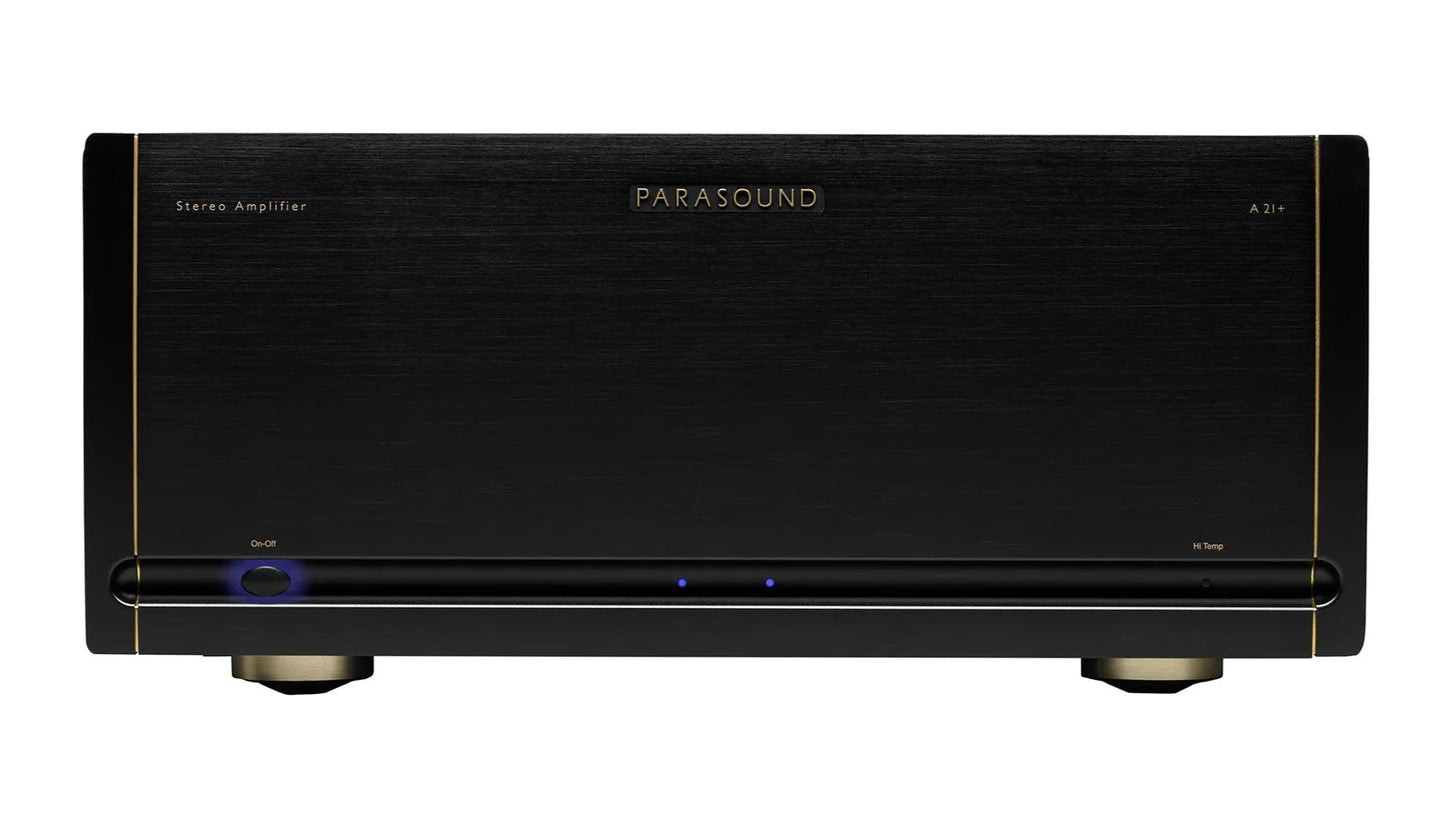
Parasound Halo A21+ Stereo Power Amplifier
Three hundred watts per channel of John Curl–designed, high-bias Class A/AB amplification — built on a 1.3 kVA power supply with 108,000 µF of filter capacitance, and capable of driving virtually any loudspeaker ever made.
What It Is and Who It's For
The Parasound Halo A21+ is a two-channel stereo power amplifier that sits at the top of Parasound's dedicated stereo amplifier line. It delivers 300 watts per channel into 8 ohms, 500 watts into 4 ohms, and 1,000 watts bridged as a monoblock into 8 ohms. At 71 pounds and with a chassis depth of 21.5 inches, it is not a compact unit — it is built around the power supply and output stage the circuit requires, and the size reflects that commitment rather than any design inefficiency.
This amplifier is built for a specific listener. That listener has a serious pair of loudspeakers — full-range floorstanders, planar magnetics, electrostatics, or other demanding designs that reward high-current amplification with control, authority, and dynamic scale. That listener has left the world of integrated amplifiers and wants a dedicated power stage that does one thing exceptionally well. That listener has heard the difference that a properly specified power supply and output stage make, and is not willing to compromise on either. The A21+ is the right answer for that buyer at its price point, and it competes — frequently favorably — with amplifiers that cost considerably more.
It is also, in practice, a remarkably versatile tool. Its balanced XLR and unbalanced RCA inputs, independent level controls, loop outputs, 12V trigger, and ground lift switch make it equally at home in a dedicated two-channel music system, a high-performance home theater front-end, or a bi-amplified configuration with a second amplifier handling a different driver range. Stereophile selected it as a Recommended Component. Future Audiophile named it the Best Affordable Audiophile Power Amp of 2023. These are not casual endorsements.
Engineering: What John Curl Actually Built
The A21+ is a refined and significantly upgraded successor to the Halo A21, which spent 15 years in the lineup — a tenure that speaks to how thoroughly right the original circuit was. The A21+ improves on it in every meaningful performance dimension while preserving the essential character of Curl's design.
The circuit topology follows the same three-stage architecture used throughout Curl's Halo designs. The input voltage amplification stage uses JFET transistors — Junction Field Effect Transistors — which are selected for their extremely low noise characteristics and their smooth, natural handling of the small signal arriving from a preamplifier. JFETs have an inherently low distortion mechanism that makes them well-suited to this role, and their use in the input stage is a deliberate choice for sonic as well as technical reasons. The driver stage uses MOSFETs — Metal Oxide Field Effect Transistors — which provide the second voltage gain stage and are associated with the liquidity and lack of harshness that characterizes well-implemented solid-state designs. The output stage uses 16 beta-matched bipolar transistors, each rated at 15 amperes and 60 MHz — chosen for the ruggedness, linearity, and current delivery capability that the output stage demands. Together, these three transistor types work in their respective domains of excellence, and together they define the sonic character of the amplifier.
The amplifier operates in high-bias Class A/AB mode. Up to approximately 8 watts of output per channel, the output transistors remain fully on for the entire audio cycle — this is pure Class A operation, and it eliminates the crossover distortion that is the primary source of listening fatigue in poorly biased designs. Above 8 watts, the amplifier transitions smoothly into Class AB. At normal residential listening levels with typical speakers, many listeners are operating within that Class A envelope for the majority of the musical program. The bias circuit is also notable for another reason: Parasound engineered it to reach proper operating temperature and bias current essentially from the moment the amplifier turns on, rather than requiring a conventional warm-up period. The amplifier sounds like itself within moments of powering on.
The power supply behind this circuit is genuinely oversized. The 1.3 kVA toroidal transformer is encapsulated for vibration resistance and wound with independent secondary windings for each channel — meaning the left and right channels draw from isolated magnetic cores, not a shared one. Each channel also has its own independent power supply stages for the input, driver, and output sections. The 108,000 µF of filter capacitance gives the output stage enormous charge reserves to draw from during transients, which is why the A21+ delivers 60 amperes of peak current per channel — a figure that reflects instantaneous current availability rather than steady-state averages. That current capability is why the A21+ can drive speakers with impedance dips to 1.5 ohms without destabilizing, and why demanding loudspeakers that compress and harden under less capable amplifiers open up and breathe with more dynamic authority when driven by this one.
The signal path is entirely direct-coupled — no capacitors or inductors anywhere in the audio chain between input and speaker terminals. This topology preserves phase accuracy at low frequencies and removes the frequency-dependent impedance of series capacitors that can subtly affect bass dynamics. The result is a damping factor exceeding 1,100 at 20 Hz, which translates directly to tight, authoritative control over woofer motion regardless of the speaker's impedance behavior.
The A21+ improved on the original A21 in every measurable dimension. Power output increased 20% at 8 ohms and 25% at 4 ohms. The transformer grew from 1.2 to 1.3 kVA. Filter capacitance increased from 88,000 to 108,000 µF. THD at full power was halved from 0.2% to 0.1%, and at normal listening levels it is specified below 0.03%. Channel separation at 20 kHz improved from 63 to 70 dB. Signal-to-noise ratio rose from 112 to 115 dB. Internal audio connections were upgraded to gold-on-gold, and the speaker binding posts were upgraded to the heavy-duty five-way terminals from the flagship JC 5. The amplifier also gained 11 pounds in the process — mass that is accounted for entirely by the larger transformer and additional filter capacitance.
How It Compares: A21+ vs. A23+ and JC 5
The Parasound Halo A23+ uses the same John Curl circuit topology — JFET input, MOSFET driver, bipolar output, dual-mono architecture — in a substantially more compact chassis. It delivers 160 watts per channel into 8 ohms versus the A21+'s 300, uses a 1.1 kVA transformer versus 1.3 kVA, and 54,400 µF of capacitance versus 108,000 µF. At 27 pounds versus 71, the A23+ fits on any shelf. The A23+ is the right choice when the room is smaller, the speakers are reasonably efficient, and form factor matters. The A21+ is the right choice when you are driving larger speakers in a larger room, running demanding loads, or simply want the full measure of headroom that this circuit is capable of delivering. Both are excellent amplifiers. The A21+ is the more capable tool.
The Parasound Halo JC 5, the amplifier above the A21+ in the Halo lineup, also delivers 400 watts per channel into 8 ohms and features dual speaker binding posts per channel — allowing true bi-wiring from the amplifier rather than at the speaker. The JC 5's output stage uses 12 output transistors per channel in a more sophisticated bias management circuit. It is heavier, larger, and more expensive. For buyers with very demanding speakers or who want the highest output in the Halo two-channel stereo line, the JC 5 is the answer. For the very large majority of serious systems, the A21+ is the amplifier the music calls for.
Key Specifications
- Type: Two-channel stereo power amplifier
- Topology: High-bias Class A/AB, dual-mono, direct-coupled
- Power Output (Stereo, 0.1% THD): 300W × 2 into 8Ω; 500W × 2 into 4Ω
- Power Output (Bridged Mono, 0.1% THD): 1,000W into 8Ω (4Ω bridged not recommended)
- THD at Full Power: <0.1%
- THD at Normal Listening Levels: <0.03%
- IMD: <0.04%
- Transient Intermodulation Distortion (TIM): Unmeasurable
- Signal-to-Noise Ratio: >115 dB (A-weighted, IHF)
- Channel Separation: >70 dB at 20 kHz
- Frequency Response: 5 Hz–100 kHz (+0/−3 dB)
- Damping Factor: >1,100 at 20 Hz
- Peak Current: 60A per channel
- Minimum Stable Impedance: 1.5Ω
- Input Transistors: JFET (input stage), MOSFET (driver stage)
- Output Transistors: 16 beta-matched 15A/60 MHz bipolar transistors per channel
- Gain: 29 dB (unbalanced); 35 dB (balanced)
- Input Impedance: 33 kΩ (unbalanced); 66 kΩ (balanced)
- Inputs: 1 pair balanced XLR (per channel); 1 pair unbalanced RCA (per channel)
- Loop Outputs: Yes (one per channel)
- Speaker Outputs: 1 pair heavy-duty 5-way gold-plated binding posts per channel
- Trigger: 12V in/out
- Ground Lift: Rear panel switch
- Power Supply: 1.3 kVA encapsulated toroidal transformer with independent secondary windings per channel; 108,000 µF filter capacitance
- Bias: Exclusive Parasound instant-bias circuit — no warm-up required
- Protection: DC servo, relay speaker protection, thermal sensors, soft-start inrush suppression
- Dimensions: 17⅝"W × 7¾"H × 21½"D (448 × 197 × 546 mm)
- Weight: 71 lbs (32.2 kg)
- Finish: Black
- Warranty: 1 years parts and labor (Parasound USA)
Why Buy From All Elite Audio
All Elite Audio is an authorized Parasound dealer, and the A21+ is one of the amplifiers we know best. We have matched it to a wide variety of speakers and preamplifiers, and we can speak specifically to how it performs in practice rather than on paper. If you are deciding between the A21+ and the A23+, or between the A21+ and the JC 5, or evaluating it against a different brand entirely, we are glad to have that conversation with you before you buy. That conversation is part of what authorized dealer service means.
Call 443-402-5055, text 443-402-5064, or visit us at 1921 York Rd, Timonium, MD 21093.
Frequently Asked Questions
What makes the Parasound Halo A21+ different from a less expensive amplifier at half the price?
The difference is in the power supply and output stage, which are the two things that determine what an amplifier actually does under real musical conditions. The A21+ uses a 1.3 kVA toroidal transformer with independent secondary windings for each channel and 108,000 µF of filter capacitance — a power supply that is genuinely oversized for the rated output and that gives the amplifier 60 amperes of instantaneous peak current per channel. Less expensive amplifiers use smaller transformers and less capacitance, which means they run out of current reserve during transients and compress the dynamics of music in a way that listeners experience as a loss of scale, authority, and engagement. The A21+ also uses John Curl's three-transistor topology — JFET input, MOSFET driver, bipolar output — rather than integrated circuit op-amps, which defines its sonic character rather than constraining it. At normal listening levels, distortion is below 0.03%, a figure that most amplifiers at this price cannot match.
What is the three-transistor circuit topology and why does it matter?
Each amplification stage in the A21+ uses a different type of transistor chosen for what it does best at that point in the circuit. The input stage uses JFETs, which handle the delicate signal from the preamplifier with very low noise and natural gain character. The driver stage uses MOSFETs, which provide smooth, liquid gain without the harshness associated with less carefully designed solid-state circuits. The output stage uses 16 beta-matched bipolar transistors per channel, chosen for their ruggedness and high-current capability. Separating these functions into three stages with the best transistor type for each role is a design philosophy John Curl has refined over decades, and it is why Halo amplifiers consistently sound more natural and less fatiguing than solid-state designs that rely on a single transistor type or integrated circuits throughout.
What does "high-bias Class A/AB" mean, and how much does it actually operate in Class A?
Class A operation means the output transistors remain active — carrying current — for the full audio cycle, even during portions of the waveform where they are not delivering output. This eliminates crossover distortion, the primary source of listening fatigue in Class AB designs. The A21+ runs in pure Class A up to approximately 8 watts per channel. Above 8 watts, the output transistors operate in Class AB — still very low distortion, but no longer fully biased. At normal residential listening levels, 8 watts is more than many listeners use for most of the musical program, which means the A21+ is operating in its purest mode during the passages that matter most. The bias circuit also reaches stable operating temperature almost immediately at power-on, so there is no waiting period before the amplifier sounds its best.
How does the A21+ compare to the Parasound Halo A23+?
Both amplifiers use the same John Curl circuit topology and dual-mono architecture. The A21+ delivers 300 watts per channel versus the A23+'s 160 watts, uses a larger power supply (1.3 kVA transformer, 108,000 µF capacitance versus 1.1 kVA and 54,400 µF), and outputs 60 amperes of peak current versus 45 amperes. The A21+ weighs 71 pounds versus 27 and occupies a significantly larger chassis. For smaller rooms, more efficient speakers, and listeners where physical size is a constraint, the A23+ is an outstanding amplifier that sounds fundamentally similar. For larger rooms, demanding speakers, and listeners who want the full measure of headroom and control this circuit is capable of, the A21+ is the right choice. We can help you assess which one fits your specific situation.
How does the A21+ compare to the Parasound Halo JC 5?
The JC 5 delivers 400 watts per channel into 8 ohms — 33% more than the A21+ — and features a more sophisticated bias management circuit, 12 output transistors per channel rather than 8, and dual sets of speaker binding posts per channel that allow true bi-wiring from the amplifier. It is heavier, larger, and more expensive. For buyers with very large rooms, very inefficient speakers, or who specifically need dual binding posts for bi-wiring, the JC 5 is the answer. The A21+ is the more appropriate and cost-effective tool for the vast majority of serious two-channel systems, and it has been praised by reviewers who compared it directly to amplifiers at two and three times its price.
Is the A21+ truly stable into low-impedance speakers? What does "stable to 1.5 ohms" mean?
Speaker impedance is not a fixed number — it varies with frequency, and many speakers rated at 4 or 8 ohms dip substantially lower in the bass region. An amplifier that cannot maintain control at those low impedances will compress dynamics, harden tonally, and in extreme cases shut down on protection. The A21+ is specified to remain stable with impedance dips to 1.5 ohms, which puts it below virtually any speaker on the market. With 60 amperes of peak current available per channel and a direct-coupled output stage with a damping factor exceeding 1,100, the A21+ maintains the same control over woofer motion at 2 or 3 ohms that it does at 8 ohms. This is why it pairs particularly well with Magnepan planar magnetics, electrostatic speakers, and other designs whose impedance curves are challenging.
Can I bridge two A21+ amplifiers as monoblocks?
Yes. In bridged mono mode, each A21+ delivers 1,000 watts into 8 ohms. This configuration is used when you want the maximum output available from the Halo power amplifier line for a demanding speaker in a large room, or when you are building a fully monoblock system for the highest level of channel isolation. Note that bridged operation into 4 ohms is not recommended — in bridged mode, the amplifier sees a 2-ohm effective load per output stage at 4-ohm nominal impedance, which approaches the lower stability limit. Bridged operation works best with 8-ohm speakers.
What preamp should I pair with the A21+?
The A21+ is a neutral, transparent amplifier that will perform well with any quality line-level preamplifier. Within the Parasound Halo family, the natural pairing is the Halo P6, which provides a DAC, phono stage, and analog bass management in addition to a clean balanced line stage. For the highest-performance two-channel system without digital or phono requirements, the JC 2 BP is the reference-grade Halo preamplifier — fully balanced dual-mono with hand-matched FETs and a DC-coupled signal path. Both carry balanced XLR outputs that take full advantage of the A21+'s discrete balanced input circuits. We carry both and are glad to discuss which makes more sense for your system.
What do the rear-panel gain controls do and how should they be set?
The A21+ has independent level controls for each channel on the rear panel, marked in clock-face positions from minimum to maximum. At maximum (fully clockwise), the gain controls are out of the circuit entirely and the amplifier operates at full sensitivity. The calibrated positions — 29 dB gain for unbalanced input at the 3 o'clock position, for example — allow you to match the A21+'s sensitivity to your preamplifier's output level and reduce overall system noise if your preamplifier has a high output voltage. Setting both channels to identical calibrated positions ensures the dual-mono channels are precisely matched. This is a genuinely useful feature in real-world installations where gain staging matters for system noise.
Does the A21+ have any protection circuits, and what happens if something goes wrong?
The A21+ incorporates a full suite of protection circuits. DC offset protection uses a DC servo circuit that continuously monitors and corrects any DC offset that could damage speakers. Relay speaker protection physically disconnects the speaker outputs if a fault condition is detected. Thermal sensors monitor the output stage temperature and will shut the amplifier down before any thermal damage can occur. AC turn-on inrush suppression uses a soft-start circuit with relay bypass that limits the initial power surge when the amplifier is switched on, protecting both the amplifier and any connected equipment from the high inrush current that large toroidal transformers generate. A ground lift switch on the rear panel allows you to break the chassis ground connection if a ground loop is causing audible hum in your specific installation.
Where can I buy the Parasound Halo A21+ and get expert support?
All Elite Audio at 1921 York Rd, Timonium, MD 21093 is an authorized Parasound dealer with the A21+ in stock. Purchasing from an authorized dealer is the only way to receive full factory warranty coverage and factory service access for the life of the product. We have direct experience with this amplifier in a range of system configurations and are glad to discuss speaker matching, preamplifier pairing, and system integration before you purchase. Call 443-402-5055, text 443-402-5064, or stop in. We ship with full warranty intact for customers outside the Baltimore area.


Outlet Deals
-
Parasound HALO A21+ (USED)
Power Amplifier (USED)Regular price $4,000.00Regular priceUnit price per$5,000.00Sale price $4,000.00SALE -
Advance Paris A12 Classic
Integrated Amplifier (USED)Regular price $3,600.00Regular priceUnit price per$4,500.00Sale price $3,600.00SALE -
 SALE
Hegel H190v
Integrated Amplifier (USED)Regular price $2,995.00Regular priceUnit price per$4,600.00Sale price $2,995.00SALE -
 SALE
HiFi Rose RS520
Streaming Integrated Amplifier (USED)Regular price $2,495.00Regular priceUnit price per$3,995.00Sale price $2,495.00SALE -
Advance Paris A10 Classic
Integrated Amplifier (USED)Regular price $2,400.00Regular priceUnit price per$3,000.00Sale price $2,400.00SALE -
 SALE
Yamaha RX-A6A
Home Theater Receiver (USED)Regular price $1,995.00Regular priceUnit price per$2,700.00Sale price $1,995.00SALE


New Releases
-
KLH Model Four
Floorstanding SpeakersRegular price $1,999.98Regular priceUnit price per$1,999.98Sale price $1,999.98 -
Dual CS 718Q
TurntableRegular price $3,500.00Regular priceUnit price per$3,500.00Sale price $3,500.00 -
EverSolo DMP-A8 Gen 2
Music Streamer, DAC & PreamplifierRegular price $1,980.00Regular priceUnit price per$1,980.00Sale price $1,980.00 -
EverSolo DMP-A8 Gen 2 Master Edition
Music Streamer, CD Player, DAC & PreamplifierRegular price $2,580.00Regular priceUnit price per$2,580.00Sale price $2,580.00 -
EverSolo T10
Streaming TransportRegular price $2,180.00Regular priceUnit price per$2,180.00Sale price $2,180.00 -
 SALE
KLH Model Seven
Floorstanding SpeakersRegular price $4,999.98Regular priceUnit price per$5,998.00Sale price $4,999.98SALE