

Accuphase
Have a trade-in item? Click here.
Specs
| Type | Precision integrated stereo amplifier, Class AB, fully balanced from input to output |
| Rated output (8 ohms) | 260 W per channel, both channels driven, 20 to 20,000 Hz |
| Rated output (4 ohms) | 350 W per channel, both channels driven, 20 to 20,000 Hz |
| Output stage | Six-fold parallel push-pull bipolar transistors per channel, driven in Class AB |
| Damping factor | 1,000 guaranteed |
| Total harmonic distortion | 0.05 percent, 4 to 16 ohm load at rated output |
| Intermodulation distortion | 0.01 percent |
| Frequency response (INPUT) | 20 to 20,000 Hz, +0 / -0.5 dB at rated output |
| Frequency response (MAIN IN) | 3 to 150,000 Hz, +0 / -3.0 dB at 1 W output |
| Volume control | Balanced AAVA with ANCC, two AAVA modules per channel, no variable resistors in the signal path |
| S/N ratio (INPUT) | 112 dB, input shorted, A weighted, at rated output |
| S/N ratio (MAIN IN) | 126 dB, input shorted, A weighted, at rated output |
| Input equivalent noise | -124 dBV (INPUT), -121 dBV (MAIN IN), input shorted, A weighted |
| Input sensitivity | 229 mV at INPUT, 1.82 V at MAIN IN, at rated output |
| Input impedance | 40 kilohms balanced, 20 kilohms line |
| Maximum input voltage | 5.0 V |
| Pre output | 1.82 V at rated output, 50 ohm output impedance, line and balanced |
| Gain | 18 dB from INPUT to PRE OUTPUT, 28 dB from MAIN IN to speaker output |
| Analog inputs | Five line inputs (TUNER, CD, LINE 1, 2, 3) plus two balanced inputs (BAL CD, BAL) |
| Recorder loop | One PLAY / REC set |
| Speaker terminals | Two sets (A / B), large binding posts connected directly to the protection circuitry |
| Speaker protection | MOS-FET switches, 0.84 milliohm on resistance, in place of mechanical relays |
| Tone controls | Bass 300 Hz plus or minus 10 dB, treble 3 kHz plus or minus 10 dB, with defeat |
| Loudness compensator | +6 dB at 100 Hz |
| Attenuator | -20 dB |
| Headphone output | Dedicated discrete headphone amplifier, 8 ohms or higher |
| Power meters | Logarithmic compression peak level display, dB and percent |
| Option board slots | Two, for DAC-60, AD-60 or LINE-10 |
| Power supply | Massive high efficiency toroidal transformer with two 47,000 uF / 100 V filtering capacitors |
| Power requirements | 120 V AC, 50 / 60 Hz |
| Power consumption | 90 W idle, 380 W per IEC 62368-1, 887 W at 8 ohm rated output, 0.4 W standby |
| Insulators | High carbon cast iron |
| Dimensions (W x H x D) | 465 x 221 x 502 mm (18.3 x 8.7 x 19.8 in) |
| Mass | 38.6 kg (85.1 lbs) net, 48 kg (106 lbs) in shipping carton |
| Supplied accessories | AC power cord (2 m) and Remote Commander RC-260 with CD player operation |
Warranty
Sold as an authorized Accuphase dealer by All Elite Audio, so your E-6000 carries the full three year manufacturer warranty from the date of purchase. Accuphase service in the United States is handled through the distributor, and we start every claim for you rather than handing you a phone number. Keep the receipt we email with your order, since it is the proof of purchase the warranty runs from.
What’s in the Box
- Accuphase E-6000 precision integrated stereo amplifier
- Remote Commander RC-260, which also operates an Accuphase CD player
- AC power cord, 2 m (6.5 ft)
- Owner's manual and warranty documentation
Overview
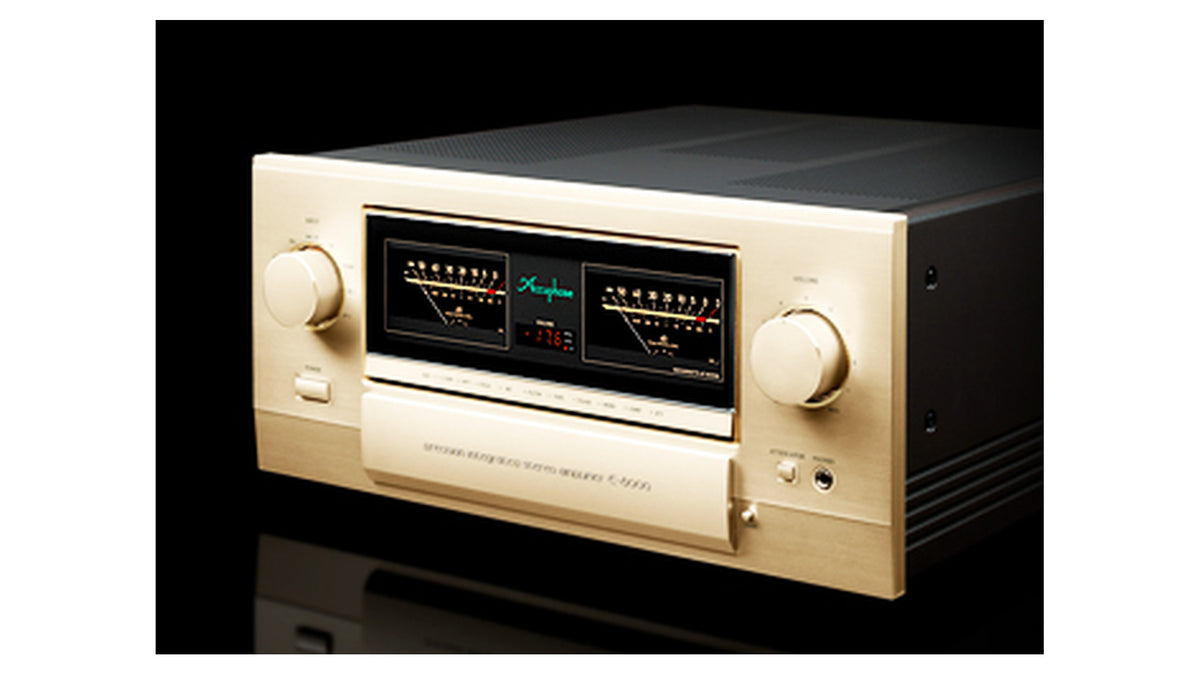
The E-6000 is the most powerful integrated amplifier Accuphase has built. Its Class AB output stage uses a six-fold parallel push-pull arrangement of bipolar transistors per channel, rated at 260 watts into 8 ohms and 350 watts into 4 ohms, with a guaranteed damping factor of 1,000. That damping figure is the same one Accuphase guarantees for the P-7500, their flagship Class AB stereo power amplifier, and it comes from the same power amplifier engine. In practice it means the E-6000 grips a difficult loudspeaker the way a serious separate power amplifier does, which is the usual reason people step past an integrated in the first place.
The preamplifier section is built around Balanced AAVA, Accuphase's volume control principle that removes variable resistors from the signal path entirely. Instead of attenuating the signal with a potentiometer that wears and adds noise, AAVA converts the signal to current, splits it into weighted steps, and recombines them. The E-6000 runs two AAVA modules per channel in a balanced arrangement and adds ANCC, a circuit that uses a second low noise amplifier to cancel the main amplifier's own noise and distortion. The guaranteed signal to noise ratio is 112 dB, and the character of it matters more than the number: there is no grit or channel imbalance at low listening levels, which is where most volume controls give themselves away.
Inside, the layout is monoblock. Separate left and right power amplifier modules sit on their own heat sinks either side of a central power supply built on a massive toroidal transformer and two 47,000 microfarad filtering capacitors. The Balanced AAVA module sits at the front of the chassis, away from the transformer, so the lowest level signals never run alongside the supply. Speaker protection is handled by MOS-FET switches rather than mechanical relays, measuring 0.84 milliohms on resistance, because a relay's contact resistance sits directly in the speaker path and works against the damping factor.
Two rear expansion slots take Accuphase option boards, so the E-6000 can become a streaming DAC or a phono stage without a second box. The front panel reads out the sampling frequency and the MC loading once a board is fitted. Elsewhere it is a full function amplifier in a way that most high end designs are not: tone controls with defeat, a loudness compensator, a -20 dB attenuator, mono, phase per input, fine balance adjustment, two sets of speaker terminals, pre outs and main ins in both line and balanced form for bi-amping, and a dedicated discrete headphone amplifier.
Key Features
- 260 watts per channel into 8 ohms and 350 watts into 4 ohms, the highest power in the Accuphase integrated line
- Six-fold parallel push-pull bipolar output stage per channel, the same engine as the P-7500 power amplifier
- Guaranteed damping factor of 1,000, equal to the flagship Class AB stereo power amplifier
- Balanced AAVA volume control with ANCC, two modules per channel, no variable resistors in the signal path
- 112 dB signal to noise ratio guaranteed, with no rasping or imbalance at low volume
- Power amplification stage configured as an instrumentation amplifier for high external noise rejection
- Balanced remote sensing, taking feedback from both the signal and ground sides at the speaker terminals
- MOS-FET speaker protection switches at 0.84 milliohms rather than mechanical relays
- Monoblock internal construction with a massive toroidal transformer and two 47,000 uF filtering capacitors
- Two option board slots for the DAC-60 digital input board, AD-60 phono board or LINE-10 line input board
- Five line inputs, two balanced inputs, a recorder loop, and two sets of large speaker terminals
- Pre outs and main ins in both line and balanced form, so the amplifier splits for bi-amping
- Tone controls with defeat, loudness compensator, -20 dB attenuator, mono and per input phase
- Newly developed large analog power meters that track levels below -60 dB
- High carbon cast iron insulators and a dedicated discrete headphone amplifier
Option Boards
The two rear slots take Accuphase option boards, and we stock the two that matter most. Either can be fitted at any time, and the front panel gains the matching controls once it is in.
Accuphase DAC-60
The digital input board, built on two ESS ES9016K2M chips driven in parallel. It adds USB, optical and coaxial inputs, handling PCM to 384 kHz and DSD to 11.2 MHz over USB, and puts the incoming sampling frequency on the front display.
Accuphase AD-60
The analog record input board, a full phono stage for MC and MM cartridges. MC runs 66 dB of gain with selectable 30, 100, 200 or 300 ohm loading from the front panel, MM runs 40 dB at 47 kilohms, and a subsonic filter is included.
How the E-6000 Compares
Where the E-6000 sits in the Accuphase integrated range, against the other models we carry. Every one of these is a fine amplifier, so the question is which kind of power delivery suits your speakers.
Accuphase E-6000 vs E-800S
The E-800S is the Class A flagship. Class A biasing gives that unmistakable Accuphase midrange at the first watt, but it is rated at lower power and runs hot by design. The E-6000 is the Class AB answer: more current on tap for demanding or low sensitivity speakers, a guaranteed damping factor of 1,000, and far less heat in the rack. Choose the E-800S for sensitive speakers in a normal room, the E-6000 when the loudspeaker is the hard part.
Accuphase E-6000 vs E-700
The E-700 is the Class A model one rung down, and it shares the family voice. The E-6000 brings substantially more output, the six-fold parallel output stage, and the ability to drive a 4 ohm load to 350 watts per channel. If your speakers are an easy load the E-700 will not leave you wanting. If they dip low in impedance or live in a large room, the E-6000 is the one with headroom to spare.
Accuphase E-6000 vs E-4000
The E-4000 is the Class AB model below this one and shares the same philosophy, including AAVA volume control and the option board slots. The E-6000 adds the six-fold parallel output stage, the larger transformer and 47,000 uF capacitors, Balanced AAVA with ANCC rather than standard AAVA, and the higher damping factor. The E-4000 is the value in the line. The E-6000 is what you buy when you intend to stop upgrading amplifiers.
Recommended Speakers
With 260 watts into 8 ohms and a damping factor of 1,000, the E-6000 is happiest driving speakers that defeat lesser amplifiers. These are pairings from our floor that suit it.
Gauder Akustik Capello 80 DV
Gauder and Accuphase share a distributor and get paired constantly, for good reason. The diamond tweeter and ceramic midrange are ruthlessly revealing of the amplifier in front of them, and the E-6000's low noise floor and grip are exactly what that kind of driver wants.
Gauder Akustik Arcona 100 MKII SD
The Arcona is the more forgiving Gauder, a steep slope crossover floorstander that stays composed at volume. A natural first pairing if you are building the system around the amplifier.
Marten Parker Trio
Ceramic drivers and a demanding impedance curve, the sort of speaker that sounds thin on an underpowered amplifier and comes alive with current behind it.
Spendor Classic 200
A large classic British monitor with real bass extension. It wants an amplifier that can control a big cone rather than merely make it loud, which is where the damping factor of 1,000 shows itself.
Frequently Asked Questions
What is the Accuphase E-6000?
It is Accuphase's most powerful integrated amplifier, a Class AB design rated at 260 watts per channel into 8 ohms and 350 watts into 4 ohms, with Balanced AAVA volume control and two slots for option boards.
How much power does the E-6000 deliver?
260 watts per channel into 8 ohms and 350 watts per channel into 4 ohms, with both channels driven from 20 to 20,000 Hz. That is the highest rated output of any Accuphase integrated amplifier.
What is AAVA?
AAVA stands for Accuphase Analog Vari-gain Amplifier. It is a volume control that uses no variable resistors at all. The signal is converted to current, divided into weighted steps, and recombined to set level, so there is nothing in the signal path to wear out, go noisy or drift between channels.
What does Balanced AAVA add over standard AAVA?
The E-6000 runs two AAVA modules per channel in a balanced arrangement rather than one. Accuphase measures roughly a 10 percent lower overall noise level at typical volume positions compared with conventional models.
What is ANCC?
ANCC is Accuphase's Noise and distortion Canceling Circuit. A second low noise amplifier produces a correction signal that cancels noise and distortion generated by the main amplifier. In the E-6000 it is applied to the current to voltage converter inside the AAVA circuit, which cleans up the transition from low to normal listening levels.
What does a damping factor of 1,000 actually mean?
Damping factor is the ratio of 8 ohms to the amplifier's output impedance, and it describes how tightly the amplifier controls the speaker cone's motion. At 1,000 guaranteed, the E-6000 matches the P-7500, Accuphase's flagship Class AB stereo power amplifier. You hear it as bass that starts and stops cleanly rather than overhanging.
Is the E-6000 Class A or Class AB?
Class AB. Accuphase builds both, and the Class A models such as the E-800S and E-700 sit alongside it. Class AB is what allows this much output and current without the heat a Class A amplifier of similar power would produce.
Will it drive difficult speakers?
That is the point of it. The six-fold parallel push-pull output stage, the 350 watt rating into 4 ohms and the damping factor of 1,000 are aimed squarely at low sensitivity and low impedance loudspeakers. Call us with your speaker model and we will tell you honestly whether you need this much amplifier.
Can I add a DAC?
Yes. The DAC-60 digital input board fits one of the two rear slots and adds USB, optical and coaxial inputs with PCM to 384 kHz and DSD to 11.2 MHz, using two ESS ES9016K2M chips in parallel. The front panel then displays the incoming sampling frequency.
Can I add a phono stage?
Yes. The AD-60 analog record input board adds a full phono stage for both MC and MM. MC runs 66 dB of gain with 30, 100, 200 or 300 ohm loading selectable from the front panel, MM runs 40 dB at 47 kilohms, and there is a subsonic filter.
Can I fit two option boards at once?
Yes. There are two slots, so a common setup is the DAC-60 and the AD-60 together, giving you digital inputs and a phono stage in one chassis.
Can the preamplifier and power amplifier sections be separated?
Yes. Pre outs and main ins are provided in both line and balanced form, so you can run the E-6000's preamp into another power amplifier, use its power amp section alone, or bi-amp a speaker that has separate low and high inputs.
Does it have tone controls?
Yes, bass at 300 Hz and treble at 3 kHz, each adjustable plus or minus 10 dB, with a defeat switch that takes them out of the circuit. There is also a loudness compensator that adds 6 dB at 100 Hz for low level listening.
Is there a headphone output?
Yes, driven by a dedicated headphone amplifier built with discrete circuitry rather than an op amp tapped off the speaker output. It suits headphones of 8 ohms impedance and higher.
How heavy is it and will it fit my rack?
It measures 465 mm wide, 221 mm high and 502 mm deep, which is 18.3 by 8.7 by 19.8 inches, and weighs 38.6 kg or 85.1 lbs. The depth is the figure to check, since half a metre is deeper than many racks allow, and you need clearance behind it for cables.
Does it run hot?
Far less than a Class A amplifier of comparable output. Idle consumption is 90 watts. Give it normal ventilation above and behind and it is happy in a rack, which is not something you can say about every amplifier at this power level.
What comes in the box?
The amplifier, the RC-260 remote commander, which also operates an Accuphase CD player, a 2 metre AC power cord, and the manual and warranty paperwork.
What is the warranty?
Three years from date of purchase through an authorized dealer. We handle any warranty claim for you directly with the distributor.
Can I hear one before buying?
Yes. We have an Accuphase room in our showroom and can set the E-6000 up with the speakers you are considering. Give us a call and we will have it warmed up before you arrive.
Why buy from All Elite Audio?
We are an authorized Accuphase dealer, so your amplifier carries its full manufacturer warranty and we handle service directly rather than sending you to a phone number. We set the gear up in our showroom, we answer the phone, and we help you install and dial it in after it arrives.