

Matrix Audio
Couldn't load pickup availability
Have a trade-in item? Click here.
Specs
| Type | Digital audio transport / network transport (no analog output, no internal DAC) |
| Supported PCM | High rate PCM |
| Supported DSD | DSD (native/DoP) |
| MQA | Supported |
| Streaming Services | AirPlay 2, DLNA/UPnP, TIDAL Connect, Qobuz Connect, Spotify Connect, vTuner, Radio Paradise, QQMusic ("The audio specs depend on the service provider") |
| Roon | Roon Ready endpoint |
| Master Clock | High precision femtosecond master clock |
| Clock Input | External clock input for Matrix Audio SC-1 |
| Network | LAN 10/100/1000 Mbps |
| Control | Matrix Audio MA app |
| Digital Output - Coaxial, Optical & AES/EBU | PCM 16-24Bit /44.1kHz, 48kHz, 88.2kHz, 96kHz, 176.4kHz, 192kHz; DSD 2.8MHz (DoP) |
| Digital Output - IIS LVDS | PCM 16-32Bit /44.1kHz, 48kHz, 88.2kHz, 96kHz, 176.4kHz, 192kHz, 352.8kHz, 384kHz, 705.6kHz, 768kHz; DSD 2.82MHz, 3.07MHz, 5.64MHz, 6.14MHz, 11.29MHz, 12.29MHz, 22.58MHz, 24.58MHz |
| Digital Output - USB DAC | Depends on the specifications supported by the connected USB DAC device. Not higher than PCM 32Bit/768kHz and DSD 24.58MHz. The USB DAC port provides a maximum of 5V/1A low-noise power supply. |
| USB Ports | USB 3.0 x 2 (the USB port provides a maximum power of 5V/1A) |
| External Clock Input | 10MHz / 50Ω / Sine wave or square wave input |
| Trigger | Trigger Input DC 6-12V<10mA; Trigger Output DC 12V/50mA |
| Storage Extension | M.2 2280 2260 2242 NVMe PCIe SSD slot x1 (slot provides DC 3.3V/3A maximum) |
| Roon Ready | PCM 16-24 Bit /44.1 kHz, 48kHz, 88.2kHz, 96kHz, 176.4kHz, 192kHz, 352.8kHz, 384kHz, 705.6kHz, 768kHz; DSD 2.82MHz, 5.64MHz, 11.29MHz, 22.58MHz |
| Local Playback (MA Player) | MP3, WMA, WAV, AIF, AIFC, AIFF, AAC, FLAC, OGG, APE, ALAC, M4A, DSF, DFF, CUE, ISO; PCM 16-24Bit/44.1kHz to 768kHz; DSD 2.82MHz to 24.58MHz |
| Controller App | MA Remote App |
| Power Voltage | AC 100V-120V 50/60Hz or AC 220V-240V 50/60Hz Auto Range |
| Standby Power Consumption | < 5W |
| Maximum Power Consumption | < 50W |
| Dimensions (W x H x D) | 330 x 97 x 267 mm (12.99 x 3.82 x 10.51 in) |
| Weight | 4.6kg (10.14 pounds) |
Warranty
Sold as an authorized Matrix Audio dealer by All Elite Audio. New Matrix Audio NT-1 units include the full Matrix Audio manufacturer warranty of 1 year parts and labor for the original owner. Contact us with any setup or service questions.
What's in the Box
- Matrix Audio NT-1 Reference Digital Audio Transport
- Power cable
- Quick start guide
- Warranty documentation
Overview
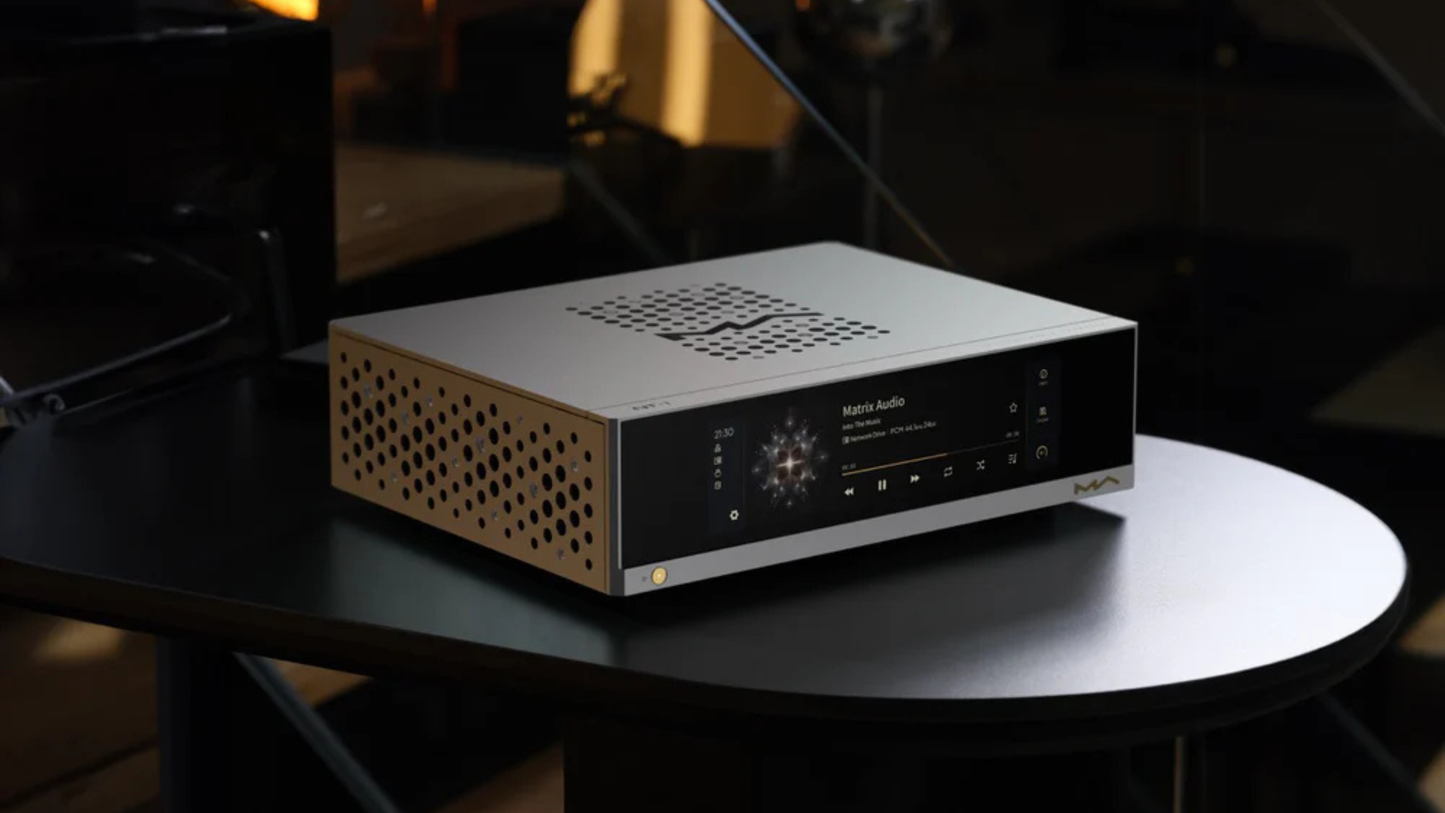
The Matrix Audio NT-1 Reference Digital Audio Transport is a dedicated network and digital source component built to deliver an ultra clean bitstream to an outboard DAC. It has no analog stage and no built-in converter by design, focusing every part of its engineering on retrieving and reclocking digital audio with the lowest possible noise and jitter. This single minded approach is aimed at listeners who already own a resolving DAC and want the cleanest possible digital feed ahead of it.
At its core the NT-1 combines native streaming with a high precision femtosecond master clock and an external clock input for the Matrix Audio SC-1 reference clock. It runs as a Roon Ready endpoint and supports TIDAL, Qobuz, Spotify, DLNA and AirPlay, with control through the Matrix Audio MA app. Format handling covers high rate PCM, DSD and MQA, and the digital outputs are engineered to pass that signal on with minimal timing error.
The NT-1 suits the serious two channel or headphone listener assembling a separates system. Pair it with a Matrix Audio DAC such as the ND-1, then add amplification and speakers to complete a source first, high resolution digital chain that can grow over time.
Key Features
- Dedicated digital transport with no onboard DAC, engineered purely for clean bitstream delivery to an external converter
- High precision femtosecond master clock for very low jitter timing
- External clock input for the Matrix Audio SC-1 reference clock to further reduce timing error
- Roon Ready endpoint with TIDAL, Qobuz, Spotify, DLNA and AirPlay support
- Native high rate PCM, DSD and MQA handling passed through the digital outputs
- Controlled through the Matrix Audio MA app for browsing and playback
- Multiple digital outputs for flexible pairing with a wide range of DACs
- Wired network connection for a stable, low noise streaming path
How the NT-1 Compares
Matrix Audio NT-1 vs Matrix Audio TT-1
The TT-1 sits a step below the NT-1 in the Matrix Audio transport ladder and shares the same core idea of a pure digital source feeding an external DAC. The NT-1 is the reference expression of that concept, with a more ambitious clocking approach and external clock capability. Choose the TT-1 for a leaner transport and the NT-1 when you want the fullest treatment of the digital path. See the Matrix Audio TT-1.
Matrix Audio NT-1 vs TEAC NT-507T
The TEAC NT-507T is another network transport that outputs digital only, making it a direct conceptual peer for feeding an external DAC. The two differ in house character and control ecosystem, with the NT-1 leaning on the Matrix Audio MA app, Roon Ready operation and SC-1 external clock support. Pick the one whose platform and connectivity match the DAC and system you already run. See the TEAC NT-507T.
Matrix Audio NT-1 vs EverSolo T10
The EverSolo T10 is also a streaming transport meant to sit ahead of a separate DAC. It offers a different user interface philosophy and feature mix, while the NT-1 focuses on reference grade clocking and the option of an external SC-1 clock. Both are valid choices for a source first digital chain, so match by control preference and the digital outputs your DAC needs. See the EverSolo T10.
Recommended DAC, Amplifier and Speakers
The NT-1 outputs digital only, so it needs an outboard DAC to make sound. Here is a complete Matrix Audio front end plus amplification and speakers to finish the system.
- Matrix Audio ND-1 DAC A dedicated DAC that gives the NT-1 transport a natural converter partner, turning the clean digital feed into an analog signal within the same brand ecosystem.
- Matrix Audio MA-1 Power Amplifier The flagship Class AB MA-1 supplies the power stage after your DAC, keeping the amplification within Matrix Audio for a coherent system approach.
- Matrix Audio MS-1 Pre If you prefer streaming, DAC and preamp duties in one chassis alongside the NT-1, the MS-1 Pre adds preamplifier control to drive the MA-1.
- Spendor A2.2 Floorstanders A refined, easy to place floorstander that rewards a clean high resolution source chain with natural tone and imaging.
- Klipsch Heresy IV A high sensitivity, dynamic Heritage design for listeners who want scale and immediacy from the NT-1 fed system.
Frequently Asked Questions
Does the Matrix Audio NT-1 have a built-in DAC?
No. The NT-1 is a dedicated digital transport with no onboard converter, so it must be paired with an external DAC to produce sound.
What is the NT-1 designed to do?
It retrieves and reclocks network and digital audio, then sends a clean bitstream to an outboard DAC with the lowest possible noise and jitter.
Is the NT-1 Roon Ready?
Yes. It operates as a Roon Ready endpoint for use within a Roon system.
Which streaming services does it support?
It supports TIDAL, Qobuz, Spotify, DLNA and AirPlay, with control through the Matrix Audio MA app.
Can I control the NT-1 from my phone?
Yes. The Matrix Audio MA app is used for browsing and playback control.
Does the NT-1 support DSD and MQA?
Yes. It handles high rate PCM, DSD and MQA and passes these through its digital outputs.
Can I connect an external clock?
Yes. The NT-1 has an external clock input for the Matrix Audio SC-1 reference clock.
What is the femtosecond clock for?
The high precision femtosecond master clock reduces timing error and jitter for a more accurate digital output.
Which DAC should I pair with the NT-1?
A Matrix Audio DAC such as the ND-1 is a natural partner, keeping the front end within one design ecosystem.
Can I use the NT-1 with a DAC from another brand?
Yes. Any DAC with a matching digital input can be used, provided its inputs suit the NT-1 digital outputs.
How does the NT-1 compare to the TT-1?
The TT-1 is the step down transport in the range. The NT-1 is the reference model with a more ambitious clocking approach and external clock support.
Is the NT-1 a good fit for headphone listening?
Yes, when paired with a DAC and headphone stage. It supplies a clean digital feed that a resolving headphone chain can showcase.
Does the NT-1 use a wired network connection?
Yes. A wired Ethernet connection is used for a stable, low noise streaming path.
Can the NT-1 grow with my system?
Yes. As a source first component it lets you build out the DAC, amplifier and speakers over time.
What amplifier works well after the DAC?
The Matrix Audio MA-1 Class AB power amplifier is a strong in brand choice for the amplification stage.
Do I need a separate preamplifier?
That depends on your DAC. A model like the MS-1 Pre combines streaming, DAC and preamp functions if you want fewer boxes.
Is a network switch or isolator worth adding?
Matrix Audio offers audio grade galvanically isolated switches and isolators that lower network noise ahead of a streamer, which can complement the NT-1.
What speakers suit an NT-1 based system?
Refined floorstanders like the Spendor A2.2 or dynamic Heritage designs like the Klipsch Heresy IV both pair well depending on your taste.
What warranty does the NT-1 include?
It carries a 1 year parts and labor warranty from Matrix Audio for the original owner.
Why buy from All Elite Audio?
All Elite Audio is an authorized Matrix Audio dealer in MD with the NT-1 in stock, so you receive a genuine unit, full warranty support and expert help building the right system around it.


Outlet Deals
-
Parasound HALO A21+ (USED)
Power AmplifierRegular price $4,000.00Regular priceUnit price per$5,000.00Sale price $4,000.00SALE -
 SALE
SALEHiFi Rose RS520
Streaming Integrated AmplifierRegular price $2,995.00Regular priceUnit price per$3,995.00Sale price $2,995.00SALE -
 SALE
SALEYamaha RX-A6A
Home Theater ReceiverRegular price $1,995.00Regular priceUnit price per$2,700.00Sale price $1,995.00SALE -
NAD C 399 with MDC2 BluOS-D
Integrated AmplifierRegular price $1,795.00Regular priceUnit price per -
 SALE
SALEEversolo DMP-A8
Network Streamer, DAC and PreamplifierRegular price $1,495.00Regular priceUnit price per$1,980.00Sale price $1,495.00SALE -
 SALE
SALETEAC AX-505
Stereo Integrated AmplifierRegular price $1,395.00Regular priceUnit price per$2,000.00Sale price $1,395.00SALE


New Releases
-
KLH Model Four
Floorstanding SpeakersRegular price $1,999.98Regular priceUnit price per$1,999.98Sale price $1,999.98 -
Dual CS 718Q
TurntableRegular price $3,500.00Regular priceUnit price per$3,500.00Sale price $3,500.00 -
EverSolo T10
Streaming TransportRegular price $2,180.00Regular priceUnit price per$2,180.00Sale price $2,180.00 -
Luxman L-100 CENTENNIAL
Pure Class A Integrated AmplifierRegular price $11,995.00Regular priceUnit price per$11,995.00Sale price $11,995.00 -
EverSolo DMP-A8 Gen 2 Master Edition
Music Streamer, CD Player, DAC & PreamplifierRegular price $2,580.00Regular priceUnit price per$2,580.00Sale price $2,580.00 -
 SALE
SALEKLH Model Seven
Floorstanding SpeakersRegular price $4,999.98Regular priceUnit price per$5,998.00Sale price $4,999.98SALE