Klipsch Heritage
Klipsch The Sevens II Powered Stereo Speakers with HDMI ARC, Built-In Phono Preamp, and Bluetooth — Pair
Klipsch The Sevens II Powered Stereo Speakers
The most capable speaker in Klipsch's powered lineup — a room-filling, full-range system with the horn efficiency and input versatility to replace an entire component rack.
At a Glance
- Horn-loaded 1-inch aluminum dome tweeter delivers the dynamic efficiency and transient precision that defines the Klipsch sound
- 6.5-inch copper-spun IMG woofer provides extended bass response and higher output than The Fives II
- Built-in Class D amplification — no receiver, no preamp, no external amp required
- HDMI ARC input connects directly to your television with a single cable, controlled by your TV remote
- Built-in moving-magnet phono preamp — connect a turntable directly and play records without additional hardware
- Bluetooth 5.0 with aptX for high-quality wireless streaming from any phone, tablet, or laptop
- Subwoofer output for seamless system expansion in larger rooms
- Optical digital, analog RCA, 3.5mm aux, and USB-C audio inputs also included
- Remote control included
- Available in matte black and walnut finishes
- Sold as a pair
What They Are and Who They're For
The Klipsch The Sevens II sit at the top of Klipsch's powered speaker lineup just below the flagship Nines II, and they earn that position not through marketing positioning but through genuine performance. Where The Fives II at $1,399.99 is optimized for desktops, bedrooms, and medium living rooms, The Sevens II at $1,999.99 are built for spaces where the music needs to fill the room — larger living rooms, open-plan layouts, dedicated listening spaces, and home offices where the speakers are doing serious work all day. They use a 6.5-inch woofer, a horn-loaded 1-inch tweeter, and a Class D amplifier with enough headroom to let the 96 dB sensitivity work the way Klipsch intends: effortlessly loud, dynamically uncompressed, and never strained.
The buyer for The Sevens II typically falls into one of two categories. The first is a music listener who has outgrown bookshelf-scale sound and wants genuine room presence without building a separate amplifier and preamp system. The second is someone who understands exactly what they are buying — a Klipsch horn speaker with a full-featured connectivity suite — and wants the most capable version of that product short of the flagship Nines II. Both buyers will find that The Sevens II delivers on every front: it sounds larger than its cabinet suggests, integrates into a modern home without visible component clutter, and handles every source from a turntable to a television to a phone without compromise.
The Engineering Behind the Sound
The Tractrix horn is the defining feature of every Klipsch loudspeaker, and The Sevens II is no exception. Horn loading increases tweeter efficiency dramatically — The Sevens II are rated at 96 dB sensitivity at 1 watt at 1 meter, a figure that puts them in the same efficiency territory as some high-end passive loudspeakers that cost multiples more. What sensitivity means in practice is that the tweeter reaches any given volume level using a fraction of the power a conventional dome tweeter would require. Lower power at the tweeter means lower distortion at normal listening levels, which translates directly into the clarity, openness, and dynamic aliveness that Klipsch speakers are known for. When a piano note strikes or a drum transient lands, it arrives with the speed and precision of a live instrument rather than a softened, averaged reproduction.
The 6.5-inch copper-spun IMG woofer is the feature that most directly separates The Sevens II from The Fives II. IMG stands for Injection Molded Graphite — a cone material that combines rigidity with low mass, which is precisely what a woofer cone needs to behave as a true piston across its operating bandwidth. The copper finish signals that this driver is built to tighter tolerances than standard production. The larger cone area and longer excursion capability of the 6.5-inch driver extend bass response meaningfully lower than the 5.25-inch woofer in The Fives II, and they allow The Sevens II to move more air — which is what you feel as well as hear when the music has real low-frequency weight. In a room of 200 square feet or larger, the difference between a 5.25-inch and a 6.5-inch woofer is not subtle.
The crossover between the woofer and the Tractrix horn tweeter is set at 1,500 Hz, which keeps the horn operating in its range of maximum competence and prevents the woofer from being asked to reproduce frequencies where its larger cone would begin to beam and lose dispersion coherence. The Class D amplifier is designed specifically for this speaker — its gain structure, damping factor, and voicing are matched to the driver system rather than applied generically, which is why The Sevens II sounds like a coherent instrument rather than a speaker with an amplifier bolted inside it.
Connectivity: Everything You Need, Nothing You Don't
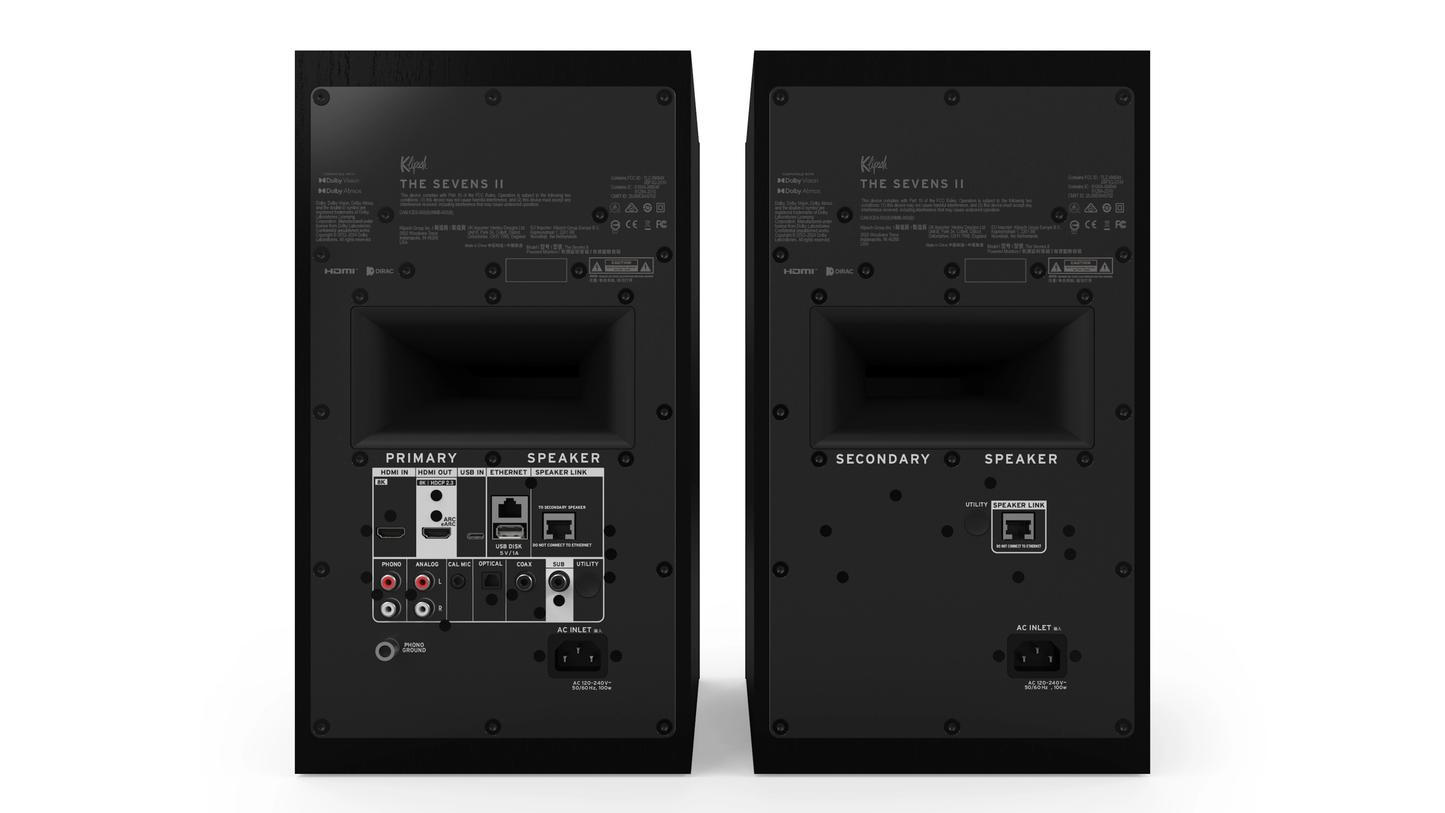
The Sevens II offers HDMI ARC, optical digital input, analog RCA stereo input, a 3.5mm aux input, USB-C audio, Bluetooth 5.0 with aptX, and a built-in moving-magnet phono preamplifier. At $1,999.99, this input suite is not a nice-to-have — it is the feature that defines the product category and justifies the purchase for buyers who would otherwise need a separate integrated amplifier, phono stage, and DAC to achieve equivalent functionality.
The built-in phono preamp handles any moving-magnet cartridge directly — Audio-Technica, Ortofon, Nagaoka, Sumiko, and the full range of MM cartridges that ship with or are commonly paired with decks from Pro-Ject, Rega, U-Turn, and Audio-Technica. The phono stage implementation in The Sevens II is appropriate for the speaker's performance level and satisfies serious vinyl listeners at this price point. Buyers who eventually upgrade to a precision low-output moving-coil cartridge will want a dedicated outboard phono stage, but for the MM listener, the built-in stage is a complete and competent solution.
HDMI ARC connects The Sevens II to a modern television with a single cable and integrates volume control with the TV remote. The implementation is standard ARC — stereo PCM — rather than eARC, which is appropriate for a two-channel speaker system not designed for surround passthrough. For music, streaming, and television audio in a stereo context, it works exactly as intended. Bluetooth 5.0 with aptX delivers strong wireless performance from Android and laptop sources. Apple devices connect via AAC rather than aptX, which The Sevens II handles without issue. USB-C audio handles direct laptop connection without an adapter. The RCA subwoofer output is included for buyers who want to add a powered sub in very large rooms.
How The Sevens II Compares to The Fives II and The Nines II
Klipsch's powered speaker lineup currently consists of The Fives II at $1,399.99, The Sevens II at $1,999.99, and The Nines II at $2,399.99, ascending in woofer size, cabinet volume, and output capability. Understanding where each sits helps buyers choose correctly rather than overbuy or underbuy for their room.
The Fives II uses a 5.25-inch woofer and is optimized for desktops, bedrooms, and living rooms up to roughly 175 to 200 square feet. It images with exceptional precision in near-field and medium-field listening positions and is the easiest of the three to place well because its smaller cabinet is less sensitive to room boundaries. The $600 step up to The Sevens II buys a 6.5-inch woofer, meaningfully deeper bass extension, and greater output in larger rooms — a worthwhile investment when the room demands it, and unnecessary when it does not. The Nines II at $2,399.99 steps up further to an 8-inch woofer and the deepest bass extension in the lineup, rated to 32 Hz, and is the right choice for rooms above 300 square feet or listeners who want the absolute ceiling of what a powered Klipsch speaker can deliver. The Sevens II sits squarely in the middle — more capable than The Fives II in larger rooms, more practical and easier to place than The Nines II in medium-to-large spaces.
At All Elite Audio, we have heard all three. The Fives II is the desk and bedroom recommendation. The Sevens II is the living room recommendation for most buyers. The Nines II is for large rooms and demanding listeners who want nothing left on the table.
Placement and Setup
The Sevens II are rear-ported, and their 6.5-inch woofer is capable of substantial bass output — which means placement relative to walls matters more here than it does with The Fives II. Ideally, allow at least six inches of clearance from the back wall, and more if the room allows. Too close to the back wall and the bass output of a 6.5-inch woofer will overload the room's boundaries and produce a heavy, undifferentiated low end that obscures midrange detail. With proper clearance, the bass is controlled, extended, and tonally accurate.
Toe the speakers in toward your listening position so the Tractrix horn tweeters aim directly at your ears. The horn's defined dispersion pattern rewards accurate aiming with a stable, focused stereo image — instruments lock into position in the soundstage and stay there. Tweeter height at ear level when seated is the target, and speaker stands are the ideal way to achieve it while also decoupling the cabinet from the floor and improving bass definition. On a media console or credenza, position the speakers at the front edge with maximum rear clearance. The right speaker houses the amplifier and all inputs; the left speaker connects via the included cable. The included remote manages volume and input switching from your chair without requiring a phone or app.
Key Specifications
Type: Powered stereo bookshelf speakers (sold as pair) Tweeter: 1" aluminum dome, Tractrix horn-loaded Woofer: 6.5" copper-spun IMG cone Crossover Frequency: 1,500 Hz Sensitivity: 96 dB (1W/1m) Frequency Response: 35 Hz – 21 kHz (±3 dB) Amplifier: Class D (built-in) Inputs: HDMI ARC Inputs: Optical digital (Toslink) Inputs: Analog RCA stereo Inputs: 3.5mm aux Inputs: USB-C audio Inputs: Bluetooth 5.0 (aptX) Phono Preamp: Built-in, moving-magnet (MM) compatible Subwoofer Output: Yes, RCA line-level Remote Control: Yes, included Dimensions (each): 8.19" W × 13.27" H × 10.94" D Weight: ~19 lbs (right/amp channel); ~15 lbs (left channel) Finish Options: Matte Black, Walnut Warranty: 2-year limited Price: $1,999.99/pair
Why Buy From All Elite Audio
All Elite Audio is an authorized Klipsch dealer, which means every speaker we sell is covered by the full manufacturer's warranty and supported by Klipsch's service network. We are not a gray-market retailer or a third-party marketplace seller. When you buy The Sevens II from us, you are buying a product Klipsch will stand behind — and you are buying it from a working dealership staffed by people who have listened to these speakers and can speak to the real differences between them, the right room size for each, and how to get the most out of whichever one you choose.
Call 443-402-5055 / Text 443-402-5064 / Visit 1921 York Rd, Timonium, MD 21093. Authorized Klipsch dealer.
Frequently Asked Questions
What makes The Sevens II different from The Fives II, and is the $600 price difference justified?
The Sevens II uses a 6.5-inch woofer compared to the 5.25-inch driver in The Fives II, which delivers meaningfully deeper bass extension — rated to 35 Hz versus 54 Hz — and greater output in larger rooms. The larger woofer moves more air, which is audible as greater bass authority and dynamic scale when the room has space to take advantage of it. In a room below 175 square feet, the difference between the two speakers is real but modest, and The Fives II at $1,399.99 is the smarter buy. In a room of 200 square feet or larger, the $600 step to The Sevens II at $1,999.99 is a genuine performance investment that the room will reward. If you are on the fence, come in and we will help you decide.
Does The Sevens II include a cartridge or turntable?
No. The Sevens II are loudspeakers only. They include a built-in moving-magnet phono preamplifier that allows direct connection from a turntable with an MM cartridge, but the turntable is sold separately. All Elite Audio carries a full range of compatible turntables — from entry-level Audio-Technica and U-Turn models to the higher-performing Pro-Ject and Rega decks that are well-matched to the performance level of a $1,999.99 powered speaker system. We can put together a complete pairing recommendation based on your budget and musical priorities.
Do I need an external phono preamp to use The Sevens II with a turntable?
No, not for a standard moving-magnet turntable. The Sevens II includes a built-in MM phono preamp on the RCA inputs that performs at a level appropriate for serious vinyl listening at this price point. If your turntable has its own internal phono stage, engage bypass mode on the turntable before connecting — otherwise you are stacking two phono stages and the result will be distorted and tonally wrong. If your turntable has no internal stage, connect it directly to the phono input on The Sevens II. Moving-coil cartridges require a dedicated MC phono stage, which The Sevens II does not provide internally.
What does the HDMI ARC input do, and does it support eARC or Dolby Atmos?
HDMI ARC allows your television to route its audio output back through the HDMI cable to The Sevens II, letting you use the TV remote for volume control without a receiver in the chain. The Sevens II supports standard ARC, which carries stereo PCM audio. It does not support eARC or Dolby Atmos passthrough — those formats require a home theater processor and are outside the scope of a two-channel speaker system. For stereo music, streaming service audio, and television content in a two-channel context, standard HDMI ARC is clean, convenient, and entirely adequate.
How do The Sevens II compare to The Nines II?
The Nines II at $2,399.99 steps up to an 8-inch woofer in a larger cabinet, extending bass response to 32 Hz compared to 35 Hz for The Sevens II. The larger woofer moves more air and maintains greater composure at high volumes in rooms above 300 square feet. In a medium-to-large room at normal to moderately loud listening levels, The Sevens II and The Nines II are closer than their $400 price difference might suggest. In a large room at high volume, or for listeners who prioritize the deepest possible bass extension, The Nines II pulls ahead. If you are genuinely unsure which is right for your space, come into All Elite Audio and we will walk you through the decision.
Can I add a subwoofer to The Sevens II?
Yes. The Sevens II includes a dedicated RCA line-level subwoofer output compatible with any powered subwoofer. The subwoofer crossover is managed by the sub itself — set the sub's crossover frequency to blend with The Sevens II's natural low-end rolloff, typically between 40 and 60 Hz given how low The Sevens II already reaches. Adding a subwoofer to The Sevens II is more about extending the last octave of deep bass in very large rooms than filling a deficiency in the speaker's own performance. In most rooms, The Sevens II is a complete system on its own.
What Bluetooth codecs does The Sevens II support?
The Sevens II uses Bluetooth 5.0 and supports aptX in addition to standard SBC. AptX delivers higher bitrate and lower latency wireless audio compared to SBC, which is meaningful for streaming from Spotify, Tidal, Amazon Music HD, or Apple Music on Android and aptX-capable laptop sources. Apple iPhones and iPads negotiate to AAC over Bluetooth rather than aptX, which The Sevens II handles cleanly. For the vast majority of wireless listening, whether from Android, Apple, or laptop, The Sevens II's Bluetooth implementation is stable and audibly strong.
Is the volume control analog or digital?
The volume control is digital, managed through the amplifier's DSP section, and the included remote controls volume through the same digital path. This is standard for powered speakers in this category and carries no practical audible penalty at normal to loud listening levels. Some listeners who use analog attenuators in separates systems notice a slight difference in behavior at the very lowest volume steps, but this is not a concern at the listening levels where The Sevens II spends most of its time.
How should I position The Sevens II for best sound?
The Sevens II are rear-ported with a 6.5-inch woofer, which means room placement has a significant effect on bass performance. Allow at least six inches of clearance behind the cabinet — more if the room allows. Too close to the back wall and the bass will become thick and overblown; with proper clearance, the low end is tight, extended, and controlled. Toe the speakers toward your listening position so the Tractrix horn tweeters aim directly at your ears. Speaker stands are the ideal solution and allow you to set tweeter height precisely at ear level when seated, which produces the best imaging and soundstage depth. On a media console, front-edge placement with maximum rear clearance is the practical alternative.
Where can I buy Klipsch The Sevens II and get expert advice?
All Elite Audio in Timonium, Maryland is an authorized Klipsch dealer with The Sevens II in stock at $1,999.99 per pair. We are a working hi-fi dealership — not an online-only retailer — and you are welcome to come in and hear these speakers before you buy. We also handle remote orders and are available by phone and text for pre-purchase consultations and post-purchase setup support. Call 443-402-5055, text 443-402-5064, or visit us at 1921 York Rd, Timonium, MD 21093.
Share