Accuphase
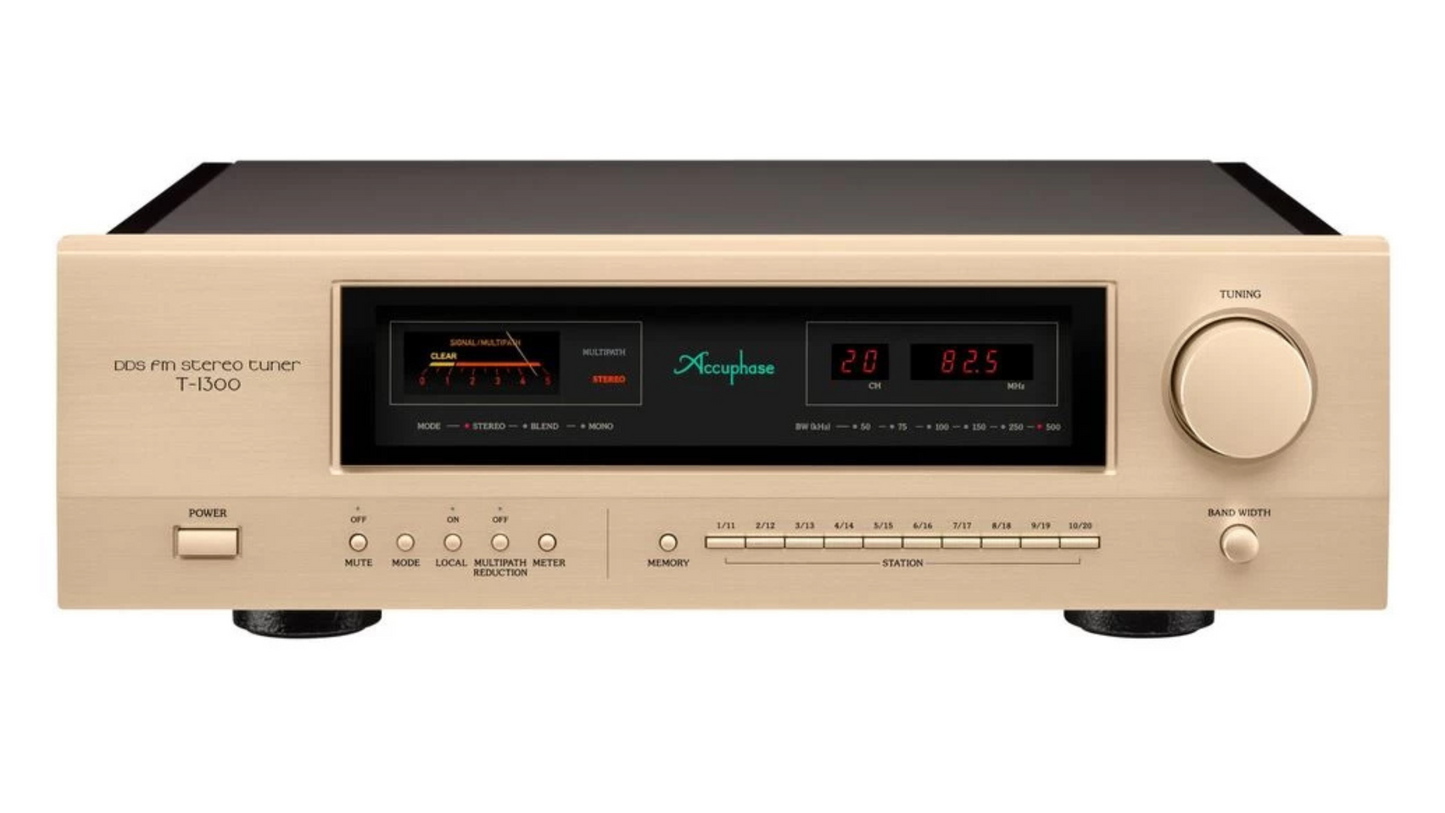
Accuphase T-1300 DDS FM Stereo Tuner
A dedicated FM tuner built around digital precision, for listeners who still believe radio deserves a reference grade source component.
Why a Dedicated Tuner Still Matters
Most systems today are built around streaming and digital files, so it is easy to forget that FM radio, done properly, can sound remarkable. The Accuphase T-1300 exists for the listener who has not forgotten. It is a tuner with no other job. It does not stream, it does not play discs, and it has no built in amplification. What it does is pull an FM signal out of the air and hand it to your system as cleanly as that signal can possibly be recovered. That single mindedness is the whole point. Every circuit inside the T-1300 is there to protect the integrity of one type of signal, and the result is a tuner that can make broadcast radio sound like a true high fidelity source rather than background noise. It is worth saying plainly that the T-1300 is built exclusively for FM. It does not receive DAB or DAB+ digital broadcasts, and Accuphase designed it that way on purpose, so that nothing in the circuit is compromised by trying to handle a second format.
Inside the Signal Path: DDS, the Front End, and Digital Demodulation
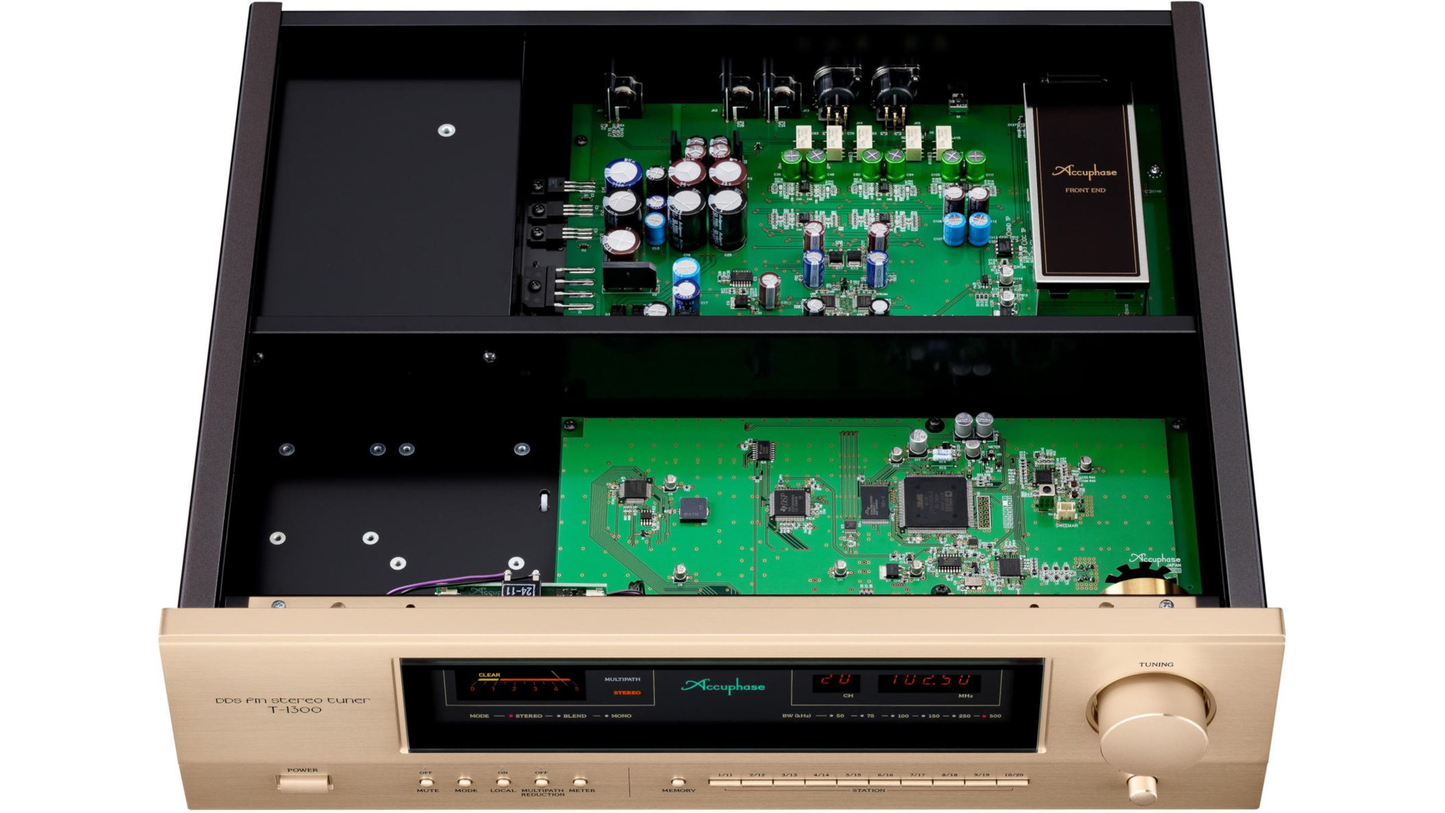
The heart of any tuner is the local oscillator, the circuit that helps convert the incoming radio frequency down to something the rest of the tuner can process. In the T-1300, that oscillator uses Direct Digital Synthesis, or DDS. Where a traditional analog oscillator can introduce faint phase noise and stray harmonics into the signal, a DDS oscillator generates a mathematically precise waveform with none of that baggage. In plain terms, it gives the rest of the tuner a cleaner starting point, which matters because every stage downstream inherits whatever noise the oscillator introduces. Ahead of that stage sits a double tuned RF front end, a design that uses two tuned circuits in sequence rather than one. This helps the tuner reject strong out of band signals and interference before they ever reach the sensitive demodulation stage, which is especially useful for listeners in areas crowded with competing stations. After the signal passes through the front end, Accuphase hands the heavy lifting to a dedicated DSP chip, which performs the FM demodulation digitally rather than through older analog methods, and applies a proprietary process Accuphase calls DS-DC stereo demodulation to recover the left and right channels with minimal crosstalk between them.
Tuning the Signal to Your Location: Variable IF Bandwidth and Multipath Reduction
Reception quality depends enormously on where you live and how crowded the FM band is in your area, and the T-1300 gives you real control over that. It offers six selectable IF bandwidth settings, ranging from a narrow 50 kHz up to a wide 500 kHz. A narrower setting helps isolate a weak or distant station from a crowded dial in a dense city, while a wider setting preserves more of the full audio bandwidth from a strong local signal without interference, which simply means more detail and a fuller sound. The tuner also includes a multipath reduction function, often shortened to MPR, which addresses a different problem entirely. Multipath distortion happens when an FM signal bounces off buildings, hills, or other obstacles and arrives at your antenna more than once, at slightly different times, which smears stereo separation and adds a subtle harshness to the sound. The T-1300's DSP analyzes the incoming signal in real time, identifies those reflected copies, and computes a correction, restoring clarity that a simpler tuner would simply pass along as distortion.
Outputs, Memory, and Everyday Control
Connectivity on the T-1300 is built for a serious system rather than a casual radio. It offers both balanced XLR and unbalanced RCA analog outputs, along with a 24 bit, 48 kHz digital coaxial output that follows the IEC 60958 and AES3 standards, which means it can feed an external DAC if you want to handle the conversion yourself, or simply use the T-1300's own analog stage if you prefer the simpler path. The XLR output includes a polarity selector, switching between pin 2 and pin 3 as the positive lead, so it matches whatever convention the rest of your balanced gear uses rather than forcing you to adapt. Day to day operation centers on twenty memory presets, and each one stores far more than just a frequency. Mute status, stereo or mono mode, local attenuation, multipath reduction status, and the IF bandwidth setting are all saved together per station, so a favorite weak signal station and a strong local one can each keep their own ideal settings without you having to readjust every time you switch. Manual tuning is handled through Accuphase's Pulse Tuning system, a large knob that generates digital pulses as it turns, giving you the tactile feel of a traditional analog dial with the precision of digital frequency control underneath it. Reception starts at the antenna input, a standard 75 ohm F-type coaxial connector, which accepts most common FM antennas without an adapter.
Build Quality and What to Expect Out of the Box
The T-1300 carries Accuphase's familiar reference component build, with a substantial aluminum chassis and a dual red LED display that is easy to read from across a room. At 28.9 pounds and roughly 18.3 inches wide, the unit has the weight and presence you would expect from a component at this level, and it is meant to sit as a permanent, serious source rather than a casual accessory. Like most dedicated tuners at this level, the T-1300 does not ship with an antenna, since the right antenna depends heavily on your distance from local transmitters and the terrain around your home. Our team can help you choose between an indoor antenna, a rooftop FM antenna, or an in wall solution based on where you live, so the rest of this tuner's performance is not held back by a mismatched antenna.
How the T-1300 Compares
The T-1300 replaces the T-1200, and the upgrade is measurable rather than cosmetic. Accuphase improved the signal to noise ratio by roughly 2 dB in both mono and stereo operation, and the T-1300 carries that improvement into a tuner market where genuine competition is thin. Among current production FM tuners, the closest alternatives sit at a fraction of the price and a fraction of the performance, typically delivering stereo signal to noise figures in the 70 to 75 dB range with noticeably higher distortion than the T-1300's 0.04 percent THD. There is currently no Accuphase tuner positioned above the T-1300, which makes it the flagship of the line rather than a step on the way to something bigger. It is also worth noting that Audio-Technica, a brand All Elite Audio carries and one closely associated with this kind of analog minded listening, does not currently produce an FM tuner of its own, so there is no direct Audio-Technica equivalent to set against the T-1300. Where Audio-Technica does fit naturally is on the other side of your system: their turntables and cartridges pair well with a system built around a component like the T-1300, for listeners who want both vinyl and broadcast radio handled at a genuinely high level rather than treating either as an afterthought.
KEY SPECIFICATIONS
- Type: FM stereo tuner with Direct Digital Synthesis (DDS) local oscillator
- Tuning Range: 87.5 to 108.0 MHz
- Antenna Input: 75 ohm F-type coaxial connector
- Usable Sensitivity (Mono): 5 dBµV (IHF)
- Signal to Noise Ratio (Mono): 94 dB, A-weighted
- Signal to Noise Ratio (Stereo): 78 dB
- Total Harmonic Distortion (Stereo): 0.04 percent at ±75 kHz deviation
- Stereo Separation: 65 dB at 1 kHz
- IF Filter Bandwidths: 50 / 75 / 100 / 150 / 250 / 500 kHz, selectable
- Multipath Reduction: Yes, DSP based
- Digital Broadcast Support: FM only; no DAB/DAB+
- Memory Presets: 20 stations, with full parameter recall
- Outputs: Balanced XLR (selectable pin 2+/pin 3+), unbalanced RCA, digital coaxial (24-bit/48kHz, IEC 60958/AES3)
- Power Consumption: Approximately 20 W
- Dimensions (W x H x D): 18.3" x 5.9" x 16.0"
- Weight: 28.9 lbs
- Price: $8,975.00 USD
- Warranty: 3-year manufacturer's warranty through authorized U.S. dealers
WHY BUY FROM ALL ELITE AUDIO
All Elite Audio is an authorized Accuphase dealer, which means every T-1300 we sell is new, fully covered under Accuphase's manufacturer warranty, and backed by a team that can help you actually integrate it into a system rather than just ship a box. We run a full home audio showroom in Timonium, Maryland, where you can hear the T-1300 on real equipment before you commit to it.
Call: 443-402-5055 Text: 443-402-5064 Visit: 1921 York Rd, Timonium, MD 21093
FREQUENTLY ASKED QUESTIONS
What is the Accuphase T-1300 and who is it for? The T-1300 is a dedicated FM stereo tuner, meaning its only job is to receive FM broadcasts and hand that signal to the rest of your system as cleanly as possible. It has no amplifier, no streaming functionality, and no disc playback built in. It is built for listeners who already have a serious amplifier and speakers and want their FM source to match that level of quality rather than relying on a built in tuner inside a receiver. If FM radio is not part of your listening habits, this is not the product for you, but for those who do still listen to broadcast radio, it represents close to the best available performance in that category.
Does the T-1300 include an antenna? No, an antenna is not included, which is standard for tuners at this level. The right antenna depends on your distance from local FM transmitters and the terrain around your home, so a one size fits all antenna bundled in the box would actually work against good reception for many buyers. We can help you choose between an indoor antenna, a rooftop antenna, or an in wall option once we know roughly where you are located and what stations you want to receive.
What is the difference between the T-1300 and the previous T-1200? The T-1300 is the direct successor to the T-1200 and the improvement is measurable rather than cosmetic. Accuphase improved the signal to noise ratio by approximately 2 dB in both mono and stereo modes, which is a meaningful gain for a mature, well refined design like this one. The core architecture, including the double tuned front end and DSP based demodulation, carries over and has been refined rather than reinvented. If you already own a T-1200 in good working condition, the upgrade is worthwhile mainly for listeners chasing the last increment of noise performance, while new buyers should simply consider the T-1300 the current and more capable version.
Is there a more advanced Accuphase tuner above the T-1300? No, the T-1300 currently sits at the top of Accuphase's FM tuner line, so there is nothing above it to step up to. Accuphase has historically updated its flagship tuner only every several years, with the T-1300 succeeding the T-1200 after roughly seven years on the market. That slow update cycle reflects how mature this particular design approach is rather than any lack of investment in the category. Buying the T-1300 today means buying the best tuner Accuphase currently makes, not a placeholder ahead of something better.
What does stereo separation mean and why does 65 dB matter? Stereo separation describes how distinctly a tuner keeps the left and right channels apart from each other. In a stereo broadcast, some bleed between channels is unavoidable, and the lower that bleed is, the wider and more precise your soundstage will feel. A figure of 65 dB at 1 kHz is a strong result for an FM tuner, meaning the left and right channels remain very distinct from one another rather than blurring toward mono. In practical terms, this is part of why a tuner like the T-1300 can produce a stereo image that feels closer to a well mastered digital source than to the flat, narrow sound many people associate with car radio FM.
What is multipath reduction and why would I need it? Multipath distortion happens when an FM signal reflects off buildings, hills, or other large objects and reaches your antenna more than once, with each reflected copy arriving at a slightly different time. Those overlapping copies interfere with each other and typically show up as a harsh, gritty quality in the sound along with reduced stereo separation, especially in urban areas or near large structures. The T-1300's multipath reduction function uses its DSP to identify those reflected signals and correct for them in real time. If you live somewhere with a clean, unobstructed signal path to your local transmitters, you may rarely notice it working, but for most real world locations it meaningfully improves how clean and stable the sound stays.
What is the difference between the IF bandwidth settings, and which one should I use? The T-1300 offers six IF bandwidth settings, from a narrow 50 kHz up to a wide 500 kHz, and the right choice depends entirely on how crowded your local FM dial is. A narrower setting helps isolate a weak or distant station that sits close on the dial to a much stronger neighboring signal, trading away a small amount of audio bandwidth in exchange for cleaner isolation. A wider setting preserves more of the full audio spectrum from a strong, uncluttered local signal, which generally sounds fuller and more detailed when interference is not a concern. Most listeners start at a middle setting and adjust station by station, since the T-1300 remembers your chosen bandwidth separately for each of its twenty memory presets.
Can the T-1300 receive AM, DAB, or internet radio stations? No. The T-1300 is built exclusively for FM stereo reception and does not include AM, DAB, DAB+, or any internet streaming functionality. Accuphase made this a deliberate design choice rather than an oversight, since concentrating the entire circuit on one format avoids the compromises that come with trying to handle several formats well in a single unit. If you want DAB or streaming alongside FM, you would need a separate device for that purpose running in parallel with the T-1300 rather than expecting one box to do everything.
What else do I need to build a complete system around the T-1300? At minimum, you will need an FM antenna suited to your location, an amplifier or preamplifier with at least one line level input to accept the T-1300's output, and a pair of speakers. Because the T-1300 has no phono stage, no streaming, and no disc playback, it works best as one source within a larger system rather than as the sole component, typically alongside an integrated amplifier or a separate preamp and power amp combination. Many of our customers pair the T-1300 with another Accuphase component, such as one of the C-series preamplifiers, to keep tonal character consistent through the whole signal path, though it works perfectly well with quality electronics from other brands too. Bring us your current setup and we can tell you exactly what, if anything, you still need.
Where can I buy the Accuphase T-1300? The Accuphase T-1300 is available now at All Elite Audio, an authorized Accuphase dealer with a full home audio showroom in Timonium, Maryland. You are welcome to call us at 443-402-5055 or text us at 443-402-5064 with questions, or visit us in person at 1921 York Rd, Timonium, MD 21093 to hear the T-1300 before you buy. Our team can also help you plan the rest of the system around it, from antenna selection to amplification, so the tuner performs the way it is meant to in your specific space.
Share