Accuphase
Accuphase P-4600 Class AB Stereo Power Amplifier
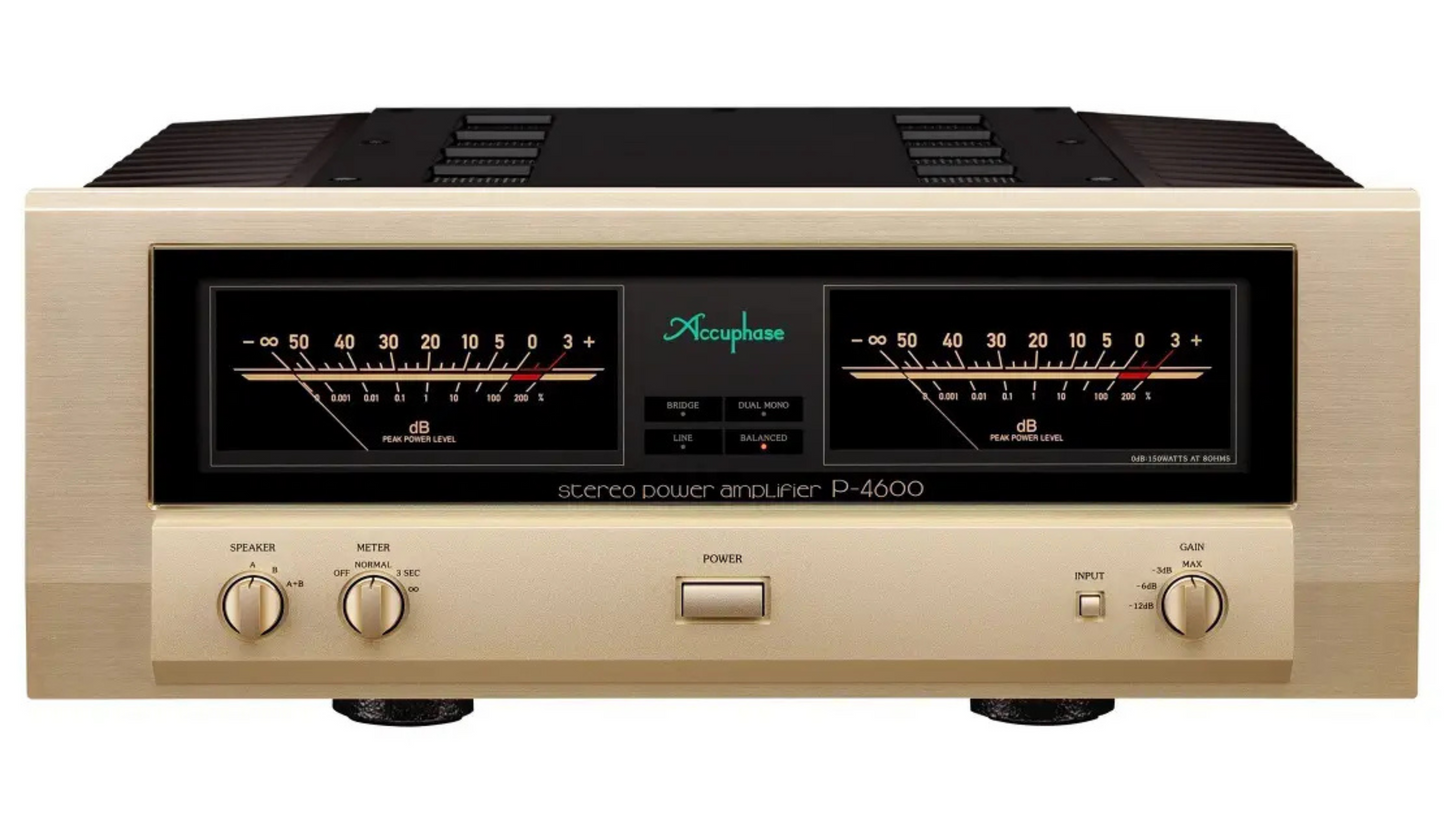
The fourth generation of Accuphase's P-4000 series — a 150-watt-per-channel Class AB stereo power amplifier with six-parallel bipolar transistor output stages, monoblock internal construction, a guaranteed damping factor of 800, and a signal-to-noise ratio of 125 dB that represents an 18 percent improvement over the P-4500 it replaces.
What It Is and Who It's For
The Accuphase P-4600 is a dedicated stereo power amplifier — a component whose sole function is to take the line-level output of a preamplifier and convert it into the current and voltage needed to drive a loudspeaker. There is no volume control, no source switching, no phono stage. What there is, instead, is an exceptional concentration of engineering around a single task: driving any speaker load, at any power level, with complete authority and minimal noise.
The P-4600 is the current standard-category Class AB power amplifier in the Accuphase lineup, the fourth generation of a product line that traces its lineage directly to the P-300 of 1973 — the amplifier that introduced Accuphase to the market and established the brand's reputation for power and control. The buyer who needs a P-4600 is typically building a separate-component system around the C-2300 or C-2900 preamplifier, or upgrading from an integrated amplifier and wants a dedicated power stage that will not be the limiting factor in a serious system. It is also the amplifier chosen when two units are required for bi-amplification or bridged mono operation at high power levels.
Six-Parallel Bipolar Output Stage and Why It Matters
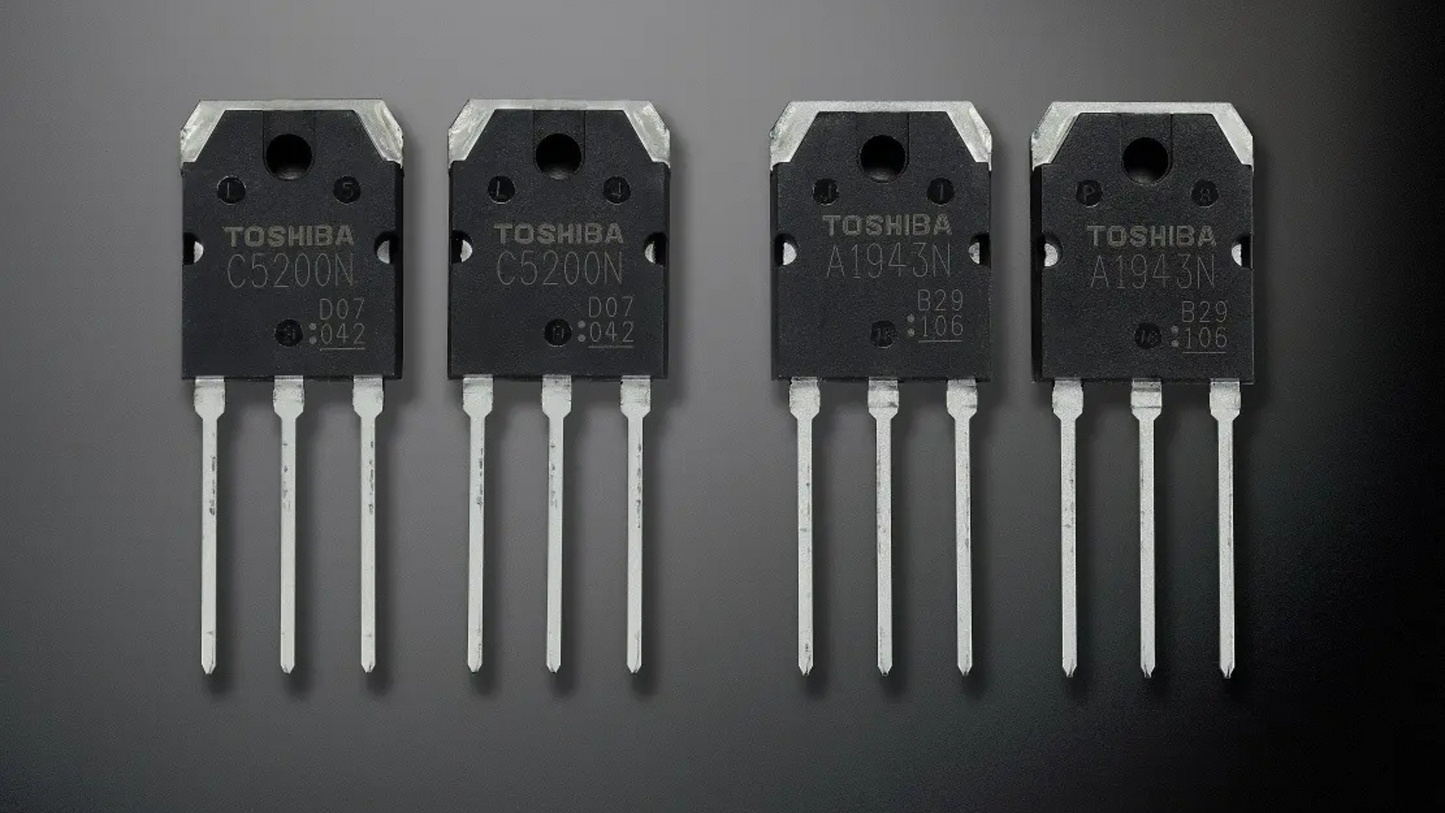
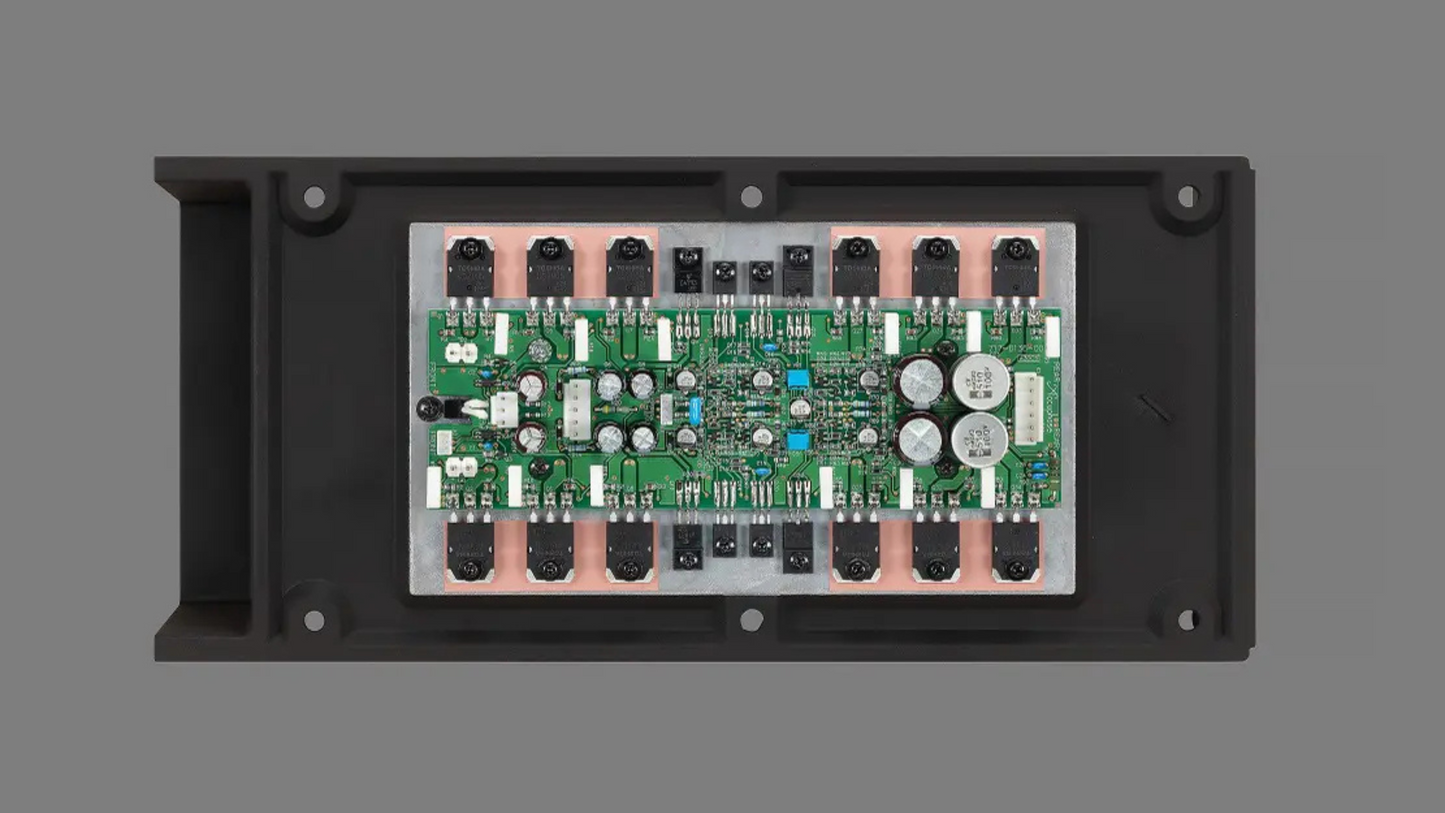
The P-4500 that the P-4600 replaces used a four-parallel push-pull output stage built around MOS-FET transistors. The P-4600 makes a deliberate change to bipolar transistors in a six-parallel push-pull arrangement — an increase in both the number of output devices and a change in device technology. Bipolar transistors in this topology offer lower output impedance than MOS-FETs, which is the direct mechanism behind the improved damping factor and the lower noise floor. By distributing the output current across six parallel pairs of devices rather than four, each transistor operates well within its thermal and current limits under all conditions — including the sustained high-current demands of low-impedance speaker loads.
The result is rated output of 150 watts per channel into 8 ohms, 300 watts per channel into 4 ohms, and 450 watts per channel into 2 ohms. The doubling and then near-tripling of output power as impedance halves is the signature of a power supply and output stage that are genuinely sized for real-world speaker loads. Many amplifiers that claim a respectable 8-ohm rating fail to double into 4 ohms because the power supply cannot sustain the current demand. The P-4600 exceeds doubling at 4 ohms and reaches three times the 8-ohm rating at 2 ohms — the kind of headroom that matters when your speakers' impedance curve dips into difficult territory during bass transients.
Monoblock Construction in a Stereo Chassis
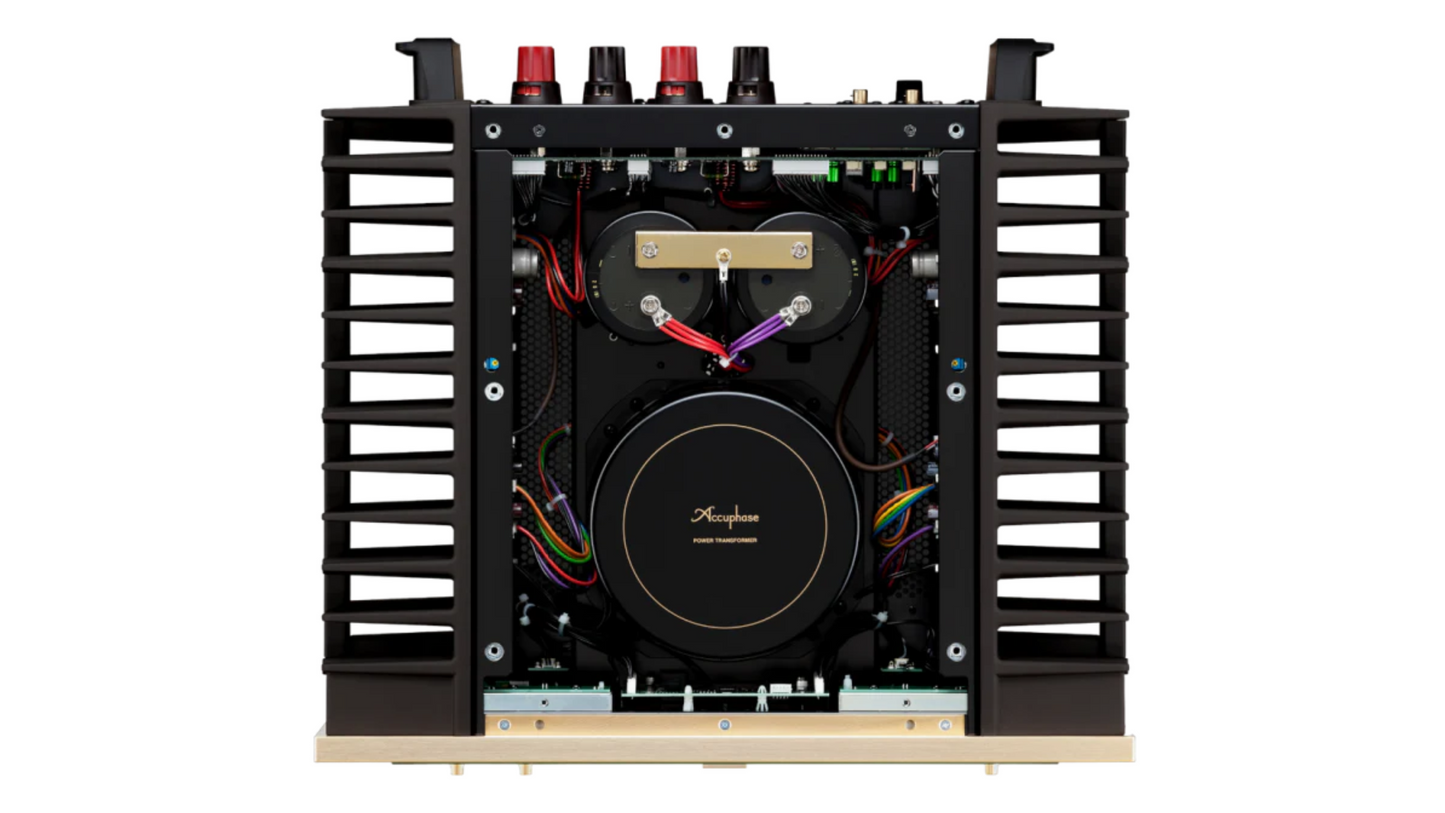
The P-4600's internal architecture is described by Accuphase as monoblock construction. The left and right channel power amplifier engines are physically separated within the chassis, each with its own heatsink and output devices. The power supply — a massive custom-specified toroidal transformer flanked by two 50,000 μF filtering capacitors — sits at the center of the unit, equidistant from both channels. This physical symmetry is not cosmetic: it ensures that both channels see identical impedances from the supply rail and draw from the same energy reservoir without one channel's transient demand reaching the other through supply-rail modulation.
The 50,000 μF of filtering capacitance is a significant number. Energy storage in a power amplifier's filter capacitors determines how quickly the supply rail can recover after a high-current transient — a loud bass note, an orchestral climax, a kick drum. Larger capacitance means faster recovery, which means the output stage sees a more stable rail voltage during the very moments when precise voltage delivery matters most.
The Instrumentation Amplifier Input Stage and S/N Ratio
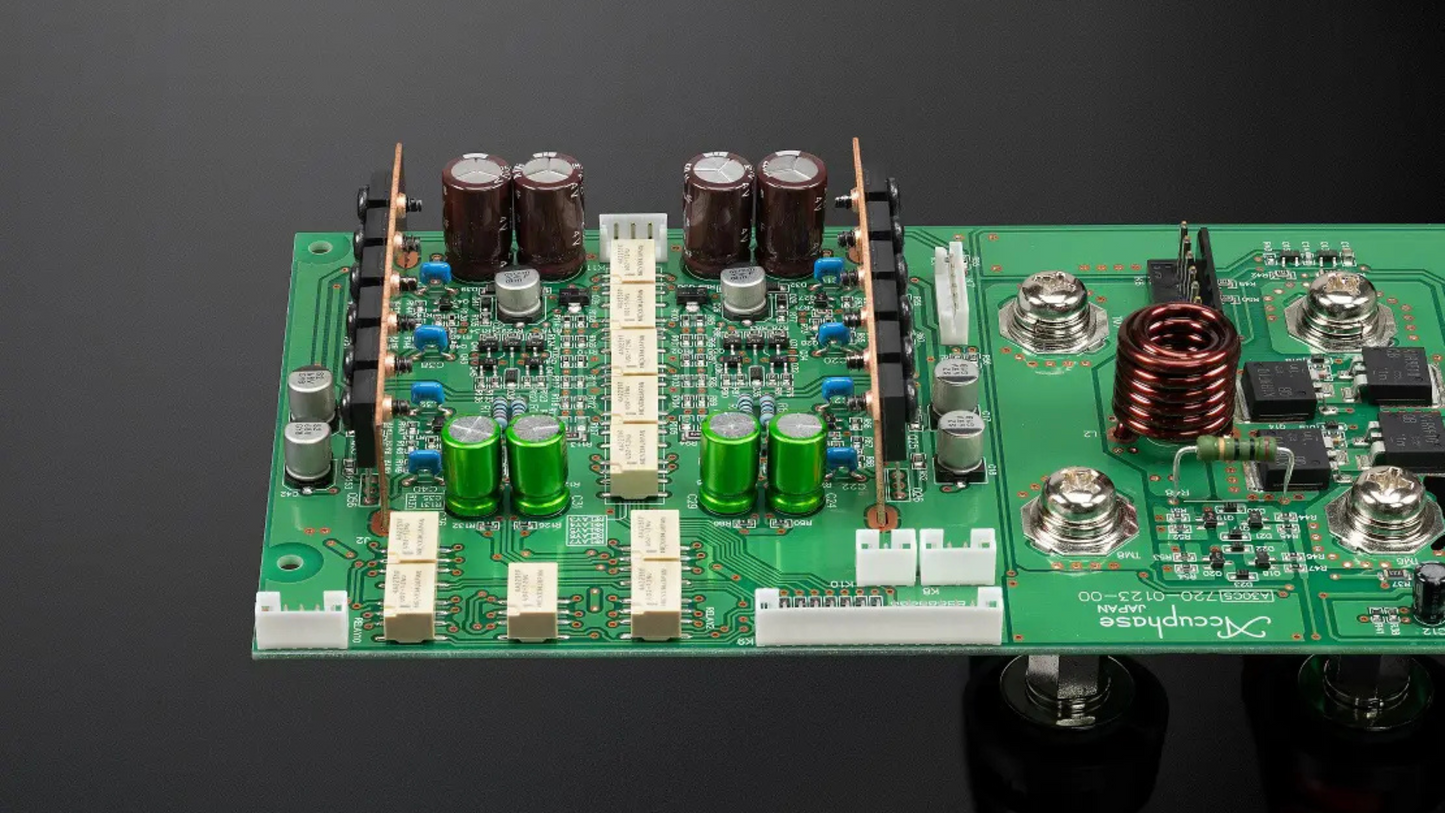
The P-4600's signal input section uses the instrumentation amplifier principle — a differential topology that equalizes input impedance on both the positive and negative signal phases, providing exceptional rejection of externally coupled noise before any amplification occurs. The input stage is assigned a high gain of approximately 12.6 times within the balanced input module itself, which means the signal is amplified by a low-noise circuit at the point where the signal is smallest and most vulnerable. Subsequent stages operate at lower relative gain, which means the noise contribution of those later stages is proportionally smaller when referred back to the input.
The practical outcome is a guaranteed signal-to-noise ratio of 125 dB at maximum gain — 4 dB better than the P-4500's 121 dB, representing an 18 percent improvement in residual output noise (19.5 μV versus 23.9 μV). At the –12 dB gain setting, the S/N ratio rises to 130 dB. These figures are guaranteed specifications, not typical measurements — Accuphase warranties every unit to meet them. For context, 125 dB of dynamic range means the amplifier's residual noise is more than 560,000 times quieter than its rated output signal. In a listening room, this translates to complete silence between notes and at idle — something that is immediately audible when switching from an amplifier with inferior noise performance.
Balanced Remote Sensing and the Guaranteed Damping Factor of 800
The P-4600 achieves a guaranteed damping factor of 800 — a 14 percent improvement over the P-4500's figure of 700 — through two complementary mechanisms. The first is the six-parallel bipolar output stage itself, whose lower output impedance compared to the four-parallel MOS-FET stage of the predecessor directly reduces the amplifier's effective output impedance. The second is balanced remote sensing.
Conventional remote sensing feeds back the signal voltage from a point close to the speaker terminals rather than from inside the output stage, eliminating the resistance of the output stage wiring from the feedback loop. Balanced remote sensing extends this by sensing both the signal line and the ground line simultaneously at points closest to the speaker terminals. The ground line has its own resistance — the resistance of the negative return path from speaker to amplifier — and conventional sensing does not account for it. By sensing both lines, balanced remote sensing eliminates the ground-line resistance from the feedback loop as well, achieving an even lower effective output impedance at the speaker terminal than the output stage alone would produce.
Speaker protection is handled by MOS-FET switches with an on-resistance of 1.6 milliohms — an improvement from the 2.0 milliohm devices in the P-4500 — rather than conventional mechanical relays, whose contact resistance is measurably higher and degrades the damping factor the amplifier presents to the speaker. The protection circuit uses photo-couplers to electrically isolate the detection circuitry from the music signal, preventing the protection electronics from affecting the signal path even during a fault event.
MCS+ and the Current Feedback Topology
The P-4600 uses Accuphase's MCS+ (Multiple Circuit Summing) topology in the output stage. MCS+ connects multiple amplifier circuits in parallel and sums their outputs, which has the effect of averaging out uncorrelated noise components from each circuit — the same noise-reduction principle used in the AAVA volume control's parallel buffer amplifiers. Because each parallel circuit contributes correlated signal but uncorrelated noise, the signal sums at full level while the noise tends to cancel, improving the effective noise floor below what any single circuit in the array could achieve alone.
The amplification stage uses current feedback topology rather than voltage feedback. Current feedback amplifiers have a characteristically high slew rate and maintain a flat, stable open-loop frequency response across a wide bandwidth. This contributes to the P-4600's frequency response specification of 0.5 Hz to 160 kHz — a bandwidth far beyond the audio range that provides a flat, undisturbed response within it, with no phase shift or frequency-dependent behavior in the audible band.
Gain Selector and Operational Flexibility
The P-4600's front panel includes a gain selector with four settings: MAX, –3 dB, –6 dB, and –12 dB. These are not attenuator settings — the gain is not reduced by inserting a resistive attenuator in the signal path. Instead, the gain adjustment operates within the input amplifier stage itself, changing the feedback ratio to alter the circuit's gain without adding any series resistance. This means that at lower gain settings, the residual noise floor drops proportionally — the –12 dB setting produces a guaranteed S/N ratio of 130 dB rather than the 125 dB at maximum gain.
The practical value of this is significant in two scenarios. First, if you are using high-efficiency speakers (95 dB/W or higher), the amplifier reaches full output at a preamplifier volume setting that may be impractically low, putting the system's usable range in a narrow band at the bottom of the volume control travel. Reducing the gain with the selector spreads the usable range across a wider control travel without degrading the signal path. Second, the lower noise floor at reduced gain settings benefits systems in quiet rooms with sensitive speakers, where residual amplifier noise can be audible at idle.
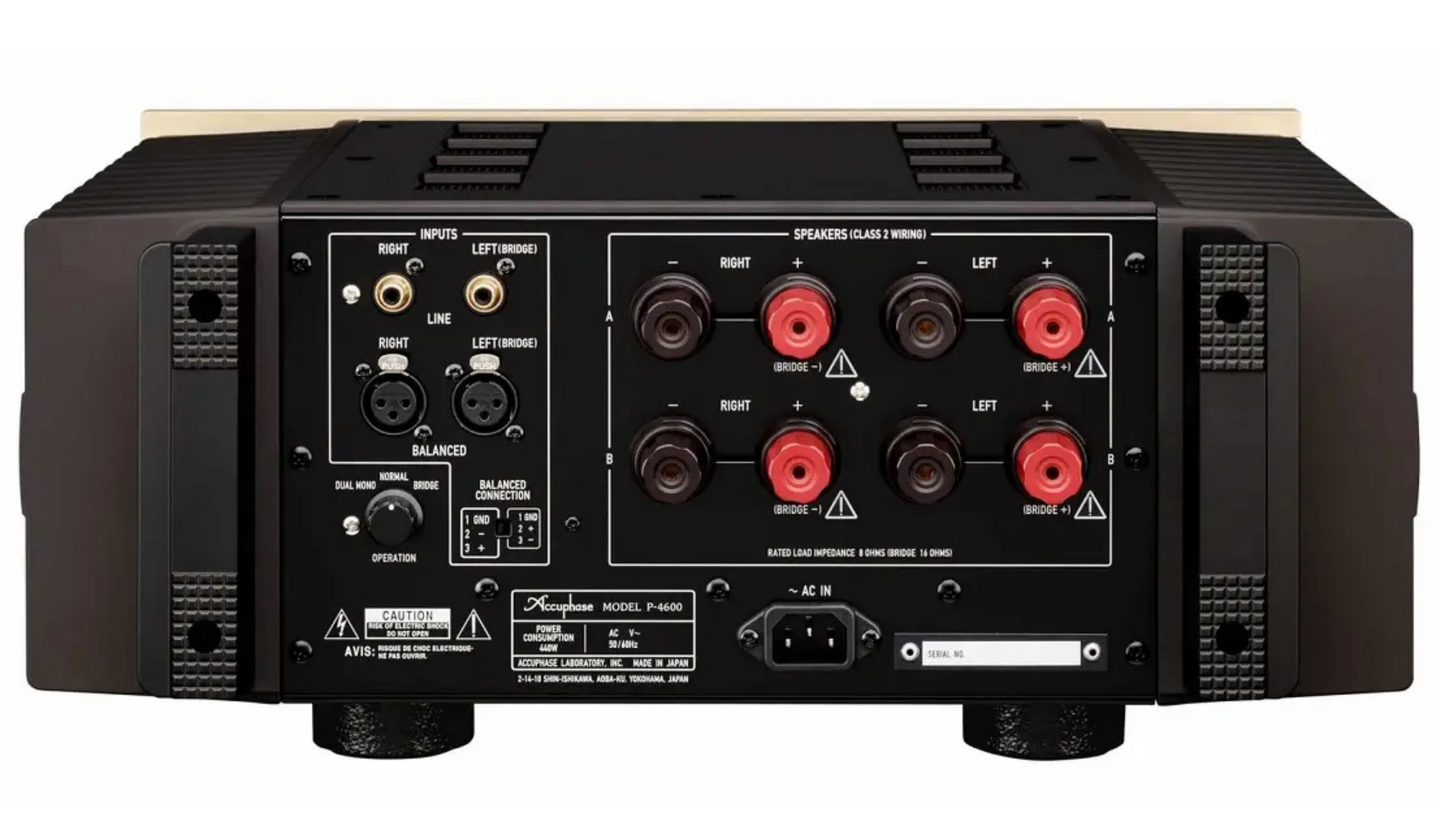
Two independent sets of speaker output terminals are provided, allowing simultaneous connection of two sets of speakers (with the same signal), or convenient access for bi-wiring a single pair of speakers. Combined with the operation mode selector, the P-4600 also supports bridged mono operation, in which both channels are combined into a single monoblock output delivering 600 watts into 8 ohms and 900 watts into 4 ohms.
How the P-4600 Compares: P-4500, P-7500, and Competitive Context
The P-4500 that the P-4600 replaces delivered 90 watts per channel into 8 ohms using a four-parallel MOS-FET output stage with a damping factor of 700 and an S/N ratio of 121 dB. The P-4600 improves on every one of those figures: 150 watts per channel (a 67 percent power increase), six-parallel bipolar output stage, damping factor of 800, and S/N ratio of 125 dB. These are not incremental refinements — the jump from 90 to 150 watts and from 700 to 800 damping factor represents a meaningfully more capable amplifier, particularly for demanding speakers and larger rooms.
Above the P-4600 in the current Accuphase lineup sits the P-7500, the flagship Class AB stereo power amplifier. The P-7500 uses a ten-parallel push-pull output stage, delivers 300 watts per channel into 8 ohms, achieves a damping factor of 1,000, and posts an S/N ratio of 130 dB. It is the amplifier chosen when nothing less than reference-level power and control will do. For the vast majority of serious two-channel systems — including those built around large floorstanding speakers in domestic rooms — the P-4600 is fully capable and the P-7500's advantages, while real, are incremental at normal listening levels.
Against competitors at this level from Pass Labs (X250.8), Luxman (M-10X), and Parasound (JC 5), the P-4600 stands out for its monoblock internal construction, guaranteed rather than typical S/N and damping factor specifications, the MCS+ output topology, balanced remote sensing, and Accuphase's assembly standard. It is one of the few power amplifiers at this price where every published specification is a guaranteed minimum rather than a best-case measurement.
Key Specifications
- Rated Output (Stereo): 150 W/ch (8 Ω), 300 W/ch (4 Ω), 450 W/ch (2 Ω)
- Rated Output (Bridged Mono): 600 W (8 Ω), 900 W (4 Ω)
- Frequency Response: 0.5 Hz–160 kHz (+0/–3 dB)
- Total Harmonic Distortion: 0.05% (20 Hz–20 kHz, both channels driven, 4–16 Ω)
- Intermodulation Distortion: Less than 0.01%
- Signal-to-Noise Ratio: 125 dB (GAIN: MAX); 130 dB (GAIN: –12 dB) — A-weighted, guaranteed
- Residual Output Noise: 19.5 μV (guaranteed)
- Damping Factor: 800 or more (JEITA, 8 Ω load at 50 Hz) — guaranteed
- Input Sensitivity (at rated output): 1.38 V
- Input Impedance: 40 kΩ (Balanced); 20 kΩ (Line)
- Gain Settings: MAX, –3 dB, –6 dB, –12 dB (adjusted at input amplifier stage, not via attenuator)
- Output Stage: 6-parallel push-pull bipolar transistors per channel, Class AB
- Power Supply: Single large custom toroidal transformer; 50,000 μF × 2 filtering capacitors
- Speaker Outputs: 2 independent sets of large-format speaker terminals
- Inputs: BALANCED (XLR) and LINE (RCA)
- Balanced Input Polarity: Switchable (pins 2 and 3 reversible)
- Operation Modes: Stereo, bi-amp, bridged mono
- Protection: MOS-FET switches (1.6 mΩ on-resistance), photo-coupler isolated detection, heatsink temperature sensors
- Power Meters: Large-scale logarithmic analog; –50 dB sensitivity; hold timer (3 sec / ∞)
- Power Consumption: Approx. 490 W (rated output); approx. 110 W (idle) — verify against owner's manual
- Dimensions (W × H × D): 465 × 190 × 427 mm
- Weight: 30.0 kg (66.2 lbs)
- Country of Origin: Japan
- Warranty: Contact All Elite Audio for current warranty terms
Why Buy From All Elite Audio
All Elite Audio is an authorized Accuphase dealer. Every P-4600 we sell is sourced through legitimate North American distribution and carries the full manufacturer warranty. Accuphase does not honor warranty claims on gray-market imports — a distinction that is material at this price point. Our staff has direct experience with the Accuphase power amplifier line and can advise on preamplifier pairing, speaker compatibility, gain setting configuration, and bi-amp or bridged mono setups. We carry the components that belong alongside the P-4600, and we take the time to make sure the system works before you leave.
Call 443-402-5055 / Text 443-402-5064 / Visit 1921 York Rd, Timonium, MD 21093
Frequently Asked Questions
What changed between the P-4500 and the P-4600?
The P-4600 is the fourth generation of the P-4000 series and represents a substantial step up from the P-4500 in every key specification. The output stage changes from a four-parallel MOS-FET push-pull configuration to a six-parallel bipolar transistor arrangement — both an increase in the number of output devices and a change in device technology, both of which contribute to lower output impedance and higher driving capability. Rated output rises from 90 watts per channel into 8 ohms to 150 watts — a 67 percent increase — with corresponding improvements at 4 ohms (from 180W to 300W) and 2 ohms (from 360W to 450W). The damping factor increases from 700 to a guaranteed 800, and the signal-to-noise ratio improves from a guaranteed 121 dB to 125 dB, representing an 18 percent reduction in residual output noise. The MOS-FET speaker protection switches are upgraded from 2.0 milliohm to 1.6 milliohm on-resistance, further reducing the effective output impedance at the speaker terminals. These are meaningful improvements across the board, not cosmetic updates.
What is the instrumentation amplifier principle and why does Accuphase use it?
The instrumentation amplifier is a differential input topology that equalizes the input impedance on both the positive and negative signal phases, making it resistant to common-mode noise — interference that appears equally on both lines. In a standard differential amplifier, the two input impedances differ, which means any common-mode signal is not perfectly cancelled. The instrumentation amplifier architecture eliminates this imbalance, giving the P-4600 excellent rejection of externally induced interference regardless of source impedance. Accuphase also distributes the gain heavily into the input section (approximately 12.6 times), which means the signal is amplified by the lowest-noise circuit at the point where it is smallest — minimizing the noise contribution of subsequent stages. This is the primary reason the P-4600 achieves a 125 dB S/N ratio despite delivering 150 watts per channel.
What is MCS+ and how does it improve sound quality?
MCS+ stands for Multiple Circuit Summing (Accuphase's proprietary implementation), and it refers to the practice of connecting multiple amplifier circuits in parallel and summing their outputs. The key insight is that each parallel circuit contributes correlated signal — all circuits amplify the same music — but uncorrelated noise, because the thermal noise generated in each circuit is independent and random. When the outputs are summed, the signal components add coherently while the noise components partially cancel, improving the effective signal-to-noise ratio below what any single circuit could achieve. The more circuits connected in parallel, the greater the noise reduction benefit. In the P-4600, MCS+ works alongside the instrumentation amplifier input stage and the six-parallel output transistors to achieve the 125 dB guaranteed S/N ratio across the full audio bandwidth.
What does the gain selector do and when should I change it from MAX?
The gain selector on the P-4600's front panel offers four settings: MAX, –3 dB, –6 dB, and –12 dB. Critically, these settings do not work by inserting an attenuator in the signal path — they adjust the gain within the input amplifier stage by modifying the feedback ratio. This means the noise floor drops proportionally with the gain: at –12 dB, the guaranteed S/N ratio improves to 130 dB rather than the 125 dB at maximum gain. There are two practical reasons to reduce the gain. First, if your speakers are high-efficiency designs (95 dB/W or greater), the amplifier may reach full output at a very low preamplifier volume setting, compressing the usable volume range into an inconveniently narrow band. Reducing the gain with the selector spreads the system's dynamic range across a wider control travel. Second, in very quiet rooms with sensitive speakers, reducing the gain can make residual amplifier noise inaudible at idle. If you are unsure which setting suits your system, contact us — we can advise based on your preamplifier output voltage and speaker sensitivity.
How does balanced remote sensing achieve a higher effective damping factor?
Damping factor is defined as the loudspeaker's nominal impedance divided by the amplifier's output impedance, and it represents the amplifier's ability to control woofer motion after the drive signal ends. Conventional remote sensing reduces output impedance by feeding back the signal voltage from a point near the speaker terminals rather than from inside the output stage, eliminating the internal wiring resistance from the loop. Balanced remote sensing extends this by sensing both the signal line and the ground return line simultaneously at the speaker terminal. The ground return path has its own resistance — typically small, but non-zero — which conventional sensing does not account for. By sensing ground simultaneously, balanced remote sensing eliminates the ground-line resistance from the feedback loop as well, achieving a lower effective output impedance at the actual speaker terminal than either the output stage alone or conventional remote sensing produces. The result is a damping factor that the speaker actually experiences of 800, not a figure measured at the amplifier's output terminals before the internal wiring.
Can the P-4600 be used in bridged mono mode and what power does it deliver?
Yes. The P-4600 supports bridged mono operation via the operation mode selector on the front panel. In bridged mode, both stereo channels are combined into a single monoblock output, delivering 600 watts into 8 ohms and 900 watts into 4 ohms. This makes two P-4600 units a practical path to a full monoblock system — one unit per channel, each delivering 600 watts into 8 ohms — for systems with very large or power-hungry speakers in large rooms. In bridged mode, the input signal should be fed to the left channel input, and the operation mode selector set accordingly; the output is taken from the left channel speaker terminals only. Note that the minimum speaker load impedance in bridged mode is 4 ohms; do not use bridged mode with speakers below this impedance. If you are planning a bridged setup, call us to discuss the specifics of your speaker load and room.
Does the P-4600 support bi-amplification?
Yes. The P-4600 provides two independent sets of speaker output terminals, which allows a single amplifier to drive the bass and treble sections of a compatible speaker system in a passive bi-amp configuration. With a second P-4600 or a compatible power amplifier, a full active bi-amp system is possible using an electronic crossover or a compatible preamplifier's dual outputs. Accuphase designs its power amplifiers with consistent input sensitivity and gain specifications across the product line, which simplifies level matching in bi-amp systems using two P-4600 units or a P-4600 paired with a P-7500. Contact us to discuss the specifics of your speaker and the bi-amp configuration that suits it best.
What preamplifiers pair well with the P-4600?
Within the Accuphase lineup, the P-4600 is a natural partner for the C-2300 and C-2900 preamplifiers, both of which provide balanced XLR outputs with the 2 V rated output voltage that the P-4600's 1.38 V input sensitivity can drive to full output with modest preamplifier gain. The fully balanced signal path from C-2300 or C-2900 through the P-4600's instrumentation amplifier input stage is the preferred configuration for maximum common-mode noise rejection. The P-4600 also accepts unbalanced RCA inputs and is compatible with any high-quality preamplifier with a standard line-level output. We carry Accuphase preamplifiers at All Elite Audio and can demonstrate the system in our showroom with speaker pairings relevant to yours.
How does the P-4600 compare to the P-7500 above it?
The P-7500 is Accuphase's flagship Class AB stereo power amplifier. It uses a ten-parallel push-pull output stage versus the P-4600's six-parallel arrangement, delivers 300 watts per channel into 8 ohms versus 150 watts, achieves a damping factor of 1,000 versus 800, and posts a guaranteed S/N ratio of 130 dB at maximum gain versus 125 dB. In bridged mono mode, the P-7500 delivers 1,200 watts into 8 ohms compared to the P-4600's 600 watts. These are meaningful differences for systems built around very large or very inefficient speakers, or in substantial rooms where the additional power headroom is genuinely used. For the majority of high-quality domestic systems, the P-4600 operates well within its capabilities and the P-7500's advantages are audible in direct comparison but not essential. The choice between them depends primarily on your speaker's efficiency and your room size.
Where can I buy the Accuphase P-4600?
The Accuphase P-4600 is available at All Elite Audio, an authorized Accuphase dealer at 1921 York Rd, Timonium, MD 21093. We carry the Accuphase power amplifier line and can arrange a listening session with preamplifier and speaker pairings from our current inventory. Buying from an authorized dealer is the only way to ensure full manufacturer warranty coverage — Accuphase does not honor warranty claims on gray-market units imported outside the official North American distribution channel. Call us at 443-402-5055, text us at 443-402-5064, or visit the showroom. We are glad to take the time these conversations require.
Share