Accuphase
Accuphase E-4000 Stereo Integrated Amplifier
Accuphase E-4000 Stereo Integrated Amplifier
Accuphase E-4000 Stereo Integrated Amplifier
The most powerful Class AB integrated amplifier in the current Accuphase lineup — 180 watts per channel, a monoblock-inspired internal architecture, and the most refined implementation of the AAVA volume control the company has ever placed in an integrated chassis.
What It Is and Who It's For
The Accuphase E-4000 is the top of Accuphase's Class AB integrated amplifier range. It succeeds the E-480 and represents the twelfth generation of high-power integrated amplifier design from a company that has been refining this specific form factor since the 1970s. Where the E-3000 sits below it serves listeners who want the AAVA volume control and a serious balanced circuit in a moderately powered package, the E-4000 is built for the listener who needs authoritative power delivery alongside that same engineering sophistication — and who wants the absolute best that Accuphase builds into a single chassis without stepping into pure Class A territory.
The buyer who belongs with an E-4000 typically owns large or demanding speakers — floorstanders from Wilson Audio, Focal, Magico, Gauder Akustik, or similar — and may be listening in a room where 120 watts falls short of the dynamic headroom the system is capable of. It is also the right choice for anyone who wants expandability: the E-4000 accepts up to two optional plug-in boards, allowing a DAC, a phono stage, or an additional line input to be added without a separate component. The amplifier is designed to grow with a system rather than define its ceiling.
Monoblock Construction in an Integrated Chassis
One of the E-4000's most significant architectural decisions is its internal layout. Accuphase describes it as monoblock construction: the two power amplifier modules are kept fully separate for the left and right channels, each with its own dedicated heatsink and large output devices. The massive toroidal transformer and 40,000 μF of filtering capacitance sit at the center of the chassis, equidistant from both channels. The AAVA volume control board is positioned at the front of the unit, physically separated from the power circuits to minimize noise induction.
This is not merely a routing decision — it is a structural philosophy. By treating each channel as an isolated amplifier within a shared enclosure, Accuphase eliminates the crosstalk and power-supply interaction that conventional integrated amplifier layouts accept as a given. The result is a stereo image that has the channel independence of a proper monoblock pair, in a form factor that occupies a single shelf.
AAVA with ANCC — The Most Advanced Volume Control in the Integrated Line
The E-4000 uses the same AAVA (Accuphase Analog Vari-gain Amplifier) volume control technology found in the E-3000, but implements it at a higher level of refinement specific to this model. Where the E-3000's AAVA uses five paralleled buffer amplifiers, the E-4000's module uses six, and adds the ANCC — Accuphase Noise and Distortion Cancelling Circuit — throughout the AAVA section.
ANCC works by monitoring the input stage of the current-to-voltage converter inside the AAVA block, detecting noise and harmonic distortion components in real time, and injecting a cancellation current of opposite polarity to null them out. A dedicated sub-amplifier, specified with a noise density of 1.5 nV/√Hz, handles the cancellation work without touching the main signal path. The practical result is a 20 percent reduction in noise compared to the E-480 it replaces — and critically, this improvement is most audible at low and medium volume settings, where most real listening actually happens. The AAVA system offers precise left/right balance adjustment through the same switched-current architecture, with no channel matching degradation at any setting.
The Output Stage: Bipolar Transistors and Balanced Remote Sensing
The E-480 that the E-4000 replaces used a three-fold parallel push-pull output stage built around MOS-FET transistors. The E-4000 makes a deliberate change to bipolar transistors in a four-fold parallel push-pull arrangement — the same circuit configuration used in Accuphase's flagship P-7500 stereo power amplifier. Bipolar transistors offer lower output impedance in this topology, which is the direct mechanism behind the E-4000's damping factor of 800 — a 33 percent improvement over the E-480's figure of 600, and equal to the A-48 pure Class A stereo power amplifier.
That damping factor number is not marketing. Damping factor is the ratio of the speaker's nominal impedance to the amplifier's output impedance, and it represents the amplifier's ability to control woofer excursion after the drive signal has ended. A damping factor of 800 means the amplifier's output impedance is ten milliohms at the speaker terminals — the amplifier stops the cone where a lesser design allows overhang. This is audible as tighter, more articulate bass and greater overall composure during complex, high-level passages.
The E-4000 further reduces effective output impedance through balanced remote sensing: rather than feeding back only the signal voltage at the output stage, the amplifier senses both the signal and the ground simultaneously at points closest to the actual speaker terminals. This eliminates the resistance of the speaker wire from the feedback loop, meaning the damping factor the amplifier achieves at its output stage is what the speaker actually receives. MOS-FET switches with an on-resistance of just 1.6 milliohms — an improvement from the 2.0 milliohm devices in the E-480 — handle speaker protection without introducing the contact resistance of conventional mechanical relays.
Inputs, Outputs, and the Option Board System
The E-4000 provides five unbalanced RCA line inputs and two balanced XLR line inputs as standard, along with a tape loop with dedicated record output. Both a preamplifier output and a power amplifier input are provided in both balanced XLR and unbalanced RCA configurations, allowing the E-4000 to be used as a standalone preamplifier driving a separate power amp, or as a power amplifier driven by a separate preamp with the AAVA volume control bypassed entirely.
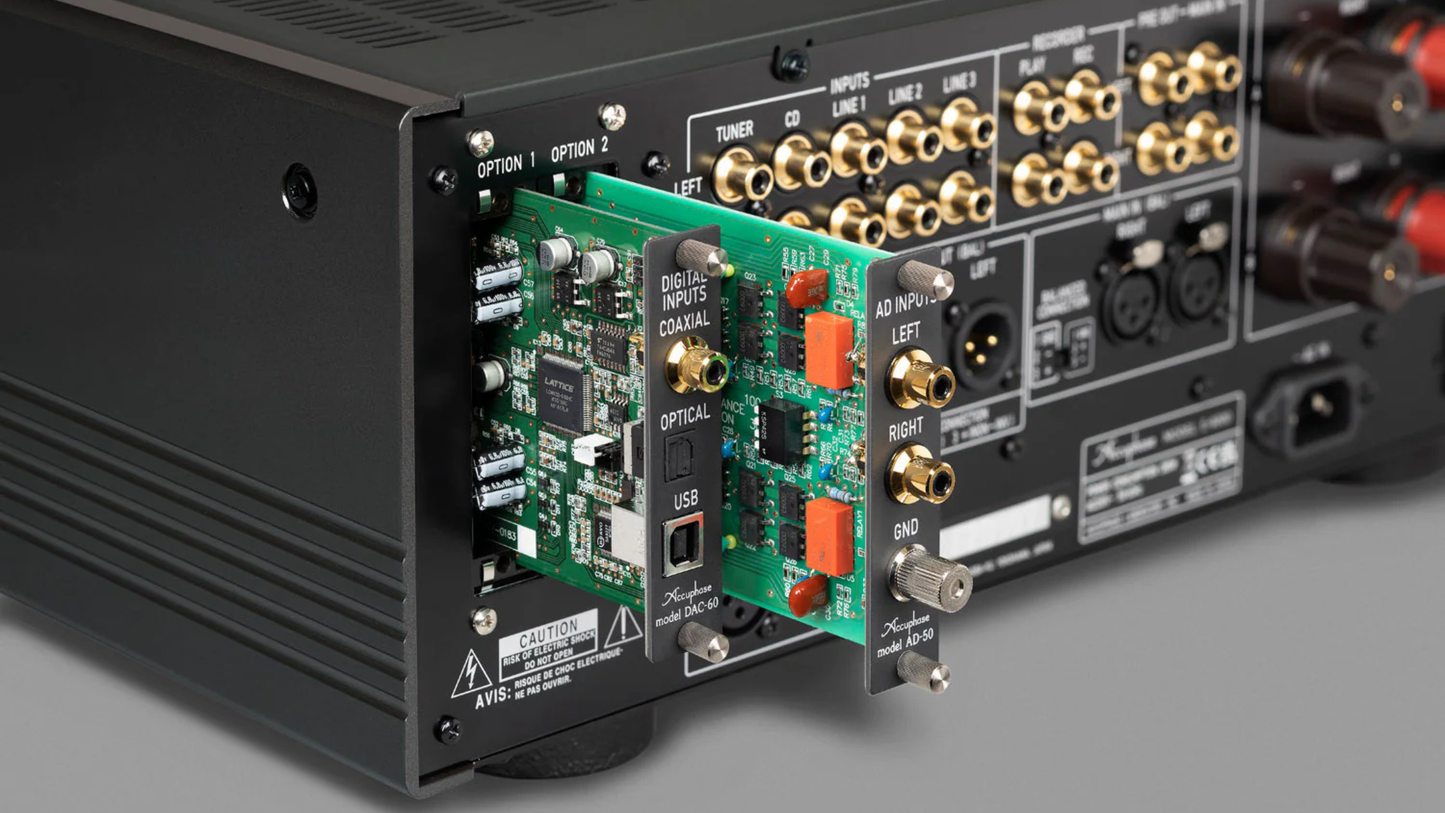
Two option board slots accept Accuphase's plug-in modules. The DAC-60 digital input board adds USB, optical, and coaxial digital inputs along with a high-quality onboard DAC. The AD-50 analog record input board provides a moving-magnet and moving-coil phono stage. The LINE-10 adds an additional unbalanced line input pair for systems that need more than five. These boards are not aftermarket modifications — they are Accuphase-designed circuits that integrate fully with the amplifier's power supply and signal architecture. The DAC-60 adds a sampling frequency display to the front panel when installed. A dedicated headphone amplifier is built in as standard, with its own high-quality output stage independent of the speaker amplification circuit.
Additional features include tone controls built around summing active filters, a loudness compensator, a mono switch, individual phase inversion per input, a –20 dB instant attenuator, and two sets of speaker output terminals for bi-amplification or second-zone use.
How the E-4000 Compares: E-3000, E-5000, and the Competition
Stepping down to the E-3000, the primary differences are output power (120 watts per channel versus 180), output stage topology (the E-3000 uses a different transistor configuration with a lower damping factor of 500), and the AAVA implementation (five buffer amplifiers without ANCC versus six with ANCC). The E-3000 is also limited to one option board slot rather than two. In practical listening, the E-4000 is the more capable amplifier with demanding speaker loads and in larger rooms. For modest-sized rooms and efficient speakers, the E-3000 is entirely sufficient and the price difference is not justified by audible performance alone.
Stepping up to the E-5000 — Accuphase's Class AB flagship, which sits above the E-4000 in the lineup — you gain a damping factor of 1,000, additional output power, and the full circuit architecture developed for the company's separate power amplifiers. The E-5000 is the correct choice if you are building a reference-level system without constraint. The E-4000 is the correct choice for every serious system that falls short of that threshold.
Against competitors at this level, the E-4000's monoblock internal construction, its ANCC-enhanced AAVA volume control, and its bipolar output stage distinguish it from Class AB integrated amplifiers from Luxman, Hegel, and Gryphon in ways that are both measurable and audible. Accuphase's assembly standards — every unit built in Yokohama, Japan, inspected individually — also result in a long-term reliability record that is genuinely exceptional in this industry.
Build Quality and the Accuphase Standard
The E-4000 weighs 28.5 kilograms and is built to the fit and finish standard that has made Accuphase instruments collectible on the used market for decades. The front panel is precision-machined aluminum with gold-plated rings at the base of the volume knob and input selector. The large analog power meters are housed behind a glass window framed by the same machined aluminum as the rest of the panel. High-carbon cast iron insulators are used underfoot for superior vibration damping. The chassis rigidity, component specification, and assembly quality are benchmarks in this price class, and the E-4000 is built with the same intention as every Accuphase product: to still be in daily use twenty years from now.
Key Specifications
- Output Power: 180 W/ch (8 Ω), 260 W/ch (4 Ω)
- Total Harmonic Distortion: 0.05% (20 Hz–20 kHz, both channels driven, 4–16 Ω)
- Intermodulation Distortion: 0.01%
- Frequency Response (at rated output, Line In): 20 Hz–20 kHz (+0/–0.5 dB)
- Frequency Response (at 1W, Main In): 3 Hz–150 kHz (+0/–3.0 dB)
- Damping Factor: 800 (guaranteed)
- Input Sensitivity (rated output, Balanced/Line): 190 mV
- Input Sensitivity (rated output, Main In): 1.51 V
- Input Impedance (Balanced): 40 kΩ
- Input Impedance (Line/Main In): 20 kΩ
- Max Input Voltage: 5.0 V
- Pre Output Voltage (at rated output): 1.51 V
- Pre Output Impedance: 50 Ω
- Balanced Inputs: 2 × XLR
- Line Inputs: 5 × RCA
- Preamplifier Output: RCA and XLR
- Power Amplifier Input: RCA and XLR
- Tape Input/Output: 1
- Speaker Outputs: 2 sets
- Headphone Output: Yes (dedicated circuit)
- Option Slots: 2 (compatible with DAC-60, AD-50, LINE-10)
- Volume Control: AAVA with ANCC (Accuphase Noise and Distortion Cancelling Circuit)
- Power Supply: Single toroidal transformer, 40,000 μF filtering capacitance
- Power Consumption: Approx. 430 W (rated output); approx. 75 W (idle)
- Dimensions (W × H × D): 465 × 197 × 479 mm
- Weight: 28.5 kg (approx. 63 lbs)
- Country of Origin: Japan
- Warranty: Contact All Elite Audio for current warranty terms
Why Buy From All Elite Audio
All Elite Audio is an authorized Accuphase dealer. Every E-4000 we sell comes through legitimate North American distribution with full manufacturer warranty coverage. Accuphase does not honor warranty claims on gray-market imports, and at this price point that distinction is not a formality — it is material protection for your investment. Our staff has spent time with the full Accuphase integrated amplifier range and can speak directly to how the E-4000 compares to the E-3000 and E-5000, which option boards make sense for your system, and how the amplifier performs with specific speaker pairings we carry. We welcome the conversation it takes to get a purchase of this magnitude right.
Call 443-402-5055 / Text 443-402-5064 / Visit 1921 York Rd, Timonium, MD 21093
Frequently Asked Questions
What exactly is the difference between the E-4000 and the E-3000?
The two amplifiers share the same fundamental philosophy — AAVA volume control, fully balanced circuit architecture, instrumentation amplifier power stage — but the E-4000 implements each of those elements at a higher level. The output stage uses bipolar transistors in a four-fold parallel push-pull configuration, versus a different arrangement in the E-3000, yielding a damping factor of 800 compared to the E-3000's 500. The AAVA module in the E-4000 uses six paralleled buffer amplifiers and adds the ANCC noise and distortion cancellation circuit, which reduces noise by 20 percent over the predecessor design and provides measurably cleaner performance at all volume settings. The E-4000 also offers two option board slots versus one in the E-3000, and monoblock-style internal construction with fully separated left and right power amplifier modules. In listening, the E-4000 is more authoritative with demanding speaker loads and has a lower noise floor; for modest rooms and efficient speakers, the E-3000 is entirely satisfying.
What is ANCC and how does it differ from AAVA?
AAVA and ANCC are two distinct technologies that work together inside the E-4000's preamplifier section. AAVA — Accuphase Analog Vari-gain Amplifier — is the volume control architecture that eliminates variable resistors from the signal path entirely, adjusting level by changing the combination of precision current sources rather than attenuating the signal through a resistive element. ANCC — Accuphase Noise and Distortion Cancelling Circuit — is a separate sub-circuit integrated into the AAVA block's current-to-voltage converter stage. It works by detecting noise and distortion components at the input of that stage in real time and injecting a cancellation signal of opposite polarity to null them. The E-4000's ANCC sub-amplifier is specified at a noise density of 1.5 nV/√Hz, which is extremely low. Together, AAVA and ANCC produce a volume control section that is measurably quieter than any previous Accuphase integrated amplifier.
Does the E-4000 include a phono stage?
No phono stage is included as standard. The E-4000 accepts the optional AD-50 analog record input board, which supports both moving-magnet and moving-coil cartridges with selectable gain and loading settings. This board installs into one of the two option slots in the rear panel and draws power from the amplifier's internal supply. It is a fully Accuphase-designed circuit built to the same standard as the rest of the amplifier, not a cost-reduced add-on. If you are a vinyl listener and want to keep your system to a single chassis, the AD-50 makes the E-4000 entirely self-contained. If you prefer a dedicated outboard phono preamplifier, the E-4000's line inputs are entirely suitable for any high-quality phono stage with a standard line-level output.
What is the DAC-60 option board and do I need it?
The DAC-60 is Accuphase's digital input board, compatible with the E-4000's option slots. It adds USB Type B, optical TosLink, and coaxial digital inputs, along with an onboard DAC that supports PCM signals up to 384 kHz/32-bit and DSD up to 11.2 MHz. When installed, it also adds a sampling frequency display to the E-4000's front panel. Whether you need it depends on your source components: if your primary digital source is a high-quality standalone DAC or streamer with its own analog outputs, the DAC-60 is redundant and the line inputs on the E-4000 are the right connection. If you want to simplify the system and connect a computer or streamer directly to the amplifier via USB, the DAC-60 is the elegant solution. It can also be upgraded independently if DAC technology advances — one of the practical benefits of the modular option system.
Why does damping factor matter and is 800 actually significant?
Damping factor is the ratio of the speaker's nominal impedance to the amplifier's output impedance, and it quantifies how firmly the amplifier controls woofer cone motion. When a woofer is driven to move and the signal stops, the cone's momentum causes it to continue moving briefly — this produces low-level distortion that smears transient detail and softens bass definition. The amplifier's output impedance, acting as a braking force through the speaker's voice coil, controls this overhang. A damping factor of 800 at 8 ohms means the E-4000's output impedance at the speaker terminals is ten milliohms — vanishingly low. The E-4000 achieves this through four-fold parallel push-pull bipolar transistors, balanced remote sensing that eliminates speaker cable resistance from the feedback loop, and MOS-FET protection switches with an on-resistance of just 1.6 milliohms. In a practical listening sense, the improvement over an amplifier with a damping factor of 200 or 300 is most audible as tighter, more articulate bass and greater composure on complex orchestral or electronic material.
Can the E-4000 drive low-impedance or difficult speakers?
Yes — this is one of the amplifier's primary engineering objectives. The E-4000 is rated at 260 watts per channel into 4 ohms, versus 180 watts into 8 ohms, which reflects a power supply and output stage genuinely sized for real-world speaker loads. Many premium loudspeakers present impedance curves that dip below 4 ohms at certain frequencies, and some combine low impedance with difficult phase angles that require high current delivery. The four-fold parallel push-pull bipolar output stage handles these demands with the same composure it brings to conventional loads. Accuphase specifically notes that the E-4000 is designed to drive low-efficiency speakers fully — a meaningful statement from a manufacturer that tests its products against real speaker loads rather than resistive bench measurements. If you own speakers that other amplifiers have struggled to control, the E-4000 is a serious solution.
What does the monoblock construction mean in practice?
In a conventional integrated amplifier, the left and right channel amplifier circuits share a common physical space, often with a shared power supply topology and physically adjacent output stages. This proximity creates opportunities for crosstalk — signal from one channel bleeding into the other — and for power supply interaction during dynamic passages when both channels draw heavily simultaneously. The E-4000's monoblock construction places the left and right power amplifier modules on opposite sides of the chassis, each with its own dedicated heatsink and output devices, with the central power supply equidistant between them. The AAVA volume control board is positioned at the front of the unit to physically distance it from the power circuits. The result is channel separation that measures and sounds like a properly implemented monoblock pair, in a form factor that sits on a single shelf.
What happens when I use the Pre Out and Main In jacks?
The E-4000 provides both preamplifier outputs and power amplifier inputs in both balanced XLR and unbalanced RCA format. By default, a jumper connects the preamp section to the power amp section. Removing the jumper breaks this connection and allows you to insert an outboard device — a room correction processor, an electronic crossover, a headphone amplifier — between the two stages. It also allows the E-4000's preamplifier section (with its AAVA volume control) to drive a separate power amplifier, which is useful for bi-amplification setups or system expansions. Alternatively, you can feed a signal directly into the Main In to use the E-4000's output stage alone as a 180-watt power amplifier driven by an external preamp, bypassing the AAVA section entirely. This flexibility makes the E-4000 a long-term investment rather than a fixed endpoint.
Does the E-4000 have tone controls and are they in the signal path all the time?
Yes, the E-4000 includes bass and treble tone controls, implemented using summing active filters — a higher-quality approach than passive tone controls that avoids the impedance interactions and insertion loss associated with conventional designs. The tone controls are defeatable, meaning they can be switched entirely out of the signal path when set to the flat position. The amplifier also includes a loudness compensator, which provides a frequency-dependent boost at low listening levels to compensate for the ear's reduced sensitivity to bass and treble at low volumes — useful for late-night listening. Individual phase inversion is available per input, which is practically useful when your source components or recordings use different absolute polarity conventions. A mono switch collapses the stereo signal to mono for auditioning mono recordings or checking channel balance.
Where does the E-4000 sit relative to the E-5000 and is the step up worth it?
The E-5000 is Accuphase's Class AB flagship integrated amplifier, positioned above the E-4000 in the lineup. It offers a higher damping factor (1,000 versus 800), greater output power, and the full circuit architecture drawn from Accuphase's separate-component reference amplifiers. In the context of all Accuphase integrated amplifiers, the E-4000 is the second most powerful Class AB design — a position it holds with complete authority in any domestic listening environment. The E-5000 is the right amplifier if you are building a system without compromise and budget is not a primary consideration. The E-4000 is the right amplifier for the vast majority of serious two-channel systems, including those built around large, demanding speakers in substantial rooms. We have heard both in controlled comparisons, and the E-4000 does nothing to suggest it is insufficient — the E-5000's advantages are real but incremental at normal listening levels.
Where can I buy the Accuphase E-4000?
The Accuphase E-4000 is available at All Elite Audio, an authorized Accuphase dealer at 1921 York Rd, Timonium, MD 21093. We carry the full Accuphase integrated amplifier range and can arrange a proper listening session with speaker pairings relevant to your system. Buying from an authorized dealer is the only way to ensure full manufacturer warranty coverage — Accuphase does not honor warranty claims on gray-market units imported outside the official North American distribution channel. Call us at 443-402-5055, text us at 443-402-5064, or visit the showroom. We take the time these conversations require.