

Accuphase
Accuphase DP-770 Precision MDSD SA-CD Player
Accuphase DP-770 Precision MDSD SA-CD Player
Accuphase DP-770 Precision MDSD SA-CD Player
A single chassis that replaces both a flagship disc player and a flagship outboard DAC, built around an eight-channel parallel conversion system that few players at any price can match.
One Chassis, Two Jobs
The Accuphase DP-770 is built for the way people actually listen today. Most serious systems now mix two very different source types: physical discs, whether CD or Super Audio CD, and digital streams arriving from a computer, a network streamer, or a USB drive. Historically, getting reference-level sound from both meant buying two separate boxes, a disc transport and a standalone DAC, and trusting that the connection between them wouldn't introduce its own problems. The DP-770 folds both jobs into one chassis, using the same conversion stage and the same analog output circuitry whether the music is coming off a disc or arriving through a digital input. For a system that needs to do both well, that single point of engineering accountability matters as much as any individual spec on the page.
Eight Converters Working Together
At the heart of the DP-770 is Accuphase's MDS++ and MDSD conversion principle, which runs the ES9028PRO converter chip from ESS Technologies in eight parallel channels rather than relying on a single converter path. PCM signals (from CD or digital input) are handled by the MDS++ side; native DSD signals (from the SA-CD layer or DSD files) are handled by the MDSD side, which processes eight phase-shifted DSD streams directly without first converting them to PCM, a method Accuphase developed specifically to avoid the high-frequency noise that conventional single-stage DSD decoding struggles to eliminate. Running eight conversion paths in parallel and summing them at the output reduces per-channel noise through averaging and reduces per-channel error through randomization, which is how the DP-770 reaches its measured numbers: a total harmonic distortion plus noise figure of just 0.0004 percent, a signal to noise ratio of 121 dB, a dynamic range of 119 dB, and channel separation of 118 dB. Accuphase's ANCC circuit, a sub-amplifier that actively cancels residual switching noise at the analog output stage, adds a further layer of cleanup after the converter has already done its work. The practical result is a noise floor low enough that quiet musical detail, a brushed cymbal, the decay of a piano note, doesn't get buried.
A Transport Engineered to Disappear
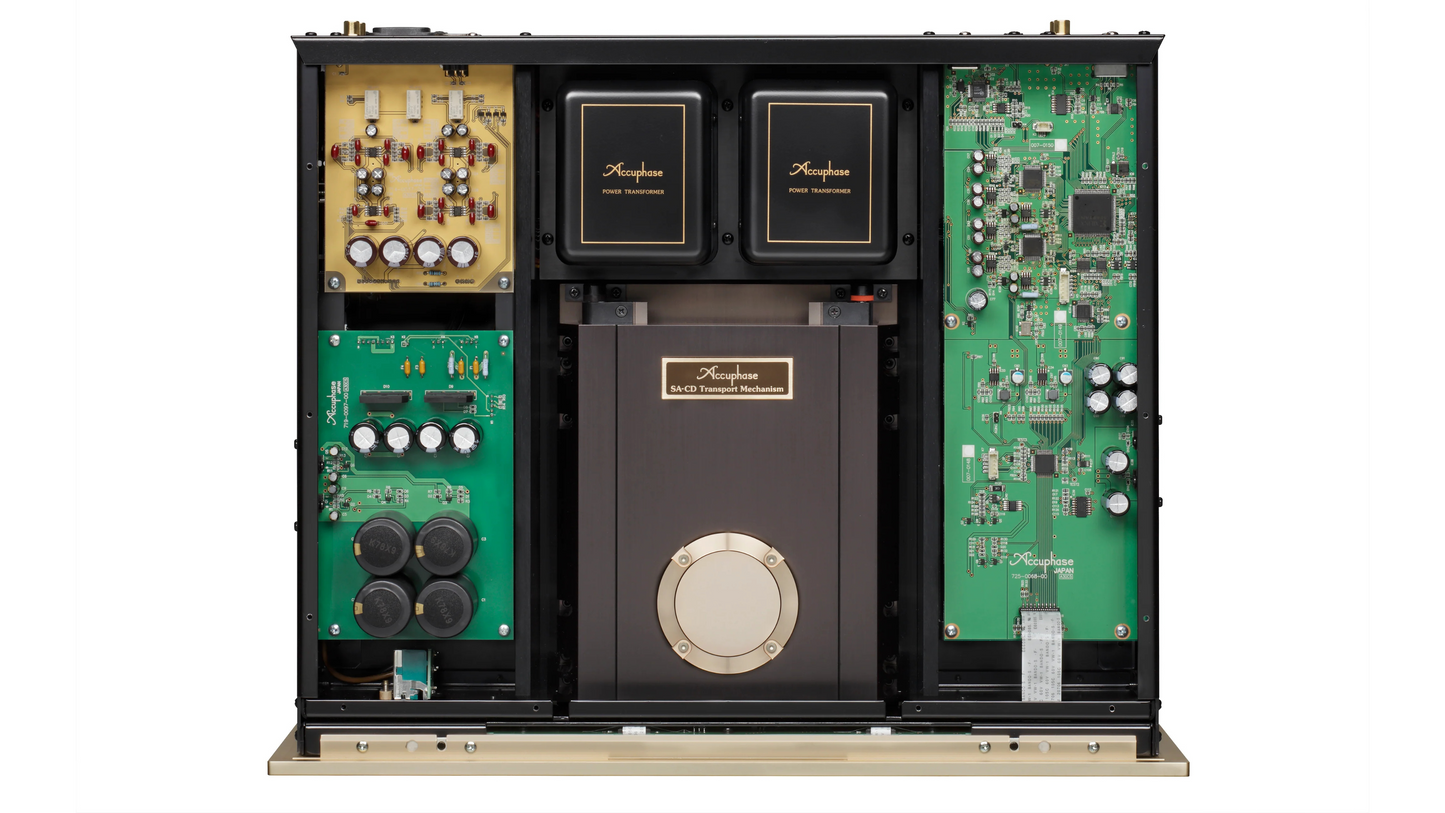
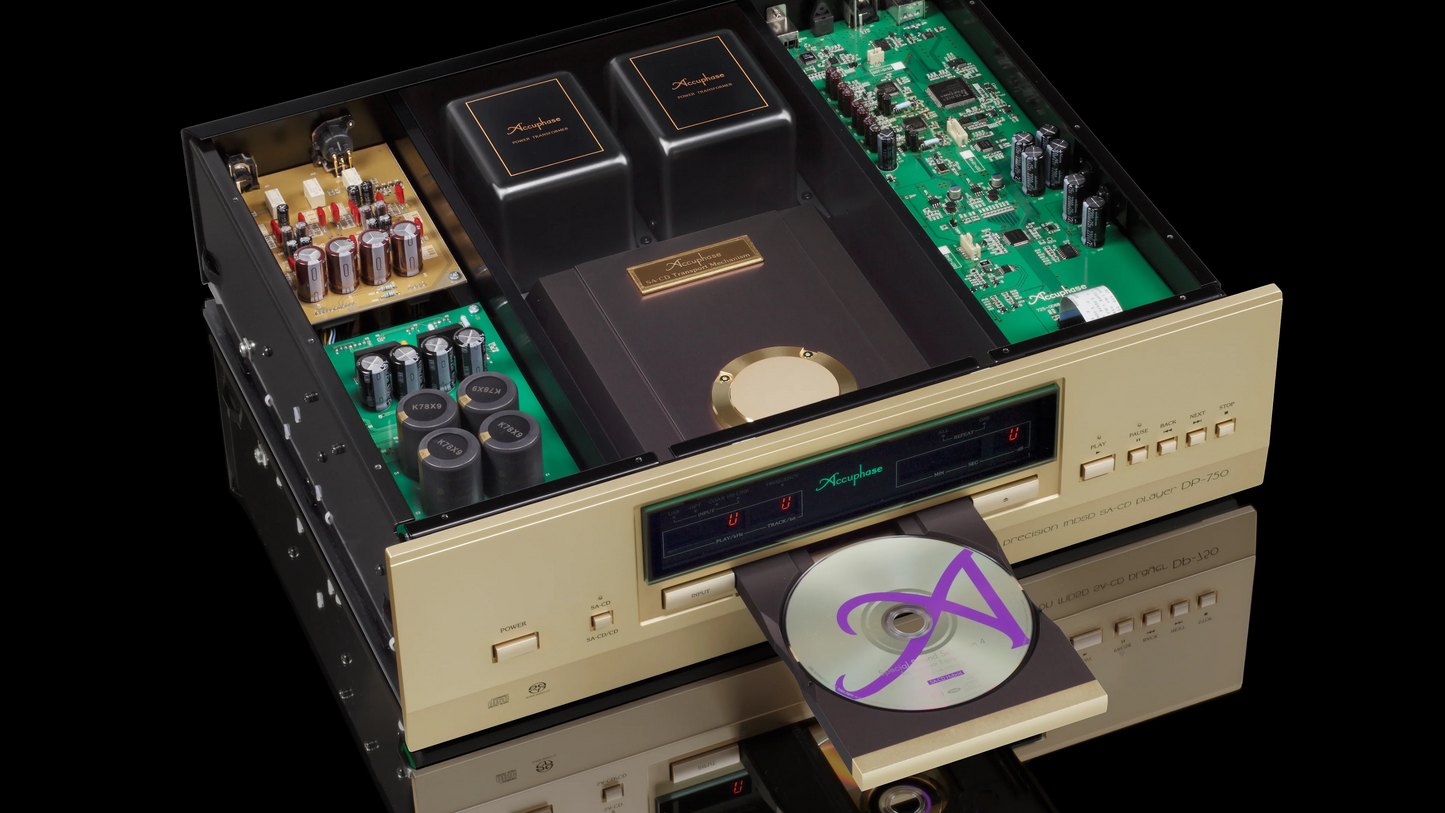
Vibration is the enemy of any spinning-disc transport, and the DP-770's mechanical design is built around minimizing it. The drive itself is a high-rigidity, machined aluminum assembly weighing 6.9 kilograms, mounted on a separate 3.4 kilogram aluminum base plate to keep the center of gravity low and prevent the housing from wobbling as the disc spins. The traverse and disc-loading mechanisms sit on elastic dampers of two different hardnesses, which reduces resonance reaching the objective lens and improves reading accuracy. An outer rotor brushless DC motor, rather than the inner rotor motors found in lower-tier players, keeps both vibration and operating noise to a minimum, and the aluminum disc tray rides on dual stay bearing shafts so it opens and closes smoothly and quietly. None of this is decorative. Every gram of that mechanical engineering exists to keep the transport's own movement from coloring the very signal it's trying to read cleanly.
Built to Anchor a Modern System
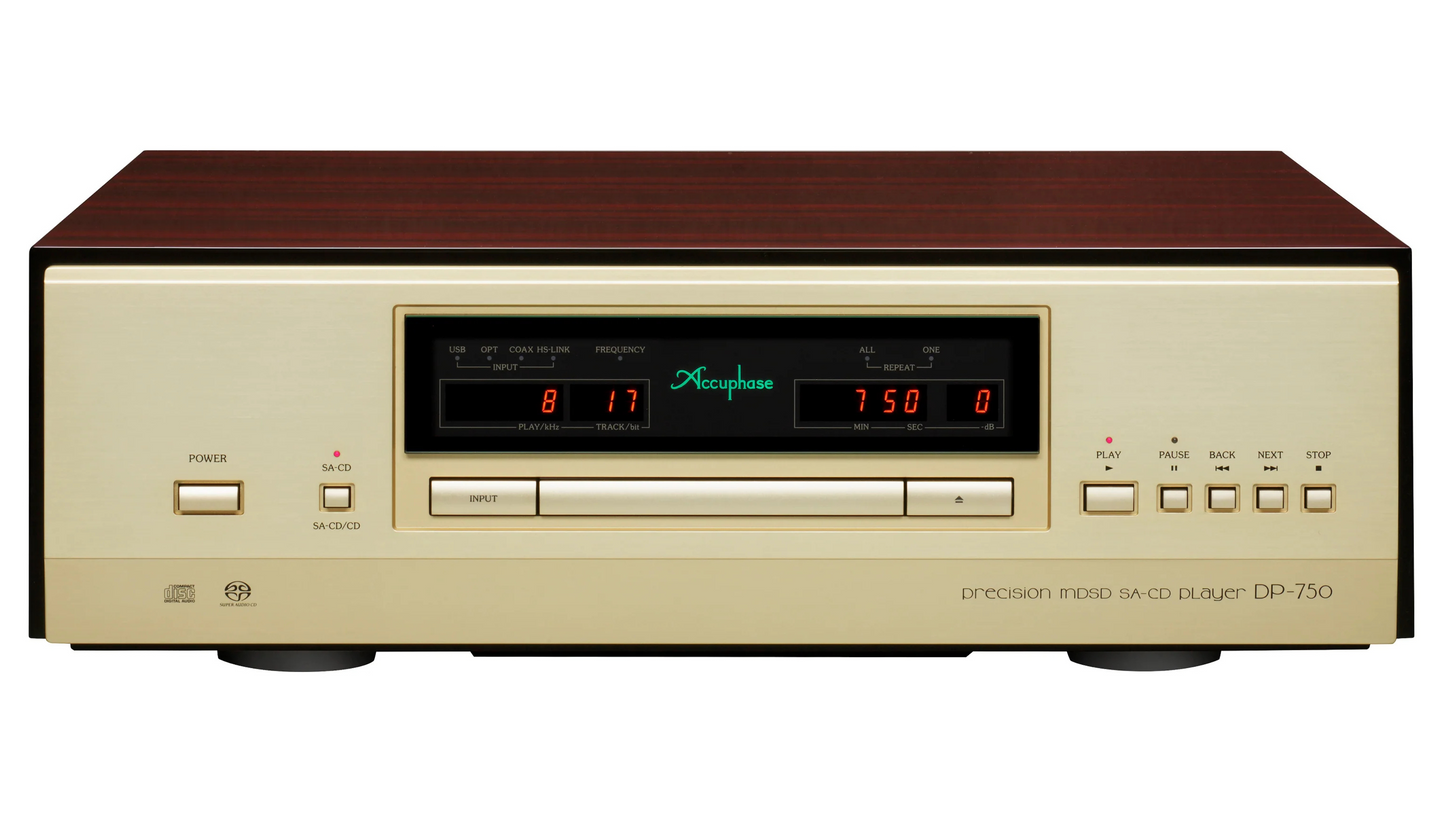
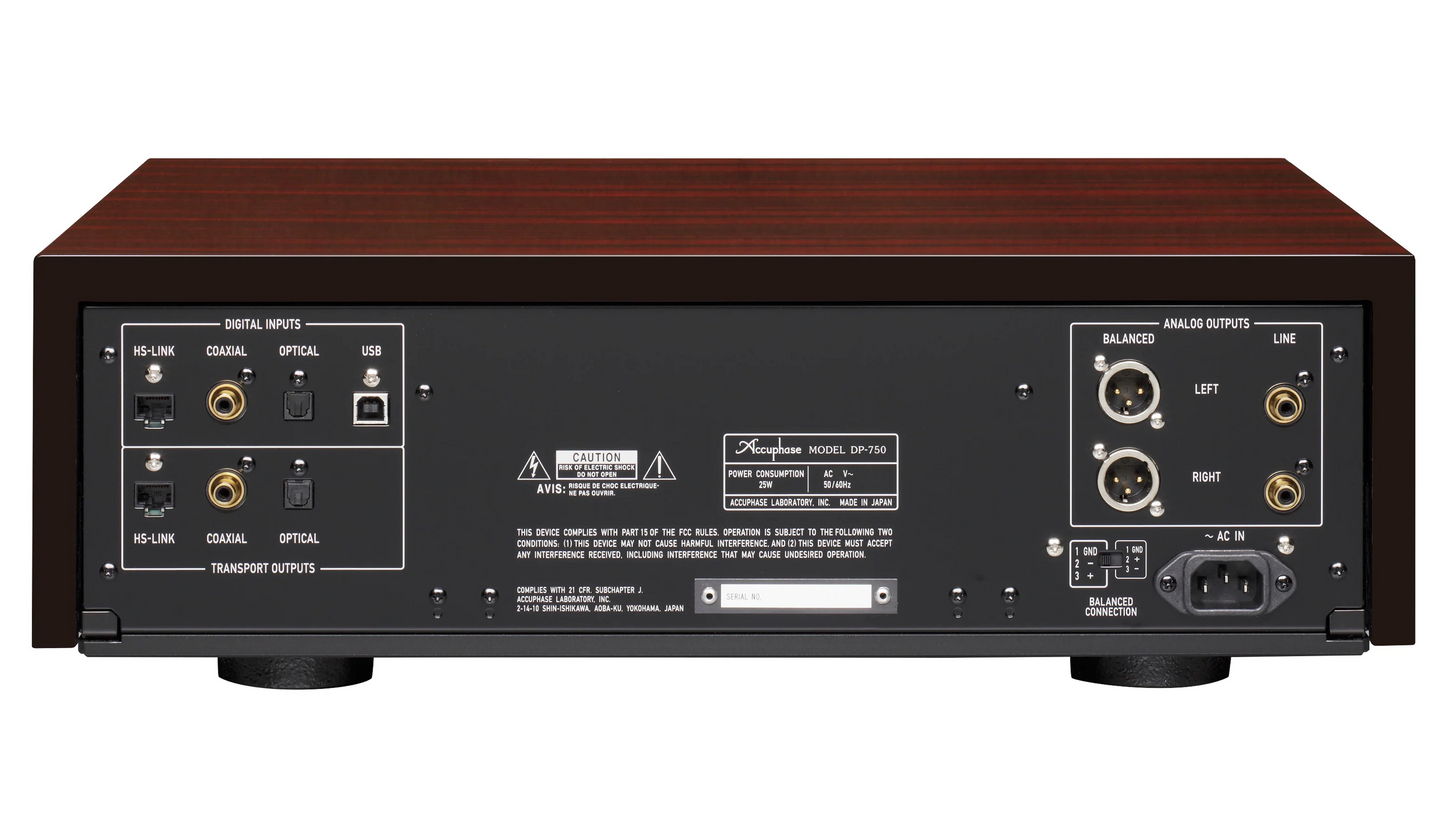
Behind the disc drive sits a digital input and output bank generous enough to make the DP-770 the hub of a full system, not just a disc player. Digital inputs include HS-LINK (Accuphase's proprietary high-speed format, in both Version 1 and Version 2), USB 2.0 Type-B for computer playback, coaxial, and optical, covering everything from a basic CD transport upstream to a high-resolution streaming source. Transport outputs over HS-LINK, coaxial, and optical let the DP-770 feed its disc signal to an external DAC or to Accuphase's DG-68 Digital Voicing Equalizer for room correction, entirely in the digital domain, before it ever reaches an analog stage. On the output side, the Direct Balanced Filter keeps the balanced (XLR) and unbalanced (RCA) signal paths completely separate from the converter outward, rather than splitting one path into two after the fact, so the balanced output carries a genuine differential signal. A phase selector switch on the rear panel lets you invert the balanced output's polarity to match the rest of your system, and digital output level control from 0 dB down to -80 dB in 1 dB steps gives you fine controlled attenuation without leaving the digital domain. The front display shows the incoming sampling frequency and bit depth in real time, and data discs, including DSD-encoded discs in WAV, FLAC, DSF, and DSDIFF formats, play back with programmable playlists so you can reorder tracks however you like.
Where the DP-770 Fits in Your System
The DP-770 isn't built in isolation from the rest of the Accuphase digital lineup, and the honest comparison for a buyer is within that lineup rather than against an outside brand. One tier down sits the Accuphase DP-570, a capable SA-CD/CD player at roughly half the price, but without the DP-770's eight-channel MDS++/MDSD architecture or its full digital input bank for outboard DAC duty. One tier up is the two-box Accuphase DP-1000 transport paired with the DC-1000 DAC, which separates the transport's mechanical-noise environment from the DAC's analog-output environment entirely, at the cost of a second chassis and a combined price well north of the DP-770's. For most rooms and most systems, the DP-770 is the point on that line where a single chassis stops being a compromise. It's worth noting that Audio-Technica, which All Elite Audio also carries, doesn't field a competing product here. AT's high-end catalog runs through turntables and phono cartridges, the analog side of a vinyl front end, while the DP-770 covers disc playback and digital conversion. They're complementary categories in a complete system, not competitors in this one. Within Accuphase's own line, the DP-770 pairs naturally with a C-2900 or C-3900 preamplifier and any of Accuphase's A-series or P-series power amplifiers for a complete digital-source-to-speaker chain.
Key Specifications
Disc Compatibility: 2-channel Super Audio CD, CD, CD-R/RW, DVD-R/RW/+R/+RW data discs (WAV, FLAC, DSF, DSDIFF)
Data Read Principle: Non-contact optical pickup
Laser Diode Wavelength: SA-CD 655 nm, CD 790 nm
D/A Converter: 8-channel MDSD (DSD signals) / MDS++ (PCM signals)
DAC Chipset: ESS ES9028PRO, 8 parallel channels
Frequency Response: 0.5 Hz to 50,000 Hz (+0 dB, -3.0 dB)
Total Harmonic Distortion + Noise: 0.0004% (20 Hz to 20,000 Hz)
Signal-to-Noise Ratio: 121 dB
Dynamic Range: 119 dB
Channel Separation: 118 dB (20 Hz to 20,000 Hz)
Output Voltage and Impedance: Balanced 2.5 V / 50 ohms (XLR), Line 2.5 V / 50 ohms (RCA)
Output Level Control: 0 dB to -80 dB in 1 dB steps (digital)
Digital Inputs: HS-LINK (Ver. 1 and 2), USB 2.0 Type-B (PCM to 384 kHz/32-bit, DSD to 11.2 MHz, 11.2 MHz ASIO only), Optical (PCM to 96 kHz/24-bit), Coaxial (PCM to 192 kHz/24-bit)
Transport Outputs: HS-LINK, Coaxial, Optical
Power Requirements: 120V / 220V / 230V AC (per rear panel rating), 50/60 Hz
Power Consumption: 30 W
Dimensions (W x H x D): 477 mm x 156 mm x 395 mm (18.8 in x 6.1 in x 15.6 in)
Weight: 28.5 kg net (62.8 lbs); 36 kg (80 lbs) in shipping carton I
ncluded Accessories: AC power cord, ASL-10B audio cable, RC-140 remote commander, USB Utility 3 disc and setup guide, cleaning cloth
Price: $26,575.00
Warranty: 3-year parts and labor warranty through Accuphase's authorized distribution network when purchased from an authorized dealer Availability: In stock
Why Buy From All Elite Audio
All Elite Audio is an authorized Accuphase dealer, which means every DP-770 we sell is sourced through Accuphase's official U.S. distribution channel, eligible for full manufacturer warranty coverage, and set up correctly before it ever leaves our showroom. Buying gray-market or parallel-imported Accuphase gear voids the warranty outright and often arrives wired for the wrong line voltage. We'll help you match the DP-770 to the rest of your system, whether that's an existing Accuphase setup or something you're building from scratch.
Call: 443-402-5055 Text: 443-402-5064 Visit: 1921 York Rd, Timonium, MD 21093
Frequently Asked Questions
What is the Accuphase DP-770? The DP-770 is Accuphase's current flagship single-chassis digital source, combining a Super Audio CD and CD transport with a full-featured standalone DAC in one unit. It plays SA-CD and CD discs natively and also accepts external digital signals over USB, HS-LINK, coaxial, and optical, routing all of them through the same eight-channel MDS++/MDSD conversion stage. It sits at the top of Accuphase's single-box digital source lineup, just below the two-box DP-1000 transport and DC-1000 DAC combination. For a system that needs both disc playback and a reference-grade DAC, it's designed to do the job of both in a single chassis.
Does the DP-770 include a phono preamp or accept a turntable directly? No. The DP-770 has no analog inputs of any kind, only digital inputs and a disc tray, so it cannot accept a turntable's signal under any circumstances, with or without a phono preamp. If you're building a system around both vinyl and digital sources, your turntable and phono stage need to connect directly to your preamplifier or integrated amplifier, with the DP-770 connected to a separate input on that same preamp. We carry phono preamplifiers and cartridges from several brands, including Audio-Technica, if you need to add that side of a system. Just ask us and we'll help you spec out a phono front end that pairs well with what you're building around the DP-770.
How does the DP-770 compare to the Accuphase DP-570 and the DP-1000/DC-1000 pair? The DP-570 is the tier below the DP-770, a genuinely capable SA-CD/CD player at roughly half the price, but it doesn't carry the DP-770's eight-channel MDS++/MDSD conversion architecture or its broader digital input bank for outboard DAC use. One tier above the DP-770 sits the two-box combination of the DP-1000 transport and DC-1000 DAC, which physically separates the disc transport's mechanical vibration environment from the DAC's analog output stage, at the cost of a second chassis and a combined price well above the DP-770's single-box cost. The DP-770 is where Accuphase consolidated that two-box performance into one chassis without the major compromises that consolidation usually requires. For most listening rooms, it's the sensible stopping point on that ladder.
What does MDSD and MDS++ mean, and why does the DP-770 use eight parallel DAC channels? MDS++ is Accuphase's name for its PCM conversion principle, and MDSD (Multiple Double Speed DSD) is the equivalent principle for native DSD signals from SA-CD discs and DSD files. Both run the ES9028PRO converter chip in eight parallel channels rather than a single channel, then sum the eight outputs together at the analog stage. Running multiple converters in parallel and averaging their outputs reduces per-channel noise and randomizes per-channel error in a way a single converter path can't, which is why the DP-770 measures as cleanly as it does across distortion, noise, and linearity. For DSD specifically, the MDSD approach processes eight phase-shifted DSD signals directly as a moving-average filter, avoiding the extra noise that comes from converting DSD to PCM first, which is how most conventional DACs handle it.
Can the DP-770 function as a standalone DAC for a streamer? Yes, and this is one of the most underused capabilities of the unit. Connect a network streamer, a music server, or a computer to the DP-770's USB, HS-LINK, coaxial, or optical input, and that signal runs through the exact same eight-channel MDS++/MDSD converter and ANCC-equipped analog output stage that handles SA-CD and CD playback. There's no secondary, lesser DAC path for external sources here. If your system already includes a streaming source and you're deciding between a separate disc player and DAC or one box that does both, the DP-770 is built for exactly that decision.
What sample rates and digital file formats does the DP-770 support? It depends on which input you're using. Over USB, the DP-770 supports PCM up to 384 kHz at 32-bit and DSD up to 11.2 MHz (the 11.2 MHz rate requires ASIO drivers). HS-LINK Version 2 matches USB's PCM ceiling and supports DSD up to 5.6 MHz, while the older HS-LINK Version 1 tops out at PCM 192 kHz and DSD 2.8 MHz. Coaxial digital input handles PCM up to 192 kHz, and optical is limited to PCM up to 96 kHz, which is worth checking against your streamer's own output capability before you pick a connection. For disc-based playback, data discs support WAV, FLAC, DSF, and DSDIFF files alongside standard SA-CD and CD formats.
Do I still need a separate preamplifier with the DP-770? In most cases, yes. The DP-770's output level control adjusts level digitally in 1 dB steps from 0 dB down to -80 dB, which gives you fine, accurate attenuation, but it's not a substitute for a full preamplifier with multiple analog inputs, input switching, and the broader functionality a system typically needs. If your system is genuinely just the DP-770 feeding a single power amplifier with no other sources to switch between, running direct is workable. For anything more than that, including a turntable, a separate streamer, or a second digital source, a proper preamplifier like the Accuphase C-2900 or C-3900 is the right way to bring everything together.
What else do I need to build a complete system around the DP-770? At minimum, you'll want a preamplifier (unless you're running the DP-770 direct into a single power amp), a power amplifier or integrated amplifier, a pair of speakers capable of resolving the detail the DP-770 is capable of producing, and quality cabling, ideally a balanced XLR run given the DP-770's true differential balanced output. If your system pulls digital audio from a network streamer or computer, you'll also want a solid USB or HS-LINK cable matched to that source. Bring us your room dimensions and your existing gear list and we'll help you build out the rest of the chain properly rather than guessing at it.
What's the difference between the balanced (XLR) and unbalanced (RCA) outputs, and which should I use? The DP-770's Direct Balanced Filter keeps the balanced and unbalanced signal paths completely separate from the converter outward, so the XLR output is a genuine differential balanced signal rather than a single path split in two after the fact. Balanced connections reject cable-induced noise more effectively over longer cable runs and are generally the better choice if your preamplifier or power amplifier has balanced inputs available. If your downstream equipment is RCA-only, the unbalanced output performs excellently on its own at the same 2.5V output level. Either way, the phase selector switch on the rear panel lets you invert the balanced output's polarity if needed to match the rest of your system.
What is the warranty on the Accuphase DP-770? Accuphase backs the DP-770 with a 3-year parts and labor warranty when it's purchased new from an authorized dealer and registered through Accuphase's official distribution channel. That coverage doesn't transfer to units bought gray-market or parallel-imported from outside the authorized network, and voltage mismatches between regions will void it entirely. Buying through All Elite Audio as an authorized Accuphase dealer means your unit, and its warranty, are both legitimate from day one. If you ever need service, we can help coordinate that through the proper channel.
Where can I buy the Accuphase DP-770? Right here. All Elite Audio is an authorized Accuphase dealer with a full home audio showroom in Timonium, Maryland, and the DP-770 is in stock now at $26,575.00. Call us at 443-402-5055, text 443-402-5064, or stop by in person at 1921 York Rd, Timonium, MD 21093 to hear it for yourself before you buy. We're happy to walk through pairing options for the rest of your system at the same time.