Skip to product information
1 of 6

Accuphase

Accuphase DP-1000 Precision SA-CD Transport

Accuphase DP-1000 Precision SA-CD Transport

Regular price $24,975.00 USD
Regular price $24,975.00 USD Sale price $24,975.00 USD
SALE Sold Out
Shipping calculated at checkout.

Call for info 443-402-5055

Accuphase DP-1000 Precision SA-CD Transport

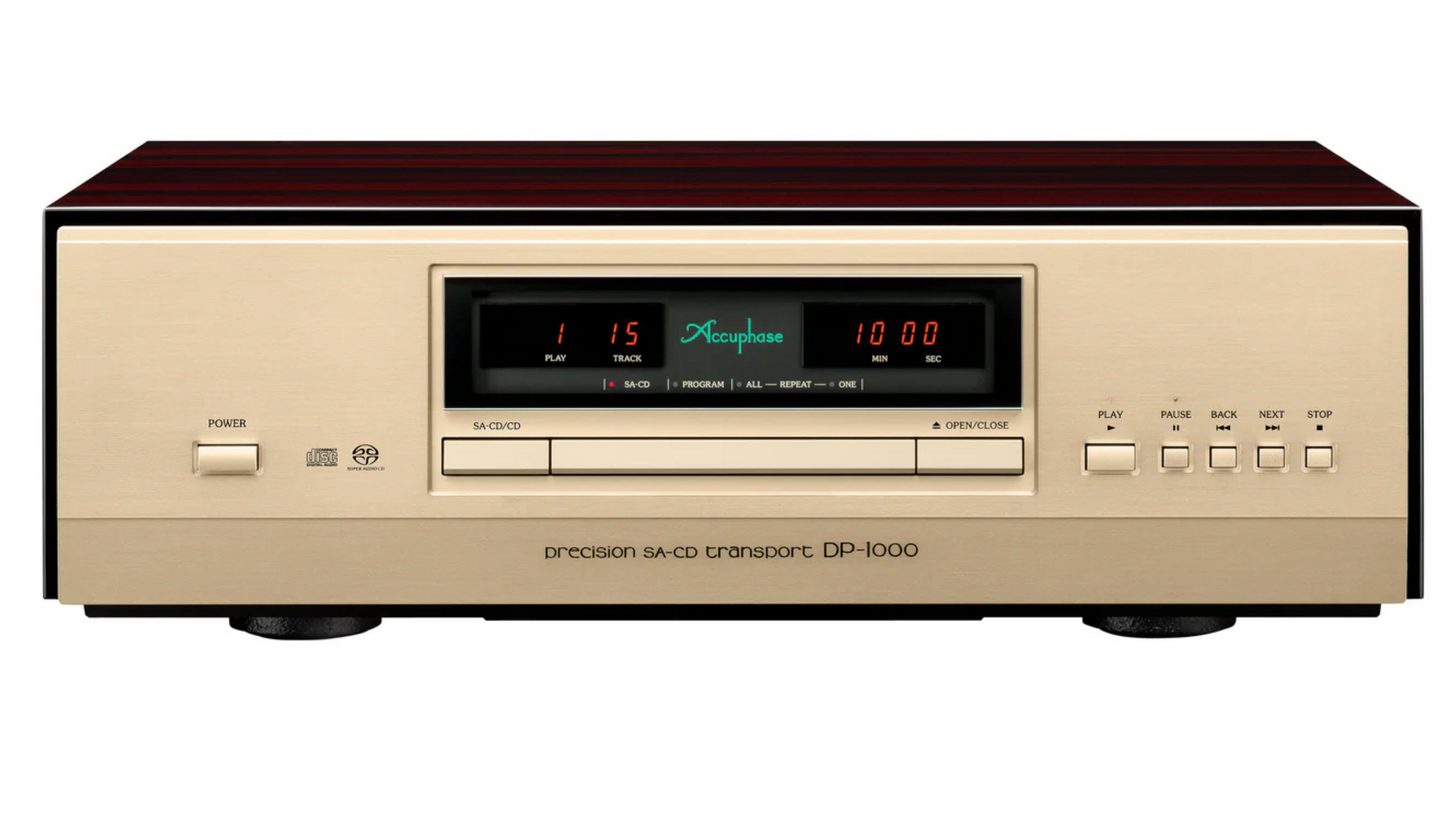
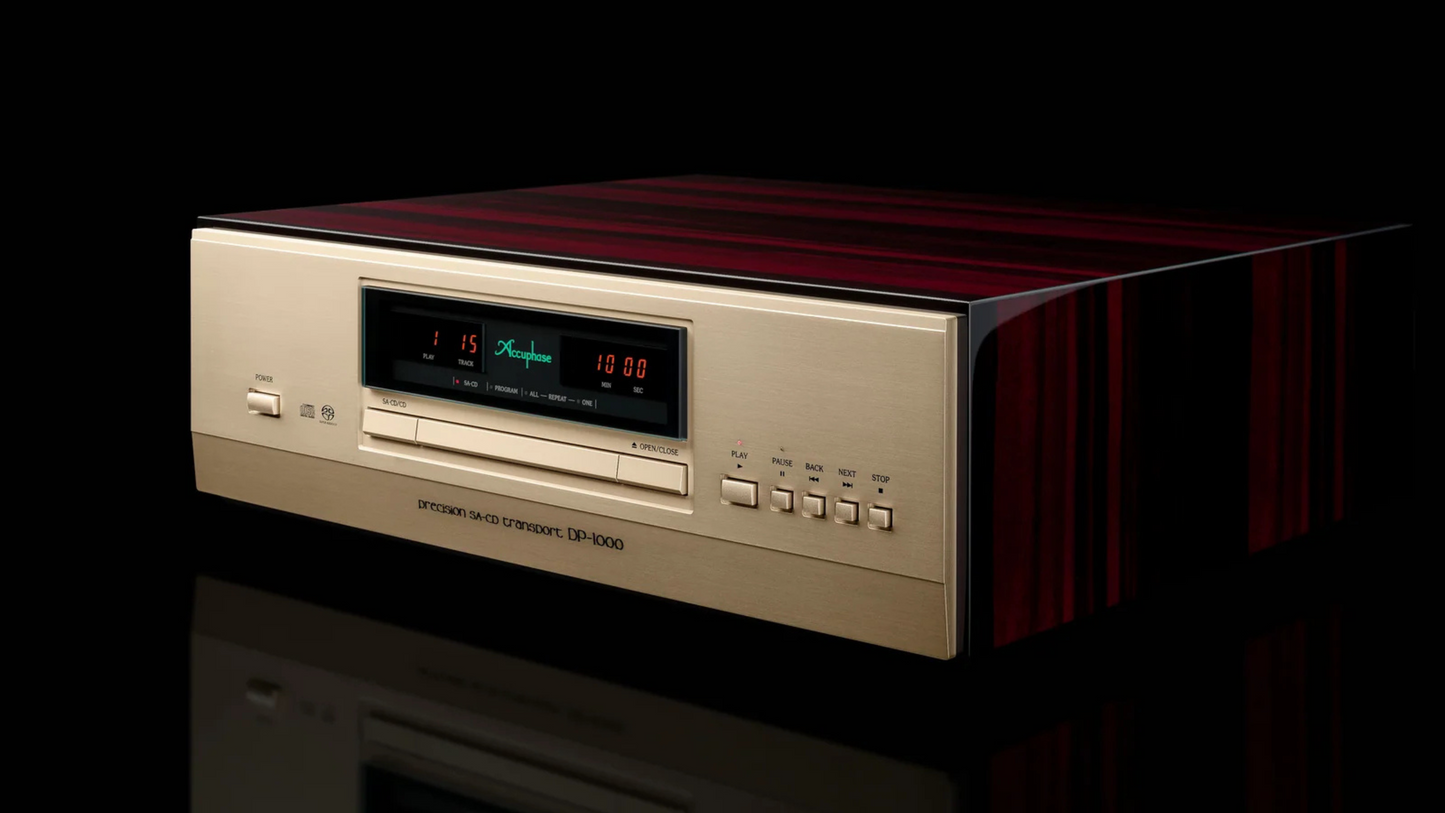
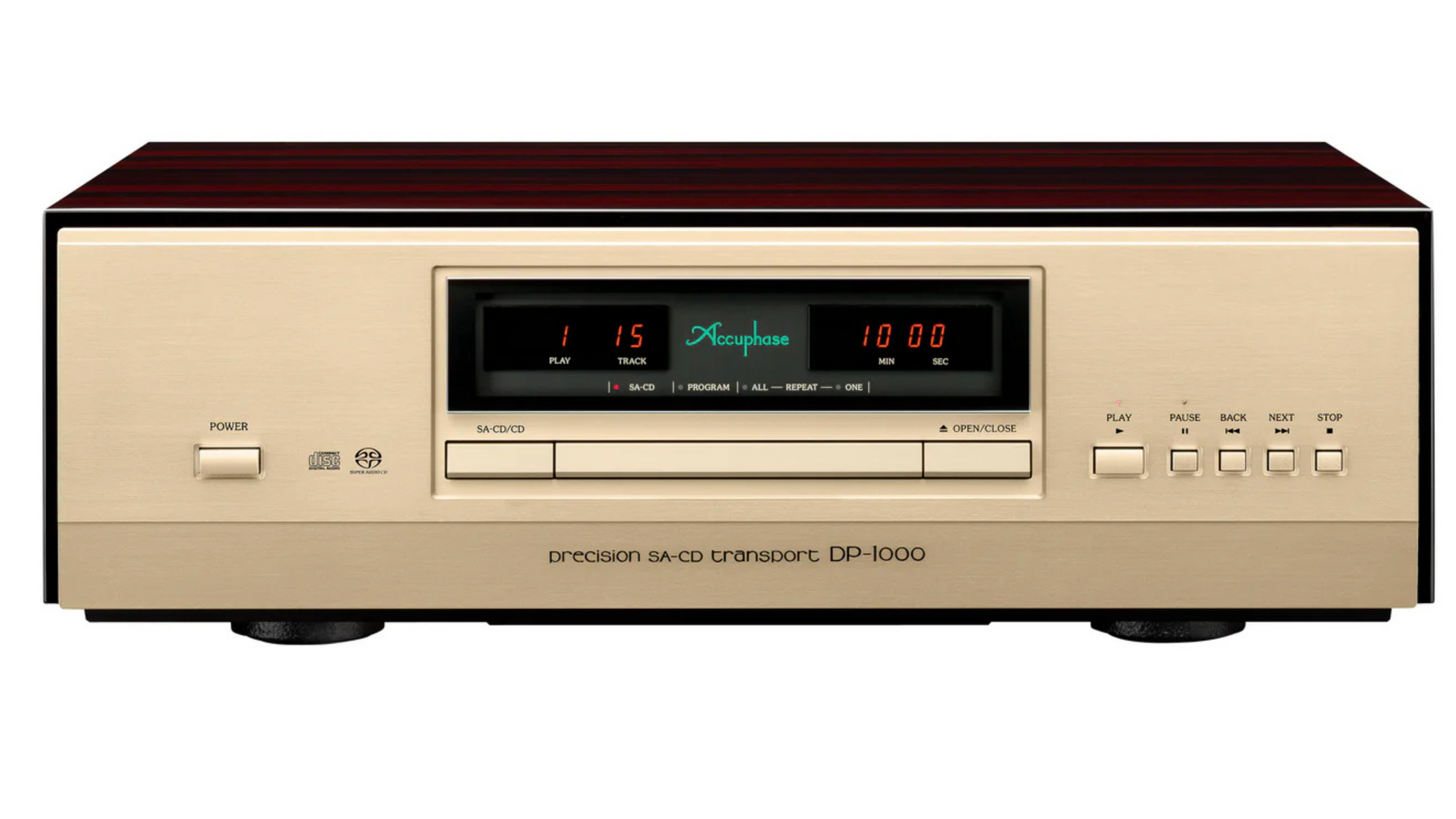
Accuphase's reference SA-CD and CD transport: a dedicated disc reading mechanism with no internal DAC, built around an 11 kilogram drive and bottom plate assembly, two independent toroidal transformers, and the HS-LINK proprietary digital output that carries SA-CD's DSD layer intact to the companion DC-1000 processor.

What It Is, and What It Is Not

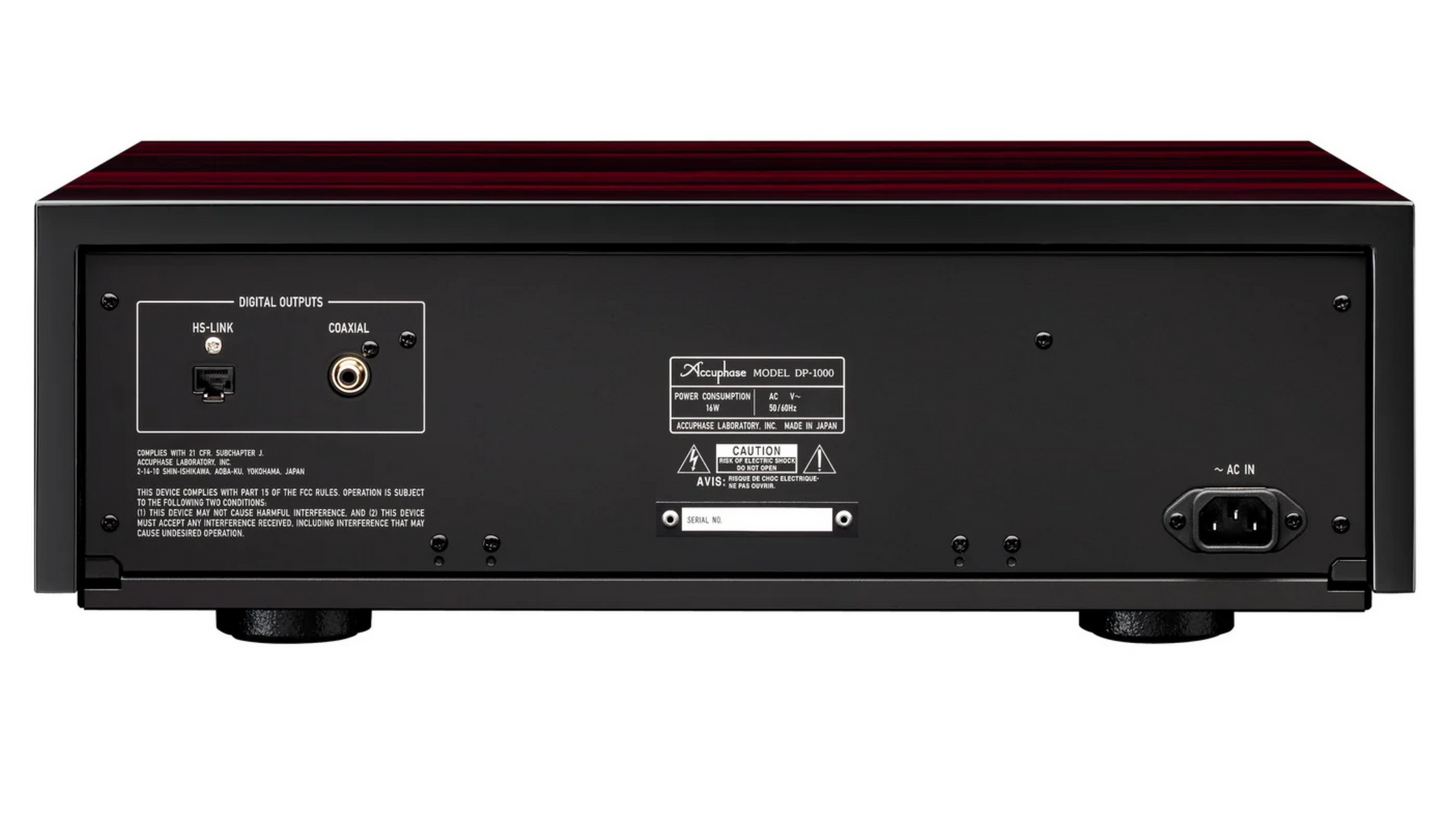
The Accuphase DP-1000 is a transport, not a player. It reads SA-CDs and CDs with exceptional mechanical precision and sends that digital data out to an external processor or DAC. It does not convert that data into an analog signal on its own. There are no analog outputs anywhere on the chassis, and there is no built in DAC. This needs to be understood before anything else about the product, because the buyer considering the DP-1000 should know exactly what they are purchasing: the finest disc reading mechanism Accuphase has built, designed from the ground up to feed a separate processor as one half of a two chassis digital source system.

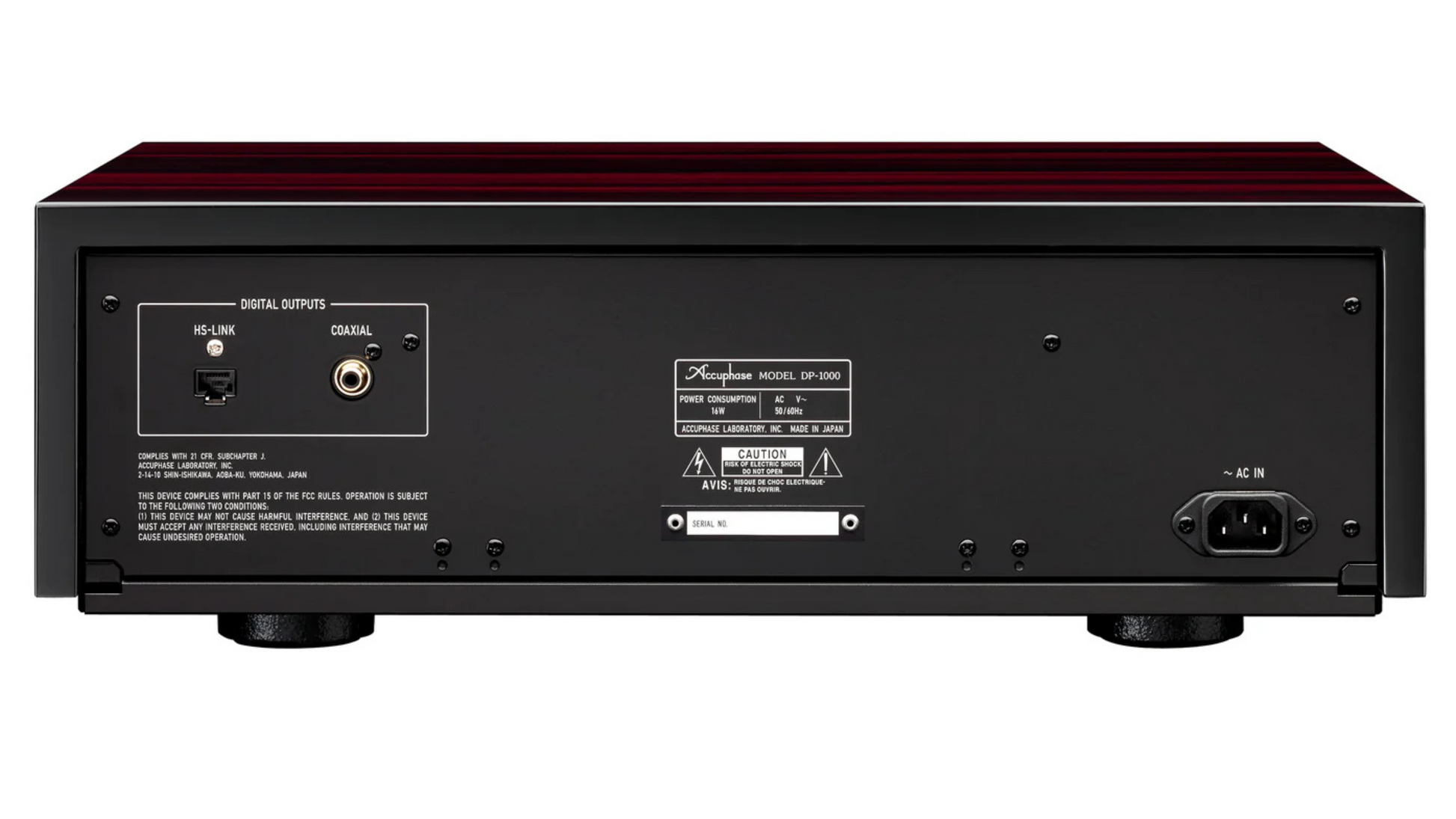
The natural partner is the Accuphase DC-1000 Precision MDSD Digital Processor, which receives the DP-1000's output over the HS-LINK interface and converts it using an eight channel parallel DAC architecture. The two components were developed together to mark Accuphase's fiftieth anniversary and form the company's reference disc playback system. The DP-1000 also outputs standard coaxial digital signal for use with other DACs, though the SA-CD layer cannot travel over that connection, only the CD layer can.

The buyer who needs a component like this has already decided that disc playback belongs in a serious system, and that the mechanical job of reading a disc is worth solving as its own engineering problem, separately from digital conversion. That decision holds up under scrutiny. A spinning disc mechanism and a DAC circuit place very different demands on a power supply, a chassis, and an internal layout, and any single chassis trying to do both well involves some degree of compromise. The DP-1000 solves the mechanical half of that problem without compromise.

The Drive Assembly: Eleven Kilograms of Controlled Mass

The engineering story of the DP-1000 is mass, rigidity, and controlled damping working together. Vibration is the natural enemy of accurate disc reading. A spinning disc inside a chassis that resonates will produce data errors and timing jitter that no amount of downstream error correction fully erases. Accuphase's solution to this is architectural, not electronic.

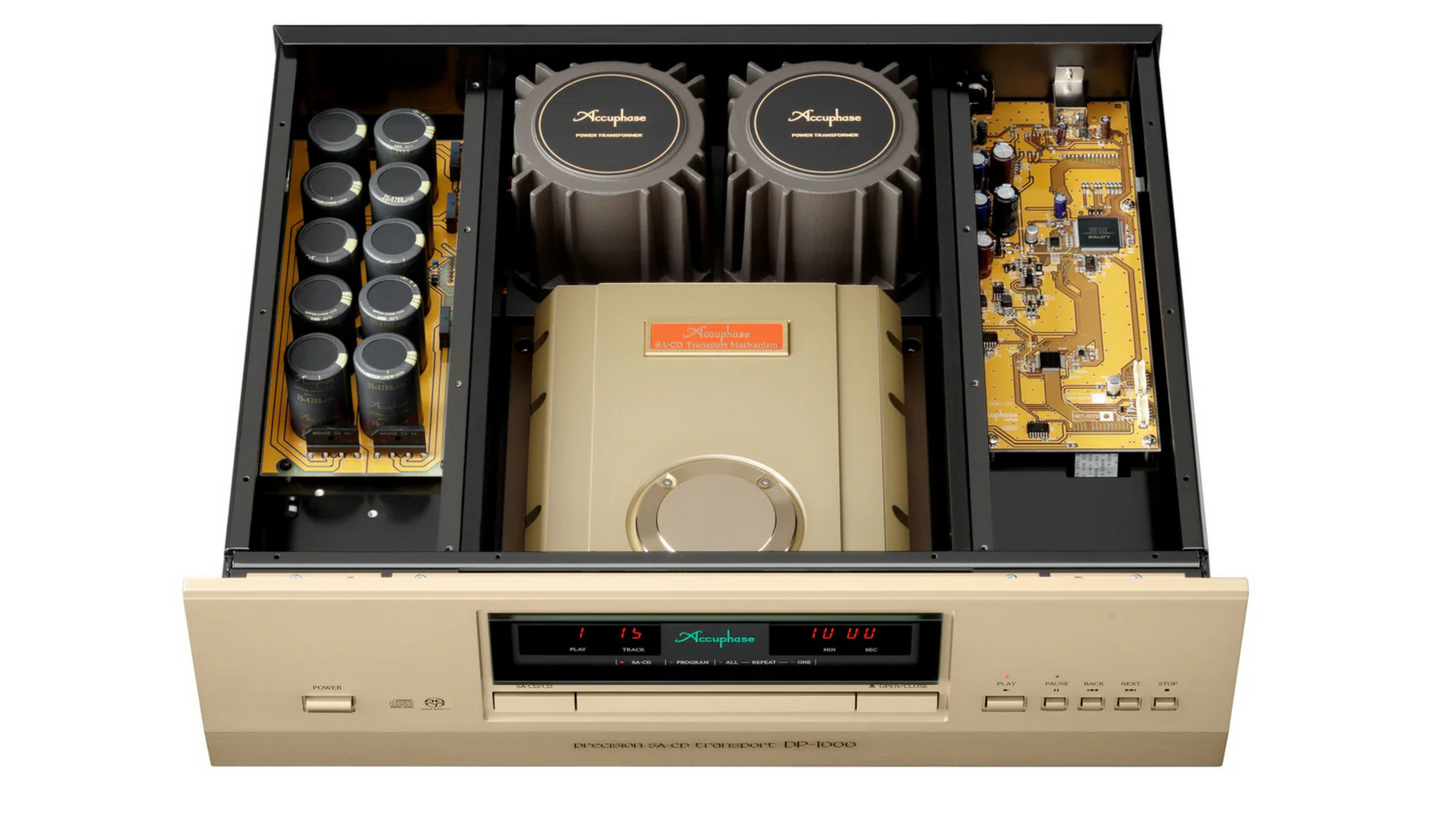
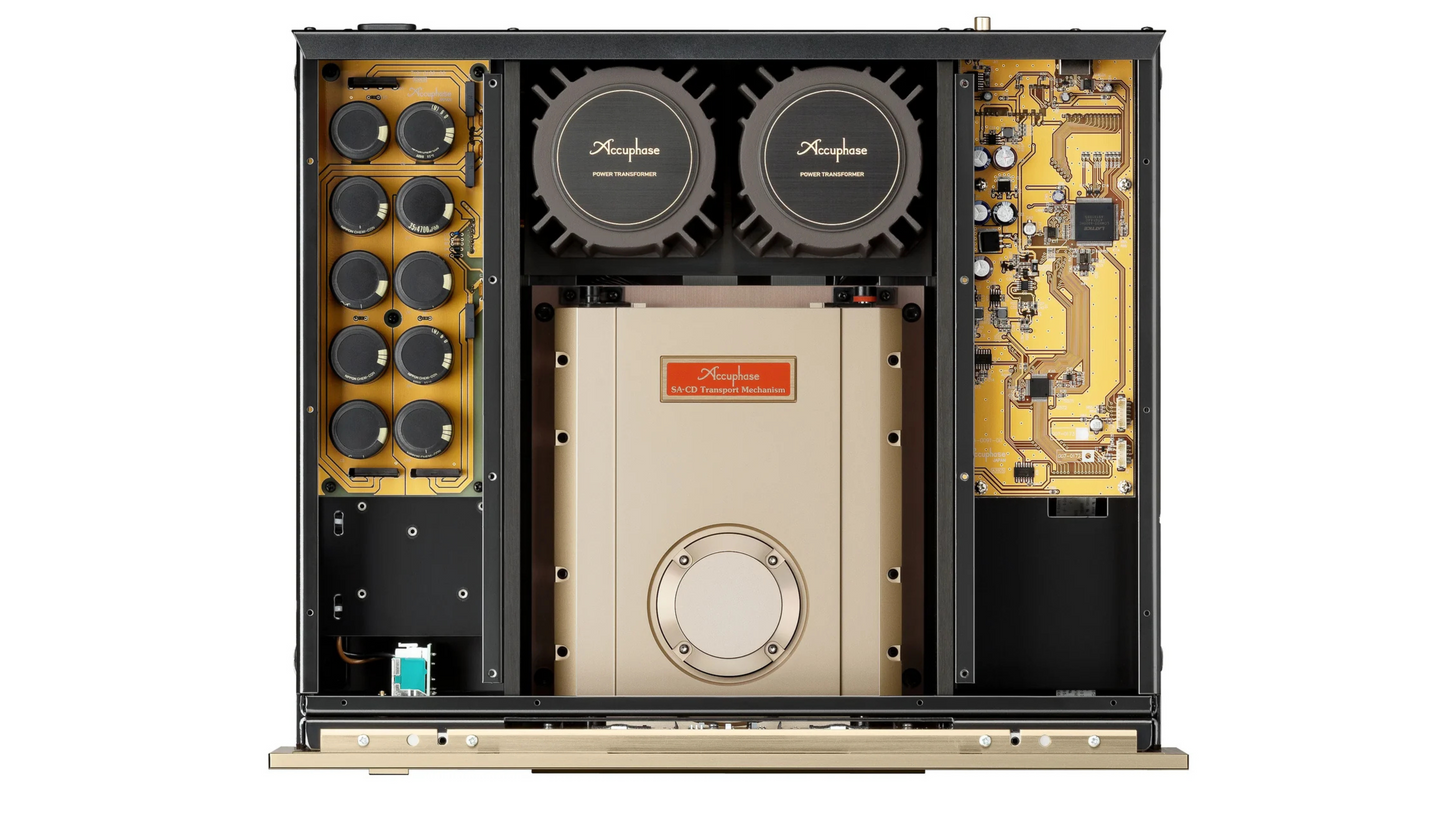
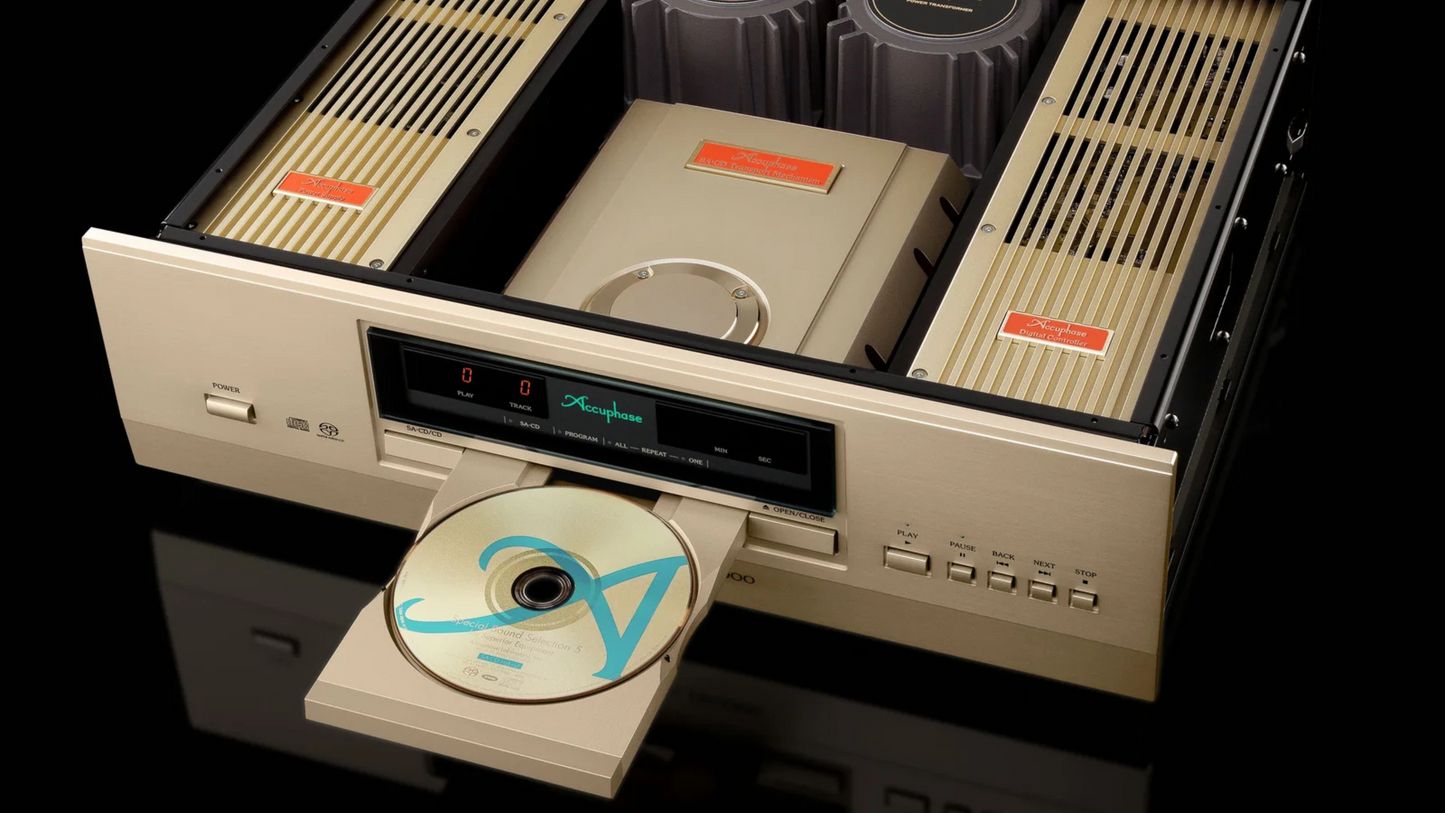
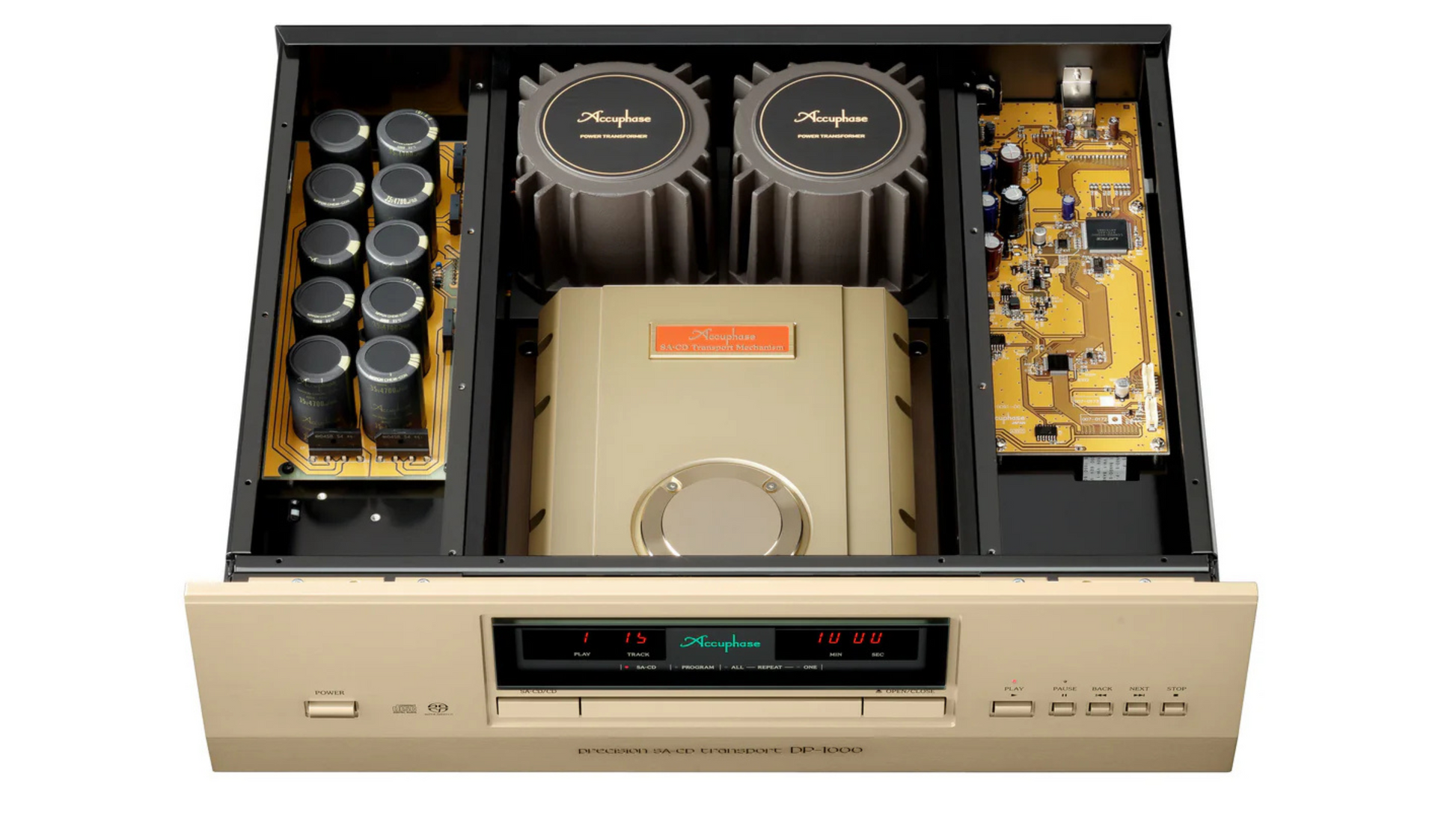
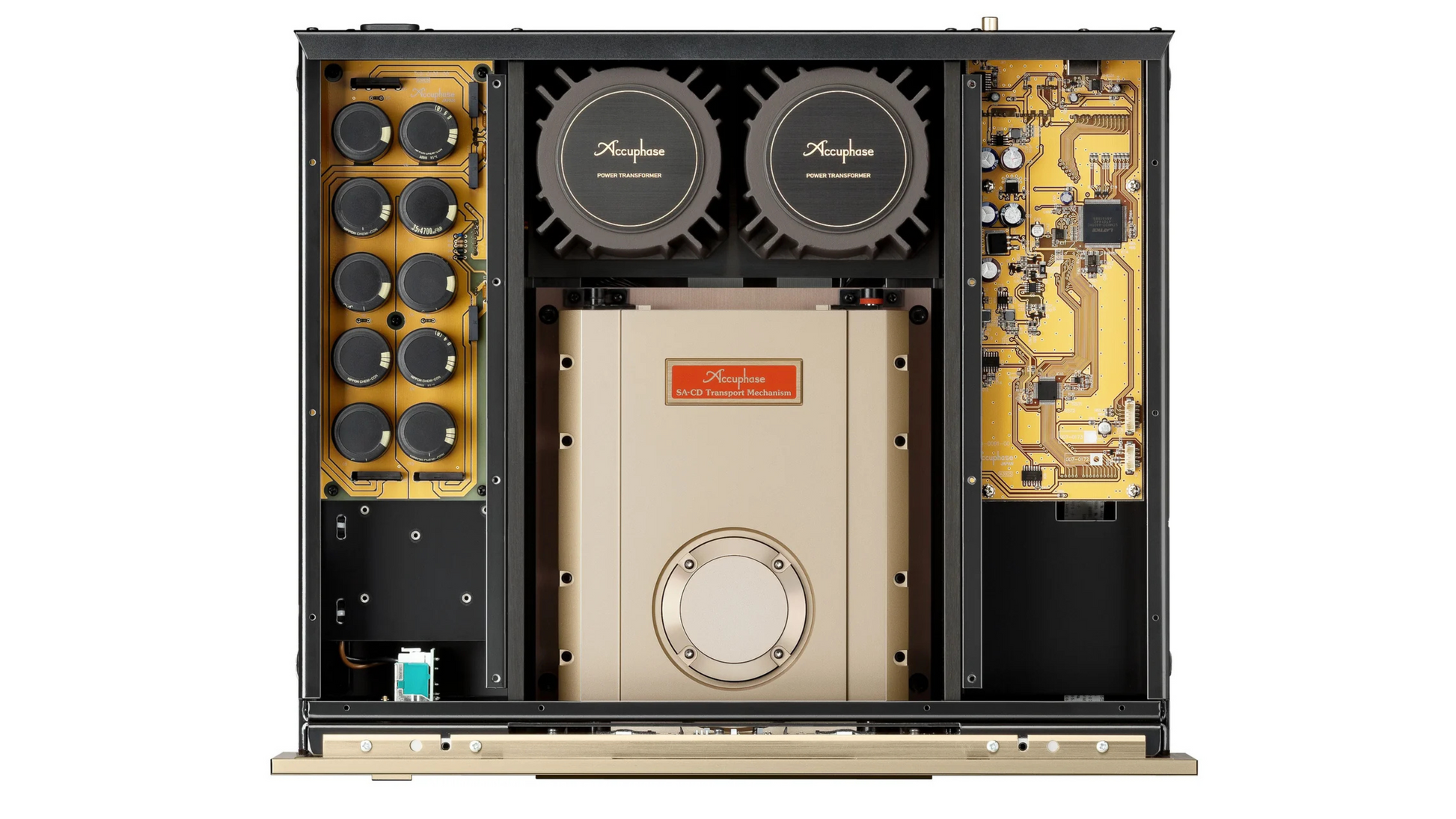
The SA-CD/CD drive assembly itself weighs 7.2 kg, heavier than many complete integrated amplifiers. It sits on a 3.8 kg machined aluminum bottom plate, 12 mm thick. Combined, the 11 kg of drive and plate sits as low as possible inside the chassis, which keeps the whole assembly from rocking or pitching in ways that would otherwise reach the laser pickup. The traverse mechanism, which moves the laser across the disc, is supported by elastic dampers built in two different hardness levels rather than one. That choice is deliberate. A single hardness damper has one natural resonant frequency, and at that frequency it amplifies vibration instead of absorbing it. Using two different hardnesses spreads those resonant points apart, so neither one lines up with the rotational harmonics the motor produces, and neither amplifies the vibration that matters most to accurate data reading.

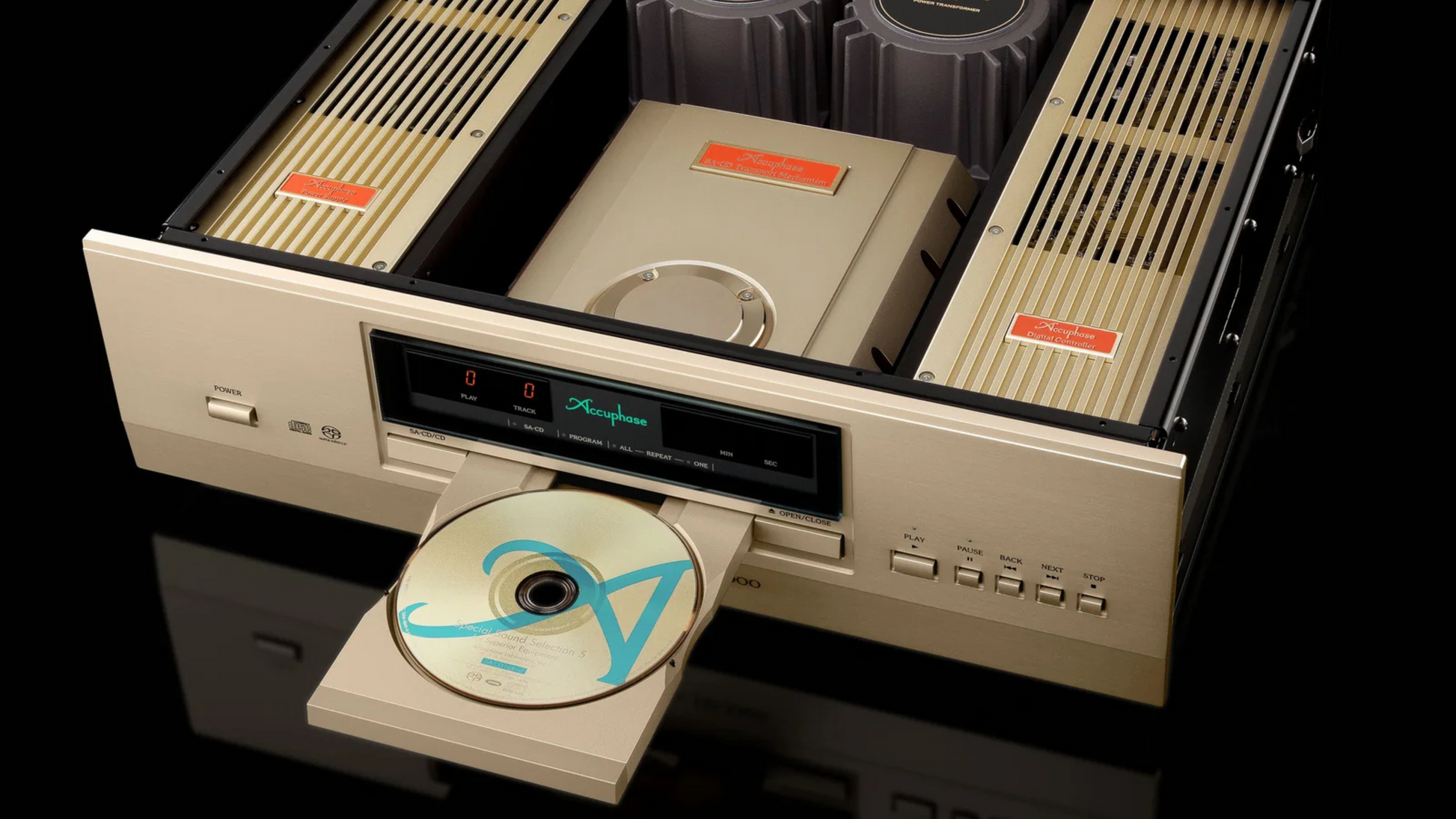
Most of the mechanical parts inside the DP-1000 are machined from solid aluminum blocks rather than stamped or cast, with tolerances held to the micron level, millionths of a meter. Accuphase describes this as nearly eliminating dimensional error during assembly, and it shows in the disc tray, which is carved from a single aluminum block and finished with a hard anodized satin surface. It rides on dual stay bearing shafts that open and close with a quiet solidity that tells you immediately how the mechanism inside was built.

The Motor: No Contacts, No Vibration

The DP-1000 spins the disc with an outer rotor brushless DC motor. A conventional disc drive motor uses commutators, mechanical contacts that switch current direction as the motor turns, and those contacts generate vibration, electrical noise, and wear over time. A brushless DC motor removes the commutator entirely. Switching happens electronically, with no mechanical contact at all. The outer rotor layout places the spinning magnet assembly on the outside of the stator rather than the inside, which gives a lower rotational mass for the same torque and helps the motor hold a steady speed more easily.

Taken together, the brushless motor, the outer rotor layout, the low center of gravity, the dual hardness dampers, and the sheer mass of the drive assembly create what Accuphase describes as an environment quiet enough that a listener forgets a rotating mechanical component is even present. That is not a slogan, it is simply the result of eliminating each identifiable source of vibration one at a time.

Dual Independent Power Supplies: Mechanical and Signal Processing Kept Apart

The DP-1000 uses two separate toroidal transformers, one dedicated to the mechanical system and one dedicated to the digital signal processing circuits. This separation exists because the two systems place very different demands on a power supply and carry very different noise characteristics. The motor and disc loading electronics generate switching transients and back voltage spikes every time the motor changes speed. If that motor drive shared a power supply with the digital signal processing circuits, those transients would couple directly into the signal path and degrade the digital output. Two separate transformers, each with its own filtering, stop that coupling before it starts. What comes out of the DP-1000's digital output reflects only the data on the disc, not the electrical environment of the mechanism reading it.

Ten large filtering capacitors are distributed across both supply channels, storing the energy needed to keep power delivery clean during the brief, intense current demands of motor startup and speed changes. The internal layout reflects this structure directly: the drive assembly sits at the center of the chassis, the mechanical transformer to one side, the signal processing transformer and digital circuits to the other, with the filter capacitors placed accordingly so the whole unit's weight is balanced on purpose.

HS-LINK: Accuphase's Proprietary Digital Interface

HS-LINK is Accuphase's own digital transmission standard, and it is the reason SA-CD can be played back at full resolution at all. Standard coaxial digital output, the format used by nearly every CD transport and player on the market, tops out at 192 kHz PCM at 24 bit. It cannot carry DSD, which is the native format stored on an SA-CD's high resolution layer. That DSD data runs at 2.8 MHz, and there is no standard digital connector built to carry it between two separate components. Only a handful of proprietary links can, HS-LINK among them.

HS-LINK solves the problem with a dedicated high speed serial connection over a proprietary cable. HS-LINK Ver. 1, which the DP-1000 supports, carries DSD at 2.8 MHz and PCM up to 192 kHz at 24 bit. HS-LINK Ver. 2 extends both figures, DSD to 5.6 MHz and PCM to 384 kHz at 32 bit. The DP-1000 supports both, switchable from the front panel, and ships with a 1.5 meter AHDL-15 HS-LINK cable that connects directly to the DC-1000, forming a closed digital path that carries the SA-CD layer whole, with no conversion, no compression, and nothing lost along the way.

The coaxial output remains available too, built to the IEC 60958/AES-3 standard at 75 ohms, for anyone connecting to a different external DAC. That connection works fine for the CD layer and for PCM, but it cannot carry the SA-CD layer at all.

Data Disc Playback and Programmable Playlists

Beyond SA-CD and standard CD, the DP-1000 also reads data discs: CD-R, CD-RW, DVD-R, DVD-RW, DVD+R, and DVD+RW, containing audio files in WAV, FLAC, DSF, or DSDIFF format. That opens the DP-1000 up to the large libraries of high resolution downloads and ripped collections that a lot of serious digital listeners have accumulated over the years, playable straight from a burned disc with no computer anywhere in the chain. DSD files in DSF or DSDIFF format are read natively, so a DSD download burned to disc and played through HS-LINK to the DC-1000 comes out at its full original resolution.

The programmable playlist function lets you set track order across a disc however you want, useful for building a custom listening sequence from a compilation, or for sorting out a data disc where the file order on the media doesn't match the order you'd actually like to hear it in. A power on play function, which starts playback automatically once a compatible Accuphase timer triggers the unit, lets the DP-1000 begin a scheduled listening session with no manual steps required.

The Chassis: Natural Wood, Cast Iron, and Machined Aluminum

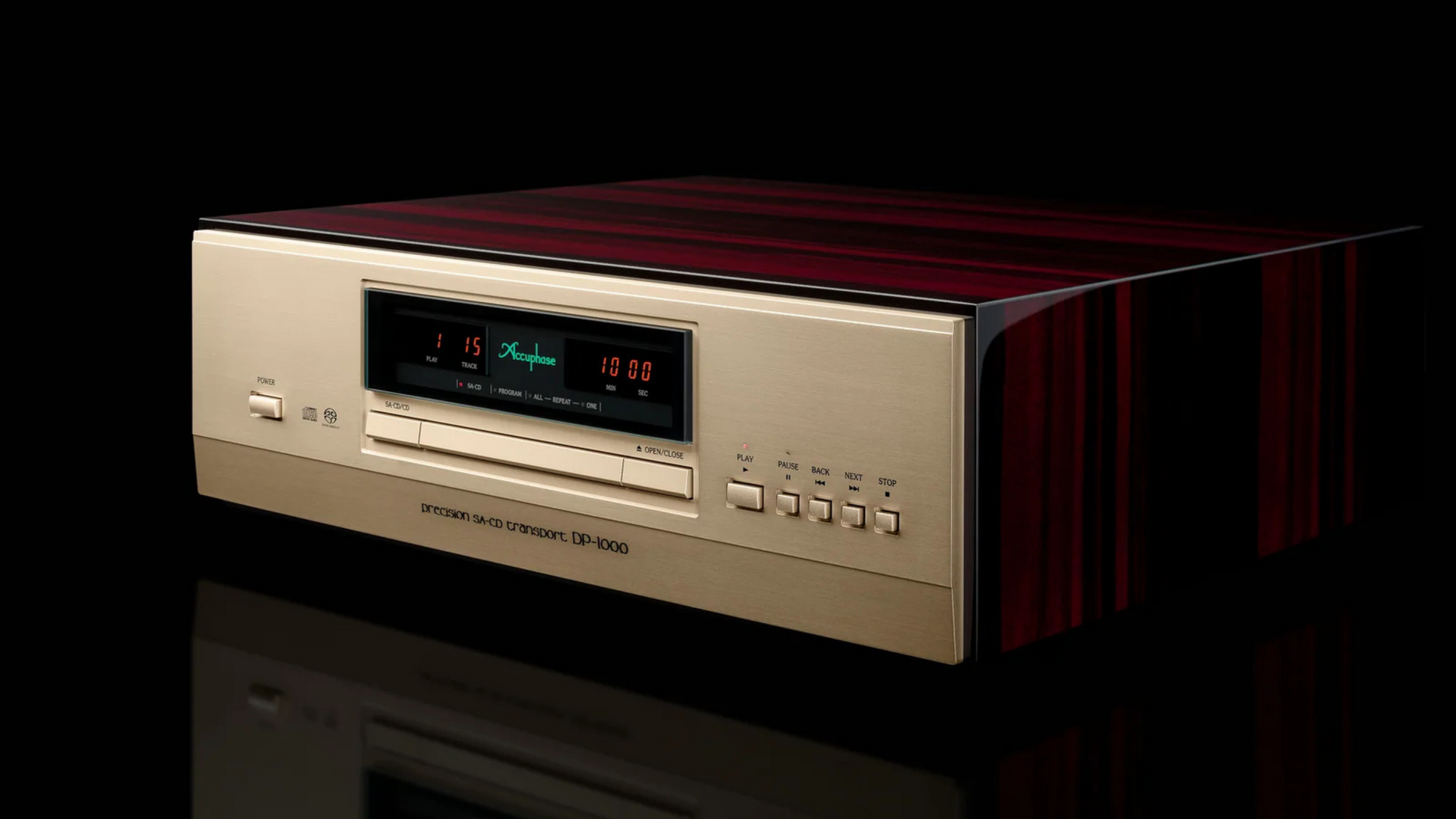
The DP-1000's chassis doesn't cut corners anywhere. The side panels are natural grain virgin wood with a mirror finish, hand finished by artisans, the same specification used on Accuphase's reference preamplifiers. The top plate is hairline finished aluminum. The insulator feet are advanced high carbon cast iron, the same custom component used across Accuphase's reference line for its vibration damping behavior. The complete chassis weighs 29.8 kg, nearly 66 pounds, the direct result of an 11 kg drive and bottom plate, two transformers, and all that machined aluminum.

How the DP-1000 Compares

Within Accuphase's own catalog, the closest comparison is the DP-770, a complete SA-CD/CD player with both transport and DAC built into a single chassis using Accuphase's MDS+ conversion principle. It's an excellent component in its own right, and the right choice for a buyer who wants one box handling disc playback from start to finish without the added complexity of a two chassis system. The DP-1000 takes on a different brief entirely. It carries no DAC at all, and its whole engineering budget goes toward the mechanical reading problem alone. The DP-770's transport mechanism is a capable design, but the DP-1000's drive assembly is more than double the weight, using structural and damping work that a chassis sharing space with a DAC simply can't accommodate.

Looking outside the Accuphase catalog, at other SA-CD transports built to this standard, the DP-1000 stands apart for its outer rotor brushless motor, its dual hardness damper system, its split power supplies, and HS-LINK itself. It's one of a small number of transports in current production that treats the mechanical reading problem with the same seriousness most manufacturers reserve for the electrical one.


Key Specifications, DP-1000 Transport

  • Category: SA-CD/CD transport, no internal DAC
  • Compatible Formats: 2-channel SA-CD; standard CD; data discs (CD-R/RW, DVD-R/RW/+R/+RW) containing WAV, FLAC, DSF, or DSDIFF files
  • Data Read Principle: Non contact optical pickup
  • Laser Wavelength: 655 nm (SA-CD), 790 nm (CD)
  • Digital Output, HS-LINK: Accuphase proprietary interface. Ver. 1 (DSD 2.8 MHz, PCM to 192 kHz at 24 bit) and Ver. 2 (DSD to 5.6 MHz, PCM to 384 kHz at 32 bit), front panel switchable, supplied AHDL-15 cable (1.5 m)
  • Digital Output, Coaxial: IEC 60958/AES-3 compliant, 75 ohm, PCM only, CD layer only
  • Drive Assembly Mass: 7.2 kg (15.9 lbs)
  • Bottom Plate: 12 mm machined aluminum, 3.8 kg (8.4 lbs)
  • Motor: Outer rotor brushless DC, no mechanical contacts
  • Damper System: Dual hardness elastic dampers, traverse mechanism and objective lens
  • Power Supply: Two independent toroidal transformers, one mechanical and one signal processing, with 10 filtering capacitors
  • Playlist Function: Programmable track order
  • Power On Play: Supported with a compatible Accuphase timer, sold separately
  • Voicing Equalizer Interface: Digital connection for the Accuphase DG-68
  • Remote Control: RC-140, included, also operates compatible Accuphase amplifiers
  • Chassis: Natural grain virgin wood side panels with mirror finish, hairline finished aluminum top plate
  • Insulator Feet: Advanced high carbon cast iron
  • Power Requirements: 120V AC, 50/60 Hz (US version)
  • Power Consumption: 16 W
  • Dimensions (W x H x D): 477 x 156 x 394 mm (18.8 x 6.1 x 15.5 in)
  • Net Weight: 29.8 kg (65.7 lbs)
  • Shipping Weight: 37 kg (82 lbs)
  • Country of Manufacture: Japan
  • Supplied Accessories: AC power cord, HS-LINK cable AHDL-15 (1.5 m), Remote Commander RC-140, cleaning cloth
  • Price: $24,975
  • Warranty: Manufacturer's limited warranty administered through Accuphase's authorized North American distributor, AXISS Audio. Accuphase does not publish a fixed published term for this market; call or visit All Elite Audio for current registration steps and coverage details

Why Buy From All Elite Audio

All Elite Audio is an authorized Accuphase dealer. Every DP-1000 we sell comes through legitimate North American distribution with full manufacturer warranty coverage intact. Accuphase has been explicit that it does not honor warranty claims on units brought into the country outside official distribution, so where you buy this from matters as much as what you buy. We carry the complete Accuphase digital source line, including the DC-1000 companion processor, and we can set up the DP-1000/DC-1000 system in our showroom with amplification and speakers suited to a proper reference level listening session. If you're putting together a serious disc playback system around Accuphase separates, we're glad to take the time that conversation deserves.

Call: 443-402-5055
Text: 443-402-5064
Visit: 1921 York Rd, Timonium, MD 21093


Frequently Asked Questions

Does the DP-1000 include a built in DAC, or do I need a separate processor to hear sound?

You need a separate processor. The DP-1000 is a transport only, meaning it reads SA-CD and CD discs and outputs that data as a digital signal, nothing more. It has no analog outputs and no internal DAC, so on its own it cannot produce sound through a pair of speakers. To actually hear anything, its digital output has to connect to an external DAC or processor, most naturally the Accuphase DC-1000 over HS-LINK for full SA-CD resolution, or any compatible external DAC over the coaxial output for CD layer playback. If a single box solution sounds more practical for your system, the Accuphase DP-770 combines transport and DAC in one chassis and is worth a look instead.

Why does SA-CD playback specifically require HS-LINK rather than a standard coaxial connection?

SA-CD's high resolution layer is encoded in DSD, a format built on a completely different structure than the PCM audio that standard coaxial digital connections were designed to carry. Coaxial output tops out around 192 kHz PCM, and DSD simply isn't compatible with that pathway at all. Moving the SA-CD layer between two separate boxes therefore requires a connection built specifically for DSD, and Accuphase's answer to that is HS-LINK. Connected through the supplied cable to the DC-1000, the full SA-CD layer transfers across intact, with no conversion or loss along the way, while the coaxial output remains limited to the CD layer alone.

What's the practical difference between HS-LINK Ver. 1 and Ver. 2, and which one do I actually need?

Ver. 1 carries DSD at 2.8 MHz, which happens to be exactly the resolution stored on a standard SA-CD, along with PCM up to 192 kHz at 24 bit. Ver. 2 extends both ceilings, DSD up to 5.6 MHz and PCM up to 384 kHz at 32 bit. For playing actual SA-CDs, Ver. 1 already covers everything the format contains, so you're not missing anything by sticking with it. Ver. 2 becomes relevant if you're playing high resolution DSD or PCM files burned to a data disc that exceed standard SA-CD resolution. The DP-1000 switches between the two from the front panel, and the DC-1000 supports both, so this is a setting you choose per disc rather than a hardware limitation either way.

Can the DP-1000 work with a DAC other than the Accuphase DC-1000?

Yes, through its coaxial output, which follows the standard IEC 60958/AES-3 protocol and works with essentially any DAC that accepts a coaxial digital input. That connection handles CD layer audio and PCM data files just fine. What it cannot do is carry the SA-CD DSD layer, which is restricted to HS-LINK alone, and HS-LINK is a proprietary Accuphase connection without published third party compatibility. If SA-CD playback at full resolution matters to you, the DC-1000 is effectively the only receiving end available for that signal. If your listening is mostly CD or high resolution PCM files, pairing the DP-1000 with another quality DAC over coaxial is a perfectly reasonable path.

What data disc formats does the DP-1000 actually play, and how does that work day to day?

The DP-1000 reads CD-R, CD-RW, DVD-R, DVD-RW, DVD+R, and DVD+RW discs carrying audio in WAV, FLAC, DSF, or DSDIFF format. In practice that means a high resolution download or a DSD file from your library can be burned to a disc and played through the DP-1000's transport with no computer or network streamer involved at all. A FLAC file at 96 kHz/24 bit or a DSD file in DSF format will play through the drive and pass to the DC-1000 over HS-LINK at its full original resolution. This is genuinely useful if you've built up a collection of high resolution downloads over the years and would rather keep physical media in your signal chain than rely on networked playback.

Why does the drive assembly weigh as much as it does, and what is that mass actually doing for sound quality?

The 7.2 kg drive, sitting on a 3.8 kg bottom plate, builds a heavy, low center of gravity platform underneath the laser and traverse mechanism. A disc transport has to track a microscopic spiral groove on a spinning disc with extreme precision, and any vibration reaching the chassis, whether from the motor, the room, or the floor, disturbs that tracking and produces data errors or timing jitter. Mass resists movement. A heavier platform takes more outside energy to disturb by any given amount, so the combined 11 kg of drive and plate gives the mechanism a stability that a lighter design simply can't match. The dual hardness dampers between the mechanism and the chassis then handle the smaller resonances that mass alone doesn't fully suppress.

Why use two separate transformers instead of one larger shared transformer?

The motor and disc loading hardware draw power that's inherently noisy, full of switching transients and voltage spikes every time the motor changes speed. The digital signal processing circuits that format the HS-LINK output are sensitive to exactly that kind of noise, which can show up as jitter or as actual data errors in the output stream. Sharing one transformer between the two systems would give that motor noise a direct path into the signal circuits. Two separate, magnetically isolated transformers close off that path entirely, each with its own filtering, so the mechanical system's electrical noise has nowhere to go but its own side of the chassis. The payoff is a cleaner digital signal, especially during the motor speed changes that happen at track boundaries and disc startup.

How does the DP-1000 compare to the Accuphase DP-770, and which one should I actually buy?

The DP-770 puts a complete transport and DAC into one chassis using Accuphase's MDS+ conversion principle, and it's a strong, well matched component for anyone who wants a single box disc source without taking on a two chassis system. The DP-1000 is built around a different premise altogether. It carries no DAC at all, and its entire engineering effort goes into the mechanical side of reading a disc, which is why its drive assembly weighs more than double what a combined chassis like the DP-770 has room for. If you've already decided disc playback deserves a dedicated, no compromise transport and you're prepared to pair it with the DC-1000, the DP-1000 is the answer. If you'd rather have one excellent box handling everything, the DP-770 is the simpler and very capable choice.

What's actually included in the box, and do I need anything else to get started?

The DP-1000 ships with an AC power cord, the 1.5 meter AHDL-15 HS-LINK cable, the RC-140 remote control, and a cleaning cloth. The HS-LINK cable is what actually connects the DP-1000 to the DC-1000, so if you're buying both together, that connection is covered out of the box. What you'll still need is a DAC or processor (the DC-1000 is the natural pairing), an amplifier, and speakers, since the DP-1000 by itself produces no audio output at all. The RC-140 remote also operates compatible Accuphase amplifiers, so depending on your system it can end up controlling more than just the transport.

What's the warranty on the DP-1000, and does it actually matter where I buy it from?

It matters quite a bit. Accuphase's warranty coverage is administered by its authorized distributor in each country, and in the United States that's AXISS Audio, working through a network of authorized dealers like All Elite Audio. Accuphase has stated plainly that it does not honor warranty claims on units imported outside that official channel, often called gray market units, regardless of how new or unused they appear. Buying through an authorized dealer is the only way to be sure your unit is registered and eligible for service through Accuphase's own network. Call or visit us and we'll walk you through current registration steps and what's covered.

Where can I buy the Accuphase DP-1000?

The Accuphase DP-1000 is available through All Elite Audio, an authorized Accuphase dealer at 1921 York Rd, Timonium, MD 21093. We carry both the DP-1000 and its companion DC-1000 processor and can set up the full system in our showroom so you can hear it before deciding anything. Buying through an authorized dealer is the only way to guarantee full manufacturer warranty coverage, since Accuphase does not honor claims on units brought in outside official distribution. If you're weighing the DP-1000 on its own against the DP-1000 paired with the DC-1000, we're glad to talk through which setup fits your system and your budget. Call us at 443-402-5055, text us at 443-402-5064, or stop by the showroom.

View full details