Accuphase
Have a trade-in item? Click here.
Specs
| Type | Digital Frequency Dividing Network |
| Division Modes | 2-way, 3-way, 4-way |
| Crossover Slopes | Selectable steep digital filter slopes |
| Per-Channel Controls | Independent frequency, level, and polarity |
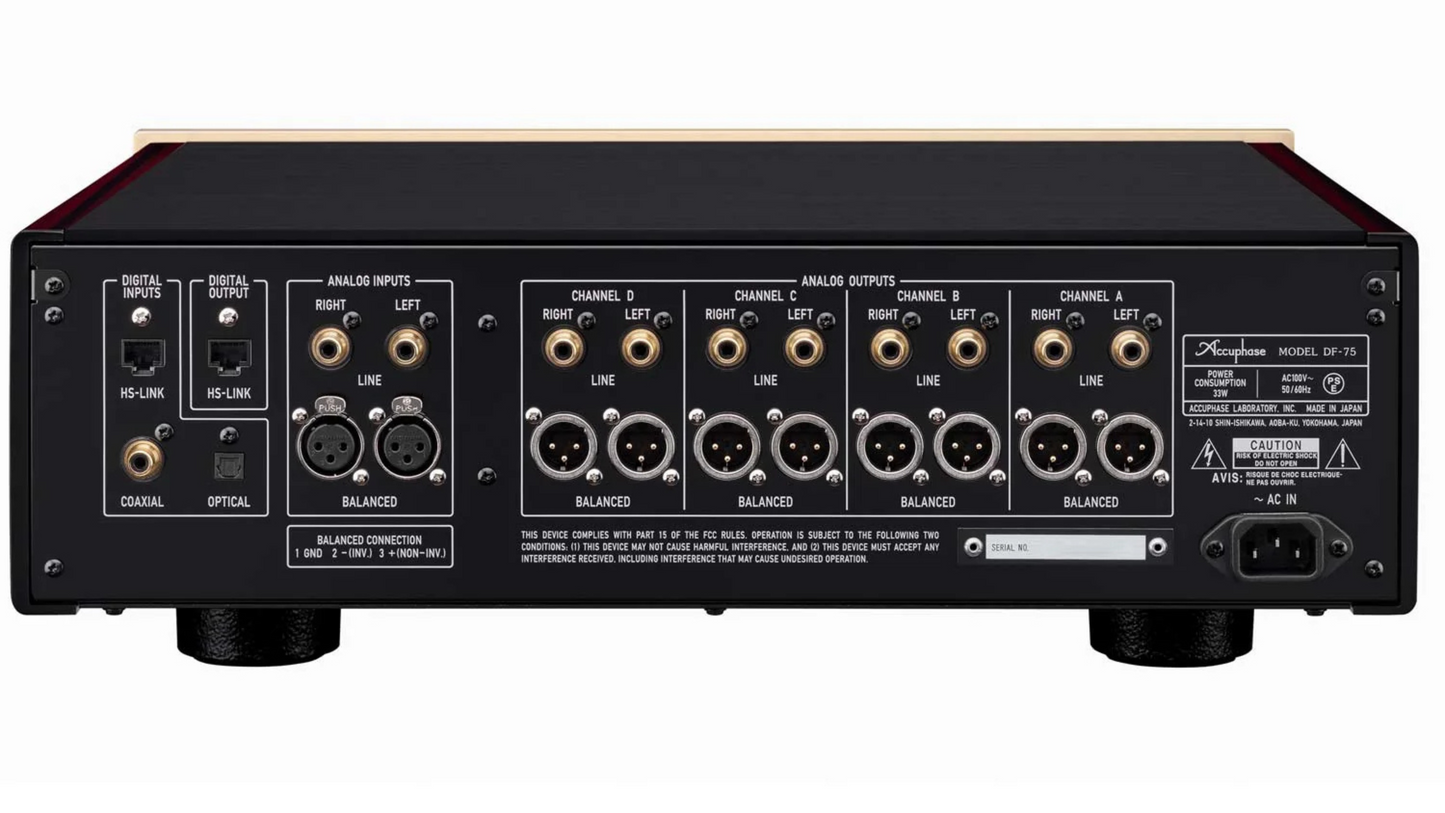
| Digital Inputs | Coaxial and optical |
| Analog Inputs | Balanced (XLR) and unbalanced (RCA) |
| Analog Outputs | Balanced (XLR) and unbalanced (RCA) per band |
Warranty
Sold as an authorized Accuphase dealer by All Elite Audio. New Accuphase DF-75 units include the full Accuphase USA manufacturer warranty of 3 years parts and labor for the original owner. Contact us with any service or setup questions.
What's in the Box
- Accuphase DF-75 Digital Frequency Dividing Network
- Power cord
- Remote handset
- Owner's manual
- Warranty documentation
Overview
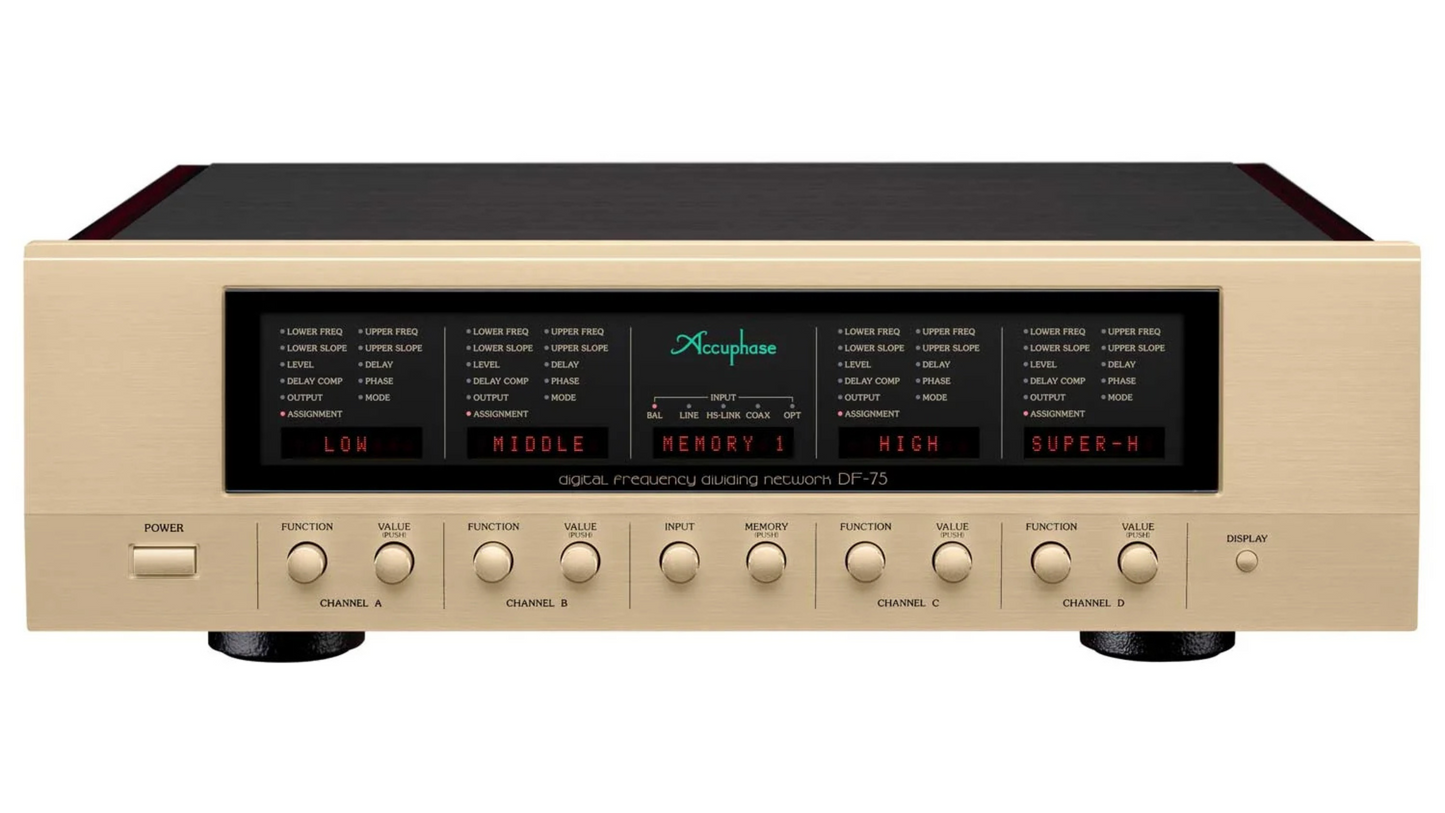
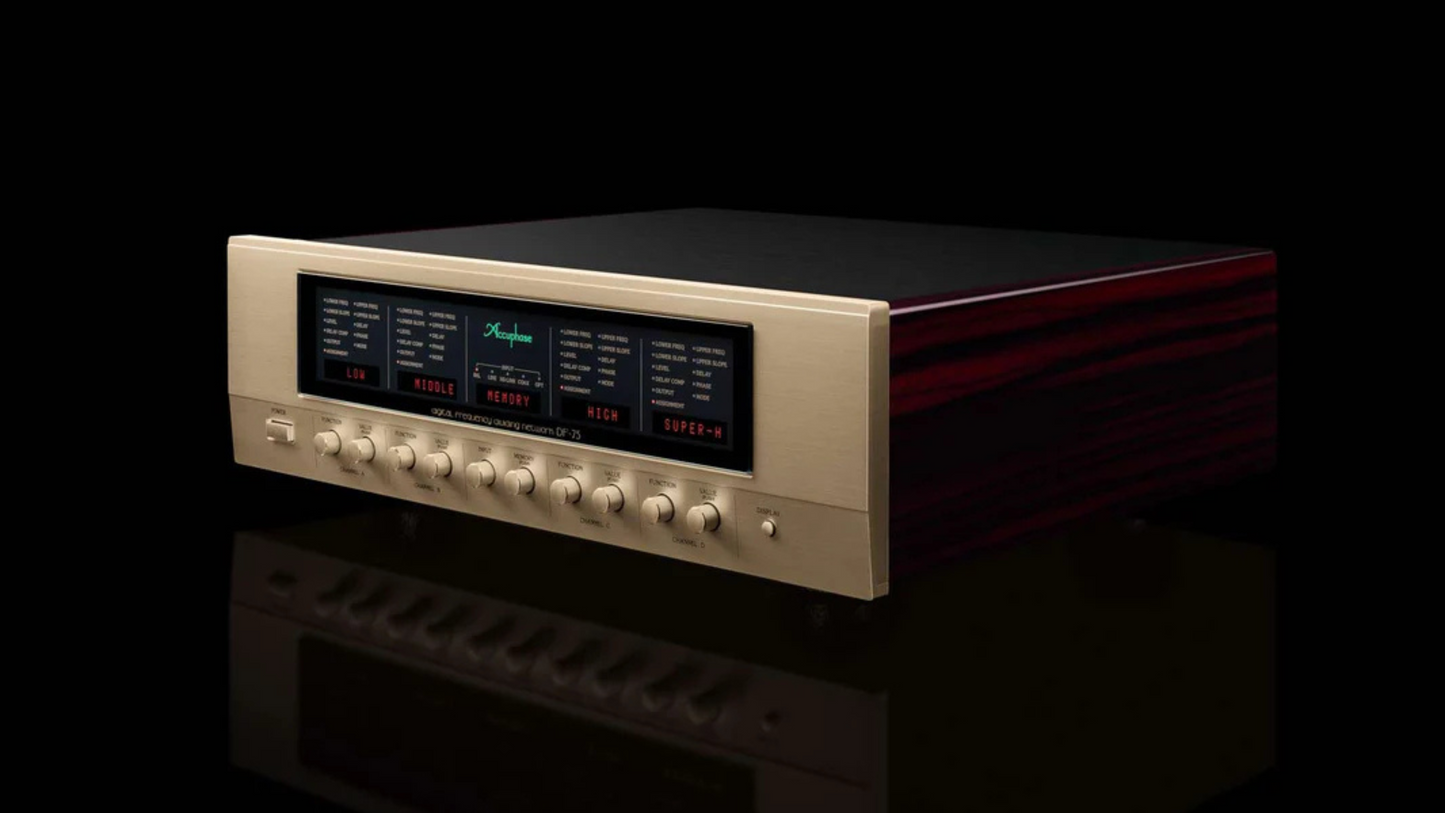
The Accuphase DF-75 is a Digital Frequency Dividing Network, a specialized processor that performs the crossover function in the digital domain for multi-amplified (bi-amp, tri-amp, and beyond) loudspeaker systems. Rather than splitting frequencies with passive components inside the speaker or with an analog active crossover, the DF-75 divides the signal with digital precision, allowing each driver band to be fed by its own dedicated power amplifier. This approach removes the losses and phase complications of passive crossover networks and gives the listener direct control over crossover frequency, slope, level, and phase for each band.
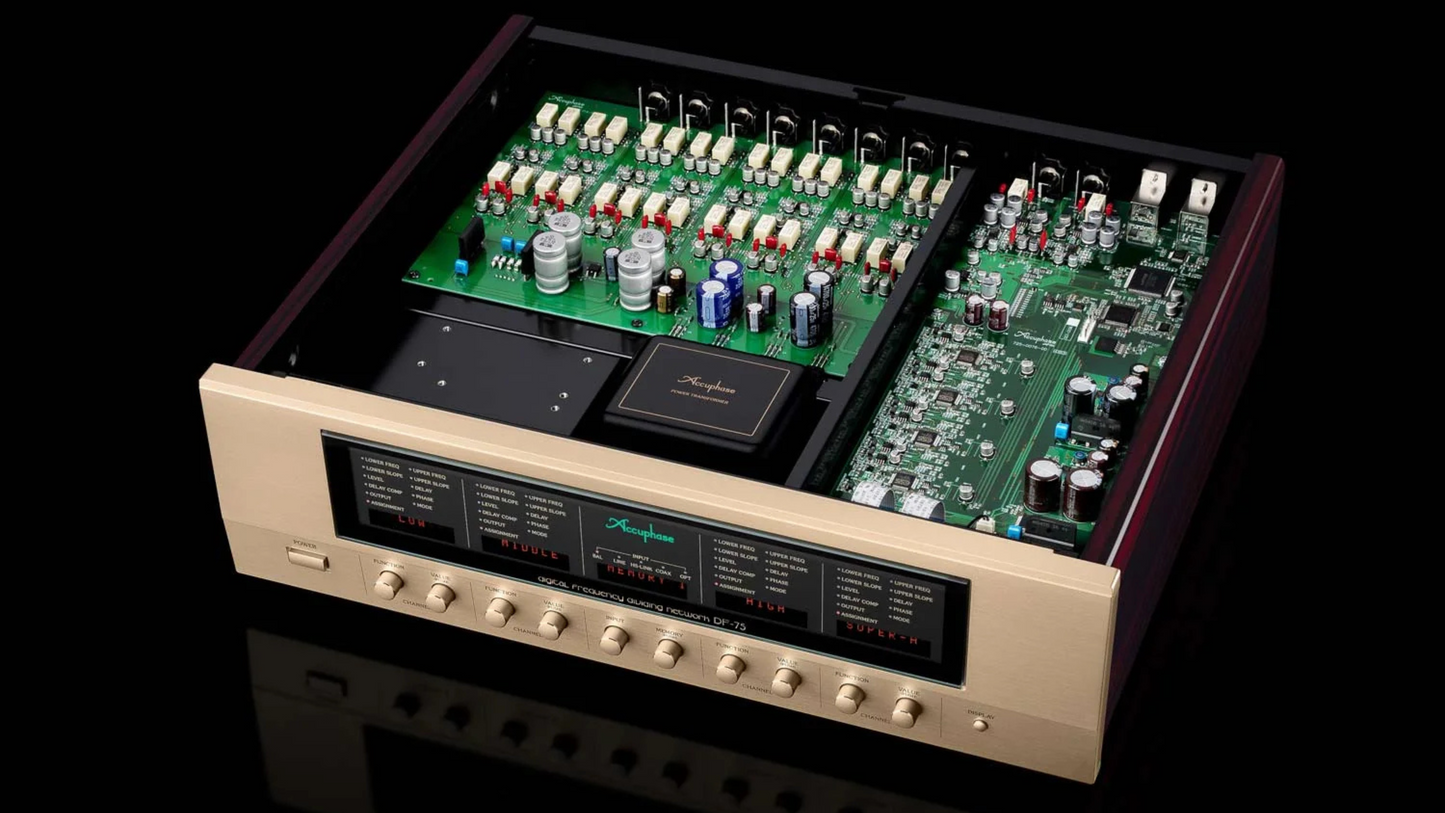
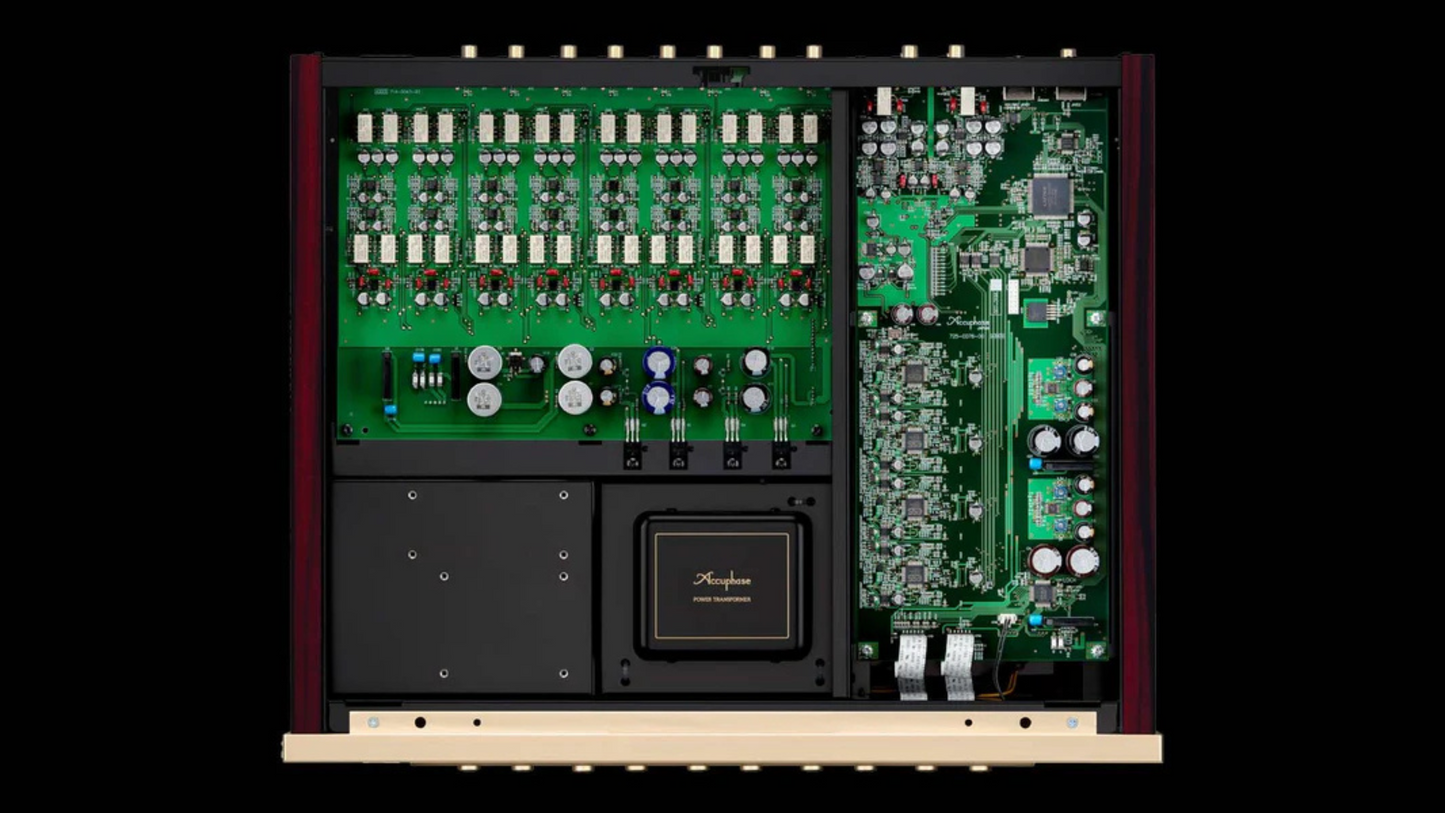
Built around high-order DSP filtering with a very high internal computational precision, the DF-75 lets you configure two, three, or four way division with adjustable crossover points and steep filter slopes. Each output channel offers independent gain and polarity control so a multi-amp system can be balanced with laboratory accuracy. As with all Accuphase digital components, the DF-75 combines meticulous circuit layout, a rigid low resonance chassis, and careful power supply design to preserve the integrity of the signal from input to output.
The DF-75 is intended for the dedicated enthusiast building a fully active loudspeaker system, for owners of speakers designed for external crossover operation, and for anyone who wants the ultimate command over driver integration. It is a purpose built tool for those pursuing the last measure of transparency and control that multi-amping can deliver.
Key Features
- Digital frequency dividing network for multi-amplified active loudspeaker systems
- Supports two, three, and four way signal division
- Independent crossover frequency selection for each band
- Steep, precise digital filter slopes for clean driver band separation
- Individual level and polarity adjustment on every output channel
- High precision DSP processing preserves signal integrity
- Balanced and unbalanced inputs and outputs for full system integration
- Rigid, low resonance chassis with careful internal layout
- Designed to remove the losses and phase issues of passive crossovers
How the DF-75 Compares
Accuphase DF-75 vs Accuphase DG-78
The DG-78 Digital Voicing Equalizer is a room and system optimization tool that analyzes and corrects frequency response, aiming to tune the sound of a conventional single amplifier system. The DF-75 instead performs the crossover itself, dividing the signal into bands for a multi-amplified active setup. Choose the DG-78 when your goal is voicing and room correction, and the DF-75 when you are building a fully active, multi-amp loudspeaker system. See the Accuphase DG-78.
Accuphase DF-75 vs Accuphase DC-1000
The DC-1000 is a reference Precision MDSD digital processor focused on converting digital sources to analog with the utmost fidelity for a standard playback chain. The DF-75 is a different kind of digital component, dedicated to splitting the signal into frequency bands for active multi-amping rather than final digital to analog conversion. They serve complementary roles and can coexist in an advanced system. See the Accuphase DC-1000.
Accuphase DF-75 vs Accuphase DC-500
The DC-500 is an MDSD digital processor built to deliver refined digital to analog conversion in a conventional signal path. The DF-75 addresses the loudspeaker interface instead, dividing frequencies in the digital domain for driver level control in an active system. Pick the DC-500 for source conversion and the DF-75 when your project centers on multi-amplification. See the Accuphase DC-500.
Complete the System
The DF-75 shines at the heart of a multi-amplified system, so it pairs naturally with multiple Accuphase amplifiers and loudspeakers suited to active operation.
- Accuphase C-3900S A reference preamplifier to feed the DF-75 with a pristine, low noise signal before it is divided across bands, keeping the front end as transparent as the crossover itself.
- Accuphase A-300 Monoblocks In a multi-amp system each band benefits from its own dedicated amplifier, and these Class-A monophonic amplifiers deliver effortless control for the most demanding driver bands.
- Accuphase A-80 A Class-A stereo power amplifier that can drive additional frequency bands with rich tonal character, ideal for building a matched active amplification stack.
- Accuphase P-4600 A powerful Class AB stereo amplifier well suited to the lower bands of an active system, offering high current delivery for bass drivers.
- Marten Parker Trio Diamond A high resolution floorstander whose refined drivers reveal the precise driver integration and transparency a fully active DF-75 based system can achieve.
Frequently Asked Questions
What is the Accuphase DF-75?
It is a Digital Frequency Dividing Network that performs the loudspeaker crossover function in the digital domain for multi-amplified active systems.
What does a digital frequency dividing network do?
It splits the audio signal into separate frequency bands digitally, so each band can be sent to its own power amplifier and driver rather than relying on a passive crossover.
How many way division does the DF-75 support?
It supports two, three, and four way division, letting you configure bi-amp, tri-amp, and four way active systems.
Why use digital crossover instead of a passive crossover?
Dividing frequencies digitally removes the losses and phase complications of passive networks and gives you precise control over crossover points, slopes, levels, and polarity.
Can I adjust the crossover frequencies?
Yes, each band offers independent crossover frequency selection so you can tailor the division to your specific drivers.
Does it allow level and polarity control per band?
Yes, every output channel has independent level and polarity adjustment for precise balancing of a multi-amp system.
Do I need multiple amplifiers to use the DF-75?
Yes, an active crossover requires a dedicated power amplifier channel for each frequency band, which is the core benefit of a multi-amp approach.
What inputs and outputs does it have?
It provides balanced and unbalanced analog connections along with digital inputs, and separate outputs for each frequency band.
What kind of speakers work best with the DF-75?
Speakers that can be run active, or that are designed for external crossover operation, benefit most from the DF-75.
How is the DF-75 different from the DG-78?
The DG-78 is a digital voicing equalizer for room and system correction, while the DF-75 performs the actual crossover division for active multi-amping.
Is the DF-75 a DAC?
It is a digital processor category component, but its role is frequency division for active systems rather than serving as a standard source DAC for playback.
Can I combine the DF-75 with an Accuphase preamplifier?
Yes, a preamplifier such as the C-3900S provides the source signal, which the DF-75 then divides across bands.
What Accuphase amplifiers pair well with it?
Multiple amplifiers such as the A-300 monoblocks, the A-80, and the P-4600 can each handle different frequency bands in an active system.
Does the DF-75 improve driver integration?
By allowing precise control of crossover points, slopes, levels, and polarity in the digital domain, it enables highly accurate integration between drivers.
Is it difficult to set up?
A multi-amp active system is more involved than a conventional setup, but the DF-75 provides clear controls, and our team can guide you through configuration.
What warranty does the DF-75 include?
It carries a 3 year parts and labor warranty for the original owner when purchased from an authorized dealer.
Is All Elite Audio an authorized Accuphase dealer?
Yes, we are an authorized Accuphase dealer, so your DF-75 is covered by the full manufacturer warranty.
Can the DF-75 be used with high resolution digital sources?
Yes, it accepts digital inputs and processes the signal with high internal precision to preserve resolution.
Who is the DF-75 designed for?
It is designed for dedicated enthusiasts building fully active, multi-amplified loudspeaker systems who want ultimate control over driver integration.
Why buy from All Elite Audio?
We are an authorized Accuphase dealer offering genuine products with full manufacturer warranty, expert system guidance, and careful support for building an active multi-amp system around the DF-75.