Accuphase
Accuphase C-2300 Precision Stereo Control Center
Accuphase C-2300 Precision Stereo Control Center
Accuphase C-2300 Precision Stereo Control Center
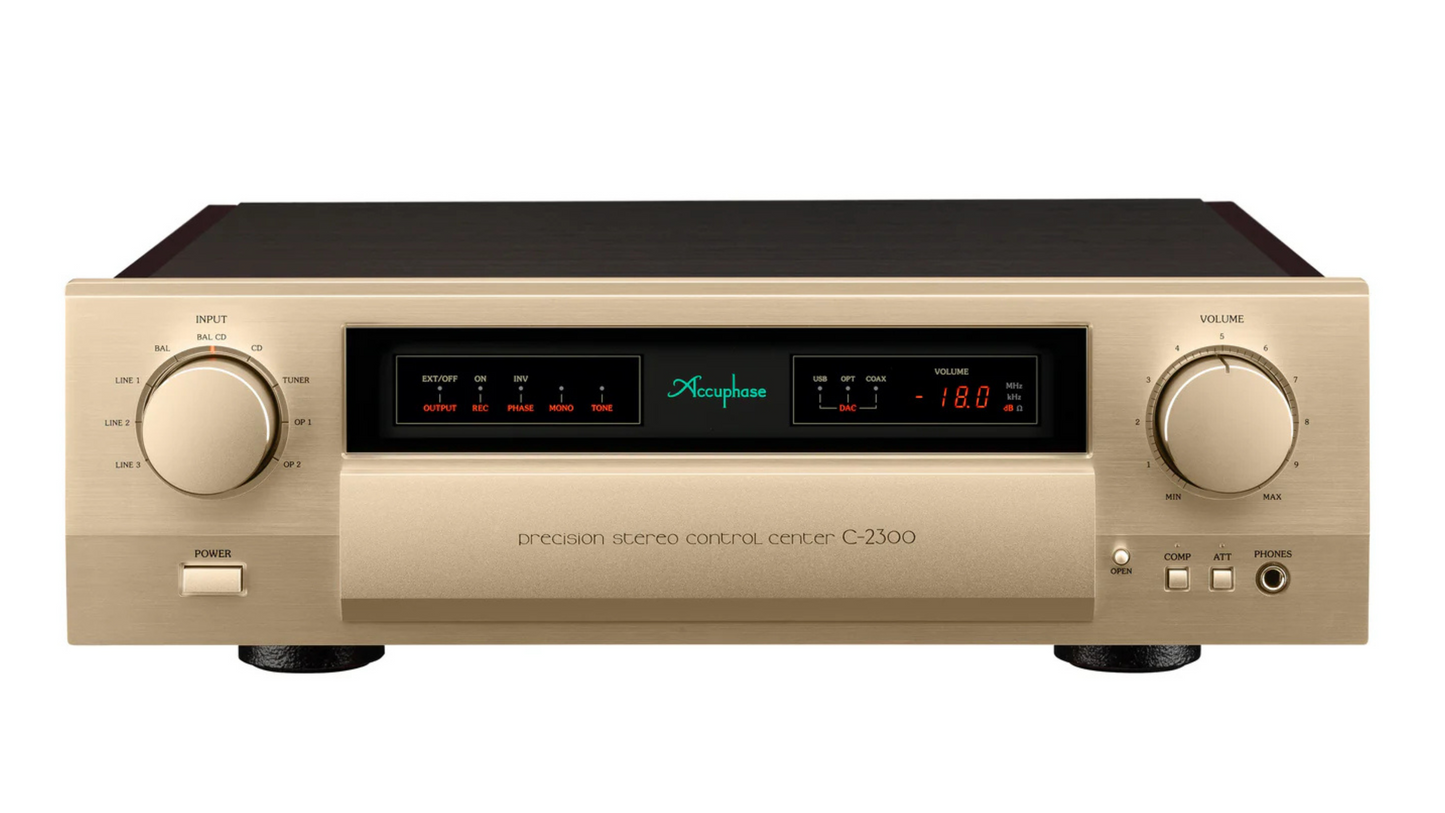
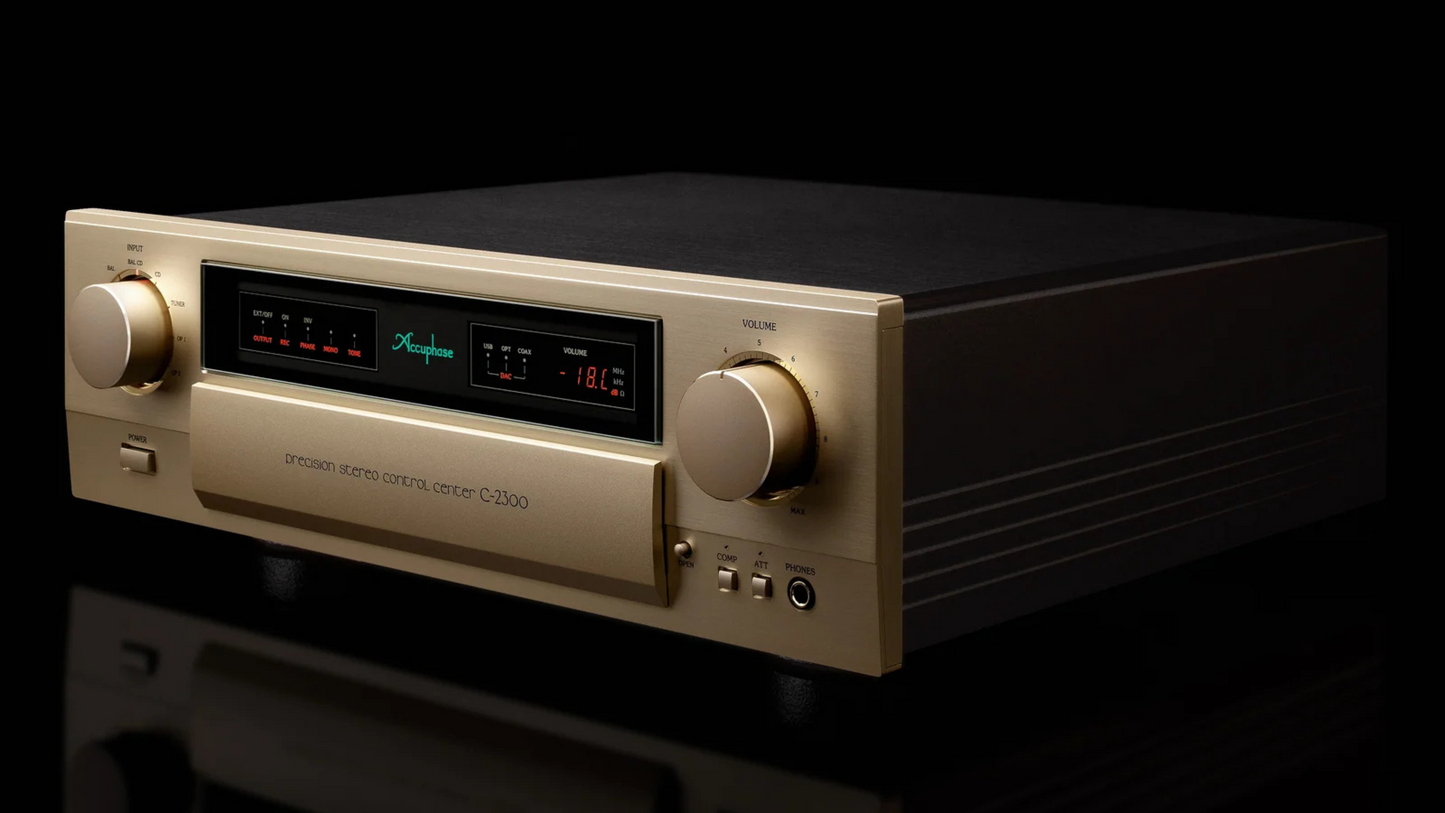
A fully balanced stereo preamplifier that brings the Balanced AAVA volume control architecture from Accuphase's reference C-2900 into a more accessible chassis — with independent left and right power supplies, a newly designed 4-band tone control, and two option slots for digital and phono expansion.
What It Is and Who It's For
The Accuphase C-2300 is a precision stereo preamplifier — what Accuphase calls a Control Center — designed to sit at the heart of a serious separate-component system. It is not an entry-level product dressed up with impressive language. It is a technically sophisticated preamplifier that consolidates two previous Accuphase product lines: the C-2000 series, which set the standard for separate preamplification in the brand's mid-tier, and the C-2400 series, which earned a strong following as the middle-class reference. The C-2300 takes the best of both and adds the Balanced AAVA volume control topology previously reserved for the flagship C-2900.
The buyer who needs a C-2300 is building or upgrading a separate-component system around Accuphase power amplifiers, or pairing this preamplifier with another brand's power stage. They want the volume control, the input flexibility, the expansion capability for phono and digital, and the physical solidity that comes from owning a component built in Yokohama to a standard that will outlast most of what surrounds it in the rack. They also want honest tone controls — something most high-end preamplifiers omit out of philosophical posture rather than engineering necessity, and which the C-2300 implements correctly.
Balanced AAVA — What It Is and Why It Matters Here
The standard AAVA volume control found in the Accuphase E-series integrated amplifiers eliminates variable resistors from the signal path by converting the input voltage to current, distributing it across a precision switched array, and reconverting the result. It is a significant improvement over conventional potentiometers and stepped attenuators. Balanced AAVA takes that architecture a step further by implementing the entire AAVA circuit in a fully balanced differential configuration from input to output.
Where standard AAVA processes the signal through a single-ended AAVA module, Balanced AAVA uses two AAVA modules — one for the positive phase, one for the negative phase — operating in parallel throughout the circuit. All signal paths, including the tone control circuits, remain balanced throughout. This matters because balanced differential circuits cancel common-mode noise — interference that couples equally into both phases — by subtraction. External interference, power supply artifacts, and thermally generated noise that would be audible in a single-ended circuit are suppressed structurally, not just filtered. The practical result is a residual noise floor of 5.6 μV — 10 percent lower than the C-2450 it replaces, and achieved without any change to the signal path beyond the architectural improvement itself.
All AAVA circuit boards in the C-2300 use a fully discrete construction — no integrated circuit chips in the signal path. The input amplifier, the voltage-to-current converters, and the current-to-voltage converter are all discrete and balanced. This is the same design philosophy used in the C-2900, implemented here at a scale appropriate to the C-2300's price point.
Independent Power Supplies for Left and Right
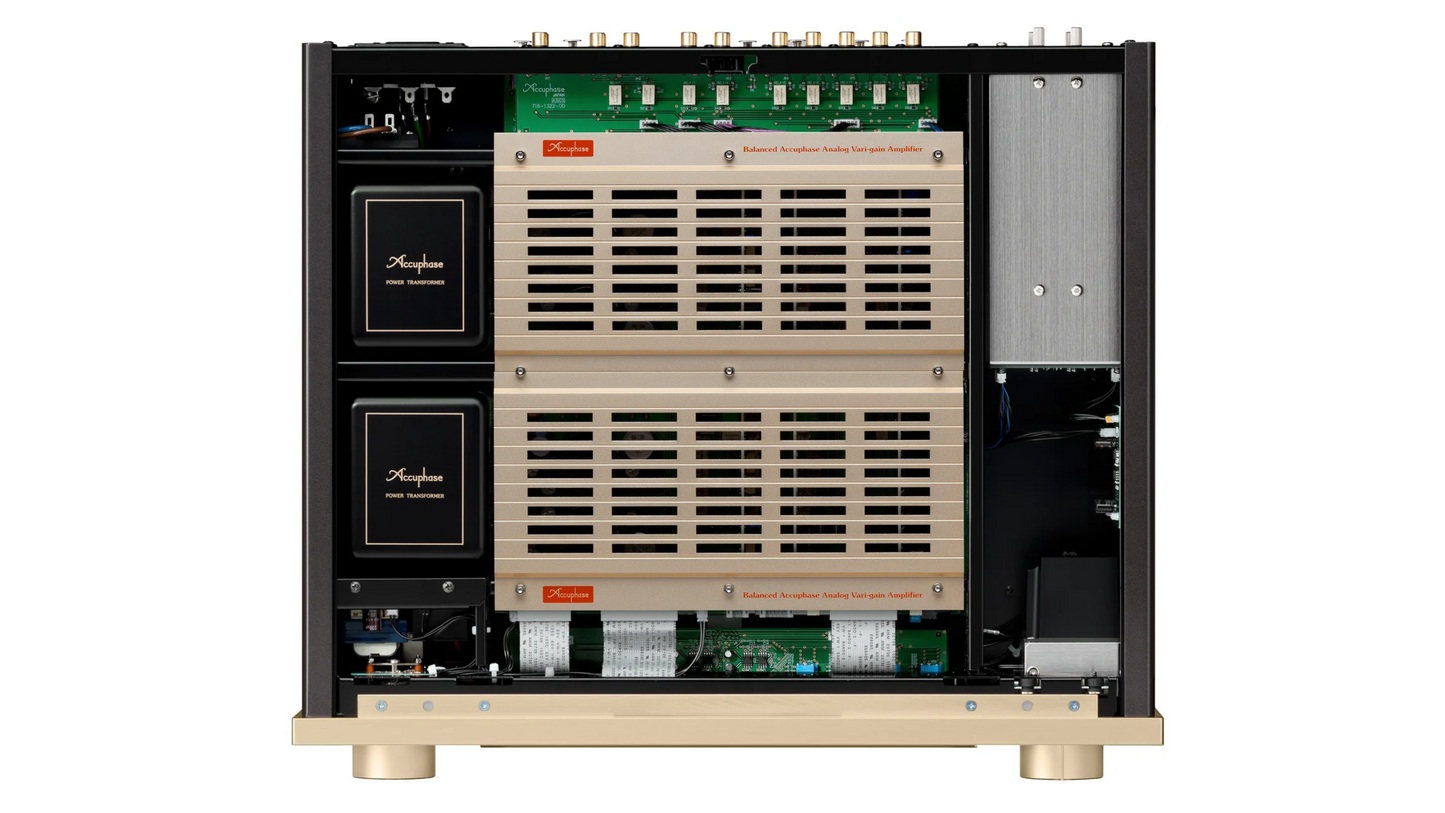
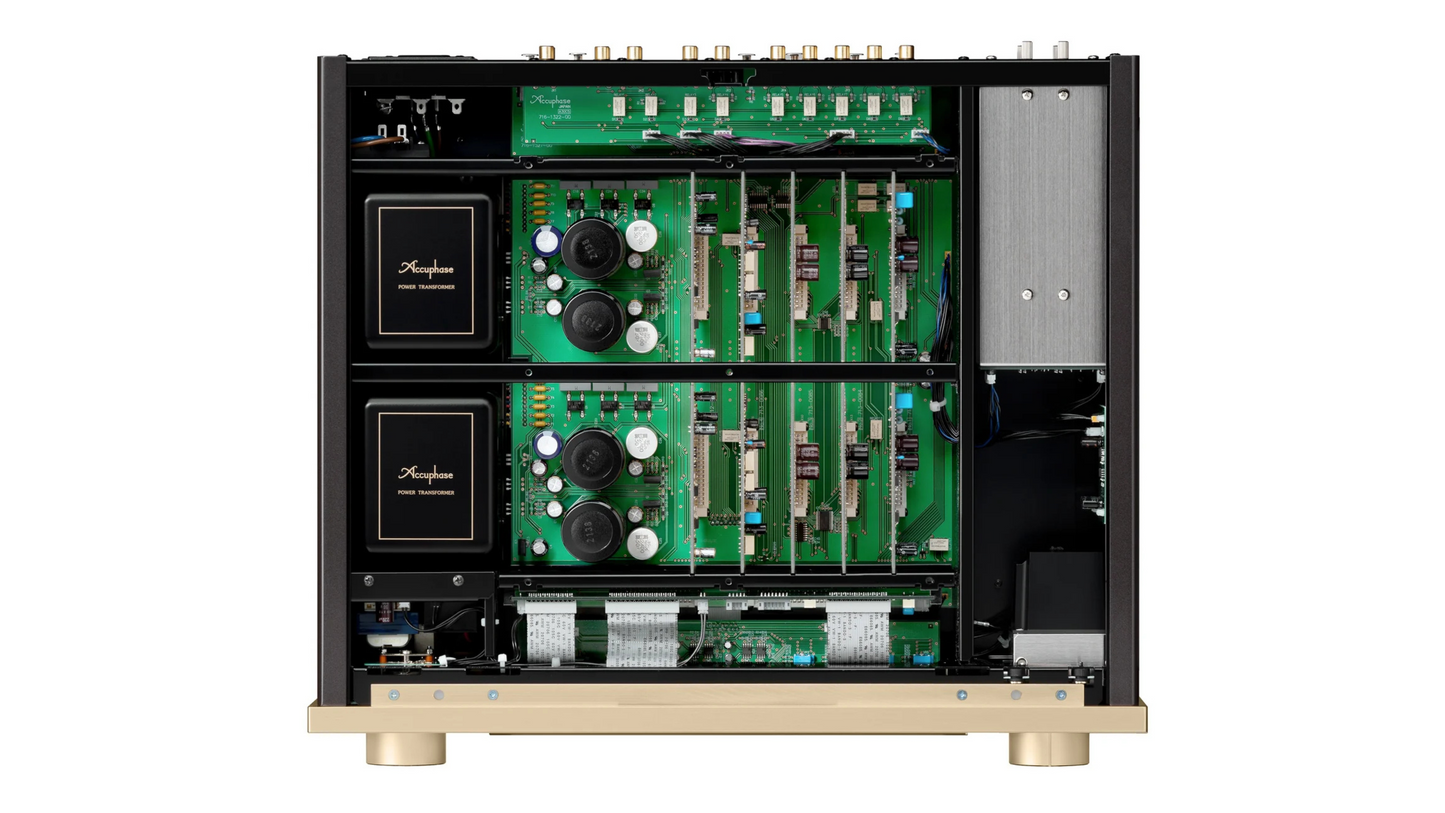
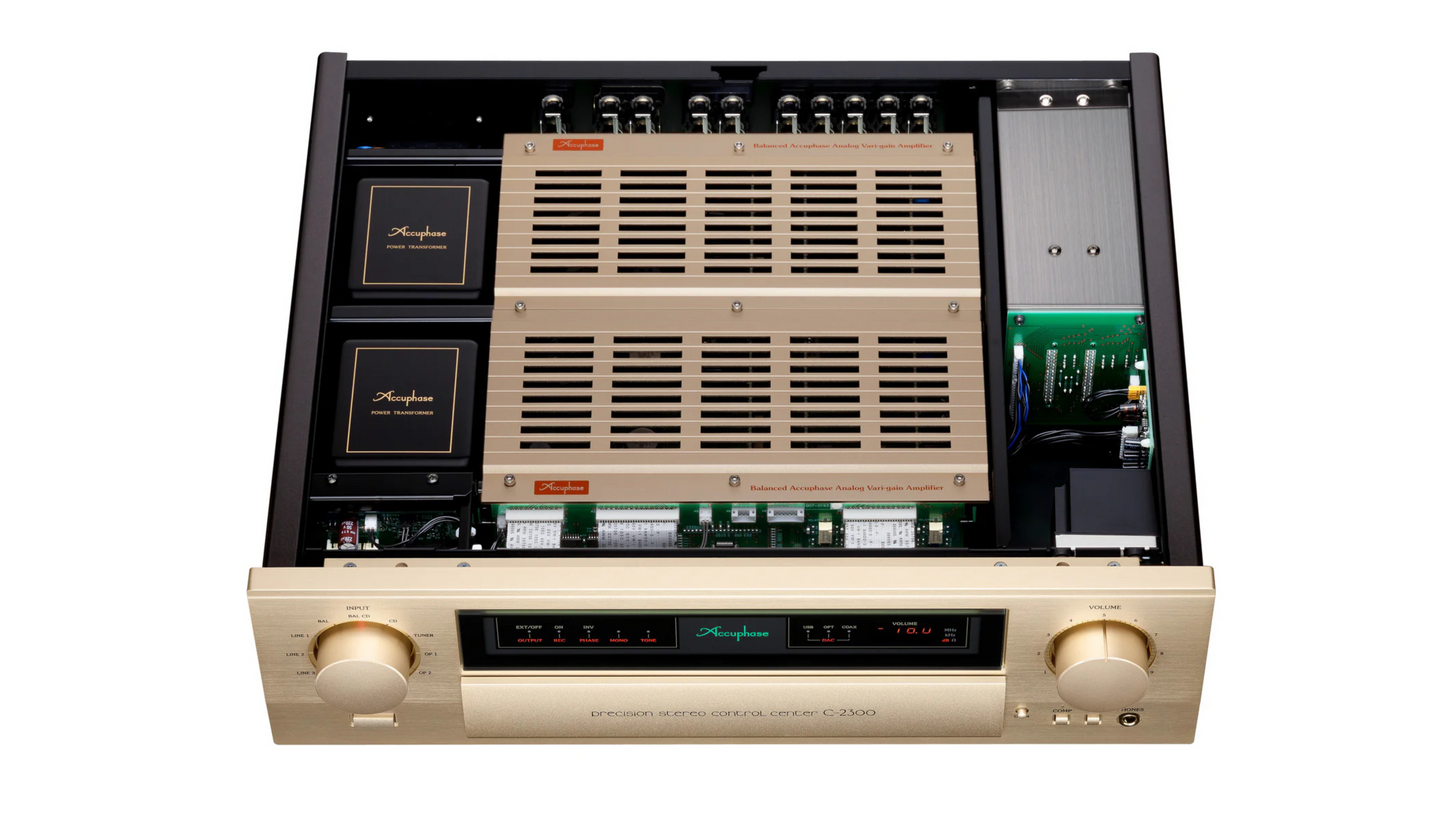
A preamplifier's power supply is not a passive component — it is an active participant in the sound. Supply-rail noise couples into the signal path. Supply-impedance variations under load modulate the gain stages. The C-2300 addresses both problems with a dual-mono power supply architecture: two separate cased high-efficiency transformers, one per channel, with four 10,000 μF high-capacity custom filtering capacitors — two per channel. Each channel's amplification circuitry draws from its own dedicated supply, and the physical casing of each transformer isolates its magnetic field from the circuits around it.
The Balanced AAVA modules for the left and right channels are physically separated within the chassis, positioned to minimize electrical interference between them. The practical effect is channel separation and power supply rejection that behaves like a monoblock pair, in a single chassis that fits on a standard shelf. The C-2300 weighs 19.3 kg — nearly identical to the C-2450 at 19.0 kg — because those power transformers and capacitor banks are real and substantial, not notional specifications.
The Volume Sensor — A Mechanical Detail Worth Noting
In AAVA and Balanced AAVA, the volume knob does not carry the signal. It is a position sensor: its rotational angle instructs the switching array which current sources to activate. Because the signal never passes through the mechanical assembly, the volume sensor could theoretically be minimized. Accuphase chose to do the opposite.
The C-2300's volume sensor is machined from an aluminum block in an ultra-precise CNC extrusion process, with a solid brass shaft 8 mm in diameter. The motor drive assembly — used for remote control operation — is mounted using a floating mechanism with custom-formulated silicone rubbers isolating it from the chassis to prevent vibration transmission. Custom-made grease is used throughout the gear train. The result is volume adjustment that is mechanically silent under remote operation and feels, under the hand, like a precision instrument rather than a consumer component. This is not a functional specification — it is a statement about how Accuphase builds things.
The 4-Band Tone Control — Why the C-2300 Has One and Uses It Correctly
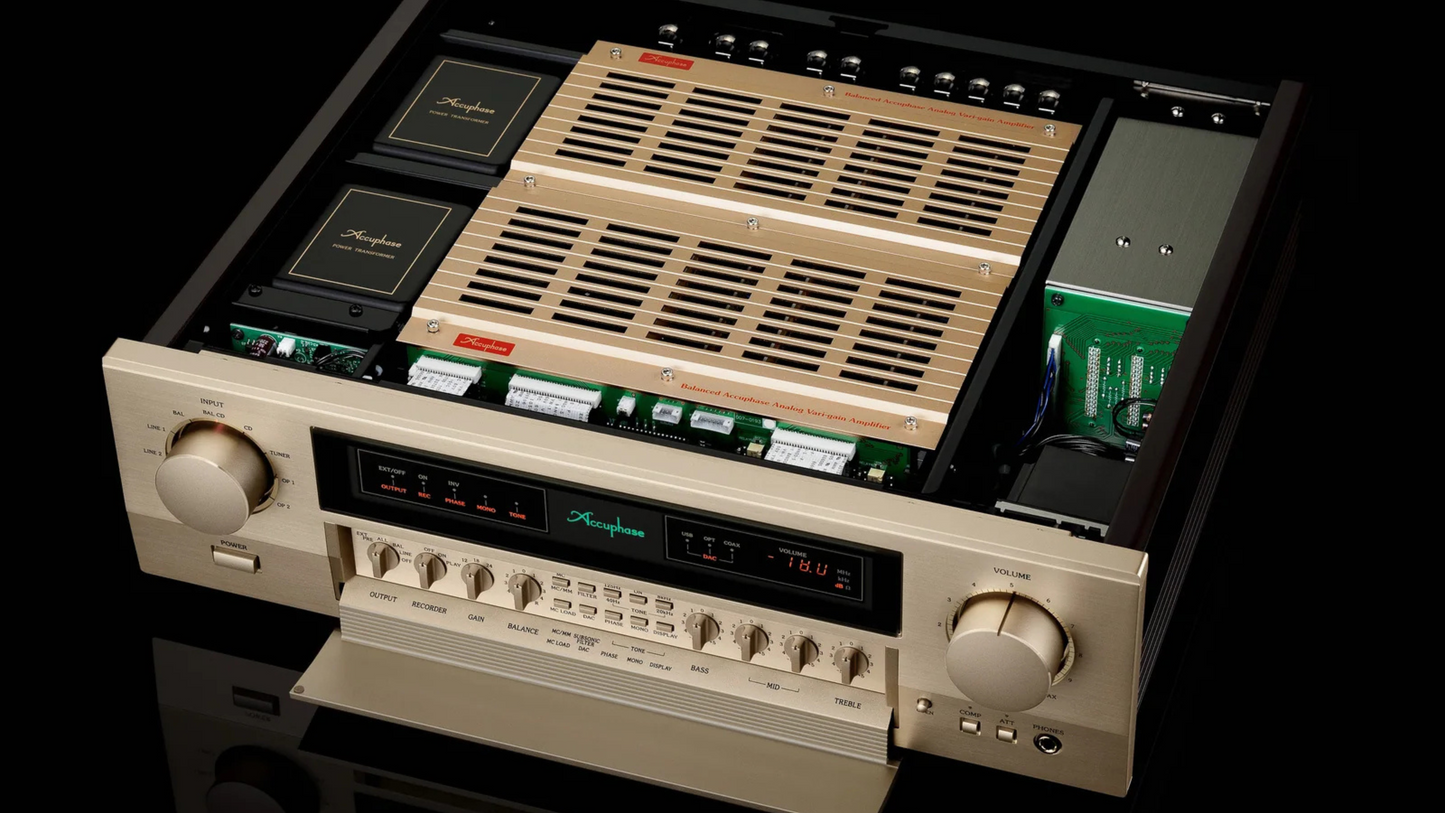
The high-end audio industry has a complicated relationship with tone controls. Many preamplifiers at this level omit them entirely on the grounds that they degrade the signal path. That position has merit when the controls are implemented as passive RC networks that must be buffered and that change the input impedance presented to the preceding stage. The C-2300's tone control circuit is implemented differently: it uses an additive active filter topology, the same approach used in professional-grade graphic equalizers. The filter adds or subtracts from the signal using an active summing stage rather than inserting resistive elements in series. When set to flat, the controls are out of the signal path.
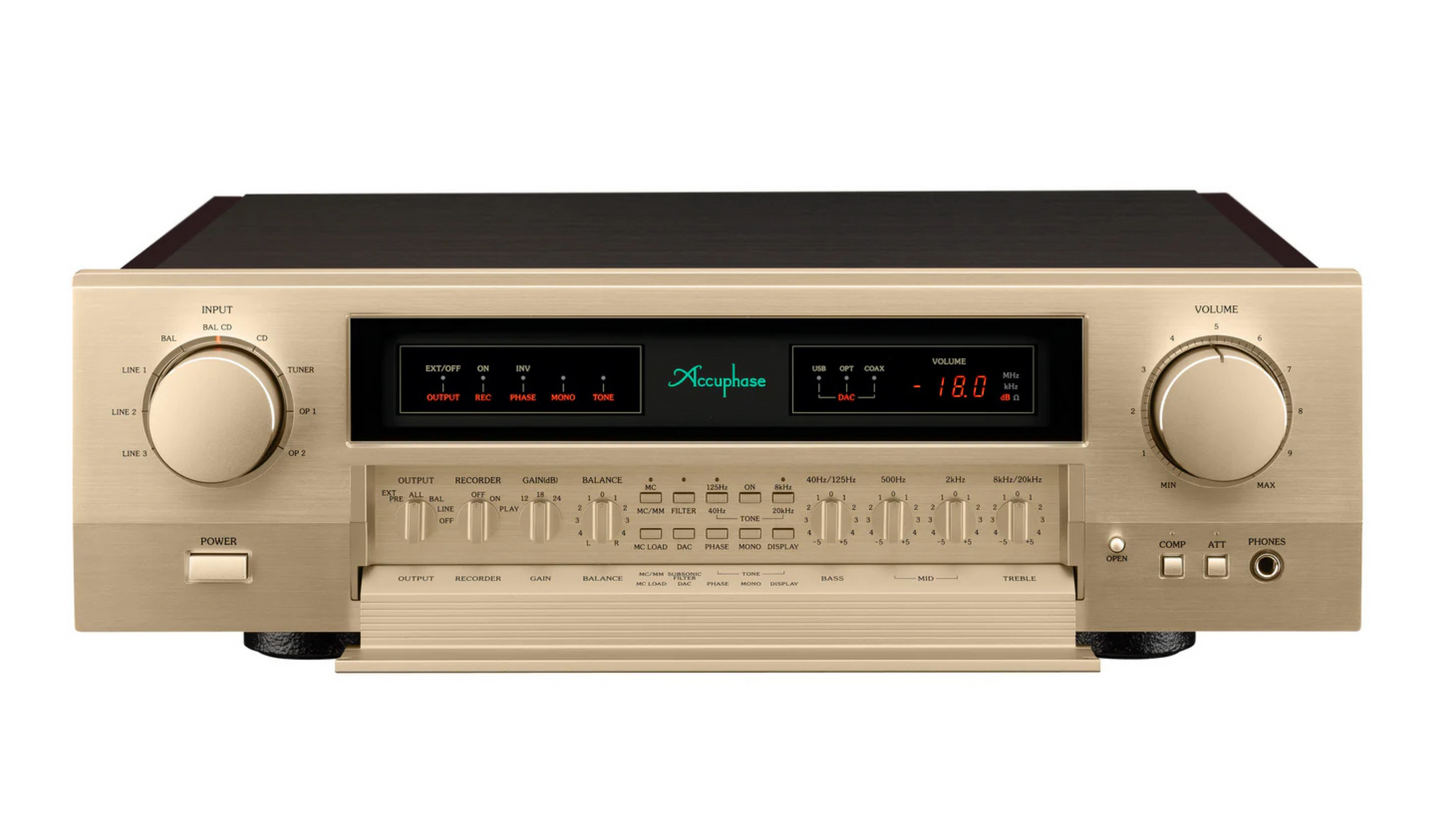
The four bands cover the frequency ranges that are practically meaningful for real listening situations. The low band is selectable between 40 Hz and 125 Hz — 40 Hz for trimming room-mode-driven bass excess without touching the midbass warmth, 125 Hz for adjusting the body of bass instruments directly. The low-midrange band at 500 Hz adjusts the weight of rhythm instruments and the chest resonance of vocals. The high-midrange band at 2 kHz handles vocal presence and string attack. The high band is selectable between 8 kHz and 20 kHz — 8 kHz for brilliance and air in recordings that need it, 20 kHz for shelf adjustments that affect perceived spaciousness without touching the presence region. Each band provides ±12 dB of adjustment. The result is a tone control system that is genuinely useful for adapting recordings and rooms, not a nod to tradition that compromises the signal at all times.
Input Flexibility and the Option Board System
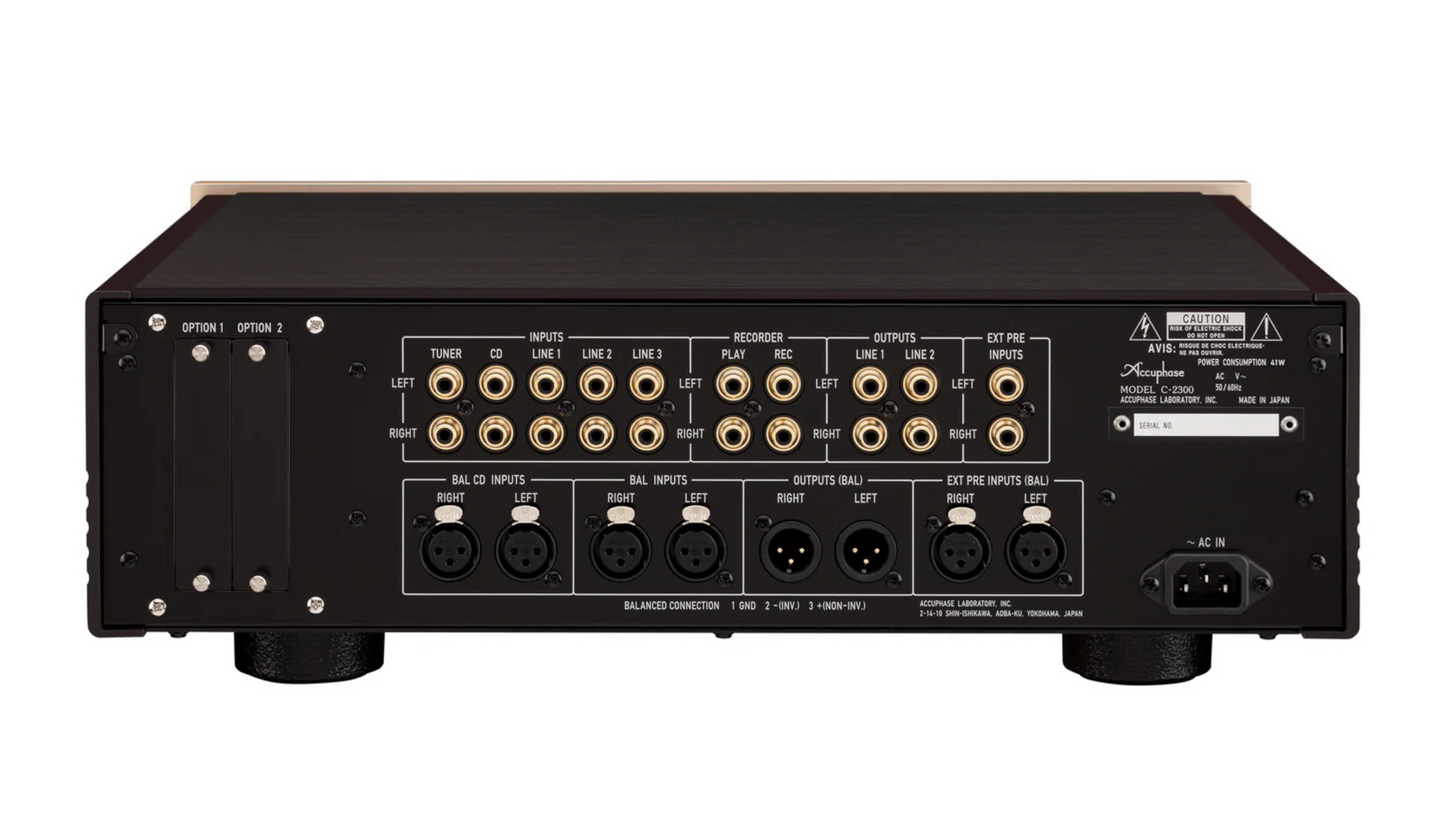
The C-2300 provides five unbalanced RCA line inputs and two balanced XLR inputs as standard, along with two line-level outputs (RCA) and one balanced output (XLR). A tape recorder loop with independent selector (OFF/ON/PLAY) is included. An EXT PRE input in both balanced and unbalanced format allows an external preamplifier or processor — a surround sound processor for home theater integration, for example — to be inserted downstream of the C-2300's volume control. Phase inversion is available per input and stored in memory after power-off, so configurations are not lost between listening sessions. Output selection can be set to ALL, LINE, BAL, or OFF independently. Overall gain is switchable among 12 dB, 18 dB, and 24 dB to match the sensitivity of the power amplifiers in the system.
Two option board slots accept Accuphase's current plug-in modules. The AD-60 analog disc input board provides a full moving-magnet and moving-coil phono stage with 40 dB MM gain and 66 dB MC gain, selectable MC load impedance (30, 100, 200, or 300 ohms), a subsonic filter at 25 Hz at –12 dB per octave, and all controls accessible from the C-2300's front panel. The DAC-60 digital input board adds USB (up to 384 kHz PCM and DSD up to 11.2 MHz), optical, and coaxial digital inputs, powered by dual ESS ES9016K2M DAC chips running in parallel. Both boards can be installed simultaneously. Legacy option boards from the AD-50, AD-30, DAC-50, and DAC-40 generation are also compatible.
The headphone amplifier uses a discrete parallel push-pull output stage with a dedicated power source — not an afterthought fed from the line output. It is rated for 2 V output into 40 ohms and is suitable for any headphone with an impedance of 8 ohms or higher.
How the C-2300 Compares: C-2450, C-2900, and the Wider Landscape
The C-2450 that the C-2300 replaces used standard AAVA in a single-ended configuration. The C-2300's primary advance is architectural: Balanced AAVA runs the entire signal path differentially, delivering the 10 percent noise reduction and improved common-mode rejection described above. The 4-band tone control is new — the C-2450 had a simpler 2-band arrangement. The power supply capacity is essentially equivalent in scale. For C-2450 owners, the C-2300 is a meaningful upgrade if the Balanced AAVA architecture and the expanded tone control matter to the system; for buyers coming to this level fresh, the C-2300 is the current standard.
Above the C-2300 sits the C-2900, Accuphase's current reference stereo preamplifier. The C-2900 implements Balanced AAVA with separate toroidal transformers per channel in a substantially heavier chassis (29 kg versus the C-2300's 19.3 kg), glass cloth fluorocarbon resin circuit boards for the signal path, a natural grain wood case option, and further refinements to the volume sensor mechanism. It is a genuinely different product at a genuinely different price, and the improvements it offers over the C-2300 are real at the level of system the C-2900 is designed for. For the system the C-2300 is designed for — including most Accuphase integrated-to-separate upgrades, and pairings with the P-series power amplifiers — the C-2300 is fully authoritative.
Against competitors at this level from Luxman, Pass Labs, and Ayre, the C-2300 distinguishes itself with the Balanced AAVA volume control (no other manufacturer offers a direct equivalent), the dual independent power supplies, the option board expansion system, and Accuphase's assembly standard. It is a quieter, more flexible, and more upgradeable product than most of what it competes against at this price.
Key Specifications
- Circuit Type: Fully balanced stereo preamplifier with Balanced AAVA volume control
- Total Harmonic Distortion: 0.005% (20 Hz–20 kHz, at rated output, all inputs)
- Frequency Response (Balanced/Line): 3 Hz–200 kHz (+0/–3.0 dB); 20 Hz–20 kHz (+0/–0.2 dB)
- Frequency Response (AD Input, MM/MC): 20 Hz–20 kHz (±0.3 dB)
- Signal-to-Noise Ratio: 111 dB (Balanced/Line, A-weighted, input shorted); 80 dB (MM); 68 dB (MC)
- Residual Noise: 5.6 μV (volume maximum, input shorted)
- Input Sensitivity (at rated output): 252 mV (Balanced/Line); 2.5 mV (MM); 0.126 mV (MC)
- Input Impedance: 40 kΩ (Balanced); 20 kΩ (Line); 47 kΩ (MM); 30/100/200/300 Ω selectable (MC)
- Gain (switchable): 12 dB / 18 dB / 24 dB (±6 dB from 18 dB default)
- Rated Output Voltage: 2 V (Balanced/Line output)
- Maximum Output Voltage: 7.0 V (Balanced/Line); 6.0 V (Recorder REC at AD output)
- Output Impedance: 50 Ω (Balanced/Line output)
- Crosstalk: –74 dB at 10 kHz
- Tone Control: 4-band — Low (40 Hz or 125 Hz selectable), Low-Mid (500 Hz), High-Mid (2 kHz), High (8 kHz or 20 kHz selectable); ±12 dB each
- Loudness Compensator: +6.0 dB at 100 Hz
- Subsonic Filter (AD-60): 25 Hz, –12 dB/octave
- Headphone Output: 2 V into 40 Ω; suitable for 8 Ω and above
- Attenuator: –20 dB (instant)
- Balanced Inputs: 2 × XLR
- Line Inputs: 5 × RCA
- Balanced Output: 1 × XLR
- Line Outputs: 2 × RCA
- Recorder Loop: Yes
- EXT PRE Input: Yes (Balanced XLR and unbalanced RCA)
- Option Slots: 2 (compatible with DAC-60, AD-60, LINE-10, and legacy boards)
- Power Supply: Dual independent cased toroidal transformers; 10,000 μF × 4 filtering capacitors
- Power Consumption: 41 W (with AD-60 and DAC-60 installed)
- Dimensions (W × H × D): 465 × 150 × 405 mm
- Weight: 19.3 kg (42.5 lbs)
- Country of Origin: Japan
- Warranty: Contact All Elite Audio for current warranty terms
Why Buy From All Elite Audio
All Elite Audio is an authorized Accuphase dealer. Every C-2300 we sell comes through legitimate North American distribution with full manufacturer warranty support. Accuphase does not honor warranty claims on gray-market units, and at this price point that distinction is material. Our staff knows the Accuphase preamplifier line from direct listening — we can speak to how the C-2300 pairs with Accuphase power amplifiers and with other brands we carry, which option boards make sense for your sources, and how the C-2300 fits into a system that is growing toward separate components. We take the time these conversations require.
Call 443-402-5055 / Text 443-402-5064 / Visit 1921 York Rd, Timonium, MD 21093
Frequently Asked Questions
What is Balanced AAVA and how is it different from the standard AAVA in Accuphase integrated amplifiers?
Standard AAVA — as found in the E-series integrated amplifiers — eliminates variable resistors from the volume control by converting the input voltage to current, routing it through a switched array of precision current sources, and reconverting the result. It is genuinely superior to potentiometers and stepped attenuators. Balanced AAVA takes that architecture further by implementing two complete AAVA modules in a fully differential balanced configuration, one for the positive phase of the signal and one for the negative phase. The entire signal path from input to output, including the tone control circuits, remains balanced throughout. The benefit is common-mode noise rejection: interference that couples equally into both signal phases is cancelled by subtraction at the output, rather than amplified along with the music. The C-2300 achieves a residual noise floor of 5.6 μV — 10 percent lower than the C-2450 it replaces — purely through this architectural change, with no additional filtering required.
How does the C-2300 compare to the C-2450 it replaces?
The C-2450 used standard AAVA in a single-ended circuit topology. The C-2300's primary advancement is the Balanced AAVA architecture, which reduces residual noise by 10 percent and improves common-mode rejection throughout the signal path. The tone control is expanded from a 2-band arrangement in the C-2450 to the C-2300's 4-band system, adding selectable low-frequency (40 Hz or 125 Hz) and high-frequency (8 kHz or 20 kHz) bands alongside the fixed midrange controls. The volume sensor mechanism is entirely new — the floating motor mount and custom grease formulation produce a smoother, quieter feel than the C-2450's mechanism. The power supply architecture is comparable in scale. For C-2450 owners, the C-2300 is a meaningful upgrade; for new buyers, it is simply the current standard at this level.
How does the C-2300 compare to the C-2900 above it?
The C-2900 is Accuphase's current reference stereo preamplifier and uses the same Balanced AAVA topology as the C-2300 but implements it with a substantially more elaborate physical platform: a heavier chassis at 29 kg versus the C-2300's 19.3 kg, glass cloth fluorocarbon resin circuit boards for the signal path to minimize dielectric loss, separate toroidal transformers and dedicated capacitor banks for each channel in a higher-capacity configuration, and a natural grain wood case option crafted by artisans. The C-2900 also uses a newly developed volume sensor construction with additional refinements beyond the C-2300's floating mechanism. For most systems and most budgets, the C-2300 is fully authoritative — the C-2900's advantages are real but are most relevant in a reference-level system where every component has been chosen to match.
Does the C-2300 include a phono stage?
No phono stage is included as standard. The optional AD-60 analog disc input board provides a complete phono equalizer supporting both moving-magnet and moving-coil cartridges. MM gain is fixed at 40 dB with a 47 kΩ input impedance. MC gain is fixed at 66 dB with selectable input impedance of 30, 100, 200, or 300 ohms to match your cartridge's optimal loading requirement. A subsonic filter at 25 Hz, –12 dB per octave, is switchable from the front panel when the AD-60 is installed. All phono controls — MC/MM selection, load impedance, and subsonic filter — are accessible from the C-2300's front panel, not buried on the board itself. The AD-60 installs into one of the two rear-panel option slots and draws power from the C-2300's internal supply.
What digital inputs does the C-2300 support?
The C-2300 has no digital inputs as standard — it is a purely analog preamplifier. The optional DAC-60 digital input board adds USB Type B (supporting PCM up to 384 kHz at 32-bit and DSD up to 11.2 MHz via ASIO), optical TosLink (up to 192 kHz PCM), and coaxial digital (up to 192 kHz PCM). The DAC-60 uses two ESS ES9016K2M DAC chips running in parallel, a topology that averages out uncorrelated noise between chips and improves dynamic range. When installed, the DAC-60 also adds a sampling frequency display to the front panel. Both the AD-60 and DAC-60 can be installed simultaneously, filling both option slots. If your digital source already has a high-quality onboard DAC with balanced analog outputs, the line inputs on the C-2300 are fully suited to that connection and the DAC-60 is redundant.
What does the EXT PRE input do?
The EXT PRE input — available in both balanced XLR and unbalanced RCA format — allows an external preamplifier or processor to be inserted into the C-2300's signal chain downstream of the volume control. The most common use is home theater integration: a surround sound processor handles the multichannel decoding and passes the front left and right channels through the C-2300's EXT PRE input, so the C-2300's volume control governs the main stereo output level during both stereo and surround listening. This arrangement allows the C-2300 to serve as both a reference two-channel preamplifier and the front-channel master volume for a combined system, without compromise to either function. The EXT PRE input bypasses the C-2300's own gain stages and passes the external signal directly to the output stage.
What does the selectable gain setting do and when would I change it?
The C-2300's overall gain is switchable among 12 dB, 18 dB, and 24 dB (the 18 dB setting is the default, with the other two settings representing ±6 dB from that reference). This setting governs how much the preamplifier amplifies the signal before it reaches the power amplifier. The practical reason to adjust it is system matching: if your power amplifier is very sensitive (reaches full output at a low input voltage), a gain of 12 dB may prevent the volume control from being crowded into a narrow usable range at the bottom of its travel. If your power amplifier requires a higher drive voltage, 24 dB may be appropriate. Most systems using Accuphase power amplifiers will be well-matched at the 18 dB default. If you are pairing the C-2300 with a power amplifier from another manufacturer, call us and we can help determine the right gain setting for your combination.
Can the C-2300 be used as a pure line preamplifier without the tone controls in the signal path?
Yes. When the tone control bands are set to flat, the additive active filter topology means the controls are not inserting resistive or reactive elements into the signal path — they are simply adding zero correction, which is electrically equivalent to their absence. The C-2300's design philosophy treats the tone controls as genuinely bypassed at flat, not merely set to unity gain through the filter network. If you prefer to listen with all corrections zeroed and want the reassurance that the circuit is as transparent as possible, setting all four bands to their center positions achieves that. The tone controls are there for when recordings or rooms require them, not to impose a character at all times.
What power amplifiers pair well with the C-2300?
Within the Accuphase lineup, the C-2300 is a natural partner for the P-4600, P-7500, and M-6200 power amplifiers — all of which accept balanced XLR inputs and are designed for the same system architecture the C-2300 represents. Beyond Accuphase, the C-2300 pairs well with any high-quality power amplifier that accepts balanced inputs and has input sensitivity in the range compatible with the C-2300's 2 V rated output. We carry power amplifiers from several brands at All Elite Audio and can discuss specific pairings based on your speakers and room. The C-2300's selectable gain makes it adaptable to power amplifiers with a wide range of input sensitivities, which is an advantage in mixed-brand separates systems.
Does the C-2300 have a headphone output and how good is it?
Yes, the C-2300 includes a headphone output driven by a dedicated discrete amplifier circuit — not a line output run through a series resistor, which is how many preamplifiers handle headphone connections. The headphone amplifier uses a parallel push-pull output stage with its own dedicated power source, physically separate from the line output circuitry. It is rated at 2 V into 40 ohms and is suitable for any headphone with an impedance of 8 ohms or higher, which covers virtually the entire headphone market. At this level of implementation, the C-2300's headphone output is a genuine listening tool, not a convenience feature. If headphone listening is important to you, it is worth connecting a quality pair of headphones to the C-2300 directly — the result is substantially better than most standalone headphone amplifiers at the same price as the preamplifier.
Where can I buy the Accuphase C-2300?
The Accuphase C-2300 is available at All Elite Audio, an authorized Accuphase dealer at 1921 York Rd, Timonium, MD 21093. We carry the full Accuphase preamplifier range and can arrange a listening session with power amplifiers and source components relevant to your system. Buying from an authorized dealer is the only way to ensure full manufacturer warranty coverage — Accuphase does not honor warranty claims on units imported outside the official North American distribution channel. Call us at 443-402-5055, text us at 443-402-5064, or visit the showroom. A purchase of this nature deserves a real conversation, and we are glad to have it.