Skip to product information
1 of 1

Accuphase

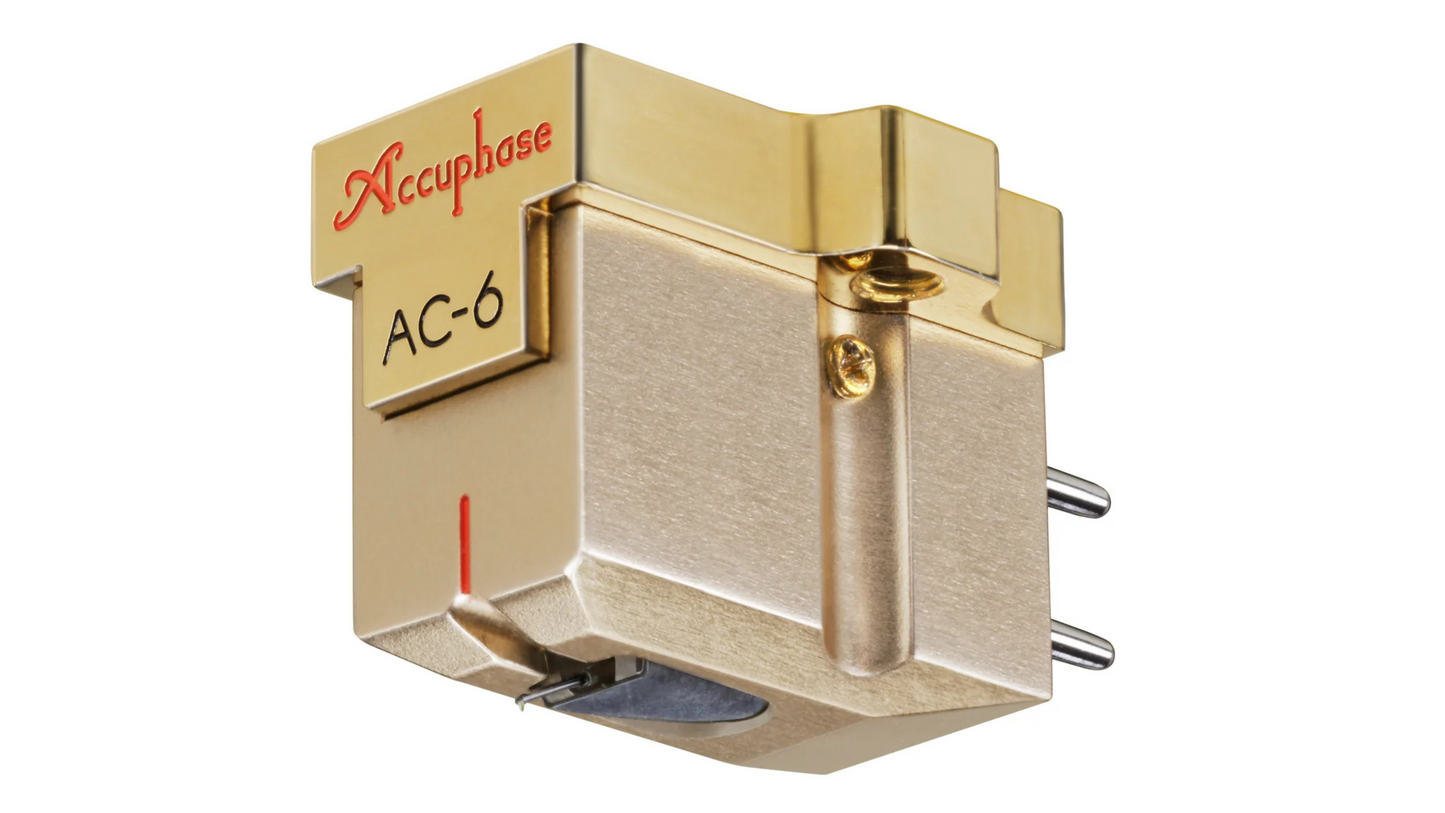
Accuphase AC-6 Moving Coil Phono Cartridge

Accuphase AC-6 Moving Coil Phono Cartridge

Regular price $6,975.00 USD
Regular price $6,975.00 USD Sale price $6,975.00 USD
SALE Sold Out
Shipping calculated at checkout.

Call for info 443-402-5055

Accuphase AC-6 Moving Coil Phono Cartridge

A reference level moving coil cartridge built in Japan for vinyl listeners who want the full resolution of the record groove, with nothing held back.

A Fifth Generation Cartridge Built on Decades of Refinement

Accuphase built its first phono cartridge, the AC-1, in 1979, and has released only a handful of successors since then: the AC-2, AC-3, AC-5, and now the AC-6. That slow pace is deliberate. Accuphase treats a cartridge launch the same way it treats an amplifier launch, as a multi year project where every material and every dimension is reconsidered rather than lightly updated. The AC-6 is the result of that process, a moving coil design built around a solid boron cantilever, a titanium and aluminum body, and a neodymium magnetic circuit, all aimed at extracting more honest detail from a record groove with less mechanical loss along the way. At $6,975, it sits among the more expensive cartridges in All Elite Audio's lineup, priced for listeners who already own a turntable and tonearm capable of showing off what this level of engineering can do.

The Solid Boron Cantilever and Why Material Choice Matters

The cantilever's only job is to carry the vibration picked up by the stylus to the coil without losing or smearing any of it along the way. That makes the speed at which a material transmits vibration just as important as how stiff it is, and boron does both well. Sound propagates through boron at roughly 16,200 meters per second, faster than beryllium and approaching the speed of diamond itself, which is why Accuphase chose a solid boron rod, 0.3 millimeters in diameter, rather than a hollow tube or a softer alloy. At the tip of that cantilever sits a semi line contact diamond stylus shaped to 3 micrometers by 30 micrometers, a profile that presents more contact area to the groove wall than a simple elliptical or spherical tip. That larger contact area reduces a distortion mechanism called the pinching effect, where the stylus gets squeezed as the groove narrows and widens through a turn, and the practical result is a cleaner top end with less added grain on busy or loud passages.

Titanium, Aluminum, and a Body Built to Stay Silent

A cartridge body that flexes or rings under vibration adds its own coloration on top of whatever the stylus picked up, so the AC-6's structure is built to do the opposite of that. The base section, which anchors the magnetic generator and the vibration transmitting assembly, is made from extruded titanium further hardened with gold ion plating. Titanium is difficult to machine, but its combination of light weight and high stiffness keeps internal losses low while holding the generator firmly in place. The outer body is extruded aluminum finished in the same gold colored alumite coating used on Accuphase's volume knobs, which is partly cosmetic and partly functional, since aluminum at this thickness resists resonance far better than the thin stamped housings found on lower cost cartridges. Together, the titanium base and aluminum body are meant to disappear acoustically, so what reaches your phono stage is the groove and not the cartridge.

Output, Impedance, and What Your Phono Stage Needs to Know

The AC-6 produces a rated output of 0.4 mV at 1 kHz, a low output figure typical of high performance moving coil designs, and it carries an internal impedance of just 1.8 ohms measured as DC resistance. That low impedance is possible because the magnetic circuit uses a grade N50 neodymium magnet, one of the strongest permanent magnet materials available, which generates enough magnetic flux that Accuphase could use a coil with fewer turns and still reach a usable output voltage. Fewer turns means less wire, less resistance, and a faster, more linear electrical response. On the amplifier side, Accuphase recommends a load impedance of 100 ohms or higher when feeding a phono preamp directly, with no particular limitation if you are instead using a step up transformer ahead of a moving magnet stage. Frequency response is specified from 10 Hz to 50 kHz, extending well past what you can hear in either direction, which matters less for raw audibility and more for preserving the transient shape of a signal without phase smearing near the edges of the audible band. Channel balance is held within plus or minus 0.5 dB and channel separation runs at least 30 dB at 1 kHz, both of which translate into a stereo image that stays centered and distinct rather than smeared toward one speaker.

Tracking Force, Compliance, and Matching the AC-6 to Your Tonearm

Compliance describes how easily the cantilever's suspension flexes under the stylus, and the AC-6 is rated at 8 times 10 to the negative 6 power cm per dyne at 100 Hz, a relatively stiff figure as cartridges go. Stiffer suspensions need a heavier tonearm to keep the combined resonant frequency of cartridge and arm in the right range, so the AC-6 is best matched to a tonearm with medium to higher effective mass rather than the lightweight arms designed around high compliance moving magnet cartridges. Recommended tracking force runs from 1.9 to 2.2 grams, centered on 2.0 grams, and the cartridge itself weighs 13.5 grams, light enough for most standard counterweights but worth checking against your tonearm's published range before you order. The terminal pins are high gloss rhodium plated, a finish chosen for long term contact reliability rather than a one time cosmetic upgrade, since rhodium resists the oxidation that can quietly degrade signal transfer over years of use. As with any cartridge at this level, careful alignment of overhang, azimuth, and vertical tracking angle matters more here than on a budget cartridge, simply because the AC-6 resolves setup mistakes as readily as it resolves music.

How the Accuphase AC-6 Compares to the Audio-Technica AT-ART1000x

All Elite Audio also carries Audio-Technica's flagship AT-ART1000x, priced at $5,999, which makes it the most directly relevant comparison in our cartridge lineup for a shopper considering the AC-6's $6,975 price tag. The two take genuinely different engineering paths to the same goal. The AC-6 uses a conventional cantilever and coil layout, refined through boron's transmission speed and a titanium anchored generator to minimize the losses that design is naturally exposed to. The AT-ART1000x instead uses Audio-Technica's Direct Power System, which places the coil directly above the stylus tip and removes the cantilever from the signal path almost entirely, a more radical departure from traditional moving coil construction. That difference shows up in output voltage too: the AC-6's 0.4 mV is a comparatively moderate output that works with a wider range of moving coil phono stages, while the AT-ART1000x's 0.22 mV output demands a phono stage or transformer with noticeably more gain on tap. Both cartridges are handbuilt in Japan and both use boron cantilevers and titanium bases, so the decision often comes down to whether you want the established cantilever to coil architecture taken to its highest traditional expression, which favors the AC-6, or you are drawn to a fundamentally different signal path and have the phono stage gain to support it, which favors the AT-ART1000x.


Key Specifications

  • Brand and Model: Accuphase AC-6
  • Cartridge Type: Moving Coil (MC)
  • Stylus: Semi line contact diamond, 3 µm by 30 µm
  • Cantilever: Solid boron, 0.3 mm diameter
  • Output Voltage: 0.4 mV (1 kHz)
  • Internal Impedance (DCR): 1.8 Ω
  • Frequency Response: 10 Hz to 50 kHz
  • Compliance: 8 times 10 to the negative 6 cm per dyne (100 Hz)
  • Recommended Tracking Force: 1.9 to 2.2 g (2.0 g standard)
  • Channel Balance: Within ±0.5 dB (1 kHz)
  • Channel Separation: 30 dB minimum (1 kHz)
  • Recommended Load Impedance: 100 Ω or higher on amplifier inputs; no limitation specified for step up transformers
  • Magnet: Grade N50 neodymium
  • Coil: OFC copper, 50 µm diameter
  • Body and Base Materials: Extruded titanium base with gold ion plating; extruded aluminum body with gold colored alumite coating
  • Terminal Pins: High gloss rhodium plated
  • Mounting: Standard half inch mount with M2.6 fastening screws
  • External Dimensions: Not published by Accuphase as a standalone L by W by H figure; compatibility is governed by the standard half inch mounting spacing and the mass listed below
  • Mass: 13.5 g
  • Included Accessories: Stylus cleaning brush, stylus protector, mounting screwdriver, fastening screws, and a matching protective case
  • Country of Origin: Japan
  • Price: $6,975 USD
  • Warranty: Manufacturer's limited warranty through Accuphase's authorized US distribution channel. As with most moving coil cartridges industry wide, styli and other wear items are typically excluded from coverage. Confirm the current term length with All Elite Audio at time of purchase.

Why Buy From All Elite Audio

All Elite Audio is an authorized Accuphase dealer, which means every AC-6 we sell is backed by genuine manufacturer support rather than a gray market import with no warranty path. Our team can also help you match the AC-6 to the right phono stage, tonearm, and turntable, and we offer in-store demonstrations so you can hear it before you commit.

Call: 443-402-5055 Text: 443-402-5064 Visit: 1921 York Rd, Timonium, MD 21093


Frequently Asked Questions

Does the Accuphase AC-6 need a separate phono preamp? Yes. The AC-6 is a passive moving coil cartridge and does not include or replace a phono preamp of any kind. Because it is a low output design rated at 0.4 mV, it needs a phono stage with a dedicated moving coil input offering substantially more gain than a typical moving magnet stage provides, or a step up transformer placed ahead of a standard moving magnet phono stage. Most receivers and integrated amplifiers with a basic built in phono input are designed around moving magnet cartridges and will sound thin, noisy, or simply too quiet with the AC-6 connected directly. All Elite Audio carries a range of dedicated moving coil phono stages and step up transformers, and our team can match one to your existing system and budget.

What comes in the box with the Accuphase AC-6? The AC-6 ships with the cartridge itself along with a stylus cleaning brush, a stylus protector to guard the diamond tip during storage and transport, a mounting screwdriver, and the screws needed to attach it to a standard half inch headshell or tonearm. Accuphase also includes a dedicated protective case finished in the same gold alumite coloring as the cartridge, which doubles as a presentation box and a safe place to keep it when it is not installed. What is not included is a step up transformer, a phono preamp, or alignment tools such as a protractor or tracking force gauge, since those depend on the rest of your system and are sold separately. All Elite Audio stocks alignment tools and phono stages alongside the AC-6, so you can leave with everything needed for a proper installation.

How does the Accuphase AC-6 compare to the AC-5 it replaced? Accuphase has built phono cartridges since 1979, starting with the AC-1 and continuing through the AC-2, AC-3, and AC-5, with the AC-6 representing the fifth generation in that lineage. Rather than a modest refresh, Accuphase rebuilt the cartridge around new material choices for this generation, carrying the brand's accumulated cartridge engineering into the boron cantilever and titanium base construction described above. All Elite Audio does not currently stock the discontinued AC-5 for a side by side comparison, so the most relevant comparison for shoppers today is against current production cartridges such as Audio-Technica's AT-ART1000x, covered in the next question. If you previously owned an AC-5 and are considering an upgrade, call or text our team and we can talk through what has changed.

How does the Accuphase AC-6 compare to the Audio-Technica AT-ART1000x? Both are flagship moving coil cartridges handbuilt in Japan, but they take different engineering paths. The AC-6 uses a conventional cantilever and coil layout refined through a fast boron cantilever and a titanium anchored generator, while the AT-ART1000x uses Audio-Technica's Direct Power System, which places the coil directly above the stylus tip and largely removes the cantilever from the signal path. The AC-6's 0.4 mV output is more moderate and compatible with a broader range of phono stages, while the AT-ART1000x's 0.22 mV output requires a phono stage or transformer with more gain on tap. At $6,975 versus $5,999, the AC-6 costs more, and the choice between them comes down to whether you prefer the established cantilever to coil architecture refined to a high standard or a more unconventional design that asks more of your phono stage.

What does moving coil mean, and how is it different from moving magnet? In a moving coil cartridge like the AC-6, tiny coils of wire are attached to the cantilever and move within a fixed magnetic field, generating a very small electrical signal as they move. A moving magnet cartridge works the other way around, with a small magnet attached to the cantilever moving near fixed coils, which typically produces a much higher output voltage with less need for specialized amplification. Moving coil designs generally use lighter moving parts, since the coils can be smaller than a magnet, which can translate into faster transient response and lower distortion, but at the cost of a much lower output that demands a dedicated moving coil phono stage or step up transformer. That tradeoff is exactly why the AC-6 needs more from your system than a typical moving magnet cartridge would. Neither design is universally superior, but the AC-6's particular strengths are built around the moving coil approach.

What does compliance mean, and why does it matter here? Compliance describes how easily the cantilever's suspension flexes under the pressure of the stylus tracking a groove, with a higher number meaning a softer, more flexible suspension and a lower number meaning a stiffer one. The AC-6 is rated at 8 times 10 to the negative 6 cm per dyne at 100 Hz, which is on the stiffer side as cartridges go. A stiff suspension needs to be paired with a tonearm of medium to higher effective mass to keep the resonant frequency of the cartridge and arm combination out of the audible range, since pairing a stiff cartridge with a very light tonearm can push that resonance up into frequencies where it audibly colors the sound. This is the kind of spec our team checks against your specific tonearm before recommending the AC-6, rather than assuming it will work with whatever you already own.

What turntable and tonearm will the Accuphase AC-6 work best with? Given its relatively stiff compliance, the AC-6 performs best on a tonearm with medium to higher effective mass rather than the very light, high compliance arms built for entry level moving magnet cartridges. It is not tied to any one turntable brand, but the combination of arm mass and cartridge compliance matters more for sound quality than which manufacturer made the table. Most serious two channel turntables in the price range that would justify a $6,975 cartridge fall comfortably into the right mass range, but tonearm geometry varies enough between models that we recommend checking with us before you buy if you are unsure. All Elite Audio's showroom lets you hear the AC-6 mounted on a properly matched arm so you know what to expect before committing.

Do I need anything else to use the Accuphase AC-6, like a step up transformer or special cables? Beyond the turntable and tonearm itself, you will need either a moving coil capable phono stage or a step up transformer paired with a standard moving magnet phono stage, since the AC-6's low output will not work properly without one of those two paths. You will also want a cartridge alignment protractor and a tracking force gauge to set up the AC-6 correctly, since accurate alignment matters more at this performance level than it does with a budget cartridge. Standard phono cabling and a properly grounded turntable are assumed but worth double checking if you are working with an older setup. All Elite Audio sells phono stages, step up transformers, and alignment tools alongside the AC-6, so you can put together a complete, compatible system in one visit. If you are unsure what else you need, call or text us before you buy and we will put together a list based on your specific turntable and tonearm.

Is the stylus on the Accuphase AC-6 replaceable? As with most fixed coil moving coil cartridges, the AC-6's stylus and cantilever assembly is not designed to be swapped out by the user the way a stylus on a moving magnet cartridge often can be. When the stylus eventually wears, the cartridge typically needs to go back through an authorized service channel for evaluation rather than a simple at home replacement. All Elite Audio can advise on service options through Accuphase's authorized distribution once that time comes, since policies and turnaround can vary. In the meantime, regular stylus cleaning and careful handling will meaningfully extend the time before service is needed.

How much does the Accuphase AC-6 weigh, and will it fit my tonearm? The AC-6 weighs 13.5 grams, which falls within the range most standard tonearm counterweights are designed to handle. Combined with its recommended tracking force of 1.9 to 2.2 grams, most tonearms built for moving coil cartridges in this performance class should accommodate it without needing an auxiliary counterweight. It is still worth checking your specific tonearm's published cartridge weight range before ordering, particularly if your arm was designed with lighter moving magnet cartridges in mind. Our team can confirm compatibility with your exact tonearm model over the phone or by text before you buy.

What is the warranty on the Accuphase AC-6? The AC-6 is covered by Accuphase's manufacturer warranty as administered through its authorized US distribution channel, which protects against defects in materials and workmanship. As is standard across the moving coil cartridge industry, normal stylus wear and other consumable wear items are typically excluded from that coverage, since a stylus is expected to wear down with use over time regardless of manufacturing quality. Because warranty term lengths and specific exclusions can be updated by the manufacturer, we recommend confirming the current terms with our team at the time of purchase rather than relying on older documentation. Buying through an authorized dealer like All Elite Audio also ensures your warranty registration is valid in the first place, which is not guaranteed with gray market units.

Where can I buy the Accuphase AC-6? The Accuphase AC-6 is available now through All Elite Audio, an authorized Accuphase dealer in Timonium, Maryland. You can reach our team by calling 443-402-5055, texting 443-402-5064, or visiting our showroom at 1921 York Rd, Timonium, MD 21093 to hear it in person before you buy. We can also help you build out the rest of your analog setup, from phono stages to tonearm matching, in the same conversation.

View full details