Accuphase
Accuphase C-57 Stereo Phono Amplifier
Accuphase C-57 Stereo Phono Amplifier
Accuphase C-57 Stereo Phono Amplifier
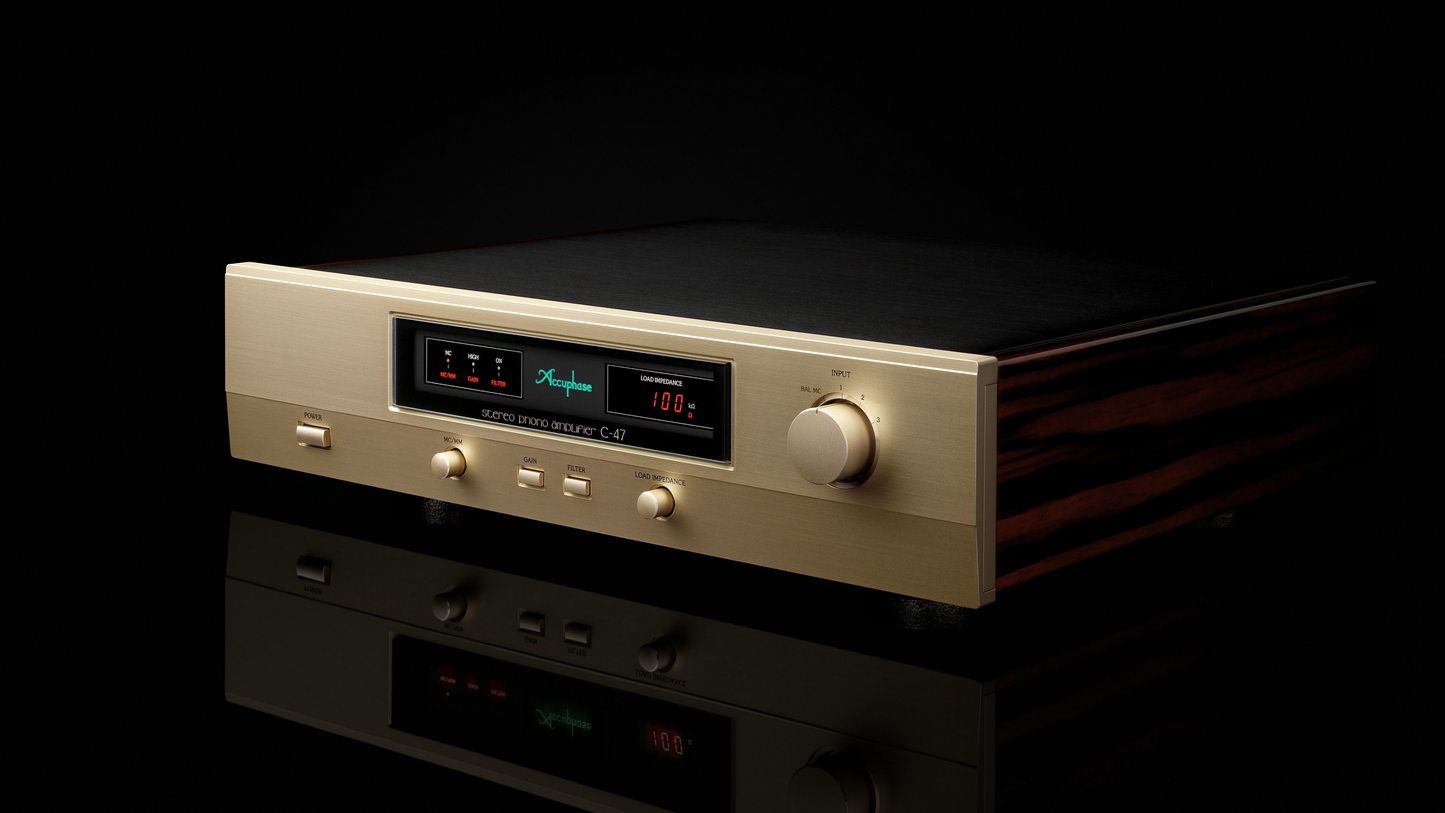
The most technically advanced phono preamplifier in Accuphase's standalone component history — a fully balanced dual-mono design with an ANCC-equipped eight-parallel bipolar MC head amplifier, guaranteed input referred noise of –156 dBV, and RIAA equalization accurate to ±0.3 dB from 10 Hz to 20 kHz.
What It Is and Who It's For
The Accuphase C-57 is a dedicated stereo phono equalizer amplifier — a standalone component whose entire engineering budget is directed at a single problem: taking the extraordinarily weak signal from a phono cartridge, applying the inverse RIAA equalization curve with exceptional precision, and delivering a clean line-level output with minimal noise and distortion added along the way. It supports both moving-magnet and moving-coil cartridges, with gain and loading adjustable from the front panel across a range that covers virtually every cartridge in production.
The C-57 is the fourth generation of Accuphase's standalone phono amplifier line, following the C-27 (2008), C-37 (2014), and C-47 (2020). Each generation has brought meaningful engineering advances. The C-57's defining advances over the C-47 are the application of ANCC noise and distortion cancellation to the MC head amplifier — a first for any Accuphase phono stage — the addition of a dedicated balanced MC phono input, the introduction of a 60 Ω MC loading option between the C-47's 30 Ω and 100 Ω settings, and circuit topologies drawn directly from the C-3900 reference preamplifier and E-800S integrated amplifier. The guaranteed input referred noise improves by 1 dB over the C-47, reaching –156 dBV for MC — a figure Accuphase's own documentation describes as world-champion-class.
The buyer who chooses the C-57 is a serious vinyl listener who has invested in a high-quality turntable, tonearm, and cartridge — and understands that an inadequate phono stage is the bottleneck through which all of that upstream investment passes. It is also the right choice for any system built around Accuphase separates, because the C-57's fully balanced output connects directly into the balanced inputs of the C-2300, C-2900, or any Accuphase integrated amplifier with balanced line inputs, creating an unbroken balanced signal path from stylus to speaker.
The Two-Stage Architecture — Why Head Amp and Equalizer Are Separate
Every phono equalizer amplifier must accomplish two tasks: amplify the cartridge signal by 40 to 70 dB depending on cartridge type, and apply the inverse RIAA equalization curve that restores flat frequency response to recordings cut with the RIAA standard's deliberate bass attenuation and treble boost. The quality of the result depends almost entirely on how those two tasks are sequenced and how much gain is concentrated in the lowest-noise stage.
The C-57 uses a two-stage architecture that addresses this directly. The first stage is the head amplifier — a dedicated circuit optimized purely for low-noise, high-gain amplification of the cartridge signal before any equalization is applied. The MC head amplifier provides 50 dB of gain; the MM head amplifier provides 20 dB of gain. The second stage is the equalizer amplifier, which applies the RIAA curve with high precision. By front-loading the majority of the total gain into the head amplifier stage, the C-57 ensures that the noise floor of the equalizer stage — which is unavoidably higher than the head amp at the signal levels it operates at — is suppressed relative to the signal level when it enters. The equalization is applied to a signal that is already substantially amplified and therefore already well above the noise floor of the equalizer circuit. This is the fundamental reason a two-stage design achieves lower noise than a single-stage phono amplifier of equivalent total gain.
The MC Head Amplifier: Eight Parallel Bipolars and ANCC
The MC head amplifier uses eight parallel low-noise bipolar transistors in a current feedback configuration. The parallelism serves the same noise-reduction function as MCS+ in the power amplifiers: correlated signal sums at full level across all eight devices, while uncorrelated thermal noise partially cancels because it is independent in each device. With eight devices in parallel rather than one, the theoretical noise improvement is a factor of √8 — approximately 9 dB — before any other noise-reduction technique is applied.
To this foundation, the C-57 adds ANCC — Accuphase Noise and Distortion Cancelling Circuit — to the MC head amplifier for the first time in any Accuphase phono stage. ANCC works by deploying a dedicated sub-amplifier alongside the main amplifier. The sub-amplifier continuously monitors the noise and distortion components at the main amplifier's output, generates a correction signal of opposite polarity, and feeds that correction back to cancel the noise and distortion in the main circuit. The sub-amplifier used for this purpose is itself a balanced low-noise design. The combination of eight-parallel bipolar inputs, current feedback topology, and ANCC produces the guaranteed input referred noise of –156 dBV at the MC input — 1 dB better than the C-47, and an improvement that is achieved at the most critical point in the circuit where the signal is smallest and most vulnerable to contamination.
The MM head amplifier uses a different approach appropriate to the different characteristics of moving-magnet cartridges: three parallel low-noise junction FETs (JFETs) in a current feedback configuration. JFETs offer lower noise at the higher impedances typical of MM cartridges than bipolar transistors, which perform better at the low impedances of MC cartridges. The MM stage does not use ANCC — the higher output voltage of MM cartridges (typically 2.5–5 mV versus 0.1–0.5 mV for MC) means the absolute noise requirement is less stringent, and the JFET parallel topology alone achieves the necessary performance.
Why MC Gets a Balanced Input and MM Does Not
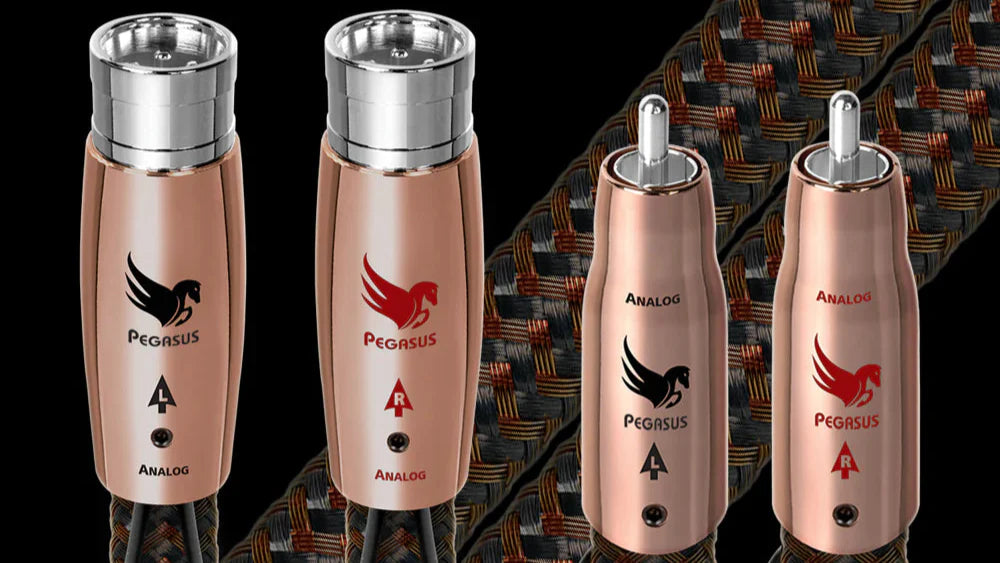
The C-57 provides one dedicated balanced XLR phono input for MC cartridges and three unbalanced RCA inputs for both MC and MM. This arrangement is deliberate and technically justified — it is not a cost-cutting measure. Accuphase's technical documentation explains the reason precisely: most moving-magnet cartridges have a static shield in their generator assembly, and that shield is connected to the negative polarity side of the signal. If an MM cartridge is connected via a balanced input, the noise at the positive and negative signal lines inside the cartridge is asymmetrical because the static shield introduces a path that breaks the symmetry the balanced input relies on for common-mode rejection. The noise cancellation benefit of the balanced connection is lost, and the balanced input actually performs worse than the unbalanced connection for MM. MC cartridges do not have this constraint, so balanced connection genuinely improves noise rejection for MC — which is exactly where lower noise is most critical, given MC cartridges' much lower output voltages.
RIAA Equalization, The Fluorocarbon PCB, and the Power Supply
The RIAA equalization curve must be reproduced with extreme precision. A 1 dB deviation at 20 Hz represents a measurable tonal imbalance across the entire bass region. The C-57 guarantees RIAA deviation of ±0.3 dB across the full 10 Hz to 20 kHz range, achieved through hand-selected high-precision resistors and capacitors in the equalizer stage. This is a tighter specification than the ±0.5 dB that many phono stages at this level achieve.
The PCB substrate used for the disc equalizer assembly is glass fiber cloth fluorocarbon resin — the same material used in Accuphase's flagship preamplifiers. This substrate has a lower dielectric constant and lower dielectric loss than standard FR4 fiberglass, which matters for high-frequency signal integrity and for thermal stability of the component values that determine the RIAA curve. At the frequency extremes of the audio band, where RIAA deviations are hardest to control, the PCB's electrical properties contribute to the accuracy of the equalization.
The power supply architecture matches the dual-mono circuit layout. Each channel has its own dedicated toroidal transformer — low flux leakage designs that minimize stray magnetic field coupling into the amplifier circuits — and its own low-noise regulated power supply circuit with four 15,000 μF filtering capacitors. That is eight 15,000 μF capacitors in total, providing 120,000 μF of total filter capacitance across the two channels. A separate dedicated low-noise power supply is provided for the ANCC circuit itself, preventing the switching activity of the cancellation circuit from coupling into the main signal supply. All signal paths are physically shortened by placing all amplifiers on a single PCB assembly, minimizing the loop area available for noise pickup.
Inputs, Outputs, Controls, and Per-Input Memory
The C-57 provides one balanced XLR MC input and three unbalanced RCA inputs — each of which can be configured independently for MC or MM operation with its own saved gain and loading settings. When you change inputs, the C-57 recalls that input's last-used settings automatically. This is practically useful in a system with multiple turntable or cartridge configurations, or when switching between an MC and MM cartridge on different inputs without reconfiguring the front panel each time.
The gain selector provides MC settings of 64 dB and 70 dB, and MM settings of 34 dB and 40 dB. The MC loading selector offers seven impedance positions: 10, 30, 60, 100, 200, 300, and 1,000 ohms. The 60 Ω setting is new with the C-57, added to provide finer resolution between the 30 Ω and 100 Ω positions that the C-47 offered — useful for cartridges whose manufacturers specify optimal loading in the 40–80 Ω range. The MM loading selector offers 1 kΩ, 47 kΩ, and 100 kΩ. All settings are displayed on a 7-segment LED display on the front panel. The subsonic filter operates at 10 Hz with a –12 dB per octave slope and is switchable on or off from the front panel.
Output is provided on both balanced XLR (with a polarity selector allowing phase inversion of the balanced output independently) and unbalanced RCA. The maximum output voltage is 8.0 V at 0.01% THD, which is sufficient to drive any preamplifier without clipping even on the most dynamically compressed recordings. Output impedance is low enough to drive long interconnect runs to the preamplifier without high-frequency loss.
How the C-57 Compares: C-47, the AD-60 Option Board, and Standalone Competitors
The C-47 that the C-57 replaces was an excellent phono stage that established a strong reputation over its production life. The C-57's improvements over it are specific and meaningful: ANCC on the MC head amplifier (a first in the lineup), guaranteed input noise 1 dB lower at –156 dBV, the addition of the 60 Ω MC loading option, the dedicated balanced MC phono input, and circuit topologies from Accuphase's current reference components. For C-47 owners, the C-57 is a genuine upgrade for the MC signal path in particular. For new buyers, the C-57 is simply the current state of the art in standalone phono amplification from Accuphase.
Against the AD-60 option board available for the C-2300, C-4000, and E-series amplifiers: the AD-60 is an excellent solution for a system where expansion slot phono amplification is sufficient, and it uses high-quality circuitry by any reasonable standard. The C-57 is a dedicated chassis with a more elaborate power supply (dual independent transformers versus a single shared supply drawn from the host unit), more loading options, ANCC on the MC head amp, and the fully balanced circuit topology that the plug-in format cannot match. For a system that centers on vinyl playback and where the turntable and cartridge represent a meaningful investment, the C-57 is the correct choice. For a system where vinyl is secondary to digital sources and the AD-60's performance level is sufficient, the option board is a practical and genuinely capable solution.
Against standalone competitors at this level — the Esoteric E-02, the Boulder 508, the Pass Labs XP-17, the CH Precision P1 — the C-57 stands out for the ANCC-enhanced MC head amplifier, the dual-mono power supply with four 15,000 μF capacitors per channel, the fluorocarbon resin PCB, and the transparency of its guaranteed specifications. It consistently competes with phono stages priced well above it, as independent reviewers have noted.
Key Specifications
- Circuit Type: Fully balanced stereo phono equalizer amplifier, dual-mono construction
- Cartridge Support: Moving-coil (MC) and moving-magnet (MM)
- MC Head Amplifier: 8-parallel low-noise bipolar transistors, current feedback, ANCC
- MM Head Amplifier: 3-parallel low-noise JFETs, current feedback
- Internal Gain Split: Head amp MC 50 dB / Equalizer; Head amp MM 20 dB / Equalizer
- Total Gain (MC): 64 dB or 70 dB (selectable)
- Total Gain (MM): 34 dB or 40 dB (selectable)
- MC Load Impedance: 10 / 30 / 60 / 100 / 200 / 300 / 1,000 Ω (7 positions)
- MM Load Impedance: 1 kΩ / 47 kΩ / 100 kΩ (3 positions)
- RIAA Equalization Accuracy: ±0.3 dB (10 Hz–20 kHz, guaranteed)
- Total Harmonic Distortion: 0.005% (1 kHz, rated output)
- Input Referred Noise: –156 dBV (MC, guaranteed); –136 dBV (MM, guaranteed)
- Signal-to-Noise Ratio: 98 dB (MC, 64 dB gain); 108 dB (MM, 34 dB gain)
- Maximum Output Level: 8.0 V (0.01% THD)
- Rated Output Voltage: 2.5 V
- Subsonic Filter: 10 Hz, –12 dB/octave, switchable
- Inputs: 1 × balanced XLR (MC dedicated); 3 × unbalanced RCA (MC or MM)
- Outputs: 1 × balanced XLR (with polarity selector); 1 × unbalanced RCA
- Per-Input Settings Memory: Yes — gain and loading stored per input
- Power Supply: Dual independent toroidal transformers; 15,000 μF × 4 per channel (8 capacitors total); dedicated ANCC power supply
- PCB Substrate: Glass fiber cloth fluorocarbon resin
- Power Consumption: 22 W
- Dimensions (W × H × D): 465 × 114 × 407 mm (18.3″ × 4.5″ × 16.0″)
- Weight: 14.8 kg (32.6 lbs)
- Chassis: Hairline-finished aluminum top plate; natural wood grain side panels; high-carbon cast iron insulators
- Country of Origin: Japan
- Warranty: Contact All Elite Audio for current warranty terms
Why Buy From All Elite Audio
All Elite Audio is an authorized Accuphase dealer. Every C-57 we sell is sourced through legitimate North American distribution with full manufacturer warranty coverage. Accuphase does not honor warranty claims on gray-market imports. Our staff knows the Accuphase phono amplifier line and carries the turntables, cartridges, and associated components that pair with it. If you are building a vinyl-centered system around Accuphase separates, we can discuss the complete signal chain — from cartridge loading and gain matching through to the balanced connection into your preamplifier — and we are glad to take the time that conversation requires.
Call 443-402-5055 / Text 443-402-5064 / Visit 1921 York Rd, Timonium, MD 21093
Frequently Asked Questions
What is the difference between the C-57 and the C-47 it replaces?
The C-47 was a genuinely excellent phono stage that earned a strong reputation during its production life, and the C-57 improves on it in specific and audible ways. The most significant advance is the addition of ANCC — Accuphase Noise and Distortion Cancelling Circuit — to the MC head amplifier, a first in any Accuphase phono stage. This reduces the guaranteed input referred noise by 1 dB to –156 dBV, meaning the C-57 is measurably quieter at the point in the circuit where quietness matters most. The C-57 also adds a dedicated balanced XLR MC phono input, allowing a fully balanced connection from a turntable or tonearm wired for balanced output — a capability the C-47 lacked. The new 60 Ω MC loading position fills a practical gap between the 30 Ω and 100 Ω settings, covering a range of cartridges whose optimal loading falls between those values. The circuit topologies draw from Accuphase's current reference components, the C-3900 preamplifier and E-800S integrated amplifier, representing the state of the art in low-noise analog circuit design at the time of the C-57's development.
Why does the C-57 have a balanced input for MC but not for MM?
This is one of the most frequently asked technical questions about the C-57, and Accuphase's answer is precise and worth understanding. A balanced input improves noise performance by rejecting common-mode interference — noise that appears equally on both the positive and negative signal lines is cancelled by the differential input amplifier. For this to work, the noise on both lines must be equal in level and opposite in polarity, which is the definition of common-mode noise. Moving-magnet cartridges have a static shield inside the generator assembly that is connected to the negative polarity side of the signal. This breaks the symmetry between the positive and negative signal lines: the noise at the positive line and the noise at the negative line are no longer equal, so the differential input cannot cancel them. Connecting an MM cartridge through a balanced input actually degrades performance compared to the unbalanced connection. MC cartridges do not have this constraint, so balanced connection genuinely improves noise rejection — which is exactly where the benefit matters most, since MC cartridges have much lower output voltages and are therefore far more sensitive to noise contamination.
What does "input referred noise of –156 dBV" mean in practice?
Input referred noise is the standard way to express a phono stage's noise floor independently of its gain setting — it describes the equivalent noise voltage at the input that would produce the observed output noise if the circuit were otherwise noiseless. A value of –156 dBV means the equivalent input noise is approximately 0.5 nanovolts — 0.0000000005 volts. To put that in context, the output of a typical low-output MC cartridge is around 0.2–0.5 millivolts, which is roughly 400,000 to 1,000,000 times larger than the C-57's input referred noise. Accuphase describes this specification as world-champion-class, and based on published specifications from competing products at this price level, that characterization is accurate. In listening terms, this noise floor translates to complete silence between notes, during quiet passages, and at the runout groove of a record — the kind of silence that lets the music emerge from a black background rather than from a low hiss.
How do I choose the right MC loading for my cartridge?
MC cartridge loading affects both frequency response and the cartridge's electrical behavior with the tonearm. Most cartridge manufacturers specify a recommended load impedance — this should be your starting point. The C-57's seven settings (10, 30, 60, 100, 200, 300, and 1,000 Ω) cover the full range of production MC cartridges, from very low-impedance designs that need 10–30 Ω loading down to higher-impedance MCs that prefer 300 Ω or 1,000 Ω. The 60 Ω setting added in the C-57 is specifically useful for cartridges whose manufacturers specify optimal loading in the 40–80 Ω range — a gap that existed in the C-47's lineup. If your cartridge's documentation does not specify a loading recommendation, a practical starting point is to set the load to approximately ten times the cartridge's internal impedance. Loading affects tonal balance: too low a load impedance can sound lean and bright; too high can sound soft and rolled-off in the treble. The C-57's per-input memory means you can set the optimal loading for each cartridge you own and recall it instantly when you switch inputs.
How does ANCC work in the MC head amplifier?
ANCC — Accuphase Noise and Distortion Cancelling Circuit — places a dedicated sub-amplifier alongside the main MC head amplifier circuit. The sub-amplifier continuously monitors the noise and distortion components present at the main amplifier's output, generates a correction signal of equal magnitude and opposite polarity, and injects that correction back into the main circuit to cancel the unwanted components. The sub-amplifier used for this purpose is itself a balanced low-noise design, specified to avoid adding its own noise to the correction signal. The effect is active noise and distortion cancellation in real time, on top of the passive noise reduction already achieved by the eight-parallel bipolar transistor input stage. ANCC was previously used in Accuphase preamplifier and integrated amplifier circuits; applying it to the MC head amplifier — where the signal is at its smallest and most vulnerable — is the most challenging and highest-value application of the technology in the phono amplification context.
Can the C-57 handle very low-output MC cartridges?
Yes, and this is one of its practical strengths. The 70 dB MC gain setting with 10 Ω loading allows the C-57 to work effectively with cartridges whose output is as low as 0.05 mV — the territory of reference-grade cartridges like the Audio Note Io, the Lyra Atlas, and the van den Hul Colibri, all of which are designed to reward an exceptional phono stage. The guaranteed input referred noise of –156 dBV means that even at these extreme output levels, the signal-to-noise ratio at the C-57's output is meaningful. For a cartridge with 0.1 mV output at 70 dB gain, the output signal is 10 V — well above the noise floor and well within the C-57's 8 V maximum output capability. If you are considering a very low-output cartridge and want to verify compatibility with your specific model, contact us and we can work through the gain and loading math with you.
How does the C-57 compare to using the AD-60 phono board inside an Accuphase preamplifier or integrated amplifier?
The AD-60 is a high-quality phono module that Accuphase offers for installation in the option slots of the C-2300, C-4000 series, and E-series integrated amplifiers. It is a genuinely capable circuit that outperforms most standalone phono stages at its price point. The C-57 is a step beyond it in several respects that matter for a vinyl-focused system. The C-57 has a more elaborate power supply — two independent cased toroidal transformers drawing from no other circuitry, versus the AD-60's shared supply from the host unit — which in a phono stage handling signals in the microvolt range is a meaningful difference. The C-57's ANCC-equipped MC head amplifier achieves lower guaranteed input noise than the AD-60. The C-57 provides seven MC loading positions versus the AD-60's five, adds the 60 Ω option, and provides a dedicated balanced MC input. For a system in which vinyl is primary and the turntable and cartridge represent a serious investment, the C-57 is the correct answer. For a system in which vinyl is important but not the primary source, and the convenience of an all-in-one chassis matters, the AD-60 is an excellent choice.
What turntables and cartridges pair well with the C-57 at All Elite Audio?
The C-57's flexibility — seven MC loading positions, two MC gain settings, and three MM loading positions — means it is compatible with essentially the full range of serious cartridges in production. At All Elite Audio we carry turntables from Thorens, and can discuss cartridge pairings appropriate to your tonearm and gain requirements. The C-57 is particularly well-suited to systems using low-output MC cartridges from makers like Ortofon (Cadenza series, Anna), Lyra, Audio-Technica (AT-ART series), or Accuphase-compatible setups using any of the cartridges we stock. If you are building or upgrading a vinyl system and want guidance on the complete chain — turntable, tonearm, cartridge, loading, and gain — call or visit us. The answer depends on your existing equipment and budget, and we are glad to work through it properly.
Does the C-57 need a separate preamplifier or can it connect directly to a power amplifier?
The C-57 is a phono preamplifier, not a full line preamplifier. It provides RIAA equalization and gain for phono cartridges and outputs a line-level signal at its balanced XLR or unbalanced RCA output jacks. That output is suitable for any preamplifier's line-level input. However, the C-57 does not include a volume control or source switching for other inputs — it is a dedicated phono stage that belongs upstream of a full preamplifier such as the C-2300 or C-2900 in a separates system. It is not designed to drive a power amplifier directly, and should not be connected to a power amplifier's input without an intervening preamplifier that provides volume control. The maximum output of 8.0 V is high enough to overdrive a power amplifier if the gain is set high and a loud passage is played — always use the C-57 with a preamplifier in between.
Where can I buy the Accuphase C-57?
The Accuphase C-57 is available at All Elite Audio, an authorized Accuphase dealer at 1921 York Rd, Timonium, MD 21093. We carry the Accuphase phono amplifier and preamplifier line and can demonstrate how the C-57 integrates into a complete system. Buying from an authorized dealer is the only way to ensure full manufacturer warranty coverage — Accuphase does not honor warranty claims on gray-market units. Call us at 443-402-5055, text us at 443-402-5064, or visit the showroom. Vinyl playback at this level deserves a real conversation, and we are glad to have it.